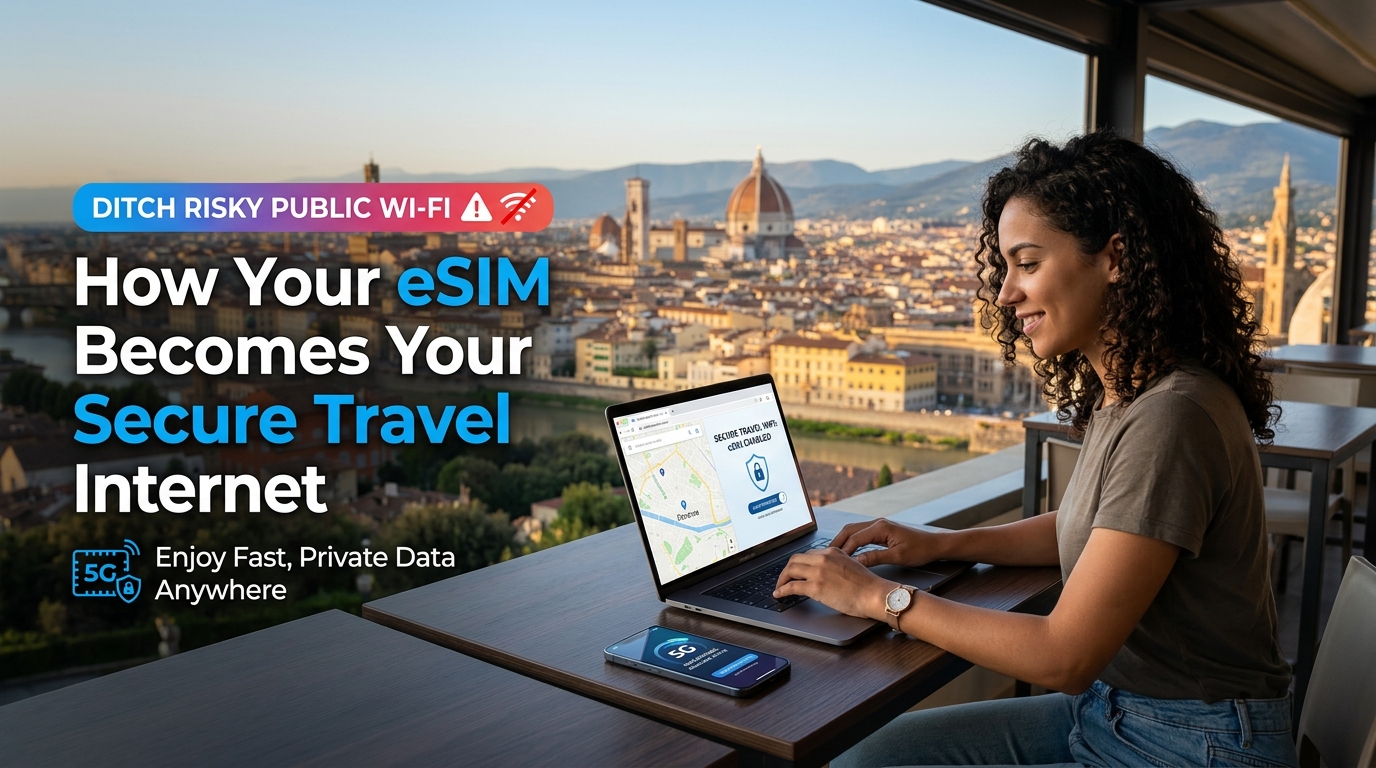
Ditch Risky Public Wi-Fi: How Your eSIM Becomes Your Secure Travel Internet
The Perilous Allure of Public Wi-Fi: A Traveler's Risky Gamble
The scene is all too familiar: a weary traveler steps off a long flight, checks into a bustling hotel, or settles into a quaint cafe in a foreign city. The first instinct, almost universally, is to seek out "free Wi-Fi." That glowing Wi-Fi icon promises instant connection to loved ones, essential navigation, social media updates, and critical work emails. The allure is undeniable – cost-free internet access, seemingly limitless convenience. Yet, beneath this veneer of accessibility lies a labyrinth of significant security vulnerabilities that transform a simple connection into a high-stakes gamble with personal and financial data.
Travelers, often eager to avoid expensive roaming charges or the hassle of local SIM cards, frequently overlook the profound risks inherent in connecting to public, unsecured Wi-Fi networks. This convenience-driven decision often exposes them to a spectrum of sophisticated cyber threats, turning what should be a seamless digital experience into a potential nightmare.
Data Interception (Sniffing): The Invisible Eavesdropper
One of the most prevalent and insidious threats on public Wi-Fi is data interception, commonly known as "sniffing." On an unsecured network, data packets are transmitted openly, making them susceptible to capture by anyone with basic hacking tools and proximity. Imagine sending a postcard through the mail versus a sealed letter; public Wi-Fi often operates like an open postcard.
Attackers can easily "sniff" traffic to capture unencrypted information, including:
- Login Credentials: Usernames and passwords for email, social media, and even banking portals.
- Personal Communications: Contents of emails, instant messages, and browsing history.
- Sensitive Documents: Any files uploaded or downloaded without end-to-end encryption.
- Financial Details: Credit card numbers, bank account information, and transaction details if interacting with non-HTTPS websites or apps.
Even with HTTPS, sophisticated sniffers can sometimes exploit misconfigurations or outdated protocols. The danger lies in the attacker's ability to passively collect vast amounts of information without the victim ever knowing their data has been compromised.
Malware Injection & Drive-by Downloads: Trojan Horses in the Network
Public Wi-Fi networks can also be weaponized to deliver malware directly to unsuspecting users. Attackers can exploit vulnerabilities in network infrastructure or even within connected devices to inject malicious code. This can manifest as:
- Drive-by Downloads: Simply visiting a compromised website while on a public Wi-Fi network can trigger an automatic download of malware onto your device, often without any explicit action or warning.
- Adware & Spyware: Programs designed to track your online activity, display unwanted advertisements, or even record keystrokes (keyloggers) to steal sensitive information.
- Ransomware: A particularly nasty form of malware that encrypts your files and demands a ransom payment for their release.
Once a device is infected, the attacker gains a foothold, potentially accessing all stored data, controlling the device remotely, or using it as a launchpad for further attacks.
Phishing via Rogue Hotspots (Evil Twin Attacks): The Deceptive Imposter
Perhaps one of the most cunning public Wi-Fi threats is the "Evil Twin" attack, a sophisticated form of phishing. Here, an attacker sets up a fake Wi-Fi hotspot designed to mimic a legitimate one. For instance, you might see "Starbucks_Free_Wi-Fi" or "Airport_Lounge_Guest" appear in your list of available networks, looking identical to the real deal.
Once a traveler connects to this rogue hotspot, they are effectively routing all their internet traffic through the attacker's device. The attacker can then:
- Redirect to Fake Login Pages: Users attempting to log into their email, banking, or social media accounts are redirected to convincing but fake login pages designed to steal their credentials.
- Monitor All Traffic: Every unencrypted piece of data sent or received passes through the attacker's control.
- Inject Malicious Content: As with malware injection, the attacker can insert malicious code into legitimate websites viewed by the victim.
The insidious nature of Evil Twin attacks lies in their ability to leverage trust and convenience, making it incredibly difficult for the average user to distinguish between a legitimate and a malicious network.
Man-in-the-Middle (MITM) Attacks: The Silent Interceptor
A Man-in-the-Middle (MITM) attack is a direct assault on the communication between two parties, where the attacker secretly relays and potentially alters the communication. On public Wi-Fi, the attacker positions themselves between your device and the internet, intercepting all data exchanged.
With an MITM attack, the perpetrator can:
- Read All Communications: Even if a website uses HTTPS, an MITM attacker can sometimes bypass or downgrade the encryption, allowing them to view sensitive information.
- Modify Data: They can alter information being sent or received, potentially changing transaction details, injecting malicious links, or spreading misinformation.
- Session Hijacking: By stealing session cookies, an attacker can hijack an active user session, gaining full access to an account without needing the password.
These attacks are particularly dangerous because they compromise the integrity and confidentiality of your online interactions, making every click and keystroke a potential risk.
The Convenience vs. Security Paradox
The fundamental paradox of public Wi-Fi is the trade-off between immediate convenience and long-term security. The desire for instant, free connectivity often overshadows the critical need for a secure, private connection. Travelers, perhaps unknowingly, expose their most sensitive personal and financial data to a myriad of threats, transforming a simple act of connecting to the internet into a perilous gamble. These pervasive dangers underscore the urgent need for a more robust, personal, and secure internet solution for travelers, one that an eSIM provides by offering a dedicated, encrypted connection, shielding users from the vulnerabilities inherent in shared, open networks.
Unmasking the Threats: Deconstructing Public Wi-Fi Vulnerabilities
🌐 Global Travel High-Speed Travel eSIM & SIM Plans
Instant QR code activation, hotspot enabled, with guaranteed 384kbps fallback speed to keep Maps & Digital Wallets active.
While the allure of free and readily available internet is strong, the underlying architecture of public Wi-Fi networks harbors a multitude of sophisticated threats that can turn a simple connection into a severe security incident. Understanding the technical mechanics behind these attacks is crucial for appreciating the profound risks involved.
Deep Dive into Man-in-the-Middle (MITM) Attacks
As briefly touched upon, a Man-in-the-Middle (MITM) attack is not just about interception; it's about active interference and impersonation. On a public Wi-Fi network, an attacker positions themselves between your device and the internet, acting as a covert relay. This is often achieved through techniques like ARP Spoofing (Address Resolution Protocol spoofing) or DNS Spoofing.
With ARP Spoofing, the attacker sends forged ARP messages over the local area network. This tricks devices on the network into associating the attacker's MAC address with the IP address of the legitimate router (default gateway). Consequently, all traffic intended for the internet from your device is rerouted through the attacker's machine first. Similarly, DNS Spoofing involves the attacker intercepting DNS requests and providing false IP addresses, directing your browser to malicious websites even when you type in a legitimate URL.
Once an MITM is established, the perpetrator can:
- Decrypt and Read Encrypted Traffic: While HTTPS offers a layer of encryption, sophisticated MITM tools can sometimes issue fake security certificates (which some users might unknowingly accept), or exploit misconfigurations to downgrade connections to less secure protocols, allowing them to decrypt and read sensitive data like login credentials, credit card numbers, and private messages.
- Modify Data in Transit: Beyond mere observation, an MITM attacker can actively alter the data exchanged. Imagine a traveler checking their flight details; an attacker could subtly change booking information or inject malicious links into the page. For online banking, this could mean altering transaction details before they reach the bank's server.
- Session Hijacking: By capturing session cookies—small pieces of data that keep you logged into websites—the attacker can effectively "hijack" your active session. This allows them to access your accounts (email, social media, banking) without needing your password, as they are impersonating an already authenticated user.
Consider a traveler using public Wi-Fi to log into their online banking portal. An MITM attacker could intercept their login credentials, or, even more subtly, hijack their session after they've logged in, gaining unauthorized access to their financial accounts.
Rogue Access Points: The 'Evil Twin' Deception
One of the most insidious public Wi-Fi threats is the Rogue Access Point, often referred to as an 'Evil Twin' attack. This involves a malicious actor setting up a fake Wi-Fi network that mimics a legitimate one. For instance, at an airport, you might see "Airport_Free_Fi" and "Airport_Free_Wi-Fi". The latter, with a subtle typo or slight variation, could be the attacker's 'Evil Twin'.
These rogue access points are designed to trick users into connecting. The attacker often uses a powerful Wi-Fi transmitter to overpower the legitimate signal, making their fake network appear stronger and more appealing. Once connected, all your internet traffic flows directly through the attacker's device. This grants them complete control over your connection, enabling them to:
- Perform MITM Attacks: With all traffic passing through their system, they can easily execute the MITM tactics described above.
- Capture All Data: Every piece of data—from website visits to login attempts—is logged and accessible to the attacker.
- Inject Malware: They can redirect users to phishing sites, display fake update prompts, or even inject malicious code into unencrypted web pages you visit, leading to drive-by downloads.
A traveler, eager to check emails at a coffee shop, might connect to "Cafe_Guest_Wi-Fi" without realizing it's an 'Evil Twin'. Every email sent, every website visited, every password entered, becomes instantly compromised.
The Peril of Unencrypted HTTP Traffic
Despite the widespread adoption of HTTPS, many websites, especially older ones or those with less critical content, still use HTTP (Hypertext Transfer Protocol). On a public Wi-Fi network, any data transmitted over HTTP is sent in plain, unencrypted text. This is akin to shouting your private information across a crowded room.
Packet sniffers, readily available and easy to use, allow anyone on the same public Wi-Fi network to intercept and read this unencrypted traffic. This includes:
- Login credentials for non-HTTPS sites.
- Personal messages sent through unencrypted chat applications.
- Browsing history and search queries.
- Sensitive form submissions on outdated websites.
Imagine a traveler booking a niche tour or checking an old forum using a non-HTTPS site. Their username, password, and any other details entered are completely exposed to anyone else on that public network.
Malware Distribution and Drive-by Downloads
Public Wi-Fi networks can also serve as a vector for malware distribution. Attackers can compromise public routers or inject malicious code into the network itself. This allows them to:
- Force Drive-by Downloads: By redirecting users to compromised websites or injecting malicious scripts into legitimate web pages, attackers can trigger automatic downloads of malware onto your device without your explicit consent or even knowledge.
- Push Fake Software Updates: You might encounter pop-ups prompting you to update your browser or a common application. These are often fake, and clicking them installs spyware, ransomware, or other malicious software.
- Ransomware and Data Theft: Once malware is installed, attackers can encrypt your files (ransomware) and demand payment, or steal sensitive data like documents, photos, and even corporate VPN credentials if you're working remotely.
A remote worker connecting to a hotel's public Wi-Fi to access company resources runs the risk of their device being infected. This could lead to a corporate data breach, exposing sensitive client information or intellectual property, or locking them out of their own work files.
These pervasive dangers underscore the urgent need for a more robust, personal, and secure internet solution for travelers. A dedicated eSIM connection, like those offered by MollySIM, bypasses these public Wi-Fi vulnerabilities entirely. By providing a secure, encrypted cellular connection, MollySIM shields users from the inherent risks of shared, open networks. Furthermore, MollySIM's Fair Use Policy speed limit of 384kbps is three times faster than many competitors' 128kbps, ensuring that essential secure functions like using Google Maps for navigation or making secure payments with Apple Pay work smoothly and reliably, without compromising security for usability.
eSIM Technology: Your Personal, Encrypted Fortress on the Go
While public Wi-Fi broadcasts your connection into an open, shared space, making it susceptible to interception and malicious activity, eSIM technology fundamentally redefines internet security for travelers. It transforms your device into a personal, encrypted fortress, providing a direct and private gateway to the internet that bypasses the inherent vulnerabilities of shared networks.
Direct, Private, and Cryptographically Secured Connections
Unlike public Wi-Fi, where your data mingles with that of countless other users on a shared access point, an eSIM establishes a direct, private, and cryptographically secured connection to a mobile network. When you connect via eSIM, your device communicates directly with a cellular tower belonging to a trusted mobile network operator. This connection utilizes robust cellular security protocols (like those underpinning 4G LTE and 5G networks), which are designed for secure, authenticated communication.
Each data packet transmitted over an eSIM connection is part of a dedicated pathway between your device and the carrier's infrastructure. This pathway is inherently more secure because:
- Authentication: Your device is authenticated by the network using unique subscriber credentials.
- Encryption: Data is encrypted end-to-end between your device and the cellular network's core, making it extremely difficult for unauthorized parties to intercept and decipher.
- Isolation: Your connection is isolated from other users' connections on the network, unlike the shared nature of a Wi-Fi router.
The Secure Element: The Heart of eSIM Security
At the core of every eSIM-enabled device lies a secure element – a tamper-resistant, embedded chip designed to store highly sensitive information. This secure element is where your eSIM profiles, which contain your subscriber identity modules (SIM), authentication keys, and other cryptographic credentials, are securely stored.
Key security features of the secure element include:
- Tamper Resistance: It's engineered to resist physical and logical attacks, making it incredibly difficult for malicious actors to extract or alter the stored data.
- Cryptographic Operations: The secure element performs cryptographic operations, such as generating and storing encryption keys, ensuring that your identity and data remain protected.
- Isolation: It operates in an isolated environment, separate from the device's main operating system, further safeguarding critical security parameters from software vulnerabilities.
This robust hardware-level security ensures that your identity and connection details are protected from cloning, unauthorized access, and other forms of digital theft that can plague traditional SIM cards or public Wi-Fi.
Secure Remote Provisioning and Reduced SIM Swapping Risk
One of the most significant security advantages of eSIM is its remote provisioning capability. Instead of relying on a physical SIM card that can be lost, stolen, or swapped, eSIM profiles are downloaded and managed digitally over the air (OTA). This process is highly secure, involving encrypted channels and strong authentication protocols to ensure that only authorized profiles are installed on your device.
The elimination of a physical SIM card inherently reduces the risk of SIM swapping attacks. In a SIM swap, an attacker convinces a carrier to transfer your phone number to a SIM card they control, thereby gaining access to your calls, texts, and potentially two-factor authentication codes. With eSIM, there's no physical card to swap, and the digital provisioning process requires multiple layers of verification, making such attacks significantly harder to execute.
Dedicated, Carrier-Managed, Encrypted Cellular Pathway
Ultimately, the most compelling security argument for eSIM over public Wi-Fi lies in its dedicated, carrier-managed, encrypted cellular pathway. When you use an eSIM, your data travels over a private infrastructure managed by a reputable mobile network operator. This network is designed with enterprise-grade security, including advanced firewalls, intrusion detection systems, and continuous monitoring, to protect its integrity and user data.
In contrast to the "best effort" security of a public Wi-Fi network, where the security posture is often unknown and varies wildly, an eSIM connection offers:
- Guaranteed Encryption: Data is encrypted from your device to the carrier's network core.
- Managed Infrastructure: The entire pathway is controlled and secured by a professional telecommunications company.
- Reduced Attack Surface: There's no shared local network segment for attackers to exploit, unlike the local area network (LAN) created by a public Wi-Fi router.
Providers like MollySIM leverage these inherent security advantages of eSIM technology to offer travelers unparalleled peace of mind. By providing a secure, encrypted cellular connection, MollySIM shields users from the pervasive risks of shared, open networks. Furthermore, MollySIM's commitment to both security and usability is evident in its Fair Use Policy speed limit of 384kbps. This is three times faster than many competitors' 128kbps, ensuring that essential secure functions like using Google Maps for navigation or making secure payments with Apple Pay work smoothly and reliably, without compromising the underlying security of the eSIM connection. With MollySIM (https://mollysim.com), you're not just getting internet access; you're getting a personal, secure internet fortress wherever your travels take you.
MollySIM's Secure Advantage: Real-World Protection & Unwavering Connectivity
Beyond the inherent security benefits of eSIM technology, MollySIM (https://mollysim.com) engineers a travel internet solution designed for practical, real-world protection and unwavering connectivity. This commitment ensures that travelers are not only shielded from digital threats but also empowered to conduct essential online activities securely, no matter where their journey takes them.
Safeguarding Your Digital Life: Practical Scenarios with MollySIM
Imagine navigating the bustling streets of a foreign city or settling into a quiet cafe. With MollySIM, your device connects directly to a secure cellular network, bypassing the vulnerabilities inherent in shared public Wi-Fi. This direct, encrypted connection is critical for protecting sensitive data in various everyday scenarios:
- Online Banking Transactions: When you need to check your balance, transfer funds, or pay bills, a secure connection is paramount. Public Wi-Fi networks are notorious for Man-in-the-Middle (MITM) attacks, where attackers can intercept your login credentials or financial data. With MollySIM, your banking app communicates over a private, carrier-grade encrypted cellular channel, significantly reducing the risk of eavesdropping or data interception. You can confidently manage your finances without the constant worry of compromise.
- Secure Video Calls & Sensitive Work Documents: For digital nomads, business travelers, or anyone needing to stay connected with work, accessing sensitive documents or participating in confidential video conferences over public Wi-Fi is a major security gamble. MollySIM provides the dedicated bandwidth and encryption necessary for secure video calls, ensuring your conversations remain private and your screen shares aren't vulnerable to prying eyes. Similarly, accessing cloud-based work documents or company VPNs via MollySIM's secure connection mitigates the risk of corporate data breaches that could occur on an unsecured network.
- Sending Private Messages: From family updates to personal communications, the privacy of your messages is crucial. While many messaging apps offer end-to-end encryption, the underlying network connection still matters. Using MollySIM ensures that the initial connection to the messaging server is secure, preventing network-level surveillance or data harvesting that can occur on compromised public Wi-Fi. Your personal conversations remain just that – personal.
Unwavering Connectivity: Global Coverage & the FUP Safety Net
MollySIM's commitment to security extends to its dedication to dependable global coverage. By partnering with leading mobile network operators worldwide, MollySIM ensures travelers have access to strong, reliable cellular signals in a vast array of destinations. This extensive coverage is a crucial deterrent against the temptation to connect to potentially unsecured public Wi-Fi networks out of sheer necessity. When you know you have a reliable, private connection in your pocket, the allure of a "free" but risky public hotspot diminishes significantly.
Crucially, MollySIM implements a Fair Use Policy (FUP) speed limit of 384kbps after high-speed data allowances are consumed. This isn't just a throttle; it's a vital safety net designed to maintain a continuous, secure connection and prevent users from reverting to risky public hotspots. While 384kbps might not be suitable for streaming high-definition video, it is three times faster than many competitors' 128kbps FUPs, making a significant difference for essential secure functions:
- Google Maps for Navigation: Smoothly load maps and get real-time directions without frustrating delays, ensuring you stay oriented and on schedule.
- Secure Payments with Apple Pay/Google Pay: Conduct contactless payments reliably and securely, even after exhausting your high-speed data.
- Secure Messaging & Email: Send and receive important messages and emails without interruption, maintaining vital communication channels.
- Light Web Browsing: Access critical information, check flight statuses, or look up emergency contacts.
This continuous, usable secure connection ensures that even if you exhaust your primary data, you're never left stranded without a safe way to connect, eliminating the pressure to seek out potentially dangerous public Wi-Fi networks.
Comparative Security and Functionality
To further illustrate MollySIM's distinct advantages, consider this comprehensive comparison:
| Feature | Public Wi-Fi | MollySIM eSIM | Traditional Physical SIM |
|---|---|---|---|
| Security Level | Very Low (High Risk) | Very High (Low Risk) | High (Low Risk) |
| Data Encryption | Often None or Weak (Depends on website/app) | Strong (Carrier-level, end-to-end for cellular) | Strong (Carrier-level, end-to-end for cellular) |
| Connection Reliability | Unpredictable, prone to drops | High, dependent on carrier network | High, dependent on carrier network |
| Privacy | Low (ISP/network owner can monitor) | High (Private connection to carrier) | High (Private connection to carrier) |
| Risk of Malware/Phishing | High (MITM, rogue hotspots, unencrypted) | Very Low (Direct, secure cellular connection) | Very Low (Direct, secure cellular connection) |
| Ease of Use | Connect & Go (but risky) | Easy digital activation, seamless switching | Physical insertion, limited flexibility |
| Cost Predictability | Free (but hidden risks) | Transparent data plans, no roaming surprises | Roaming charges can be high |
| Always-On Secure Connectivity | No (unreliable, risky) | Yes (384kbps FUP ensures continuous secure access) | Yes (as long as data is available) |
| Vulnerability to Physical Theft | N/A | Low (eSIM is embedded, not easily removed) | High (SIM can be physically removed/swapped) |
MollySIM's blend of robust security, extensive global coverage, and a thoughtful FUP ensures that travelers can truly ditch the risks of public Wi-Fi, embracing a secure, reliable, and always-on internet experience.
Beyond eSIM: Layering Security with Best Practices and VPNs
While an eSIM, particularly a robust solution like MollySIM, fundamentally transforms your travel internet security by eliminating the inherent dangers of public Wi-Fi, a truly impenetrable digital defense requires a multi-layered approach. Think of your eSIM as the secure foundation, but you still need walls, a roof, and an alarm system. Maximizing your digital security while traveling involves combining the inherent benefits of eSIM with diligent personal practices and the strategic use of a Virtual Private Network (VPN).
Essential Digital Hygiene for Travelers
Even with the secure, private connection an eSIM provides to its cellular network, your devices and online habits remain potential vectors for attack. Adopting these best practices significantly strengthens your overall security posture:
- Keep All Software Updated: This is non-negotiable. Operating systems (iOS, Android, Windows, macOS), web browsers, and all applications (banking apps, messaging apps, email clients) must be kept up-to-date. Software updates frequently include critical security patches that fix newly discovered vulnerabilities. Delaying updates leaves your devices exposed to known exploits. Enable automatic updates whenever possible, or make it a routine to check for and install them.
- Employ Strong, Unique Passwords: Reusing passwords across multiple services is akin to using the same key for your home, car, and office. If one service is compromised, all others become vulnerable. Utilize a reputable password manager to generate and securely store complex, unique passwords for every account. Aim for passwords that are long, random, and combine uppercase and lowercase letters, numbers, and symbols.
- Enable Two-Factor Authentication (2FA) Everywhere Possible: 2FA adds a crucial second layer of verification beyond just a password. Even if a malicious actor obtains your password, they would still need access to your second factor (e.g., a code from an authenticator app like Authy or Google Authenticator, a fingerprint, or a hardware security key) to gain access. Prioritize 2FA for email, banking, social media, and any other sensitive accounts.
- Exercise Extreme Caution with Links and Emails: Phishing and social engineering attacks are increasingly sophisticated. Never click on suspicious links, open attachments from unknown senders, or provide personal information in response to unsolicited emails or messages. Always verify the sender's identity and the legitimacy of the request independently, especially if it seems urgent, demands immediate action, or promises something too good to be true. Be wary of public charging stations that might be compromised ("juice jacking").
The Indispensable Role of a VPN with an eSIM
An eSIM, like those offered by MollySIM, secures the connection between your device and the cellular network, effectively bypassing the "man-in-the-middle" risks and eavesdropping prevalent on public Wi-Fi. However, a Virtual Private Network (VPN) adds another critical layer of encryption and privacy, addressing different threat vectors and offering additional benefits that even a secure cellular connection doesn't inherently provide.
1. End-to-End Encryption Beyond the Carrier
While your eSIM connection to the cellular tower is encrypted and private, your data's journey beyond the carrier's network to its final destination (e.g., a website server, an email server) might not always be fully secure, especially if you're connecting to services that don't use HTTPS. A VPN creates an encrypted tunnel from your device all the way to the VPN server. This means:
- Your cellular provider (ISP) cannot see your internet activity. While they know you're connected to their network and using data, they cannot monitor which websites you visit or what data you transmit. This adds a significant layer of privacy, preventing even your own cellular ISP from profiling your online behavior.
- Protection against sophisticated attacks: Even if a highly advanced threat actor somehow compromised a part of the internet infrastructure your data travels through, the VPN's encryption would render your data unreadable, safeguarding your sensitive information.
2. Bypassing Geo-Restrictions and Censorship
For many travelers, a VPN is essential for accessing content or services that are geographically restricted. By routing your internet traffic through a server in a different country, a VPN masks your true IP address and makes it appear as if you are browsing from that location. This is invaluable for:
- Accessing your home country's streaming services (e.g., Netflix, Hulu) that might be unavailable or have different content libraries abroad.
- Using specific online banking portals or government services that might restrict access from foreign IPs.
- Bypassing internet censorship in certain regions, ensuring you have access to a free and open internet.
3. Secure Access to Corporate Networks
For business travelers, a VPN is often a mandatory tool for securely accessing company resources. Corporate networks typically require employees to connect via a VPN to ensure that sensitive data exchanged between the employee's device and the company's servers remains encrypted and protected. An eSIM provides the reliable, high-speed internet connection needed to sustain a stable VPN link, ensuring seamless and secure remote work. MollySIM's robust global coverage and its generous 384kbps Fair Use Policy (FUP) speed limit – which is 3x faster than many competitors' 128kbps – are particularly beneficial here. This FUP speed is sufficient to maintain a functional VPN connection for essential tasks like email, secure messaging, and light browsing (e.g., Google Maps, Apple Pay), even if you've used up your high-speed data, preventing a complete loss of secure connectivity. This ensures critical business operations can continue without interruption, maintaining productivity and security.
The Ultimate Security Posture: eSIM + VPN
Combining the inherent security of an eSIM with the advanced encryption and privacy features of a VPN creates a truly robust, multi-layered security posture. Your MollySIM eSIM ensures you're always connected via a private, carrier-grade network, eliminating the immediate threat of public Wi-Fi. The VPN then takes over, encrypting your data from your device to its final destination, masking your online identity, and providing access to a global internet.
This powerful combination offers unparalleled peace of mind, allowing you to conduct sensitive transactions, access corporate resources, and enjoy unrestricted, private browsing, no matter where your travels take you. It's the definitive strategy for the modern, security-conscious traveler seeking the ultimate in digital protection.
Embrace Secure Travel: The Future is Private, The Future is eSIM
Having explored the inherent risks of public Wi-Fi and the robust defenses offered by eSIM technology, the path forward for secure travel internet is unequivocally clear. The era of crossing your fingers and hoping for a safe public hotspot is over. We stand at the precipice of a new standard for global connectivity – one where privacy, data integrity, and peace of mind are not luxuries, but fundamental expectations, delivered effortlessly by your eSIM.
The Unassailable Advantages of eSIM Security
The contrast couldn't be starker. On one side, public Wi-Fi networks, often unsecured, unencrypted, and ripe for exploitation by malicious actors. They present a constant threat of man-in-the-middle attacks, data sniffing, malware injection, and the insidious risk of fake hotspots designed to steal your credentials. Every connection becomes a gamble, every transaction a potential vulnerability, leaving your sensitive information exposed to the whims of an unknown network operator or a lurking cybercriminal.
On the other side, the inherent security architecture of an eSIM like MollySIM. When you connect via an eSIM, you are tapping directly into a private, carrier-grade cellular network. This fundamentally eliminates the shared, vulnerable infrastructure that plagues public Wi-Fi. Your connection is authenticated, encrypted by default at the network level, and dedicated to you. There's no anonymous third party lurking between your device and the internet, no shared bandwidth exposing your data to strangers. This foundational security ensures that your online activities, from checking emails to accessing banking apps, are shielded from the pervasive threats that define public Wi-Fi, guaranteeing a level of data integrity and privacy that is simply unattainable through shared, open networks.
From Hope to Certainty: A Proactive Security Paradigm
The most significant shift an eSIM facilitates is the transition from a reactive to a proactive security posture. Traditionally, travelers have been forced into a reactive stance: hoping the coffee shop Wi-Fi is legitimate, constantly scrutinizing network names, and then layering a VPN on top as an afterthought to mitigate existing risks. This approach is inherently flawed, as the initial connection itself might already be compromised before your VPN can even establish its protective tunnel.
With an eSIM, you establish a secure foundation from the very first byte. Your connection is private by design, offering an immediate and significant upgrade in security. Adding a Virtual Private Network (VPN) on top of this already secure eSIM connection doesn't just mitigate risk; it elevates your digital defense to an unparalleled level. This powerful combination ensures your data is encrypted from your device, through a private cellular network, and then through a secure VPN tunnel to its destination. This multi-layered approach guarantees that your digital footprint remains minimal, your identity masked, and your data inviolable, providing a level of certainty and peace of mind that public Wi-Fi can never offer. You move from constantly managing potential threats to confidently operating within a guaranteed secure environment.
MollySIM: Your Partner in Secure Global Connectivity
For travelers seeking to embrace this future of secure connectivity, MollySIM (https://mollysim.com) stands out as an exemplary choice. Beyond its extensive global coverage, MollySIM understands that security isn't just about high-speed data; it's about reliable, continuous protection. Its generous 384kbps Fair Use Policy (FUP) speed limit is a testament to this commitment. This speed is a crucial differentiator, being 3x faster than many competitors' restrictive 128kbps FUP, which often renders connections unusable for anything beyond basic text.
Why does this matter profoundly for security and peace of mind? It means that even if you exhaust your high-speed data, your essential secure services remain fully functional. Imagine navigating a foreign city: you can still reliably use Google Maps for directions, ensuring you're not stranded or forced onto an insecure network out of desperation. You can confidently use Apple Pay or other secure payment methods, knowing your transaction will process smoothly and securely, without the anxiety of a stalled connection. This persistent, usable connectivity prevents a complete loss of secure functionality, ensuring critical business operations can continue and personal safety is maintained, even under limited data conditions. MollySIM ensures you're never truly disconnected from your secure digital lifeline, providing continuous reliability when it matters most.
Making the Smart Switch: Your Call to Secure Travel
The message is clear for every type of traveler: from the globe-trotting digital nomad who relies on constant, secure access, to the business executive needing to protect sensitive corporate data, and even the casual tourist simply wanting to browse safely and share memories without fear. Embracing eSIM technology is no longer an option; it is the definitive standard for safer, more connected, and utterly worry-free journeys.
Make the proactive choice. Invest in your digital security and peace of mind. Ditch the inherent risks of public Wi-Fi and step into a future where your travel internet is as private and secure as your home network. The future is private, the future is connected, and the future is eSIM. Secure your travels, secure your data, and unlock a world of truly worry-free exploration with MollySIM.
🌐 Global Travel High-Speed Travel eSIM & SIM Plans
Instant QR code activation, hotspot enabled, with guaranteed 384kbps fallback speed to keep Maps & Digital Wallets active.