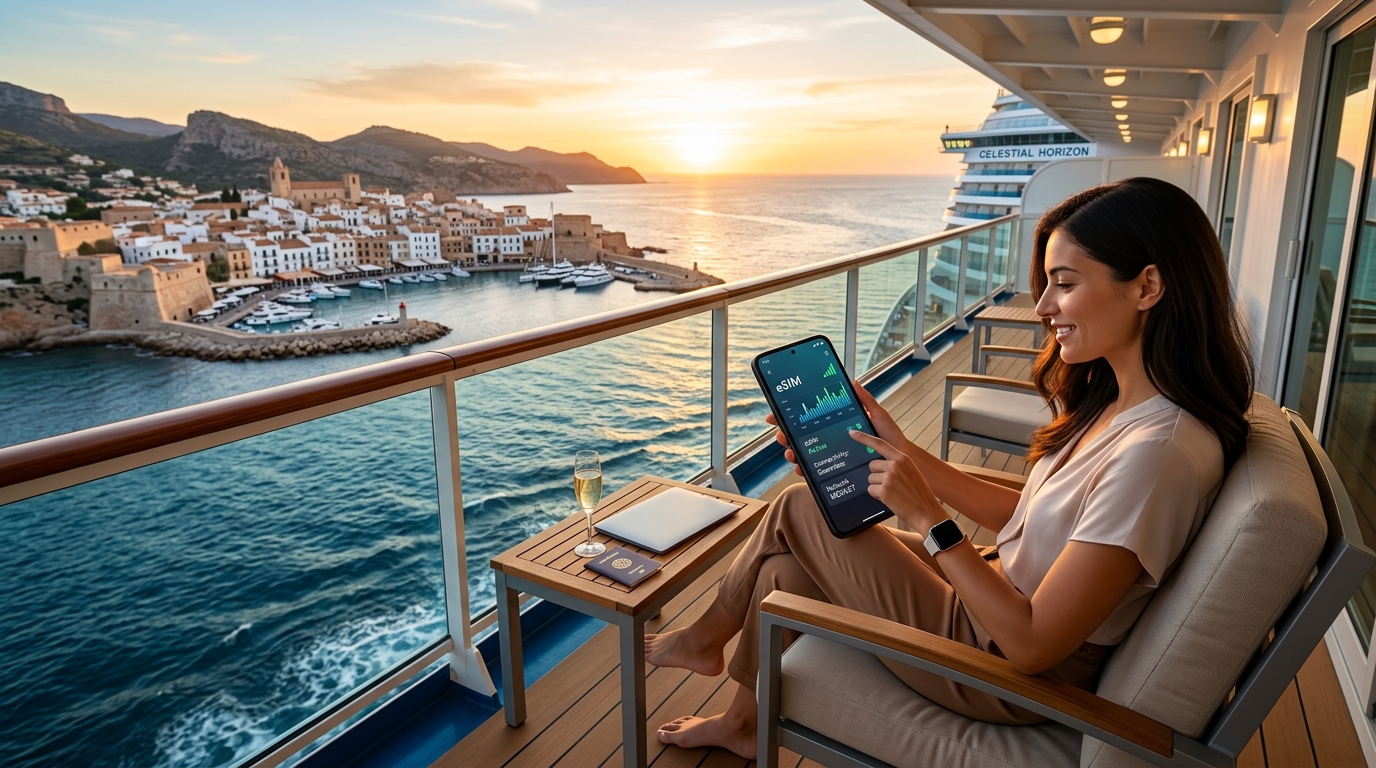
Seamless Connectivity at Sea: The Ultimate eSIM Guide for Multi-Port Cruise Ship Travel
The Connectivity Conundrum at Sea: Why Traditional Options Fall Short
The allure of a cruise ship vacation is undeniable: waking up to a new horizon each day, exploring diverse cultures, and indulging in unparalleled luxury. Yet, beneath this veneer of excitement often lies a subtle, persistent anxiety for many modern travelers: the fear of losing touch with the digital world. In an era where connectivity is not merely a convenience but a fundamental aspect of daily life, the traditional methods of staying online at sea frequently transform this dream into a frustrating digital dilemma.
The High Seas, High Costs: Onboard Wi-Fi's Many Woes
The first port of call for many seeking internet access on a cruise is the ship's onboard Wi-Fi. While seemingly convenient, this option is riddled with significant limitations that quickly dampen the spirit of seamless connectivity.
- Exorbitant Costs: Cruise ship Wi-Fi packages are notoriously expensive. Travelers often face a choice between per-minute rates that quickly add up, daily passes that offer limited data, or premium packages that cost a small fortune for the duration of the trip. These costs can easily rival or even exceed the price of shore excursions, leading to unwelcome budget surprises.
- Notoriously Slow Speeds and High Latency: Unlike terrestrial internet, onboard Wi-Fi relies on satellite connections, which inherently suffer from high latency and significantly slower speeds. Basic tasks like checking emails can take minutes, while attempting to upload a vacation photo to Instagram or stream a short video often results in endless buffering and frustration. Video calls with loved ones become a pixelated, stuttering mess, making genuine connection almost impossible.
- Frequent Disconnections and Unreliability: Satellite signals are susceptible to weather conditions, ship movement, and geographical location. This often translates to frequent disconnections, dropped calls, and intermittent service, leaving passengers stranded offline precisely when they need to connect most.
- Restrictive Package Limitations: Many onboard Wi-Fi packages impose strict data caps, limit the number of devices that can connect simultaneously, or throttle speeds after a certain usage threshold. This forces travelers to constantly monitor their data consumption, adding another layer of stress to their vacation.
- Potential Security Vulnerabilities: Like any public Wi-Fi network, onboard internet connections can pose security risks. Without proper precautions, personal data transmitted over these networks could be vulnerable to interception, making online banking or sensitive communications ill-advised.
Even basic tasks like checking Google Maps for directions in port, using Apple Pay, or quickly looking up restaurant reviews become frustratingly slow or entirely impossible with typical onboard Wi-Fi or throttled roaming plans. This is where the limitations become truly apparent, especially when you consider that a modern solution like MollySIM offers a 384kbps Fair Use Policy speed limit, which is 3x faster than many competitors' 128kbps. This seemingly small difference is monumental, enabling essential applications like Google Maps and Apple Pay to work smoothly, a stark contrast to the sluggish experience offered by traditional methods.
Navigating the Roaming Minefield: Physical SIMs and Bill Shock
For those venturing ashore, traditional international roaming presents its own set of formidable challenges, particularly on multi-port cruise itineraries.
- The Dreaded 'Bill Shock': One of the most significant fears for international travelers is returning home to an exorbitant phone bill. Unbeknownst to many, standard roaming rates can be incredibly high, with data overages quickly escalating into hundreds or even thousands of dollars for even moderate usage. Managing multiple country-specific bundles from your home provider can be a complex and confusing endeavor, often leading to costly mistakes.
- Complexity of Multi-Country Bundles: A cruise visiting multiple countries (e.g., Italy, Greece, Turkey) would require either a prohibitively expensive global roaming plan from a home carrier or the daunting task of researching and activating separate local SIM cards for each destination.
- Inconvenience of Manual Physical SIM Swapping: Imagine fumbling with tiny physical SIM cards in a bustling foreign port, trying to locate a local vendor, navigating language barriers, and then repeatedly swapping cards as your ship sails from one country to the next. This process is not only inconvenient but also carries the risk of losing your home SIM card or damaging your device's SIM tray.
- Limited or Non-Existent Coverage: While traditional roaming might work in major port cities, coverage can be spotty or non-existent in more remote cruise destinations, small islands, or, crucially, in the vast international waters between ports. This leaves travelers completely disconnected for significant portions of their journey.
The Multi-Port Maze: Unique Connectivity Demands
The very nature of a multi-port cruise amplifies these connectivity challenges. Your connectivity needs to seamlessly adapt across diverse national networks as you hop from one country to another, often within a single day. One moment you're relying on a Spanish network, the next a French one, and then an Italian one. The vastness of the open sea, where terrestrial networks are out of reach, further complicates matters, forcing reliance on expensive and slow satellite connections. This dynamic environment, where connectivity requirements are constantly shifting, underscores the critical need for a modern, flexible, and cost-effective solution that can transcend geographical boundaries and provide consistent, reliable internet access throughout the entire cruise experience.
Unlocking Global Connectivity: The Power of eSIM for Multi-Port Cruise Travel
🇺🇸 United States High-Speed Travel eSIM & SIM Plans
Instant QR code activation, hotspot enabled, with guaranteed 384kbps fallback speed to keep Maps & Digital Wallets active.
The quest for seamless, affordable connectivity across diverse international waters and multiple port stops has long been a significant hurdle for cruise travelers. Fortunately, a revolutionary technology has emerged as the definitive answer: the eSIM. Moving beyond the limitations of traditional physical SIM cards, eSIM technology offers unparalleled flexibility, convenience, and cost-effectiveness, making it the ultimate solution for the complex demands of multi-port cruise itineraries.
What is an eSIM and How Does It Fundamentally Work?
An eSIM, short for embedded Subscriber Identity Module, is a digital version of the physical SIM card. Instead of a removable plastic chip, the eSIM is a small, reprogrammable chip built directly into your smartphone, tablet, or smartwatch during manufacturing. This embedded chip securely stores multiple digital SIM profiles, allowing you to activate a cellular plan without ever needing a physical card.
The fundamental working principle is straightforward: instead of inserting a physical card, you simply download and activate a digital profile from a cellular provider. This profile contains all the necessary information to connect your device to a specific network. You can store multiple eSIM profiles on a single device and switch between them with a few taps in your phone's settings, effectively giving you the power to change networks and plans on the fly, without ever opening your SIM tray.
The Transformative Advantages of eSIM for Multi-Port Cruise Travel
For the multi-port cruise traveler, the advantages of eSIM technology are nothing short of transformative, directly addressing the pain points associated with traditional connectivity methods:
- No More Physical SIM Swaps: The most immediate benefit is the complete elimination of physical SIM card swapping. No more fumbling with tiny cards in a foreign port, risking loss or damage to your device's SIM tray. Your home SIM can remain active for receiving calls or texts, while your travel eSIM handles data.
- Instant Activation & Flexibility: Purchase and activate an eSIM plan online, often within minutes, either before you depart or even while at sea (when connected to Wi-Fi). This unparalleled flexibility allows you to adapt your connectivity as your itinerary unfolds.
- Multiple Profiles, Seamless Transitions: An eSIM-compatible device can store several eSIM profiles simultaneously. This means you can have your primary home plan, a regional cruise plan, and even a backup plan all ready to go. As your ship sails from one country to the next, you can effortlessly switch between pre-purchased regional plans tailored for your specific itinerary, ensuring continuous data access.
- Cost-Effectiveness & Roaming Avoidance: eSIMs allow you to bypass exorbitant international roaming charges from your home carrier. By purchasing local or regional data plans specifically designed for travelers, you gain access to local network rates, significantly reducing your connectivity costs.
MollySIM: Your Premier Partner for Cruise Connectivity
Recognizing the unique connectivity challenges faced by cruise passengers, MollySIM (https://mollysim.com) stands out as a premier and reliable eSIM provider, offering tailored solutions designed to simplify multi-port cruise travel. MollySIM specializes in providing global and regional eSIM options that are perfectly suited for complex itineraries across popular cruise destinations.
Imagine embarking on a Mediterranean cruise, hopping between Spain, France, Italy, and Greece. With MollySIM, you don't need four separate local SIMs. Instead, you can activate a single, comprehensive MollySIM regional plan covering the entire Mediterranean. The same applies to Caribbean, Alaskan, or Northern European routes. This unified solution means you purchase one plan, activate it once, and enjoy consistent data access across multiple countries, completely eliminating the need for physical SIM swaps, managing multiple local SIM cards, or dealing with unpredictable roaming charges.
Furthermore, MollySIM distinguishes itself with a superior user experience, particularly concerning data speeds. While many competitors enforce a restrictive 128kbps Fair Use Policy speed limit, MollySIM offers a generous 384kbps Fair Use Policy speed limit. This speed is 3x faster, making a tangible difference in your daily cruise life. It ensures that essential applications like Google Maps function smoothly for navigation in port cities, Apple Pay transactions are swift and reliable, and you can comfortably send messages, check emails, and browse light web pages without frustrating delays.
Essential Device Compatibility and Unlocked Status
While eSIM technology offers incredible advantages, it's crucial to understand the device compatibility requirements. Not all smartphones support eSIM functionality. Generally, newer flagship models from the past few years are eSIM compatible.
Common compatible phone models and brands include:
- Apple: iPhone XS, iPhone XS Max, iPhone XR, and all newer models (iPhone 11, 12, 13, 14, 15 series, and SE 2nd/3rd gen).
- Google: Google Pixel 3, Pixel 3 XL, and all newer Pixel models (Pixel 4, 5, 6, 7, 8 series, and Fold).
- Samsung: Samsung Galaxy S20, S20+, S20 Ultra, and all newer S series models (S21, S22, S23, S24 series), as well as Galaxy Note 20, Note 20 Ultra, and Z Fold/Flip series.
- Other Brands: Select models from Huawei, Motorola, Oppo, and Xiaomi also offer eSIM support. It's always best to check your specific device's specifications.
Crucially, your device must be unlocked to utilize eSIM services effectively. A carrier-locked phone is restricted to using only the network of the original carrier it was purchased from. This restriction prevents you from activating and using eSIM profiles from other providers like MollySIM. Before your cruise, verify your phone's unlocked status by checking your device settings or contacting your home carrier. An unlocked device ensures you have the freedom to choose the best and most cost-effective connectivity solution for your multi-port adventure.
Your MollySIM Journey: Activation, Data Management, and Seamless Network Handoffs
Embarking on a multi-port cruise requires a connectivity solution that's as fluid as your itinerary. MollySIM (https://mollysim.com) is engineered precisely for this, offering a streamlined experience from plan selection to automatic network transitions. Here’s how to navigate your MollySIM journey for uninterrupted connectivity.
Selecting and Purchasing Your Ideal MollySIM Plan
The first step to seamless connectivity is choosing the right MollySIM plan for your cruise. MollySIM offers a variety of options tailored to different travel needs and durations.
- Visit MollySIM.com: Head to the MollySIM website to browse available plans.
- Specify Your Destination(s): Use the search or filter options to input the countries your cruise will visit. For multi-port cruises, MollySIM's regional or global plans are often the most convenient, covering multiple countries under a single eSIM profile. This eliminates the need to purchase individual eSIMs for each port.
- Determine Data Needs: Consider your typical usage. Are you a light user checking emails and messages, or do you plan on frequent social media updates, navigation, and occasional video calls? MollySIM offers plans with varying data allowances (e.g., 1GB, 3GB, 5GB, 10GB, unlimited).
- Choose Duration: Select a plan that covers the entire length of your cruise, plus a buffer for travel days.
- Review Plan Details: Before purchasing, carefully check the plan's validity period, included countries, and any specific terms.
- Purchase Your eSIM: Once you've selected your plan, add it to your cart and proceed to checkout. You'll receive a confirmation email containing your eSIM activation details, typically a QR code and manual installation instructions.
Effortless eSIM Activation on Your Device
Activating your MollySIM eSIM is a straightforward process, best completed before you depart or while you still have a stable Wi-Fi connection.
- Access Your eSIM Details: Open the confirmation email from MollySIM. You'll find a QR code or manual activation codes.
- On iOS (iPhone):
- Go to Settings > Cellular (or Mobile Data) > Add eSIM.
- Choose "Use QR Code" and scan the QR code provided by MollySIM.
- Follow the on-screen prompts to label your new eSIM (e.g., "MollySIM Cruise") and set it as your primary line for cellular data when abroad.
- On Android (Google Pixel, Samsung Galaxy, etc.):
- Go to Settings > Network & internet (or Connections) > SIMs (or SIM card manager) > Add eSIM (or Download a SIM).
- Choose "Scan QR code" and scan the QR code.
- Follow the prompts to activate and configure your new eSIM.
- Enable Data Roaming: Once activated, ensure data roaming is enabled for your MollySIM eSIM profile in your phone's settings. This allows your device to connect to local networks in each port.
- Switching Between eSIM Profiles: If you've purchased multiple single-country eSIMs (though regional plans are recommended for cruises), you can easily switch between them in your phone's cellular settings by simply toggling the desired eSIM profile "on" and others "off." However, with a MollySIM regional plan, this manual switching between countries is entirely unnecessary.
Intelligent Data Management and Usage Estimates
Monitoring your data usage is key to staying connected without unexpected interruptions. MollySIM provides tools to help you manage your data effectively.
- MollySIM Account Portal: Log into your MollySIM account on their website to view real-time data consumption, remaining allowance, and plan validity.
- Device Settings: Your phone's cellular settings also provide a breakdown of data usage by app, helping you identify data-hungry activities.
To give you a realistic perspective, here are estimated data consumptions for common cruise activities:
| Activity | Estimated Data Usage (per hour/action) | Notes |
|---|---|---|
| Social Media (e.g., Instagram, Facebook) | 1-3 MB per minute (browsing) | Varies heavily with content type (photos vs. videos). Uploading a photo: ~2-5MB. Uploading a short video: 10-50MB. |
| Messaging Apps (WhatsApp, iMessage) | Minimal (KB per message) | Text messages are tiny. Photos: 0.5-2MB. Short videos: 2-10MB. Voice/video calls: 0.5-1MB per minute. |
| Email (text-only) | Minimal (KB per email) | Emails with attachments can be several MBs. |
| Navigation (Google Maps, Apple Maps) | 0.5-2MB per hour (active navigation) | Offline maps consume no data, but initial download requires Wi-Fi. Live traffic and search will use data. |
| Web Browsing (light) | 0.5-2MB per page load | Heavy sites with lots of images/scripts use more. |
| Video Call (e.g., Zoom, WhatsApp) | 10-20 MB per minute (HD) | Standard definition uses less. Background apps also consume data. |
| Email (with attachments) | 5-20 MB per email | Highly dependent on the size and number of attachments. |
| Total (per day, approx.) | 25-50 MB (light) / 100-200 MB (moderate) / 500MB+ (heavy) | These are rough estimates. Background app refresh, automatic updates, and streaming can significantly increase usage. |
Seamless Network Handoffs: From Sea to Port
One of MollySIM's most compelling advantages for cruise travelers is its ability to ensure continuous connectivity with minimal manual intervention.
Automatic Transition at Sea
While at sea, your phone will typically connect to the ship's satellite Wi-Fi (if purchased) or show "No Service." As your cruise vessel approaches a port, MollySIM's technology automatically begins searching for terrestrial cellular networks.
- Proximity Detection: As the ship comes within range of land-based cell towers, your device, with the MollySIM eSIM activated, will automatically detect and attempt to connect to the strongest available partner network in that country.
- Instant Connection: Upon successful connection, you'll see your network indicator change from "No Service" or "Satellite" to the name of the local carrier (e.g., "Vodafone," "Orange," "AT&T"). This transition is designed to be smooth and automatic, meaning you can often start using data as soon as you step off the ship, or even before, without needing to manually switch networks or settings.
Intelligent Regional eSIM Management
For travelers utilizing a MollySIM regional or global plan, the experience is even more seamless. As your cruise moves from one port in one country to another port in a different country (within the plan's coverage), your MollySIM eSIM profile intelligently switches to the appropriate local partner network.
- No Manual Intervention: You do not need to purchase new eSIMs or manually activate different profiles for each country. The single regional MollySIM eSIM handles the network handoff automatically, connecting you to the best available network in each new destination. This "set it and forget it" convenience is invaluable for multi-port itineraries, ensuring you're always connected without the hassle of managing multiple local SIMs or profiles.
MollySIM's High-Speed Data and Fair Usage Policy (FUP)
MollySIM is committed to providing not just connectivity, but quality connectivity. All MollySIM plans start with high-speed data, allowing for smooth browsing, fast downloads, and reliable communication.
However, to ensure fair access for all users and prevent network congestion, MollySIM implements an intelligent Fair Usage Policy (FUP). Should your data consumption exceed a very high threshold within a short period (typically indicative of continuous heavy streaming or large file downloads), your data speed may be adjusted to 384kbps.
It's crucial to understand the implications of this speed:
- Still Highly Functional: While 384kbps is not peak 5G speed, it is perfectly adequate for essential communication and many daily tasks. This speed ensures you can continue to use messaging apps like WhatsApp and iMessage, send and receive emails, perform light web browsing, and update social media without significant frustration.
- Superior to Competitors: MollySIM's 384kbps FUP speed is a significant advantage, being 3x faster than the 128kbps offered by many competitors. This higher speed is critical for modern smartphone functionality. For instance, at 384kbps, essential services like Google Maps will load maps and navigate smoothly, and Apple Pay (or other mobile payment systems) will function reliably for transactions, which often struggle or fail entirely at slower 128kbps speeds.
- Peace of Mind: This policy provides peace of mind, guaranteeing continuous, cost-effective connectivity without unexpected service cut-offs or additional charges. You'll always have a reliable connection for emergencies, navigation, and staying in touch, even after extensive usage. MollySIM prioritizes keeping you connected, not cutting you off.
Strategic Connectivity: A Comparative Analysis for Cruise Travelers
Navigating the myriad of connectivity options for a multi-port cruise can be as complex as charting a course through an archipelago. From the moment your ship leaves port to each new destination, understanding your choices is paramount to staying connected without breaking the bank or sacrificing convenience. Below, we present a comprehensive comparison of the most common connectivity solutions, followed by an in-depth analysis to guide your decision.
| Feature | Ship Wi-Fi (Basic) | Traditional Roaming (Carrier) | Local Physical SIM | Pocket Wi-Fi Device | eSIM (MollySIM) |
|---|---|---|---|---|---|
| Cost | High (per day/package) | Very High (per MB/day) | Moderate (per GB) | Moderate (rental/device + data) | Low (per GB/package) |
| Speed | Slow, Variable | Variable, often throttled | Fast | Fast | Fast (then 384kbps FUP) |
| Reliability | Poor (at sea), Fair (port) | Fair (in port), None (at sea) | Good (in port) | Good (in port) | Excellent (in port), None (at sea) |
| Ease of Use | Simple (if purchased) | Automatic (but costly) | Complex (find store, swap) | Moderate (device mgmt, charge) | Very Easy (digital install, switch) |
| Coverage | Limited (ship only) | Varies by carrier/country | Single country only | Single country/region | Multi-country, Global |
| Data Management | Package-based | Hard to track, bill shock | Manual top-ups | Device management | Easy (app, real-time tracking) |
| Security | Low (public network) | High (carrier network) | High | High (private network) | High (carrier network) |
| Device Compatibility | Any Wi-Fi device | Any phone | Unlocked phone | Any Wi-Fi device | eSIM-compatible, unlocked phone |
| Multi-Country | No | Yes (but costly) | No | No | Yes (seamless switching) |
Unpacking the Comparison: Why MollySIM Leads the Fleet
When evaluating these options, it becomes clear that for the unique demands of multi-port cruise travel, MollySIM emerges as the optimal solution, offering an unparalleled blend of flexibility, cost-effectiveness, ease of use, and reliable coverage.
The Pitfalls of Traditional Options
- Ship Wi-Fi, while convenient at first glance, is notoriously expensive, often charging premium rates for slow, inconsistent speeds that struggle with anything beyond basic messaging. Its coverage is strictly limited to the ship itself, leaving you disconnected the moment you step ashore.
- Traditional Carrier Roaming offers automatic connectivity but comes with the significant risk of exorbitant costs and dreaded bill shock. Data rates can be astronomical, and even "roaming packages" often have hidden limitations or high overage fees, making them unsustainable for extensive use across multiple countries.
- Local Physical SIMs provide good speed and reliability within a single country, but they are incredibly impractical for multi-port cruises. Each new country requires finding a local store, purchasing a new SIM, and physically swapping it out – a time-consuming hassle that eats into precious port exploration time. Furthermore, your primary number becomes inactive during this process.
- Pocket Wi-Fi Devices offer a personal hotspot but introduce another device to manage, charge, and potentially rent. Like local SIMs, they often have single-country or limited regional coverage, making them less ideal for diverse itineraries.
MollySIM: The Smart Navigator for Global Travel
MollySIM's eSIM technology directly addresses the shortcomings of these alternatives, providing a seamless and superior experience for cruise travelers.
Unparalleled Flexibility and Multi-Country Coverage
MollySIM's core strength lies in its ability to provide multi-country coverage without the need for physical SIM swaps. For a cruise traveler visiting several different nations, this is a game-changer. You purchase a single eSIM plan that covers all your destinations, and your phone automatically connects to the best available network in each port. This eliminates the stress of searching for local SIM cards or dealing with expensive roaming charges, allowing you to focus on enjoying your trip.
Strategic Partnerships for Robust Local Connectivity
MollySIM's promise of reliable, high-quality coverage in port is underpinned by its strategic partnerships with leading local mobile operators worldwide. Instead of relying on a single, overarching network, MollySIM leverages the existing, robust infrastructure of top-tier carriers in popular cruise destinations.
- In the Mediterranean, this means connecting to networks like Vodafone, Orange, and Telefonica, ensuring you experience the same high-speed, stable internet as local residents in iconic ports from Barcelona to Athens.
- For Caribbean cruises, MollySIM partners with major players such as AT&T, T-Mobile, and Claro, guaranteeing strong signals and fast data speeds whether you're exploring the beaches of St. Maarten or the vibrant markets of San Juan.
- On Canada and Alaska routes, travelers benefit from connections to reliable networks like Bell, Telus, and Rogers, providing seamless access even in more remote coastal towns.
These partnerships are crucial. They mean that when your ship docks, your MollySIM-enabled device instantly connects to a proven, high-performance local network, delivering the best possible signal strength and data speeds available in that area. This ensures you can confidently use data for navigation, communication, and sharing your experiences without interruption.
Cost-Effectiveness and Transparent Data Management
MollySIM offers low-cost data packages that are significantly more affordable than ship Wi-Fi or traditional roaming. With clear, upfront pricing, you know exactly what you're paying for, eliminating the risk of unexpected charges. Furthermore, MollySIM provides easy, real-time data tracking through its app, empowering you to monitor your usage and top up as needed, maintaining complete control over your budget.
Superior Fair Usage Policy (FUP)
Even with extensive usage, MollySIM's intelligent Fair Usage Policy ensures continuous connectivity. Should your data consumption exceed a very high threshold, your speed may be adjusted to 384kbps. This is a critical advantage, as 384kbps is 3x faster than the 128kbps offered by many competitors. This higher FUP speed is not just a number; it translates directly to functionality. Essential services like Google Maps will load maps and navigate smoothly, and Apple Pay (or other mobile payment systems) will function reliably for transactions, tasks that often struggle or fail entirely at slower 128kbps speeds. MollySIM prioritizes keeping you connected and functional, not cutting you off.
Effortless Setup and Security
The ease of use of MollySIM is unmatched. Digital installation means no physical SIM cards to handle or lose. You simply scan a QR code, and your eSIM is ready. Switching between your primary number and the eSIM is effortless, ensuring you never miss an important call while still benefiting from local data rates. Moreover, by leveraging established carrier networks, MollySIM provides a high level of security for your data, superior to open public Wi-Fi networks found on ships or in cafes.
For the modern cruise traveler, MollySIM represents the pinnacle of connectivity, offering a smart, secure, and cost-effective way to stay connected across every port of call.
Mastering Your MollySIM: Pre-Cruise Preparation and Onboard Best Practices
To truly unlock the full potential of your MollySIM and ensure a stress-free, connected cruise experience, meticulous preparation and smart usage practices are paramount. This section provides actionable, comprehensive advice, guiding you from pre-departure checks to efficient data management in every port.
Pre-Cruise Preparation: Setting Sail with Confidence
Your journey to seamless connectivity begins long before you step foot on the gangway. Thoughtful planning ensures your MollySIM is ready to perform from the moment you disembark at your first port of call.
1. Verify Device Compatibility
Before purchasing any eSIM plan, including those from MollySIM, the absolute first step is to confirm your device supports eSIM technology. While most modern smartphones (e.g., iPhone XS/XR and newer, Samsung Galaxy S20 and newer, Google Pixel 3 and newer) are compatible, it's crucial to double-check. Visit the MollySIM website (https://mollysim.com) for their up-to-date compatibility list. Attempting to install an eSIM on an incompatible device will lead to frustration and wasted effort.
2. Ensure Your Device is Fully Unlocked
This is a non-negotiable requirement for using any third-party eSIM. If you purchased your phone through a carrier contract, it might be "locked" to that network, preventing the use of other carriers' eSIMs. Contact your current mobile provider well in advance of your cruise to confirm your device's unlocked status. If it's locked, request an unlock. This process can take a few days, so do not leave it until the last minute. An unlocked phone is fundamental to MollySIM's functionality.
3. Strategic Pre-Purchase of Your MollySIM Plan
One of the most significant advantages of MollySIM is the ability to purchase and install your plan well before your departure. This strategic move offers several benefits:
- Avoid Last-Minute Stress: No scrambling for local SIMs or dealing with unreliable airport Wi-Fi upon arrival.
- Immediate Connectivity: Your MollySIM can be activated the moment your ship docks, providing instant access to local networks.
- Plan Ahead: Carefully review your cruise itinerary. Consider the number of ports, the duration of your stay in each, and your expected data needs. MollySIM offers various plans tailored to different regions and data allowances.
- Understand Validity & Data Allowances: Pay close attention to the validity period (e.g., 7, 15, 30 days) and the data allowance of your chosen plan. For multi-port cruises, select a plan that covers your entire travel duration and provides sufficient data for all your port visits. This foresight ensures continuous connectivity throughout your voyage.
Onboard & In-Port Best Practices: Maximizing Your Connectivity
Once your MollySIM is installed, smart usage practices will help you conserve data and optimize your experience, whether you're navigating a bustling port or enjoying ship amenities.
1. Smart Data Management in Port with MollySIM
When your ship is in port and you're relying on your MollySIM, these granular tips will help you make the most of your data:
- Disable Background App Refresh: Many apps silently consume data in the background, updating content or fetching notifications. Go into your phone's settings and disable background refresh for all non-essential apps.
- Turn Off Wi-Fi Assist (iOS) / Adaptive Wi-Fi (Android): These features automatically switch to cellular data when a Wi-Fi connection is weak. While useful at home, on a cruise ship, this can inadvertently drain your MollySIM data if the ship's Wi-Fi is spotty.
- Download Offline Maps: Before leaving the ship, download maps of your port destinations using Google Maps, Apple Maps, or other navigation apps. This allows for turn-by-turn navigation without consuming any cellular data, ensuring essential services like Google Maps load smoothly, even if your data usage approaches MollySIM's generous 384kbps Fair Usage Policy speed limit, which is 3x faster than competitors' 128kbps.
- Utilize Data-Saver Modes: Most browsers (Chrome, Safari) and many social media or streaming apps offer data-saver modes. Enable these to compress data and reduce consumption.
- Limit High-Bandwidth Activities: Avoid video streaming, large file downloads, or extensive video calls when using your MollySIM in port. Save these activities for when you have access to ship Wi-Fi (if affordable) or a stronger, unlimited connection.
- Monitor Data Usage: Regularly check your data consumption through your phone's settings or the MollySIM app. This allows you to track your allowance and adjust your usage behavior accordingly.
2. Strategic Use of Ship Wi-Fi vs. MollySIM
Understand when to leverage each connectivity option. Use the ship's Wi-Fi for general browsing, email, and social media while at sea, especially if you've purchased a package. Reserve your MollySIM for when you are in port, where it provides reliable, high-speed local data for navigation, local communication, and mobile payments like Apple Pay, which functions reliably at MollySIM's 384kbps FUP speed.
Troubleshooting Common Issues & Leveraging Support
Even with the best preparation, minor connectivity hiccups can occur. Knowing how to troubleshoot and access support is key.
1. Common Troubleshooting Steps
- APN Settings: While MollySIM typically configures APN settings automatically, if you experience connectivity issues, check your device's cellular settings to ensure the correct Access Point Name (APN) is selected. MollySIM's support resources can provide specific APN details if needed.
- Network Selection: Your phone usually selects the best local network automatically. If you're having trouble, try manually selecting a different network operator from your cellular settings.
- Restart Device: The classic fix often works wonders. A quick restart can resolve many temporary network glitches.
2. MollySIM Customer Support
MollySIM prides itself on dedicated customer support. Familiarize yourself with their support channels (e.g., live chat, email, comprehensive FAQ section) before you embark. Should you encounter any issues, their team is equipped to provide prompt assistance, ensuring you remain connected throughout your cruise.
The Future of Cruise Connectivity: eSIM at the Helm
The landscape of cruise connectivity is rapidly evolving. The increasing integration of high-speed satellite internet, such as Starlink, on cruise ships offers significantly faster and lower-latency Wi-Fi while at sea. This complements eSIM technology perfectly, providing a robust solution for onboard connectivity, while eSIMs like MollySIM continue to dominate for reliable, cost-effective, and high-performance data access in every port of call. As technology advances, eSIM will only become more central to global travel, simplifying the process of staying connected across borders and making multi-port cruise adventures more seamless and stress-free than ever before.
🇺🇸 United States High-Speed Travel eSIM & SIM Plans
Instant QR code activation, hotspot enabled, with guaranteed 384kbps fallback speed to keep Maps & Digital Wallets active.