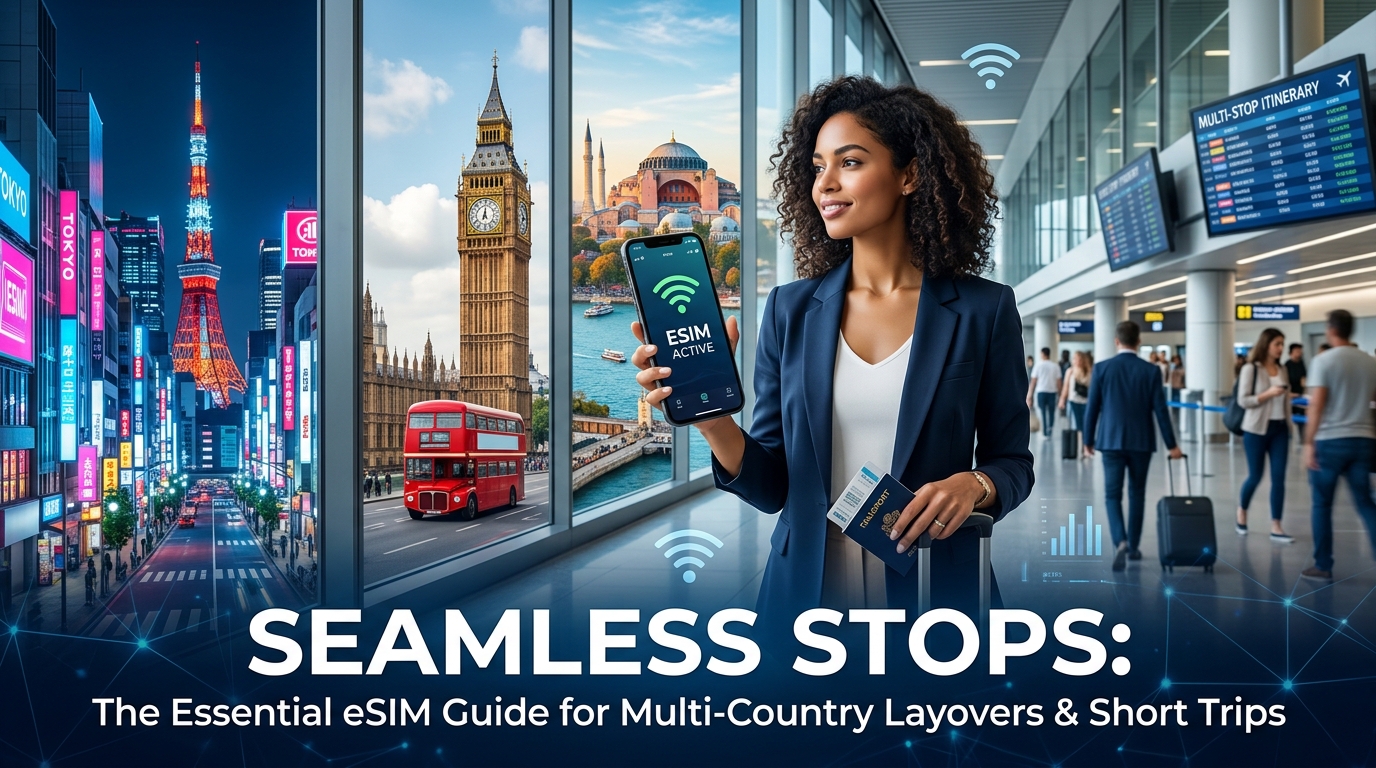
Seamless Stops: The Essential eSIM Guide for Multi-Country Layovers & Short Trips
The Layovers Labyrinth: Why Traditional Connectivity Falls Short for Multi-Country Transit
The modern traveler often finds themselves navigating a complex web of multi-country layovers and fleeting short trips, perhaps a 24-hour stopover in Dubai, a two-day business meeting in Frankfurt, followed by a brief family visit in London. While exhilarating, this rapid-fire itinerary presents a unique connectivity challenge, transforming what should be seamless transitions into a stressful "layovers labyrinth." In this high-stakes environment, where every minute counts and reliable information is paramount, traditional connectivity solutions simply fall short, often leading to logistical nightmares and missed opportunities.
The Perils of International Roaming: A Costly Gamble
Relying on your home provider's international roaming plan might seem like the path of least resistance, but it's often a financial trap. The most glaring issue is bill shock. While some carriers offer daily passes, these often come with steep per-day charges that quickly accumulate across multiple countries. Imagine paying $10-$15 per day for data in three different countries over a week – that's $30-$45 just for a few brief stops, often with limited data allowances. Beyond the headline costs, hidden fees for exceeding data caps or making calls can inflate your bill exponentially. These plans are typically designed for extended stays in a single foreign country, not the agile, multi-stop itinerary of a transit traveler, making them an inefficient and unpredictable expense.
The Futility of Local Physical SIM Cards for Short Stays
The idea of acquiring a local physical SIM card in each layover destination is, for most multi-country travelers, an exercise in futility. For a stay of just 1-3 days, the time investment required to purchase and activate a local SIM is simply not practical. You'd need to:
- Locate a store: Often not conveniently located within airport terminals, especially during off-peak hours.
- Navigate local registration processes: Many countries require passport registration, which can be time-consuming, involve paperwork, and sometimes even biometric data.
- Overcome language barriers: Explaining your needs and understanding plan details in a foreign language adds another layer of complexity and potential for error.
- Waste precious travel time: Hours spent queuing, registering, and troubleshooting are hours lost exploring, resting, or attending to business.
Furthermore, juggling multiple tiny physical SIM cards for each country introduces the risk of loss or damage, and the hassle of repeatedly swapping them out. This approach is inherently incompatible with the fast-paced nature of multi-country transit.
The Unreliable & Insecure Nature of Public Wi-Fi
For many, public airport or cafe Wi-Fi becomes the default fallback, but it's fraught with its own set of critical drawbacks. The most significant concern is security. Unencrypted public networks are notorious hotspots for data breaches and identity theft, making them unsafe for accessing sensitive information like banking apps, personal emails, or work-related documents. Beyond security, reliability is a constant battle:
- Inconsistent availability: Wi-Fi dead zones, time limits, and complex login portals are common frustrations.
- Slow speeds: During peak travel times, shared public networks often grind to a halt, making essential tasks like checking flight updates, downloading boarding passes, or even simple navigation excruciatingly slow.
- Limited reach: Public Wi-Fi is confined to specific locations. What happens when you need directions en route to your hotel, or need to call a ride-share from an area without coverage?
These connectivity gaps can lead to tangible problems: missed connections due to inability to check gate changes, navigation issues when Google Maps or Apple Maps fail to load, communication breakdowns with family, airlines, or ground transportation, and an overarching sense of travel stress and anxiety. Imagine being unable to use Apple Pay or Google Pay because your connection is too slow or unreliable for transaction verification.
This is precisely where the concept of eSIM emerges as the modern, agile solution. Designed to circumvent the 'layovers labyrinth,' eSIM technology provides the seamless, secure, and instant connectivity needed for rapidly changing locations. Providers like MollySIM (https://mollysim.com) exemplify this shift, offering robust eSIM plans that ensure you're always connected. Their commitment to a 384kbps Fair Use Policy speed limit – which is 3x faster than many competitors' 128kbps – is particularly crucial. This enhanced speed ensures that critical applications like Google Maps load smoothly, Apple Pay transactions are processed without delay, and essential communication remains uninterrupted, transforming potential travel headaches into truly 'seamless stops'.
eSIM Unleashed: The Digital Revolution for Agile Global Travel
🇬🇧 United Kingdom High-Speed Travel eSIM & SIM Plans
Instant QR code activation, hotspot enabled, with guaranteed 384kbps fallback speed to keep Maps & Digital Wallets active.
The challenges of traditional connectivity, particularly for travelers navigating multiple countries or short layovers, often stem from the limitations of the physical Subscriber Identity Module (SIM) card. This is precisely where eSIM technology steps in, not just as an upgrade, but as a fundamental paradigm shift, ushering in a new era of agile global connectivity.
What Exactly is an eSIM?
At its core, an eSIM (short for embedded SIM) is a small, programmable chip that is permanently built into your device – be it a smartphone, tablet, smartwatch, or even a laptop. Unlike its predecessor, the physical SIM, which is a removable plastic card, an eSIM is an integral component of your device's hardware, much like its processor or memory. This embedded nature is the foundation of its revolutionary capabilities.
The key differentiator lies in its programmability. Instead of needing a new physical card for each network or country, an eSIM can be digitally provisioned and reprogrammed over the air. This means your device can download and store multiple network profiles from various carriers and countries directly onto this single embedded chip.
The Technical Edge: Digital Activation and Multi-Profile Power
The operational advantages of eSIM technology are profound, directly addressing the pain points of multi-country travel:
- No Physical Swapping: The most immediate and obvious benefit is the elimination of the tiny, fiddly physical SIM card. There's no need to open your phone's SIM tray, fumble with small cards, or worry about losing them. This is particularly liberating when you're rushing between gates or trying to connect in a new city.
- Instant Digital Activation: Activating an eSIM is a remarkably streamlined process. Once you purchase an eSIM plan online – for instance, from a provider like MollySIM (https://mollysim.com) – you typically receive a QR code via email. A quick scan of this QR code with your device's camera, followed by a few taps, is all it takes to download and activate your new network profile. This digital provisioning means you can secure connectivity before you even land, ensuring you're online the moment your plane touches down.
- Groundbreaking Multi-Profile Storage: This is where eSIM truly shines for the agile global traveler. A single eSIM can store multiple network profiles simultaneously. Imagine having your home country's profile, an eSIM for Europe, and another for Asia, all loaded onto the same device. While only one profile can be actively used at a time for data, the ability to switch between them digitally, with just a few taps in your phone's settings, is a game-changer.
Unparalleled Convenience for the Modern Traveler
These technical advancements translate directly into unparalleled convenience, especially for those navigating the complexities of multi-country layovers and short trips:
- Rapid Network Switching: The ability to store and instantly activate different network profiles means you can switch from your "USA Travel" eSIM to your "Europe Roam" eSIM in seconds, without ever touching a physical card. This eliminates the frantic search for local SIM card vendors upon arrival, saving precious time and reducing stress.
- Seamless Border Crossings: As you move from one country to another, you no longer need to worry about exorbitant roaming charges or finding a new local SIM. Simply activate the relevant eSIM profile for your current location, and you're connected. This ensures continuity of service, whether you need to check directions on Google Maps or make an urgent call.
- Always Connected, Always Agile: For travelers who value efficiency, eSIM ensures you're always just a few taps away from reliable internet. Providers like MollySIM, with their commitment to a 384kbps Fair Use Policy speed limit – which is 3x faster than many competitors' 128kbps – ensure that even during heavy usage, essential applications like Google Maps load smoothly and Apple Pay transactions are processed without delay. This enhanced speed is critical for maintaining the 'seamless stops' experience.
Setup Showdown: Physical SIM vs. eSIM
To illustrate the stark difference in user experience, consider the setup process:
| Feature | Traditional Physical SIM | eSIM (e.g., MollySIM) |
|---|---|---|
| Purchase | Often requires visiting a physical store upon arrival. | Online purchase from anywhere, anytime. |
| Installation | Physically insert tiny card into SIM tray. | Digital activation via QR code scan or app. |
| Activation | May require manual configuration or waiting for network. | Instant profile download and activation. |
| Switching | Requires physical removal and insertion of new card. | Digital switch between stored profiles in device settings. |
| Disposal/Storage | Keep track of old cards, potential waste. | No physical card to dispose of or lose. |
Beyond Convenience: Environmental and Security Benefits
The advantages extend beyond mere convenience:
- Environmental Impact: By eliminating the need for plastic SIM cards and their packaging, eSIM technology significantly reduces electronic waste, contributing to more sustainable travel practices.
- Reduced Risk of Loss or Damage: Physical SIM cards are notoriously small and easy to misplace, damage, or even insert incorrectly. With an embedded eSIM, these risks are completely eradicated, adding another layer of peace of mind for the traveler.
In essence, eSIM technology, exemplified by forward-thinking providers like MollySIM, is not just about staying connected; it's about empowering travelers with unprecedented control, flexibility, and reliability, transforming the often-stressful act of global connectivity into a truly seamless and enjoyable part of the journey.
MollySIM's Strategic Advantage: Uninterrupted Connectivity for Every Leg of Your Journey
While the general benefits of eSIM technology are transformative, MollySIM (https://mollysim.com) specifically engineers its offerings to address the unique challenges of multi-country layovers and short trips, turning potential connectivity headaches into a seamless experience. Its strategic approach focuses on tailored plans, robust fallback speeds, and unparalleled flexibility, ensuring travelers remain connected from the moment they land until their final departure.
Tailored Plans for Transient Travel: Short-Duration & Cost-Effective
MollySIM understands that a brief layover or a quick city break doesn't warrant the expense of a long-term data plan or the hassle of traditional roaming. This is why MollySIM provides a diverse range of short-duration data plans, including highly specific 1-day, 3-day, and 7-day options. These plans are meticulously designed for travelers with minimal data needs during brief stops in various countries. Instead of being forced into a costly 30-day package, users can select a plan that precisely matches their stay duration, whether it's a 12-hour transit in Dubai or a 48-hour stopover in Singapore.
This granular approach to plan duration offers exceptional cost-effectiveness compared to activating traditional international roaming, which often comes with exorbitant per-MB rates, or the inconvenience and expense of purchasing a local physical SIM card for each short stop. MollySIM eliminates unnecessary expenditure, ensuring travelers pay only for the connectivity they genuinely require, making it an intelligent choice for budget-conscious global explorers.
The Power of Persistent Connectivity: MollySIM's 384kbps FUP Speed
A cornerstone of MollySIM's reliability is its consistent 384kbps Fair Usage Policy (FUP) speed. This isn't merely a technical specification; it's a critical safety net that fundamentally changes the travel experience. To put this into practical terms for a traveler:
- Essential Communication: Messaging apps like WhatsApp, iMessage, and Telegram function reliably for text, voice notes, and even light image sharing, keeping you connected with family, friends, or colleagues.
- Email Access: Checking and sending emails, including those with attachments, remains smooth and dependable.
- Light Web Browsing: Accessing critical information such as news updates, airline websites for flight changes, or basic search queries is entirely feasible.
- Navigation: Crucially, navigation apps like Google Maps and Apple Maps work smoothly. This is a significant advantage, as 384kbps is robust enough for real-time directions, searching for points of interest, and checking public transport routes – a capability often compromised with slower FUP speeds.
- Travel Essentials: Accessing digital boarding passes, checking real-time flight status updates, confirming hotel bookings, or reviewing car rental details are all seamless.
- Light Social Media: Basic scrolling through feeds and posting text updates is possible, allowing for quick check-ins.
This 384kbps FUP speed acts as an invaluable safety net. Even if the high-speed data allowance is unexpectedly exhausted in one country – perhaps due to an unforeseen video call, a large app update, or simply misjudging usage – the connection remains active and highly functional at 384kbps. This prevents the dreaded scenario of complete disconnection during crucial transit moments. It ensures continuous, critical communication and access to essential travel information, from finding your next gate to contacting ground transportation, providing invaluable peace of mind from airport to airport.
Furthermore, MollySIM's 384kbps FUP speed stands out significantly against competitors, whose FUP speeds are often capped at 128kbps. MollySIM's speed is 3x faster, making a tangible difference in usability, particularly for data-intensive applications like Google Maps, which can become frustratingly slow or unusable at lower speeds. This superior fallback speed ensures that even when primary data is depleted, your essential travel tools remain fully operational.
Unmatched Flexibility and Control: Activation & Top-Ups
The ease of managing connectivity with MollySIM further enhances its strategic advantage. Through the intuitive MollySIM app or website, travelers gain unparalleled flexibility and control over their data plans. Quick plan activation is a hallmark of the service; a new plan can be purchased and activated in minutes, often while still on the tarmac or during a brief layover, eliminating the need to search for local SIM card vendors or navigate language barriers.
Should travel plans change, or if more data is unexpectedly needed, seamless top-ups are readily available. This instantaneous process allows travelers to extend their service or add more high-speed data with just a few taps, ensuring uninterrupted connectivity without any physical interaction or delay. This level of digital empowerment means travelers can adapt their connectivity needs on the fly, ensuring they are always connected precisely when and where it matters most during their multi-country journey.
Mastering Multi-Profile Management: Your Guide to Sequential & Overlapping eSIMs
The true power of eSIM technology, particularly for multi-country travelers, lies in its ability to manage multiple digital profiles on a single device. This capability transforms how you stay connected, offering unprecedented flexibility and control that physical SIM cards simply cannot match. With MollySIM, navigating complex itineraries and ensuring seamless connectivity across borders becomes a straightforward process.
Effortless eSIM Activation: Getting Started
Adding a new eSIM profile to your device is remarkably simple, typically taking just a few minutes. MollySIM streamlines this process to ensure you're connected swiftly, often before you even leave the tarmac.
- QR Code Scan (Primary Method): Most eSIM providers, including MollySIM, will provide a QR code upon purchase of a data plan.
- On iOS: Go to
Settings > Cellular(orMobile Data)> Add eSIM. ChooseUse QR Code. Scan the provided QR code using your device's camera. Follow the on-screen prompts to confirm and activate. - On Android: Navigate to
Settings > Network & internet > SIMs > Add more(or+). SelectDownload an eSIM insteadand thenScan QR code. Scan the QR code and proceed with the setup.
- Manual Entry (Alternative): If QR code scanning isn't feasible, you can manually enter the activation details. MollySIM provides these details, which typically include an SM-DP+ Address and an Activation Code.
- On iOS/Android: After selecting
Add eSIM, look for an option likeEnter Details Manually. Input the provided information precisely.
Once activated, your new MollySIM profile will appear in your device's cellular settings, ready for use.
Strategic Naming and Organization for Clarity
With multiple eSIM profiles, clear organization is paramount. Immediately after activation, rename your new profile to something descriptive and easily identifiable. This prevents confusion, especially when toggling between plans for different countries or purposes.
- For Travel Plans: Use a format like
MollySIM [Country Name] Data(e.g., MollySIM France Data, MollySIM Germany Transit). - For Home Plans: Label your primary SIM clearly (e.g., Home SIM - Primary, Work Line).
- For Multi-Country Plans: If using a regional MollySIM plan, name it
MollySIM Europe TriporMollySIM Asia Roam.
This simple step saves valuable time and reduces the risk of accidentally using the wrong data plan, which could incur unexpected charges or deplete a plan prematurely.
Instant Profile Switching: Your Connectivity Command Center
Switching between active eSIM profiles is one of the most powerful features of this technology, offering unparalleled control over your connectivity. It's as simple as toggling a switch in your phone's settings.
- On iOS:
- Go to
Settings > Cellular(orMobile Data). - Under
Cellular Plans, you'll see a list of your installed eSIMs and physical SIMs. - Tap on the profile you wish to use and toggle
Turn On This Lineto activate it. You can also set which line is used forCellular DataandDefault Voice Line.
- On Android:
- Navigate to
Settings > Network & internet > SIMs. - Here, you'll see your available SIMs. Toggle the switch next to the desired eSIM profile to
Onto enable it. - You can also specify which SIM is used for
Mobile data,Calls, andSMS messages.
This instantaneous switching means you can activate a specific country's data plan the moment you land, without ever needing to physically swap cards.
Sequential Travel Strategy: Seamless Country Transitions
For itineraries involving multiple distinct countries, a sequential activation strategy is ideal.
- Country A Arrival: Upon landing in your first destination (e.g., France), activate your
MollySIM France Dataprofile. Ensure it's set as your primary data line. - Usage in Country A: Enjoy high-speed data provided by MollySIM. Even if your high-speed data allowance is depleted, MollySIM's industry-leading 384kbps FUP speed (3x faster than competitors' 128kbps) ensures essential apps like Google Maps, Apple Pay, and messaging services remain fully functional, preventing frustrating slowdowns.
- Country B Transition: As you prepare to depart for your next destination (e.g., Germany), you can either deactivate (turn off) the
MollySIM France Dataprofile or simply switch your active data line to yourMollySIM Germany Dataprofile upon arrival. This ensures you're immediately connected with local rates and optimal performance in each new country.
This method eliminates the scramble for local SIMs at each border, providing continuous, stress-free connectivity.
Overlapping Scenarios: Balancing Home & Travel Connectivity
Many travelers need to keep their home number active for calls, texts, or two-factor authentication (2FA) while relying on a travel eSIM for data abroad. This "overlapping" scenario is where eSIMs truly shine.
- Designate Roles: In your device's cellular settings, set your physical SIM (or home eSIM) as the
Default Voice LineandDefault SMS Line. - Assign Data: Then, select your MollySIM travel eSIM (e.g.,
MollySIM Europe Data) as yourCellular Dataline. - Dual Functionality: This configuration allows you to receive calls and texts on your home number (potentially incurring roaming charges for calls/SMS, depending on your home plan) while enjoying affordable, high-speed data through MollySIM. This is particularly beneficial for critical services like banking apps requiring 2FA via SMS, ensuring you never miss an important message while still browsing, navigating, and communicating with local data.
Monitoring Usage and Maintaining a Tidy Device
Effective management extends beyond activation and switching.
- Data Usage Monitoring: Both iOS and Android provide built-in data usage trackers per cellular line in their respective settings menus (
Settings > Cellularon iOS,Settings > Network & internet > SIMson Android). For more detailed insights and to easily top up, utilize the intuitive MollySIM app or website, which offers real-time usage tracking and plan management. - Profile Deletion: Once a trip is complete and you're certain you won't need a specific MollySIM profile again (e.g., a single-country plan), it's good practice to delete it from your device. This keeps your cellular settings tidy and prevents clutter.
- On iOS: Go to
Settings > Cellular > [eSIM Name] > Remove eSIM. - On Android: Go to
Settings > Network & internet > SIMs > [eSIM Name] > Delete SIM.
This comprehensive approach to multi-profile management empowers you with unparalleled flexibility, ensuring you're always connected, organized, and in control, no matter how complex your multi-country itinerary.
The Smart Traveler's Data Playbook: Optimizing Costs & Ensuring Continuous Connection
Navigating multi-country layovers and short trips demands a strategic approach to data usage to ensure continuous connectivity without overspending. MollySIM empowers the smart traveler to achieve this balance, offering flexible plans and features designed for efficiency.
Assessing Your Data Needs for Brief Stints
The first step in optimizing costs is accurately estimating your data requirements. Unlike extended stays, short layovers or 1-3 day trips typically involve minimal data consumption focused on essential tasks. Overestimating leads to unnecessary expenditure, while underestimating can leave you scrambling.
Here's a practical guide to benchmark your data usage for brief visits:
- Navigation (Google Maps, Apple Maps): 1-2 hours of active navigation consumes approximately 5-10 MB per hour. Pre-downloading maps significantly reduces this.
- Instant Messaging (WhatsApp, iMessage, Telegram): Sending 50-100 text messages (without heavy media) uses roughly 1-5 MB.
- Email Checks: Checking 10-20 emails (text-based) might use 2-5 MB. Downloading attachments will increase this.
- Flight Updates & Boarding Passes: Accessing airline apps or websites for critical updates consumes minimal data, typically 1-2 MB per session.
- Light Web Browsing/Social Media: Quick checks of news or social feeds for 15-30 minutes could use 10-30 MB, depending on content.
- Ride-Sharing Apps (Uber, Lyft): Opening and booking a ride uses very little data, usually less than 1 MB per session.
For most multi-country layovers (up to 24 hours) or short 1-3 day trips focused on essential communication and navigation, a data plan between 500 MB to 1 GB is often more than sufficient.
Strategic Plan Selection with MollySIM
MollySIM's diverse range of plans is specifically designed to cater to varying travel needs, making it easy to align your plan with your actual trip duration and data requirements. For layovers and short trips, the most cost-effective options are typically:
- 1-Day Plans: Ideal for single, extended layovers or very brief border crossings. These plans offer a set amount of data valid for 24 hours, ensuring you only pay for the connectivity you need during your transit.
- 3-Day Plans: Perfect for weekend trips, multi-city layovers, or short business excursions. These provide a slightly larger data allowance over a longer period, offering flexibility without committing to a long-term plan.
- Small Data Bundles: MollySIM offers various data bundles (e.g., 500MB, 1GB) that can be activated for specific regions or countries. These are excellent for travelers who have a clear idea of their minimal data needs and prefer a fixed allowance over a time-based plan.
By opting for these shorter-duration or smaller data bundle plans, you avoid the higher costs associated with larger, longer-term plans that would largely go unused. Always check the latest offerings on the MollySIM website (https://mollysim.com) to find the most suitable and economical option for your specific itinerary.
Actionable Data Optimization Tips
Even with a perfectly chosen plan, smart data management can extend its longevity and prevent unexpected run-outs.
- Download Offline Maps: Before you depart or while connected to reliable Wi-Fi, download maps of your destination cities using Google Maps or Apple Maps. This allows for navigation without consuming cellular data.
- Utilize Secure Wi-Fi: Take advantage of free, secure Wi-Fi networks at airports, hotels, or reputable cafes for data-intensive tasks like streaming, large downloads, or video calls. Always use a VPN on public Wi-Fi for security.
- Disable Background App Refresh: On both iOS and Android, go into your device settings and turn off background app refresh for non-essential applications. This prevents apps from consuming data while not actively in use.
- Restrict Streaming to Wi-Fi Only: Set your video and music streaming apps (Netflix, Spotify, YouTube) to only download or stream content when connected to Wi-Fi.
- Turn Off Automatic Media Downloads: In messaging apps like WhatsApp or Telegram, configure settings to prevent automatic downloading of photos and videos. Manually download only what you need.
- Update Apps on Wi-Fi: Ensure your device is set to only download app updates when connected to Wi-Fi.
- Pause Cloud Sync: Temporarily pause cloud synchronization for photos and documents (Google Photos, iCloud, Dropbox) until you have a stable Wi-Fi connection.
MollySIM's Fair Use Policy (FUP): Your Cost-Saving Safety Net
One of MollySIM's standout features, and a significant contributor to cost-effectiveness, is its Fair Use Policy (FUP). Should you exhaust your high-speed data allowance, MollySIM doesn't cut you off entirely. Instead, your data speed is throttled to 384kbps.
This 384kbps speed is a crucial differentiator, being 3x faster than the 128kbps offered by many competitors. This enhanced speed ensures that even after your primary data runs out, you can still perform essential tasks smoothly:
- Google Maps and Apple Maps: Continue to navigate effectively, as 384kbps is sufficient for real-time map loading and directions.
- Apple Pay and other mobile payment systems: Transactions can process without issue, preventing awkward situations at checkout.
- Instant Messaging: Send and receive text messages, ensuring you remain in contact with family, friends, or colleagues.
- Email: Check and send text-based emails for critical communications.
- Flight Updates: Access airline apps for last-minute gate changes or boarding information.
This robust FUP acts as an invaluable safety net, preventing the immediate need for potentially expensive top-ups for critical communication and navigation. It ensures continuous, budget-friendly connectivity for essential tasks, significantly enhancing your travel experience and peace of mind, even when your primary high-speed data is exhausted.
Connectivity Showdown: eSIM vs. The Alternatives for Agile Global Travel
Navigating the complexities of global connectivity can be a significant hurdle for travelers embarking on multi-country layovers or short, agile trips. The need for constant, reliable, and cost-effective internet access across different borders is paramount, yet traditional solutions often fall short, introducing either exorbitant costs, inconvenient logistics, or unreliable performance. To truly achieve "seamless stops," it's essential to critically evaluate the available options against the specific demands of this dynamic travel style.
Below, we present a comprehensive comparison of various connectivity solutions, assessing their suitability for travelers who prioritize convenience, budget control, and uninterrupted service across multiple international destinations. This detailed breakdown will help illuminate why the right eSIM solution, particularly one like MollySIM, stands out as the optimal choice for the modern global explorer.
| Feature / Option | Traditional International Roaming | Local Physical SIM Card | Portable Wi-Fi Device | General eSIM (Standard Providers) | MollySIM eSIM (https://mollysim.com) |
|---|---|---|---|---|---|
| Initial Setup/Activation | Automatic upon arrival (if roaming is enabled by home carrier). | Complex & Time-Consuming: Requires physical purchase, often passport registration, and manual SIM swap in each new country. | Medium: Rental process, device pickup/delivery, charging, and manual connection. | Instant Digital: Purchase online, scan QR code or activate via app. No physical interaction. | Instant Digital: Purchase online, scan QR code or activate via app. Streamlined for quick deployment. |
| Cost for Short Stays | Very High: Exorbitant per-MB rates or expensive daily passes that often expire quickly, leading to "bill shock." | Low-Medium: Initial purchase cost is low, but requires a new purchase in each country, which adds up. | Medium-High: Rental fees, insurance, potential delivery/return costs. Can be cost-effective for groups, but less so for solo travelers. | Low-Medium: Variable plan costs, generally good value for data, but can lack specific short-term flexibility. | Low: Tailored short-term plans designed for layovers and brief visits. The 384kbps FUP significantly reduces the need for expensive top-ups. |
| Multi-Country Convenience | Poor: High risk of unexpected charges. Rates vary wildly by country, making budgeting difficult. | Impractical: Requires finding a store, buying, and swapping SIMs in every new country, wasting precious travel time. | Good: One device works across multiple countries, but it's another gadget to carry, charge, and manage. | Excellent: Digital switching between plans for different countries or regions without physical swaps. | Superior: Seamless digital switching across countries. The robust 384kbps FUP ensures continuous essential connectivity, even if high-speed data runs out. |
| Physical Hardware Required | No (uses your existing phone). | Yes: Requires a new physical SIM card for each country visited. | Yes: A separate portable Wi-Fi device, charger, and potentially a power bank. | No (digital profile stored on your phone). | No (digital profile stored on your phone). |
| Reliability/Fallback | Network Dependent: Performance varies. No fallback once data allowance is exhausted, leading to complete disconnection. | Local Network: Generally reliable within the specific country, but no fallback once data is depleted. | Device Dependent: Relies on device battery, signal strength, and network coverage. No fallback if device fails or data runs out. | Network Dependent: Performance varies. Many providers throttle to a slow 128kbps or cut off data entirely after allowance is used. | Consistent 384kbps FUP: Even after high-speed data is exhausted, essential services like Google Maps, Apple Pay, and instant messaging continue to function smoothly. This is 3x faster than many competitors' 128kbps. |
| Security | Good: Uses your home carrier's secure network. | Good: Connects directly to local, secure mobile networks. | Medium: While generally secure, reliance on a rented device can introduce minor risks if not managed carefully. | Good: Provides a private, secure connection to mobile networks. | Excellent: Offers a private, secure connection to mobile networks, minimizing risks associated with public Wi-Fi. |
| Data Management | Limited Control: Often difficult to track usage in real-time, leading to unexpected bills. | Manual: Requires checking usage via carrier apps or SMS, and manual top-ups. | Device Admin: Managed via the device's interface or a companion app. | App-Based: Easy tracking and top-ups via a dedicated app. | App-Based with FUP Safety Net: Real-time usage tracking via the MollySIM app, combined with the 384kbps FUP, provides unparalleled control and peace of mind. |
| MollySIM Specifics | N/A | N/A | N/A | N/A | Consistent 384kbps FUP (3x faster than 128kbps competitors): Ensures essential apps like Google Maps, Apple Pay, and messaging work even after high-speed data is used. Quick top-ups and tailored short-term plans ideal for multi-country layovers and short trips. |
For the agile global traveler, the choice of connectivity solution is not merely about getting online; it's about optimizing every moment and minimizing stress. Traditional international roaming is a financial gamble, often resulting in exorbitant "bill shock." Local physical SIM cards, while potentially cheaper per country, introduce significant logistical headaches and time wastage with each border crossing. Portable Wi-Fi devices offer multi-country convenience but add another gadget to manage, charge, and potentially lose.
While general eSIM services offer a significant leap forward in convenience, MollySIM distinguishes itself by addressing the critical pain points of multi-country travel with unparalleled precision. Its flexible, short-term plans are specifically designed for the transient nature of layovers and brief visits, ensuring travelers only pay for what they need. Crucially, MollySIM's robust 384kbps Fair Use Policy (FUP) acts as an invaluable safety net. This speed, which is 3x faster than the 128kbps offered by many competitors, guarantees that even if high-speed data is exhausted, essential services like real-time navigation with Google Maps, secure transactions with Apple Pay, and critical instant messaging remain fully functional. This unique combination of instant digital activation, cost-effective tailored plans, and a reliable fallback speed positions MollySIM as the superior choice, offering the best balance of convenience, cost-effectiveness, and uninterrupted, reliable connectivity for complex, multi-country itineraries.
🇬🇧 United Kingdom High-Speed Travel eSIM & SIM Plans
Instant QR code activation, hotspot enabled, with guaranteed 384kbps fallback speed to keep Maps & Digital Wallets active.