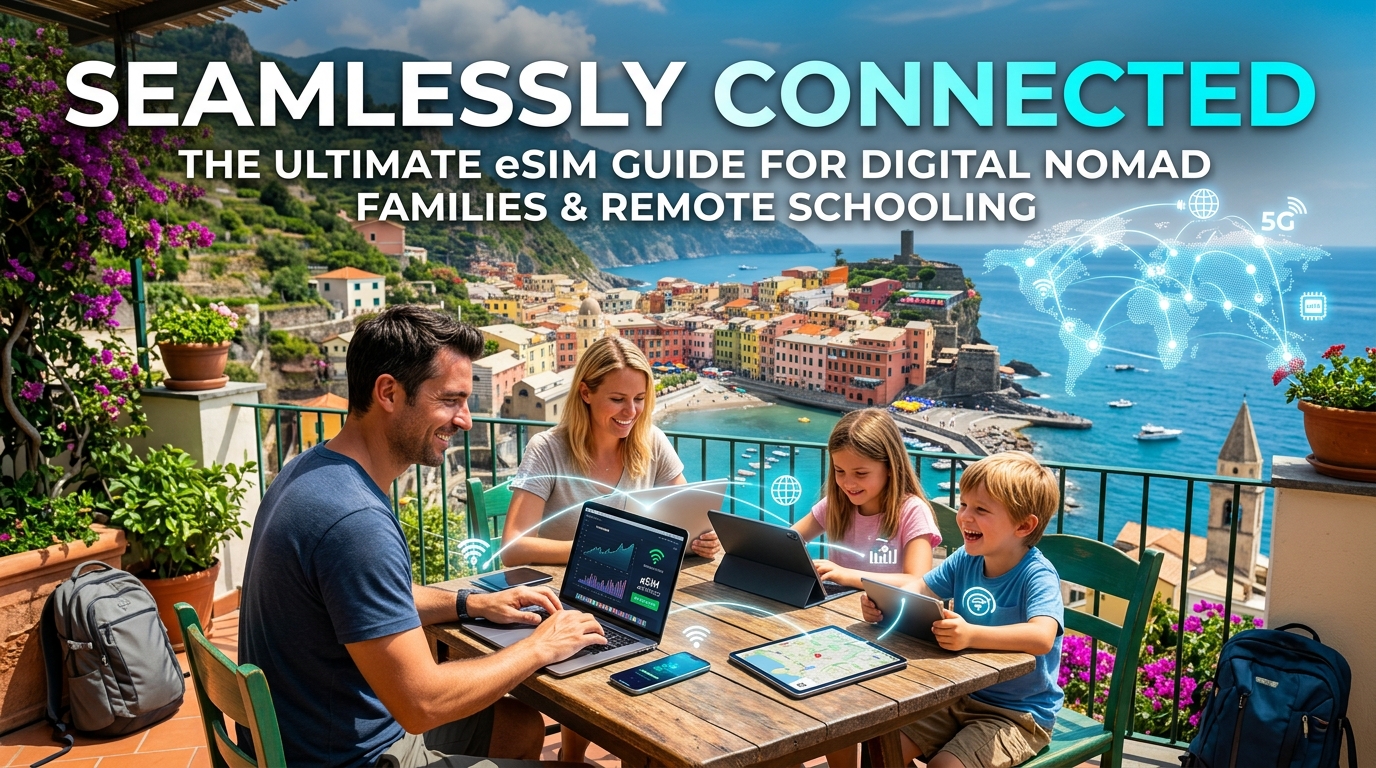
Seamlessly Connected: The Ultimate eSIM Guide for Digital Nomad Families & Remote Schooling
The Connectivity Conundrum: Why Digital Nomad Families Need a Smarter Solution
For digital nomad families, the dream of global exploration often collides head-on with the stark reality of staying connected. Unlike solo travelers who might tolerate sporadic internet, a family unit – balancing remote work, online schooling, and daily logistics – demands an unwavering, high-quality connection. This isn't just about convenience; it's the operational backbone of their entire lifestyle. The constant search for reliable internet becomes a pervasive source of stress, impacting productivity, learning, and overall family well-being.
The Pitfalls of Traditional Connectivity for Nomad Families
Traditional internet solutions, designed for static living or occasional travel, crumble under the unique, dynamic pressures of a digital nomad family's needs.
The Local SIM Scramble: A Never-Ending Chore
Imagine landing in a new country with children in tow, perhaps after a long flight. Before you can even think about finding your accommodation or grabbing a meal, the immediate, pressing task is to secure internet access. This often means a frantic search for a local SIM card vendor, navigating language barriers, deciphering complex data plans, dealing with registration requirements (which can be surprisingly stringent in some countries), and then the inevitable activation delays. Multiply this by two parents and potentially multiple devices for older children, and you have a logistical nightmare. Every border crossing resets this arduous process, transforming what should be an exciting arrival into a connectivity chore.
Roaming Roulette: The Fear of Bill Shock
Relying on international roaming from your home provider is a financial gamble few digital nomad families can afford. Exorbitant per-megabyte charges can lead to astronomical bills, forcing families to constantly monitor data usage or, worse, switch off data entirely. This fear of bill shock creates a state of digital isolation, preventing access to essential navigation apps like Google Maps, communication with family back home, or critical work updates. The choice between connectivity and financial solvency is a false dilemma that modern families shouldn't face.
Public Wi-Fi Peril: Unreliable and Insecure
Public Wi-Fi, whether in cafes, airports, or hotels, offers a tempting but ultimately flawed solution. Its unreliability is legendary – slow speeds, intermittent drops, and frustrating time limits are common. For a parent on a critical video conference call or a child trying to submit a time-sensitive assignment, a dropped connection isn't just an inconvenience; it's a direct hit to productivity and academic performance. Beyond performance, public Wi-Fi poses significant security risks. Sensitive work documents, personal banking information, and children's learning platform logins are all vulnerable on unsecured networks, making it an unsuitable primary connection for professional and educational use.
The Multi-Device Management Maze
A digital nomad family is a small, interconnected network in itself. Parents need internet for work – video calls, large file transfers, secure VPN access. Children require it for remote schooling – interactive learning platforms, live video lessons, research, and homework submissions. Beyond work and school, there's the universal need for navigation, emergency communication, and family entertainment (streaming, video calls with grandparents). Managing multiple physical SIM cards across various phones, tablets, and laptops, tracking individual data allowances, and remembering expiry dates for each country becomes an overwhelming task. Adding a pocket Wi-Fi device only introduces another gadget to charge, carry, and potentially lose, often with its own regional limitations and data caps. This fragmented approach leads to constant frustration, downtime, and a significant drain on mental energy.
The High Stakes of Disconnection: Stress and Productivity Loss
The cumulative effect of these connectivity challenges is profound. Poor internet isn't just an annoyance; it's a direct impediment to a family's ability to function. Missed work deadlines, interrupted lessons, failed video calls with teachers, and the inability to access critical information (like directions or local emergency services) create a constant undercurrent of stress. This stress impacts every family member, leading to frustration, arguments, and a pervasive feeling of being disconnected from both their work/school responsibilities and the wider world. Productivity plummets as precious time is wasted troubleshooting connections or searching for alternatives.
This critical need for consistent, reliable, and multi-device internet access is where the concept of eSIMs emerges as a revolutionary answer. By eliminating the physical SIM card and streamlining the connection process, eSIM technology offers a paradigm shift for digital nomad families. Imagine a single, unified solution that provides seamless connectivity across borders, on multiple devices, without the fear of hidden charges or the hassle of local SIM hunts. This is precisely the gap that innovative solutions like MollySIM (https://mollysim.com) are designed to fill. MollySIM, for instance, understands the nuances of family travel, offering robust data plans with a Fair Use Policy speed limit of 384kbps – three times faster than competitors' typical 128kbps. This seemingly small detail is critical, ensuring that even after high data usage, essential functions like Google Maps and Apple Pay continue to work smoothly, keeping families oriented and able to make crucial payments without interruption. It's about transforming the connectivity conundrum into a seamless, stress-free experience, allowing families to focus on the adventure, learning, and work that define their unique lifestyle.
eSIM Demystified: A Family's Gateway to Global Freedom
🇺🇸 United States High-Speed Travel eSIM & SIM Plans
Instant QR code activation, hotspot enabled, with guaranteed 384kbps fallback speed to keep Maps & Digital Wallets active.
For digital nomad families, the concept of reliable, ubiquitous internet access isn't a luxury; it's the foundational pillar supporting remote work, online schooling, and maintaining vital connections. This is precisely where the eSIM (embedded Subscriber Identity Module) steps in, revolutionizing how families stay connected across continents. Unlike its physical predecessor, an eSIM is a small chip permanently embedded directly into a compatible device during manufacturing. It functions identically to a traditional SIM card, storing your subscriber profile and enabling connection to cellular networks, but without the need for a physical, swappable card.
eSIM vs. Traditional SIM: A Side-by-Side Comparison
To truly appreciate the paradigm shift an eSIM offers, especially for families constantly on the move, it's helpful to contrast it with the familiar physical SIM card.
| Feature | Traditional Physical SIM Card | eSIM (Embedded SIM) |
|---|---|---|
| Physicality | Small, removable plastic card (nano, micro, mini sizes) | Integrated chip within the device, non-removable |
| Activation | Requires physical insertion into a tray | Digital activation via QR code or app download |
| Plan Switching | Requires swapping physical cards or buying new ones | Digital download of new profiles; multiple profiles can be stored simultaneously |
| Availability | Purchased locally, often requiring ID/registration | Purchased online from anywhere, activated instantly |
| Durability | Susceptible to loss, damage, or misplacement | Securely embedded, no risk of physical damage or loss |
| Multi-Device Use | One SIM per device, limited flexibility | Easier management of multiple lines/devices, often via family plans or hotspotting |
| Environmental | Plastic waste from manufacturing and disposal | Reduced plastic waste, more eco-friendly |
The Transformative Advantages for Digital Nomad Families
The inherent design of eSIM technology translates into a suite of powerful benefits specifically tailored to the dynamic and often unpredictable life of a digital nomad family.
Simplicity & Unrivaled Convenience
Imagine landing in a new country and instantly connecting to the internet without the frantic search for a local SIM card vendor, navigating language barriers, or dealing with registration paperwork. This is the core promise of eSIMs. With providers like MollySIM (https://mollysim.com), families can purchase and activate data plans online before they even depart, or even mid-journey. A simple QR code scan or app-based activation is all it takes. This digital ease eliminates a significant source of travel stress, freeing up precious time for exploring a new destination or settling into a temporary home. No more fumbling with tiny SIM trays or worrying about losing a minuscule card.
Unlocking Multi-Device Potential
For families with multiple smartphones, tablets, and laptops, an eSIM solution offers unprecedented flexibility. While a single eSIM profile is typically tied to one primary device, its utility extends far beyond. A parent's MollySIM-enabled smartphone, for instance, can serve as a powerful mobile hotspot, sharing its robust data connection with children's tablets for remote schooling, a partner's laptop for work, or even smartwatches. This means a single, reliable data plan can effectively power an entire family's digital ecosystem. Furthermore, for families where multiple members have compatible devices, some providers offer the ability to manage individual eSIM profiles under a unified family plan, simplifying billing and data allocation. This ensures that every family member, from the youngest student to the busiest parent, has the connectivity they need, precisely when they need it.
Flexibility & Scalability for Dynamic Lifestyles
Digital nomad life is rarely static. Data needs can fluctuate wildly, from high-bandwidth demands during intensive remote schooling periods with video conferences and large file downloads, to more moderate usage during a holiday exploring national parks. eSIMs excel in this adaptability. Families can easily adjust their data plans on the fly, upgrading to a larger package for a month of heavy work/school or scaling down during a period of reduced online activity. This agility ensures cost-effectiveness, preventing overspending on unused data while guaranteeing sufficient bandwidth when it's critical. MollySIM, for example, allows families to pick plans that align with their specific travel duration and data consumption patterns, providing peace of mind that connectivity will always match their current lifestyle demands.
Seamless Global Coverage
One of the most compelling advantages of eSIMs for global travelers is their extensive international reach. Instead of buying a new local SIM in every country, an eSIM provider like MollySIM offers global or regional data plans that cover a vast number of destinations. This eliminates the need for country-specific solutions, providing a consistent and reliable connection as families cross borders. Imagine uninterrupted online classes for your children as you transition from Portugal to Spain, or seamless navigation with Google Maps as you explore a new city in Thailand. This broad coverage is a cornerstone of stress-free international travel.
Enhanced Security & Peace of Mind
Beyond convenience, eSIMs offer an often-overlooked security benefit. Because the eSIM is embedded and cannot be physically removed, it significantly reduces the risk of SIM card theft or unauthorized swapping, a common tactic for identity theft. If a device is lost or stolen, the eSIM profile remains secure within the device, making it harder for unauthorized individuals to access your phone number or associated accounts. This added layer of security provides crucial peace of mind for families carrying valuable devices and sensitive information while traveling. Furthermore, with MollySIM's Fair Use Policy speed limit of 384kbps (three times faster than competitors' typical 128kbps) even after high data usage, essential services like Google Maps and Apple Pay continue to function smoothly. This seemingly small detail is critical for safety and convenience, ensuring families can always navigate and make crucial payments without interruption, fostering a true sense of freedom and significantly reducing travel-related stress.
MollySIM: Powering Remote Schooling & Family Life, Uninterrupted
Digital nomad families face a unique set of connectivity challenges, balancing the demands of remote work, online schooling, and staying connected across continents. MollySIM (https://mollysim.com) has been meticulously designed to address these complexities, offering a robust and reliable eSIM solution that ensures uninterrupted digital life, no matter where your adventures take you.
Tailored Data Plans for Diverse Family Needs
Understanding that no two digital nomad families are alike, MollySIM offers a diverse portfolio of data plans engineered for maximum flexibility. Whether your family consists of a single parent and child or a larger group with multiple devices, you'll find options that align perfectly with your data consumption patterns. MollySIM provides regional and global plans with varying data allowances and durations, allowing families to select packages that cover specific travel itineraries or broader, long-term nomadic lifestyles. This flexibility means you can choose a plan that adequately supports multiple devices – from laptops and tablets used for remote schooling and work, to smartphones for navigation, communication, and entertainment – without overpaying for unused data or constantly scrambling for top-ups. The ability to consolidate connectivity under a single, manageable eSIM profile simplifies expense tracking and ensures consistent service across all family members' devices, making budget management and connectivity oversight significantly easier for busy parents.
The Unrivaled Advantage: MollySIM's 384kbps Fair Usage Policy
One of MollySIM's most critical differentiators, and a true game-changer for digital nomad families, is its Fair Usage Policy (FUP) speed limit of 384kbps after high-speed data is consumed. To truly appreciate its significance, it's vital to understand what this means and why it stands head and shoulders above competitors, which typically throttle speeds down to a mere 128kbps.
When your high-speed data allowance on a MollySIM plan is exhausted, your connection doesn't vanish. Instead, it gracefully transitions to a consistent, usable speed of 384kbps. This isn't just a minor reduction; it's a three-fold increase in fallback speed compared to the industry standard. This sustained, higher-tier throttled speed is absolutely critical for maintaining essential digital functions, preventing the complete disconnection that can derail remote schooling, urgent work tasks, or even safety in an unfamiliar location.
Remote Schooling Continuity, Uninterrupted
For families relying on remote schooling, the 384kbps FUP is a lifeline. Imagine a scenario where your child is midway through an important online lesson, or needs to submit a time-sensitive assignment, and your primary high-speed data runs out. With MollySIM, the learning doesn't stop. At 384kbps, children can still:
- Access text-based learning platforms and educational websites without frustrating delays, ensuring research and reading assignments remain accessible.
- Participate in basic video conferencing for online classes, albeit at a lower resolution, ensuring they can still see and hear their teachers and classmates, and actively engage in discussions.
- Send and receive emails for homework submissions, teacher communications, and project updates, preventing missed deadlines.
- Download smaller files like worksheets, syllabi, or reading materials, crucial for keeping up with coursework.
This consistent fallback speed ensures that critical educational activities remain accessible, providing unparalleled peace of mind for parents and preventing significant disruptions to their children's academic progress, even in unexpected data depletion scenarios.
Uninterrupted Work & Essential Communication
Parents managing remote work while traveling will find the 384kbps FUP equally indispensable. When high-speed data is depleted, you can still confidently:
- Send and receive essential work emails and attachments, maintaining professional communication.
- Utilize messaging apps like WhatsApp or Slack for team communication and urgent updates.
- Perform basic web browsing for research, accessing cloud-based documents, or managing project workflows.
- Maintain emergency communication with family, friends, or local services, which is paramount for safety while abroad.
Crucially, this speed also ensures that vital services like Google Maps and Apple Pay continue to function smoothly. This seemingly small detail is paramount for safety and convenience, allowing families to navigate unfamiliar cities, find essential services, and make crucial payments without interruption, even when high-speed data is exhausted. This fosters a true sense of freedom and significantly reduces travel-related stress by eliminating the fear of being completely cut off.
Maintaining Basic Family Connectivity & Entertainment
Beyond schooling and work, the 384kbps FUP ensures that families remain connected for everyday needs and even some low-bandwidth entertainment. Children can still:
- Communicate with friends and family via messaging apps, helping them stay connected to their social circles.
- Access low-bandwidth content like streaming music, basic social media feeds, or simple online games, preventing complete boredom during downtime or long journeys.
This consistent, usable speed prevents the frustration of complete digital isolation, ensuring that families can always stay in touch and access essential information, maintaining a sense of normalcy amidst their travels.
Extensive Global Network & Dedicated Support
MollySIM's commitment to uninterrupted connectivity extends to its extensive global network. Partnering with leading local carriers worldwide, MollySIM ensures that families have reliable and robust connectivity in a vast array of destinations, from bustling metropolitan centers to more remote, off-the-beaten-path locations. This broad coverage means less time worrying about finding local SIMs and more time experiencing your travels. Furthermore, MollySIM understands the unique needs of travelers and offers dedicated customer support specifically tailored to assist digital nomad families with any connectivity questions or issues, ensuring a smooth and stress-free experience from activation to ongoing usage.
Mastering Family Data: Technical Considerations & Optimization Strategies
Navigating the digital landscape as a nomadic family requires more than just a data plan; it demands strategic management and optimization. With MollySIM, families gain access to robust global connectivity, but understanding how to best utilize and conserve that data is paramount to a seamless experience. This section provides actionable advice to ensure your family's digital life remains uninterrupted and efficient.
Data Allocation Strategies for Family Connectivity
Effectively distributing data across multiple devices is a cornerstone of family data management. MollySIM offers flexibility whether you're sharing a single plan or opting for individual profiles.
Hotspotting Best Practices & Battery Management
For younger children or occasional use, hotspotting from a primary device (usually a parent's phone) is an efficient way to share MollySIM's high-speed data.
- Setup: Most smartphones allow easy hotspot creation via settings (e.g., "Personal Hotspot" on iOS, "Wi-Fi Hotspot" on Android). Always use a strong, unique password to prevent unauthorized access.
- Usage Control: Monitor connected devices and disconnect those not actively in use. Be mindful that video streaming or large downloads on a hotspotted device will rapidly consume data from the primary device.
- Battery Drain: Hotspotting is power-intensive. Always carry a portable power bank or ensure the primary device is connected to a charger when acting as a hotspot, especially during remote schooling sessions or long work periods.
Dedicated Profiles vs. Shared Hotspot
Deciding between a shared hotspot and individual MollySIM profiles depends on usage patterns and family dynamics:
- Shared Hotspot (Primary Device): Ideal for families with younger children who have limited data needs or for occasional internet access on secondary devices. It simplifies management to a single plan.
- Dedicated MollySIM Profiles: For older children (teens) or parents with significant, independent data requirements (e.g., heavy video conferencing, large file transfers, online gaming), dedicated MollySIM profiles offer distinct advantages. Each individual gets their own guaranteed bandwidth, preventing one user from inadvertently consuming all the shared data. This also provides greater privacy and independence. MollySIM's straightforward activation process makes setting up multiple eSIM profiles incredibly easy.
Setting Data Limits on Devices and Apps
Preventing unexpected data overages is crucial. Both iOS and Android offer robust tools to manage data consumption:
- Per-App Data Restriction:
- iOS: Go to
Settings > Cellularand scroll down to toggle off cellular data for specific apps that don't require constant internet access or consume excessive data in the background. - Android: Navigate to
Settings > Network & internet > Internet, tap the gear icon next to your MollySIM connection, thenApp data usage. Here you can see usage per app and restrict background data for specific applications. - Data Warning & Limit (Android): Set a monthly data warning and a hard data limit. Once the limit is reached, cellular data will automatically turn off, preventing overages. Find this under
Settings > Network & internet > Internet > Data warning & limit. - Low Data Mode (iOS): Enable
Low Data ModeunderSettings > Cellular > Cellular Data Options. This reduces data usage by pausing automatic updates and background tasks.
Speed Requirements for Family Activities
Different online activities demand varying levels of internet speed. Understanding these requirements helps manage expectations and optimize usage.
| Activity Type | Minimum Recommended Speed (Download/Upload) | MollySIM Capability computer Molly
The Smart Choice: MollySIM vs. Traditional Connectivity Options
For digital nomad families, reliable and cost-effective internet access isn't a luxury; it's the backbone of their lifestyle, enabling remote work, online schooling, and staying connected with loved ones. Navigating the myriad of connectivity options across different countries can be a daunting task, often leading to unexpected costs, frustrating inconveniences, or unreliable service. This section provides a data-driven comparison, dissecting common traditional connectivity methods against the streamlined efficiency of MollySIM's eSIM solution, highlighting why MollySIM stands out as the superior choice for families on the move.
The Pitfalls of Traditional International Roaming
Relying on your home carrier's traditional international roaming might seem like the easiest option due to its automatic activation, but it's often the most financially perilous. The costs associated with roaming data are notoriously exorbitant, with per-MB or per-GB rates that can quickly escalate into hundreds or even thousands of dollars, leading to dreaded "bill shock." Data allowances are typically meager, and once exhausted, speeds often drop to unusable levels or cease entirely, leaving families stranded without essential connectivity. Imagine trying to conduct a critical work video call or a child's remote lesson only to have the connection drop due to prohibitive roaming charges. Furthermore, these plans offer minimal flexibility, often locking users into expensive, fixed bundles with little room for adaptation to varying data needs.
The Hassle of Local SIM Cards
Purchasing local SIM cards in each new country is a common strategy, offering potentially lower per-GB costs than roaming. However, this approach introduces a significant layer of inconvenience and logistical challenges. Families must dedicate valuable travel time to locating a mobile store, navigating potential language barriers, and enduring often lengthy registration processes that frequently require local identification or addresses. Once acquired, there's the physical hassle of swapping SIM cards in multiple devices, managing different phone numbers for each country, and the constant risk of misplacing your home SIM. This fragmented approach means a lack of continuity, with each border crossing necessitating a new search for connectivity, disrupting the seamless flow essential for digital nomad life.
The Limitations of Pocket Wi-Fi Devices
Pocket Wi-Fi devices, or mobile hotspots, present another alternative, offering the ability to share a single internet connection among multiple devices. While seemingly convenient, they come with their own set of drawbacks. Primarily, it's yet another device to carry, charge, and keep track of, adding to the digital nomad's already extensive gadget collection. Battery life concerns are paramount; a dead device means no internet for anyone, a critical vulnerability during travel days or remote schooling sessions. There are also upfront rental costs or purchase prices, followed by recurring data plan expenses. Moreover, a pocket Wi-Fi device represents a single point of failure; if it's lost, stolen, or malfunctions, the entire family loses their primary internet access, creating immediate disruption and stress.
| Feature | MollySIM eSIM | Traditional International Roaming | Local SIM Cards (per country) | Pocket Wi-Fi Device |
|---|---|---|---|---|
| Cost-Effectiveness | High (flexible plans, long-term savings) | Very Low (exorbitant per MB/GB) | Medium (varies, can add up) | Medium-High (rental + data costs) |
| Convenience | Very High (digital activation, no physical swaps) | Low (automatic, but costly) | Low (physical purchase, registration, swaps) | Medium (extra device, charging, pickup/return) |
| Global Coverage | Excellent (single solution for many countries) | Good (carrier dependent, but expensive) | Limited (country-specific) | Varies by provider, often regional |
| Data Flexibility | Excellent (easy plan changes, top-ups) | Very Low (fixed, expensive bundles) | Medium (can buy different local plans) | Medium (fixed plans, limited flexibility) |
| Multi-Device Support | Excellent (hotspot, multiple eSIM profiles) | Limited (single device, costly for others) | Limited (one SIM per device, or hotspot) | Good (shares connection, but single device source) |
| Fallback Speed (FUP) | Crucial 384kbps (uninterrupted basics) | None (data cuts off or becomes extremely slow) | Varies (often hard cut-off) | Varies (often hard cut-off) |
| Setup Complexity | Low (QR code scan) | Very Low (automatic) | High (store visit, ID, language barrier) | Medium (pickup, setup, charging) |
| Peace of Mind | Very High (consistent, predictable, reliable) | Very Low (constant worry about costs) | Medium (initial hassle, then stable locally) | Medium (worry about device loss/battery) |
MollySIM: The Unrivaled Solution for Digital Nomad Families
When stacked against these traditional methods, MollySIM (https://mollysim.com) emerges as the clear winner, offering a solution specifically tailored to the unique demands of digital nomad families. Its eSIM technology provides unparalleled convenience, allowing for digital activation via a simple QR code scan, eliminating the need for physical SIM swaps, store visits, or language barriers. This translates to immediate, seamless connectivity upon arrival in a new country, a game-changer for families with tight schedules and remote schooling commitments.
MollySIM's cost-effectiveness is derived from its flexible plans and transparent pricing, offering significant long-term savings compared to the unpredictable expenses of roaming or the cumulative costs of multiple local SIMs. Its excellent global coverage means a single, reliable solution across numerous destinations, simplifying connectivity management immensely.
Crucially, MollySIM offers an industry-leading 384kbps Fair Use Policy (FUP) fallback speed. This isn't just a number; it's a lifeline. While competitors often drop to an unusable 128kbps or cut off data entirely, MollySIM's 384kbps ensures that even after high-speed data is consumed, essential services remain functional. This speed is robust enough for critical tasks like using Google Maps for navigation, making Apple Pay transactions, sending and receiving messages, checking emails, and even light web browsing – vital for maintaining basic communication and operational efficiency for a traveling family. This consistent, predictable connectivity provides immense peace of mind, allowing families to focus on their adventures and responsibilities without constant worry about internet access. With MollySIM, digital nomad families gain a truly cost-effective, convenient, and reliable connectivity partner, ensuring uninterrupted learning and working no matter where their journey takes them.
Embracing the Future: Activating MollySIM & Thriving as a Connected Nomad Family
Transitioning to a digital nomad lifestyle with a family requires meticulous planning, and connectivity is paramount. MollySIM simplifies this crucial aspect, offering a robust and intuitive solution. This section guides you through the practical steps of integrating MollySIM into your family's travel routine, ensuring uninterrupted learning, working, and exploring.
Getting Started with MollySIM: Your Family's Connectivity Hub
The journey to seamless global connectivity with MollySIM begins with a few straightforward steps, designed for ease of use even for busy families.
1. Ensuring eSIM Compatibility
Before purchasing, verify that your family's devices are eSIM compatible. Most modern smartphones, tablets, and even some smartwatches support eSIM technology.
- Apple Devices: iPhone XS, iPhone XS Max, iPhone XR, and newer models.
- Samsung Devices: Galaxy S20, S20+, S20 Ultra, S21, S21+, S21 Ultra, Note 20, Note 20 Ultra, Fold, Z Flip, and newer models.
- Google Pixel Devices: Pixel 3, 3 XL, 3a, 3a XL, 4, 4 XL, 4a, 5, 6, and newer models.
- Other Brands: Many newer models from Huawei, Motorola, Oppo, and Xiaomi also support eSIM.
To confirm, check your device's settings (e.g., "Settings > Cellular/Mobile Data > Add eSIM" on iOS, or similar options on Android) or consult the manufacturer's website.
2. Purchasing and Activating Your MollySIM Plan
Acquiring a MollySIM plan is a quick, entirely digital process:
- Visit MollySIM.com: Browse the available plans, selecting the destination or regional package that best suits your family's travel itinerary and data needs. MollySIM offers flexible options, from short-term travel to extensive multi-country plans.
- Select Your Plan & Purchase: Choose your desired data allowance and duration. The transparent pricing ensures you know exactly what you're paying for, avoiding unexpected roaming charges.
- Receive Your QR Code: Immediately after purchase, you'll receive an email containing a unique QR code and detailed activation instructions.
- Activate Your eSIM:
- On iOS: Go to
Settings > Cellular(orMobile Data)> Add eSIM. ChooseUse QR Codeand scan the code provided in your email. - On Android: Navigate to
Settings > Network & internet > SIMs > Add more(orDownload a SIM). Follow the prompts to scan the QR code. - Label Your eSIM: Assign a clear name to your new eSIM profile (e.g., "MollySIM Europe," "MollySIM USA") to easily distinguish it from your home SIM or other profiles.
- Set as Primary for Data: Ensure the MollySIM profile is selected for cellular data usage. Remember to enable data roaming for the MollySIM profile if prompted, as this is necessary for it to connect to local networks abroad.
3. Managing Multiple eSIM Profiles Across Devices
MollySIM provides the flexibility needed for a multi-device family:
- On a Single Device: Many modern smartphones can store multiple eSIM profiles simultaneously, though only one can be actively used for data at a time. You can easily switch between profiles in your device's cellular settings, ideal for parents managing both a personal and a work line, or for switching between regional plans.
- Across Family Devices: For optimal individual connectivity, each family member with a compatible device can have their own MollySIM plan. This ensures everyone has direct access to data for remote schooling, video calls, or entertainment, without relying solely on a single hotspot. Alternatively, a primary device can act as a hotspot, sharing its MollySIM data with other family members, though this can drain battery faster.
4. Effortless Data Top-ups and Plan Switching
As your family's travel plans or data consumption evolve, MollySIM makes managing your connectivity simple:
- Monitor Usage: Keep track of your data consumption through your device's settings or MollySIM's online portal (if applicable).
- Easy Top-ups: If you're running low on data, purchasing a top-up is as simple as visiting MollySIM.com and selecting an add-on package for your active plan.
- Switching Plans: For extended stays or new destinations, you can easily purchase a new MollySIM plan and activate it, deactivating the old one as needed. This flexibility ensures you always have the most cost-effective and appropriate plan for your current location and needs.
Troubleshooting & Dedicated Support for Nomads
Even with the most reliable technology, occasional issues can arise. MollySIM is designed with digital nomad families in mind, offering robust support.
Common Troubleshooting Tips:
- "No Service" or Connectivity Issues: Double-check that data roaming is enabled for your MollySIM profile. Ensure the correct eSIM profile is selected for cellular data. Sometimes, simply restarting your device can resolve minor glitches. If issues persist, try manually selecting a network operator from your phone's cellular settings.
- Slow Data Speeds: While MollySIM offers high-speed data, network congestion can occur. Crucially, even after high-speed data is consumed, MollySIM's industry-leading 384kbps Fair Use Policy (FUP) fallback speed ensures essential services remain functional. This is three times faster than competitors' typical 128kbps, meaning you can still reliably use Google Maps for navigation, make Apple Pay transactions, send messages, check emails, and perform light web browsing – a lifeline for families on the go.
MollySIM's Customer Support:
MollySIM understands the unique needs of digital nomads. Their customer support channels (typically available via online chat or email) are staffed by knowledgeable professionals ready to assist with activation, plan management, or troubleshooting. This dedicated support provides invaluable peace of mind, knowing expert help is just a message away, no matter your time zone.
Future-Proofing Connectivity: The eSIM Advantage
The landscape of global travel technology is rapidly evolving, and eSIMs are at the forefront of this transformation. As physical SIM cards become obsolete, integrated eSIM technology offers unparalleled convenience, security, and flexibility. Robust solutions like MollySIM are not just keeping pace; they are leading the charge in enabling truly seamless global travel. By embracing MollySIM, digital nomad families are not just solving today's connectivity challenges; they are future-proofing their ability to stay connected anywhere in the world.
MollySIM offers an unparalleled sense of peace of mind for digital nomad families. Knowing that remote work, schooling, and vital family communication will remain consistently connected, regardless of your location, frees you to fully immerse yourselves in the adventure. This freedom and flexibility allow families to focus on experiencing the world together, creating lasting memories without the constant worry of internet access, truly embodying the 'Seamlessly Connected' ethos.
🇺🇸 United States High-Speed Travel eSIM & SIM Plans
Instant QR code activation, hotspot enabled, with guaranteed 384kbps fallback speed to keep Maps & Digital Wallets active.