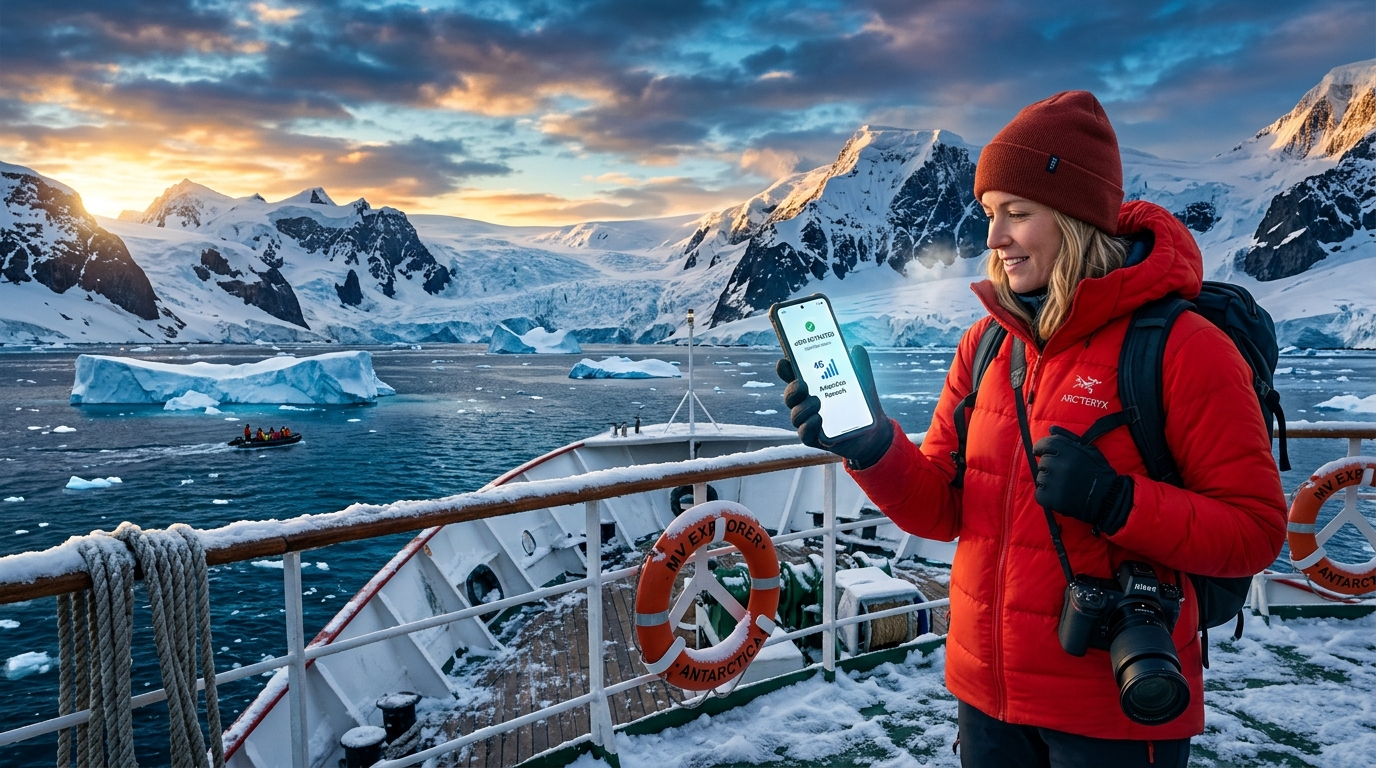
Conquering the Cold: Your Essential eSIM Guide for Antarctica Expedition Connectivity
The Antarctic Connectivity Conundrum: Why Your Phone Needs an eSIM
An expedition to Antarctica is, for many, the ultimate journey – a pilgrimage to a realm of unparalleled natural grandeur. Imagine towering icebergs sculpted by millennia, the silent majesty of colossal glaciers, and the vibrant cacophony of penguin colonies teeming with life. It's a place where the air is crisp, the silence profound, and the sense of isolation from the modern world is both exhilarating and deeply humbling. Travelers seek this profound disconnect, a chance to shed the digital shackles of daily life and immerse themselves fully in the raw beauty of the White Continent.
Yet, even in pursuit of this digital detox, the modern adventurer faces a stark reality: complete digital disconnect carries inherent risks and logistical challenges. While the desire to unplug is strong, the need for strategic connectivity remains a crucial, often overlooked, component for a smooth, safe, and secure Antarctic expedition. This isn't about constant streaming or endless social media updates; it's about having reliable access for essential communication, critical updates, and peace of mind during the journey to and from the continent, and for any fleeting moments of limited coastal coverage.
The Myth of Mobile Roaming in the White Continent
Let's be unequivocally clear: standard mobile roaming is virtually non-existent on the Antarctic continent itself. Unlike a trip to a bustling European city or a remote national park with scattered cell towers, Antarctica's vast, icy expanse is not equipped with commercial cellular infrastructure. The few scientific research stations present operate their own highly specialized satellite communication systems, primarily for operational and scientific purposes, not for public mobile access. Your traditional physical SIM card, with its domestic roaming agreements, will become little more than a plastic placeholder once you venture south of the Drake Passage.
This absence of conventional connectivity means that relying on your home network for calls, texts, or data is simply not an option. Expedition ships typically offer their own satellite-based Wi-Fi services, which are notoriously expensive, slow, and often reserved for critical communications or emergency use. Therefore, the period before you board your vessel and after you disembark in gateway cities like Ushuaia (Argentina) or Punta Arenas (Chile) becomes critically important for managing your digital needs.
Why Strategic Connectivity is Non-Negotiable
The concept of 'strategic connectivity' for an Antarctic journey isn't a luxury; it's a practical necessity. It serves several vital functions that contribute to a seamless and secure experience:
- Safety and Emergency Preparedness: Before and after your expedition, having reliable communication is paramount. This includes confirming travel arrangements, coordinating with tour operators, accessing emergency contact information, or notifying loved ones of your safe arrival and departure from gateway cities. While on the continent, satellite phones on ships handle emergencies, but your personal device with an active eSIM ensures you're reachable during the crucial transit phases.
- Logistical Management: Imagine arriving in a foreign port city only to find your connecting flight delayed, your hotel booking needs confirmation, or you require directions to a meeting point. Without data, these simple tasks become monumental hurdles. Strategic connectivity allows for real-time updates on flights, accommodation, and transfers, ensuring you stay ahead of any unforeseen logistical challenges.
- Peace of Mind: Even the most adventurous traveler appreciates the ability to send a quick "I'm safe" message to family, check a banking app for transactions, or access essential travel documents stored in the cloud. This intermittent, controlled access provides a vital psychological anchor, allowing you to fully embrace the remote experience without underlying anxieties about being completely cut off from the outside world.
- Navigation and Local Information: In the bustling port cities that serve as gateways to Antarctica, having data for navigation apps like Google Maps or for quickly looking up local services (restaurants, pharmacies, transport) is invaluable. It transforms potentially stressful situations into manageable ones, allowing you to explore with confidence.
eSIMs: Your Bridge to the White Continent's Edge
This is precisely where eSIMs emerge as a crucial, often overlooked, tool for your Antarctic adventure. An eSIM eliminates the need for physical SIM cards, allowing you to activate local or regional data plans digitally, often before you even leave home. For a journey that traverses multiple countries (e.g., your home country, a transit hub, and then Argentina/Chile), the flexibility of an eSIM is unparalleled. It allows you to seamlessly switch between networks, ensuring you have data coverage in those critical pre- and post-expedition phases.
Platforms like MollySIM (https://mollysim.com) offer a compelling solution for this strategic connectivity. Their global and regional eSIM plans provide data coverage in the countries you'll pass through, ensuring you're connected when it matters most. A significant advantage of MollySIM is its 384kbps Fair Use Policy speed limit, which is a remarkable 3x faster than many competitors' standard 128kbps. This seemingly technical detail translates into a tangible difference in user experience:
- Smooth Navigation: At 384kbps, apps like Google Maps or Apple Maps load much faster, making real-time navigation in unfamiliar cities efficient and stress-free.
- Reliable Essential Apps: Critical applications like messaging services (WhatsApp, iMessage), email clients, and even mobile payment systems like Apple Pay or Google Pay function smoothly, allowing for quick transactions and communications without frustrating delays.
- Efficient Updates: Receiving weather updates, flight notifications, or coordinating with your expedition team becomes a quick, seamless process rather than a test of patience.
By embracing an eSIM, you're not sacrificing the allure of disconnection in Antarctica; rather, you're intelligently managing your connectivity needs to ensure a safer, smoother, and more enjoyable journey to the very edge of the world. It's about empowering yourself with the right tools to navigate the modern travel landscape, even when your ultimate destination is gloriously off-grid.
Navigating the Digital Void: Understanding Connectivity Options (and Limitations) on the White Continent
🇪🇺 Europe 33 Countries High-Speed Travel eSIM & SIM Plans
Instant QR code activation, hotspot enabled, with guaranteed 384kbps fallback speed to keep Maps & Digital Wallets active.
Venturing to Antarctica is to step into one of the last true wildernesses on Earth, a realm where nature reigns supreme and the digital world largely recedes. Understanding the profound limitations of connectivity on the White Continent is crucial for setting realistic expectations and appreciating the strategic value of an eSIM for the journey itself. Unlike virtually any other populated landmass, Antarctica operates in a unique digital void, entirely devoid of the terrestrial cellular infrastructure we take for granted.
The Absence of Terrestrial Networks: A Continent Apart
The fundamental reason for Antarctica's severe connectivity limitations is straightforward: there are no terrestrial cellular towers or fiber optic cables anywhere on the continent. This isn't merely an oversight; it's a consequence of its extreme environment, lack of permanent civilian population, and the international treaties (like the Antarctic Treaty System) that prioritize scientific research and environmental protection over commercial development. Building and maintaining such infrastructure in sub-zero temperatures, across vast icy expanses, and for a transient population of researchers and tourists is logistically impossible and economically unfeasible. Therefore, the concept of "roaming" onto a local Antarctic network simply doesn't exist.
The Reign of Satellite Connectivity: The Only Lifeline
With no ground-based networks, satellite internet becomes the sole lifeline for all communication in and around Antarctica. Expedition ships, research stations, and even some specialized aircraft rely exclusively on satellite dishes to beam signals to and from geostationary or low-Earth orbit satellites. While this technology enables some level of connectivity, it comes with significant inherent drawbacks that drastically differentiate it from land-based networks:
- Extremely High Cost Per MB: Satellite bandwidth is a premium commodity. The sheer distance signals must travel, the specialized equipment required, and the limited capacity mean that data costs are astronomically higher than terrestrial rates. Passengers on expedition ships often pay upwards of $1 per MB, making casual browsing or streaming prohibitively expensive.
- Significantly Lower Bandwidth: Compared to the multi-megabit per second (Mbps) speeds common on land, satellite internet in remote polar regions typically offers only a fraction of that. A ship's entire complement of hundreds of passengers and crew might share a connection that struggles to reach a few Mbps, leading to severe congestion. This means even basic tasks like loading web pages or checking emails can be agonizingly slow.
- High Latency: Due to the vast distances signals must travel (tens of thousands of kilometers to geostationary satellites and back), satellite connections suffer from high latency. This delay, often several hundred milliseconds, makes real-time applications like video calls or online gaming virtually impossible and can make even simple web browsing feel sluggish and unresponsive.
- Shared, Throttled Access: To manage the limited and expensive bandwidth, expedition ships universally implement Fair Use Policies (FUPs), throttling speeds, limiting data allowances, and often restricting access to bandwidth-intensive applications. Passengers typically receive a small, daily data allowance, or pay for expensive packages that still offer very limited speeds, especially during peak usage hours. This ensures that essential operational communications for the ship take precedence.
Bridging the Gap: Connectivity in Crucial Transit Hubs
While Antarctica itself is a digital desert, the journey to and from the continent passes through crucial transit hubs where robust connectivity is readily available. Cities like Ushuaia, Argentina, often dubbed "the End of the World," and Punta Arenas, Chile, serve as the primary gateways for Antarctic expeditions. In these vibrant port cities, travelers will find reliable local cellular networks, offering excellent 4G and increasingly 5G coverage.
This is precisely where an advanced connectivity solution like an eSIM becomes not just convenient, but indispensable. Before boarding your ship in Ushuaia or Punta Arenas, or upon your return, an eSIM allows you to seamlessly connect to local networks, ensuring you can:
- Coordinate Logistics: Confirm transfers, check flight statuses, and communicate with tour operators.
- Navigate with Ease: Utilize apps like Google Maps or Apple Maps to explore these unfamiliar cities. Here, MollySIM's impressive 384kbps Fair Use Policy speed limit, which is a remarkable 3x faster than many competitors' standard 128kbps, makes a tangible difference. This speed ensures maps load quickly, preventing frustrating delays when you're trying to find your hotel or a local restaurant.
- Stay in Touch: Send messages, make calls, and update loved ones about your incredible journey before you truly disconnect.
- Handle Financials: Access mobile banking, make payments with Apple Pay or Google Pay, and manage any last-minute purchases without connectivity worries. MollySIM's enhanced speed ensures these critical applications function smoothly and securely.
Setting Realistic Expectations: The eSIM's True Role
It's vital to understand that an eSIM, while a game-changer for international travel, does not provide direct connectivity on the Antarctic Peninsula or its surrounding islands. Its purpose is to empower you with seamless, affordable, and fast data connectivity in the critical transit phases of your journey – the weeks leading up to your departure, your time in gateway cities, and your return home. By equipping yourself with an eSIM from providers like MollySIM, you're not trying to conquer the digital void of Antarctica itself, but rather intelligently managing your connectivity needs to ensure a safer, smoother, and more enjoyable expedition to the world's most remote continent.
Your Digital Lifeline: How an eSIM Powers Your Antarctic Journey (MollySIM Deep Dive)
While the vast, icy expanse of Antarctica remains largely untouched by terrestrial cellular networks, the journey to and from this continent is where an eSIM transforms from a convenience into an indispensable tool. An eSIM, or embedded Subscriber Identity Module, fundamentally redefines how you connect internationally. Unlike traditional physical SIM cards, an eSIM is a digital profile embedded directly into your device. This means no more fumbling with tiny plastic cards, no searching for local stores, and no worrying about losing your primary SIM. With an eSIM, you can instantly download and activate a data plan for a specific country or region, switching between multiple profiles with ease – all from your phone's settings.
Seamless Connectivity Across Transit Hubs with MollySIM
For an Antarctic expedition, your journey typically begins long before you set foot on a ship. Gateway cities like Ushuaia (Argentina) or Punta Arenas (Chile) serve as crucial staging points, often requiring several days for preparation, briefings, and last-minute purchases. This is precisely where MollySIM's global and regional eSIM plans shine.
- Effortless Activation: Before you even leave home, you can purchase and activate a MollySIM plan covering Argentina, Chile, and other transit countries. Upon arrival, your phone seamlessly connects to local networks, eliminating the need to hunt for a local SIM card vendor or navigate confusing foreign mobile plans.
- Consistent Connectivity: MollySIM provides reliable data access throughout your transit, ensuring you can confirm bookings, coordinate with your expedition group, or simply explore these unfamiliar cities. As mentioned, MollySIM's impressive 384kbps Fair Use Policy speed limit is a remarkable 3x faster than many competitors' standard 128kbps. This speed ensures critical applications like Google Maps load quickly, preventing frustrating delays when you're trying to find your hotel or a local restaurant, and enabling smooth transactions with Apple Pay or Google Pay.
- Cost-Effective Solution: By opting for a single MollySIM plan, you avoid the expense and hassle of purchasing multiple local SIMs for each country you pass through, offering a streamlined and budget-friendly approach to pre-expedition connectivity.
MollySIM: Your Reliable Backup for Coastal and Port Connectivity
It's crucial to reiterate that an eSIM will not provide consistent high-speed internet across the Antarctic Peninsula. However, MollySIM serves a vital role as a reliable backup for essential communications in specific, limited scenarios:
- Coastal Proximity: While rare, there are instances where your ship may come close enough to land, particularly near research stations or certain islands, for your device to pick up a very weak, intermittent cellular signal from a distant landmass. In these fleeting moments, MollySIM can potentially allow for basic communication.
- Port Stops (Extremely Rare): Should your itinerary include an exceptionally rare stop at a populated port (e.g., a scientific base with limited infrastructure), MollySIM could theoretically provide a lifeline for critical messages.
- Essential Communications: Even with a weak signal, MollySIM's optimized connectivity can facilitate the sending and receiving of crucial text messages, short emails, or WhatsApp messages. This could be vital for urgent family updates or receiving critical operational information from your expedition leader if traditional onboard communication channels are temporarily unavailable or overloaded.
The Practical Utility of MollySIM's 384kbps Fallback Speed
MollySIM's commitment to a 384kbps Fair Use Policy speed limit is a significant differentiator. While not suitable for streaming high-definition video, this speed is perfectly adequate for a range of critical tasks when high-speed data is scarce:
- Updated Weather Forecasts: Quickly download text-based weather updates, crucial for understanding changing conditions in a dynamic environment like Antarctica.
- Basic Navigation Apps: Load essential map data for land excursions or verify your ship's position using apps that don't require constant, high-bandwidth updates.
- Emergency Messaging: Send and receive critical messages via text or low-bandwidth messaging apps, ensuring you can communicate in an emergency.
- Staying in Touch: Send short, reassuring messages to loved ones, letting them know you're safe and enjoying your incredible journey, even when full internet access is unavailable. This speed ensures these messages go through without frustrating delays.
Complementing Onboard Satellite Wi-Fi
Most Antarctic expedition vessels offer satellite Wi-Fi, but it's notoriously expensive, often slow, and typically sold in limited data packages. MollySIM does not replace this onboard service but rather complements it by offering a cost-effective alternative for critical needs during the transit phases and as a potential backup for basic communications when near land. By offloading your essential pre- and post-expedition connectivity to MollySIM, you can conserve your expensive onboard satellite data for truly urgent communications or specific tasks while at sea, optimizing your overall connectivity budget and experience.
Strategic Connectivity: Maximizing Your eSIM for Pre- and Post-Expedition Needs
While the vast, pristine wilderness of Antarctica remains largely beyond the reach of conventional cellular networks, strategic use of an eSIM like MollySIM (https://mollysim.com) is paramount for seamless connectivity during the critical pre- and post-expedition phases. Optimizing your eSIM experience ensures you remain connected when it matters most, from logistical coordination to sharing initial glimpses of your journey.
Pre-Departure Planning: Setting Up for Success
The foundation of a stress-free Antarctic journey begins long before you set sail. Proactive eSIM planning is key:
- Choosing the Right MollySIM Plan: Antarctica itself has no cellular coverage, meaning your MollySIM plan will serve you in the gateway cities (Ushuaia, Argentina; Punta Arenas, Chile) and potentially during transit through other South American countries. Evaluate your itinerary:
- Regional South America Plan: Ideal if your travel is confined to the expedition's starting and ending points.
- Global Plan: Recommended if you have extended travel plans across multiple continents before or after your Antarctic adventure.
Consider your expected data usage for navigation, messaging, and light browsing, then select a MollySIM plan with an appropriate data allowance.
- Activating Your eSIM Before You Leave Home: This is a non-negotiable step. Purchase your MollySIM plan from https://mollysim.com and activate it while still in a reliable Wi-Fi environment. You'll typically receive a QR code or manual details to add the eSIM profile to your device. Activating early allows you to troubleshoot any issues without the pressure of travel and ensures immediate connectivity upon landing in your transit city.
- Verifying Device Compatibility: Before purchasing, confirm your smartphone is eSIM-compatible and unlocked. Most iPhone models from XS/XR onwards and many recent Android flagship devices support eSIMs. MollySIM's website provides a comprehensive list of compatible devices, ensuring your device is ready for the journey.
During Transit: Essential Connectivity in Gateway Cities
Upon arrival in Ushuaia or Punta Arenas, your MollySIM becomes an invaluable tool for navigating the final logistical hurdles and settling into your pre-expedition routine:
- Local Navigation: Use apps like Google Maps or Apple Maps to find your hotel, locate the expedition port, discover local restaurants, or explore attractions. MollySIM's superior 384kbps Fair Use Policy (FUP) speed limit, which is three times faster than competitors' 128kbps, ensures these navigation apps load smoothly and provide real-time directions without frustrating delays.
- Making Reservations & Confirmations: Easily confirm hotel bookings, make last-minute dinner reservations, or book local excursions.
- Expedition Updates & Communication: Stay in direct contact with your tour operator for any last-minute briefing changes, departure time adjustments, or important pre-boarding instructions. Send reassuring messages to loved ones, letting them know you've arrived safely.
- Flight & Cruise Schedule Verification: Double-check your onward flight details or confirm your cruise schedule, ensuring all your travel logistics are perfectly aligned.
- Mobile Payments: For quick transactions, use mobile payment systems like Apple Pay or Google Pay, which benefit from MollySIM's reliable connectivity.
Onboard: Realistic Expectations for Antarctic Waters
It's crucial to set realistic expectations for connectivity once your ship departs for Antarctica.
- No Antarctic Cellular Coverage: The Antarctic continent and surrounding waters do not have conventional cellular network coverage. Your MollySIM will primarily function during the transit leg to and from the continent.
- Extremely Limited Coastal Signals: While highly unreliable and not to be counted upon, there might be fleeting, weak cellular signals from local providers if your ship passes very close to certain populated islands (e.g., Falkland Islands, South Georgia) or research bases (e.g., King George Island) during the approach or departure phases. These are rare occurrences and should be considered a bonus, not an expectation.
- Re-entering Transit Country Networks: As your ship completes its journey and approaches the coasts of Argentina or Chile on the return leg, your MollySIM will automatically reconnect to local networks. This allows you to reconnect with the outside world, check emails, catch up on news, and coordinate post-expedition travel arrangements before you even disembark.
Data Management & Cost Control: Smart Usage Tips
Even with a generous MollySIM plan, smart data management is essential to make your data last and control costs:
- Disable Automatic Updates: Turn off automatic app updates and operating system updates, which can consume significant data in the background.
- Limit Background App Refresh: Configure your device to prevent non-essential apps from refreshing content in the background.
- Avoid Streaming & Large Downloads: Refrain from streaming video/music or downloading large files when relying on cellular data.
- Utilize Wi-Fi Whenever Available: In your transit cities, always connect to hotel or public Wi-Fi networks for data-intensive tasks.
- Download Offline Maps: Before leaving Wi-Fi, download offline maps for Ushuaia or Punta Arenas to reduce data usage for navigation.
- Monitor Data Usage: Regularly check your data consumption through the MollySIM app. This allows you to track your usage and adjust your habits accordingly. Remember, even after your high-speed data is consumed, MollySIM's 384kbps FUP speed is still highly functional for essential tasks like messaging and navigation, unlike slower competitor offerings.
Device Preparation: Optimizing Your Phone for the Cold
Preparing your device correctly ensures both connectivity and longevity in the challenging Antarctic environment:
- Enable International Roaming for eSIM: Navigate to your phone's cellular settings and ensure "Data Roaming" is enabled specifically for your MollySIM eSIM profile. This is crucial for your eSIM to connect to partner networks in Argentina and Chile.
- Disable Roaming for Physical SIM: If you have a physical SIM from your home country, immediately disable "Data Roaming" for that profile to prevent accidental and potentially exorbitant charges. Consider removing the physical SIM entirely if you don't need it, or ensure your MollySIM is set as the primary data line.
- Battery-Saving Tips for Extreme Cold: Cold temperatures drastically reduce battery life.
- Keep Your Device Warm: Store your phone in an inner pocket close to your body or in an insulated pouch.
- Minimize Screen Time: The screen is a major power drain. Use your phone only when necessary.
- Utilize Airplane Mode: When no cellular signal is expected (which will be most of your time in Antarctica), switch to airplane mode to conserve battery.
- Carry a Portable Power Bank: An essential accessory for recharging your device, especially one rated for cold weather.
Connectivity Options Compared: eSIM, Satellite, & Onboard Wi-Fi for Polar Journeys
Embarking on an Antarctic expedition means venturing into one of the world's most remote regions, where conventional cellular coverage is virtually non-existent. Understanding your connectivity options, their strengths, and their limitations is paramount for staying in touch, managing logistics, and even for emergencies. While no single solution offers seamless, high-speed internet across the entire journey, a strategic combination can ensure you're prepared for every leg of your polar adventure.
eSIM (e.g., MollySIM)
For the critical transit phases of your journey – whether you're exploring Buenos Aires, preparing in Ushuaia, or flying through Punta Arenas – an eSIM like MollySIM stands out as the most practical and cost-effective solution. Its primary advantage lies in its flexibility and unparalleled ease of use. You can activate a data plan digitally before you even leave home, eliminating the hassle of finding local SIM card vendors, dealing with language barriers, or physically swapping cards. MollySIM offers global coverage for these transit countries, providing reliable cellular data for navigation, communication with loved ones, checking flight details, and accessing essential apps.
While eSIMs cannot provide direct connectivity on the Antarctic continent itself, they are an invaluable primary solution for your journey to and from the departure ports and a reliable backup for essential communication. MollySIM's competitive pricing and generous data packages make it a smart choice for pre- and post-expedition travel. Crucially, its Fair Use Policy (FUP) speed of 384kbps is significantly faster than many competitors' 128kbps limits. This means that even if you exceed your high-speed data allowance, essential tasks like messaging, checking emails, using navigation apps like Google Maps, or making payments via Apple Pay remain highly functional, ensuring you're never truly cut off during your transit through South America.
Onboard Satellite Wi-Fi
Once your ship departs for Antarctica, onboard satellite Wi-Fi becomes the sole option for digital communication while at sea or actually on the continent. This connectivity is facilitated by the ship's satellite dish, beaming signals to geostationary satellites. The primary "pro" here is simply its availability – it's the only game in town for direct Antarctic connectivity. However, the "cons" are significant and numerous. Expect extremely high costs, often charged per megabyte or even per minute, making even basic browsing prohibitively expensive. Speeds are typically very slow, often comparable to dial-up connections from decades past, and suffer from high latency due to the vast distances signals must travel. Bandwidth is shared among all passengers, leading to frequent throttling, disconnections, and general unreliability, especially during peak usage times. It's best reserved for urgent text messages or very brief email check-ins, not for streaming, large downloads, or extensive social media use. Many ships also restrict certain services to preserve bandwidth.
Local Physical SIMs (in Transit Ports)
For travelers who prefer a localized approach, purchasing a physical SIM card in transit cities like Buenos Aires or Punta Arenas is an option. These can offer potentially cheaper local rates and good network speeds within that specific country. However, the hassle factor is considerable: you'll need to locate a vendor, navigate local registration processes (which can be complex for foreigners), and physically swap out your home SIM, risking loss or damage. This solution is limited to a single country and offers no continuity as you move between transit points or, critically, once you board your ship for Antarctica. It's not a global or seamless solution for a multi-country expedition.
Satellite Phones
For the utmost in reliable emergency communication, particularly in areas beyond conventional cellular reach, a satellite phone is unparalleled. These robust devices offer a dedicated, robust connection for voice calls and very basic data (e.g., text-based email), making them ideal for critical situations where other forms of communication might fail. They provide direct coverage even in polar regions. However, they come with a very high cost, whether for rental or purchase, and can be complex to use, often requiring clear line-of-sight to satellites and specific dialing procedures. For most tourists, the expense and learning curve outweigh the benefits unless you have a specific, high-stakes need for constant, guaranteed emergency contact.
Pocket Wi-Fi (Rentals)
Pocket Wi-Fi devices, also known as mobile hotspots, can be rented for use in transit countries. Their main advantage is the ability to share a single internet connection with multiple devices or travel companions, providing local network access. However, they introduce another device to carry, charge, and manage, adding to your travel tech burden. Like local physical SIMs, they are limited to specific regions or countries and are entirely unsuitable for use once you leave cellular range for Antarctica. For a solo traveler or someone prioritizing simplicity and minimal gear, an eSIM is often a more streamlined and convenient alternative for transit connectivity.
Here's a comprehensive comparison of these options:
| Feature | eSIM (e.g., MollySIM) | Onboard Satellite Wi-Fi | Local Physical SIM (Transit Ports) | Satellite Phone (Rental) | Pocket Wi-Fi (Rental) |
|---|---|---|---|---|---|
| Coverage Area | Transit countries, limited coastal | Ship-wide (Antarctica) | Specific transit country | Global (incl. polar regions) | Specific transit country |
| Cost | Moderate (per GB) | Very High (per MB/min) | Low-Moderate (local rates) | Very High (rental + usage) | Moderate (rental + data) |
| Speed/Reliability | Good (transit), 384kbps fallback | Very Slow, often unreliable | Good (local network) | Reliable (voice), Slow (data) | Good (local network) |
| Ease of Use | Very Easy (digital activation) | Easy (connect to ship Wi-Fi) | Moderate (purchase, swap) | Complex (device, setup) | Moderate (device, setup) |
| Best Use Case | Transit, backup, essential comms | Emergency, last resort | Local needs in specific ports | Critical emergency comms | Group sharing in transit |
| Antarctic Direct | No | Yes (sole option) | No | Yes | No |
The Unseen Value: Peace of Mind in the White Continent with an eSIM
Antarctica is a realm of unparalleled natural grandeur, an expedition designed to disconnect you from the digital noise and immerse you in the raw power of nature. Yet, the journey to and from this magnificent continent often involves complex international transit through various countries, each with its own connectivity challenges. This is precisely where a well-planned eSIM strategy, particularly with a reliable provider like MollySIM, transcends mere convenience to deliver an invaluable, often intangible, benefit: profound peace of mind.
A Safety Net Beyond the Ice
While the White Continent itself demands a digital detox, the preceding and succeeding travel legs are where an eSIM truly shines as a critical safety tool. Imagine unexpected flight delays in a bustling transit hub like Buenos Aires or Santiago, or a sudden change in your itinerary. With an active eSIM, you retain the ability to instantly contact emergency services if needed, or to update anxious family members about your whereabouts and revised travel plans. This immediate communication capability is not just about convenience; it's a fundamental layer of security. Furthermore, an eSIM allows you to quickly check crucial travel advisories, monitor local news for potential disruptions, or access real-time weather updates that could impact your onward journey. Knowing you have a reliable connection, even if just for critical updates, significantly reduces stress in potentially volatile travel situations. This proactive approach to safety ensures you're never truly isolated, even when navigating unfamiliar territories en route to the world's most remote destination.
Streamlining Logistics: A Smooth Passage
The logistical dance of an Antarctic expedition is intricate, involving multiple flights, transfers, and often pre- and post-expedition hotel stays. An eSIM becomes an indispensable tool for streamlining these complex arrangements. You can effortlessly confirm onward travel details, check in for flights, and communicate with ground operators or tour companies regarding pickups, transfers, or any last-minute itinerary adjustments. Picture needing to reconfirm a transfer from Ushuaia airport to your expedition ship, or coordinating with a local guide for a pre-cruise excursion in Punta Arenas. A seamless data connection, facilitated by an eSIM, ensures these communications are swift and efficient, preventing potential missteps that could delay or complicate your journey. This proactive connectivity ensures that your focus remains on the adventure ahead, not on logistical headaches, allowing you to transition smoothly from the urban landscape to the pristine wilderness.
The Comforting Link: MollySIM's Role in Connectivity
Beyond the practicalities, there's a deep psychological comfort in knowing you possess a reliable link to the outside world, even if you choose not to constantly engage with it. In an environment as remote and isolating as the journey to Antarctica can be, this connection acts as a subtle reassurance. It’s the ability to quickly check an email from home, access banking apps, or even use navigation tools like Google Maps to confidently navigate an unfamiliar city during a layover. This is where a provider like MollySIM (https://mollysim.com) truly excels. Their commitment to a superior user experience is evident in their 384kbps Fair Use Policy speed limit, which is a remarkable three times faster than many competitors' 128kbps. This enhanced speed isn't just a number; it translates directly into practical utility. With 384kbps, you can smoothly load maps, process mobile payments via Apple Pay or Google Pay without frustrating delays, and even manage essential messaging apps effectively. This robust connectivity ensures that your moments of necessary digital interaction are efficient and stress-free, reinforcing that invaluable sense of peace of mind.
Smart Connectivity: Embracing the Best of Both Worlds
Ultimately, the goal of an Antarctic expedition is to disconnect and fully immerse oneself in the unparalleled beauty and wilderness of the White Continent. An eSIM strategy is not about encouraging constant screen time, but rather about enabling smart connectivity. It’s about having the power to connect when and how you need to, without detracting from the profound experience of being in Antarctica. It ensures that the journey to and from this magnificent destination is smoother, safer, and significantly less stressful, allowing you to fully embrace the awe-inspiring moments that await. By strategically leveraging an eSIM for transit and essential communications, you gain the best of both worlds: the profound peace of mind that comes from being prepared and connected, alongside the profound joy of disconnecting and experiencing one of Earth's last true wildernesses. This intelligent approach to connectivity truly allows you to conquer the cold, both literally and figuratively, with confidence and calm.
🇪🇺 Europe 33 Countries High-Speed Travel eSIM & SIM Plans
Instant QR code activation, hotspot enabled, with guaranteed 384kbps fallback speed to keep Maps & Digital Wallets active.