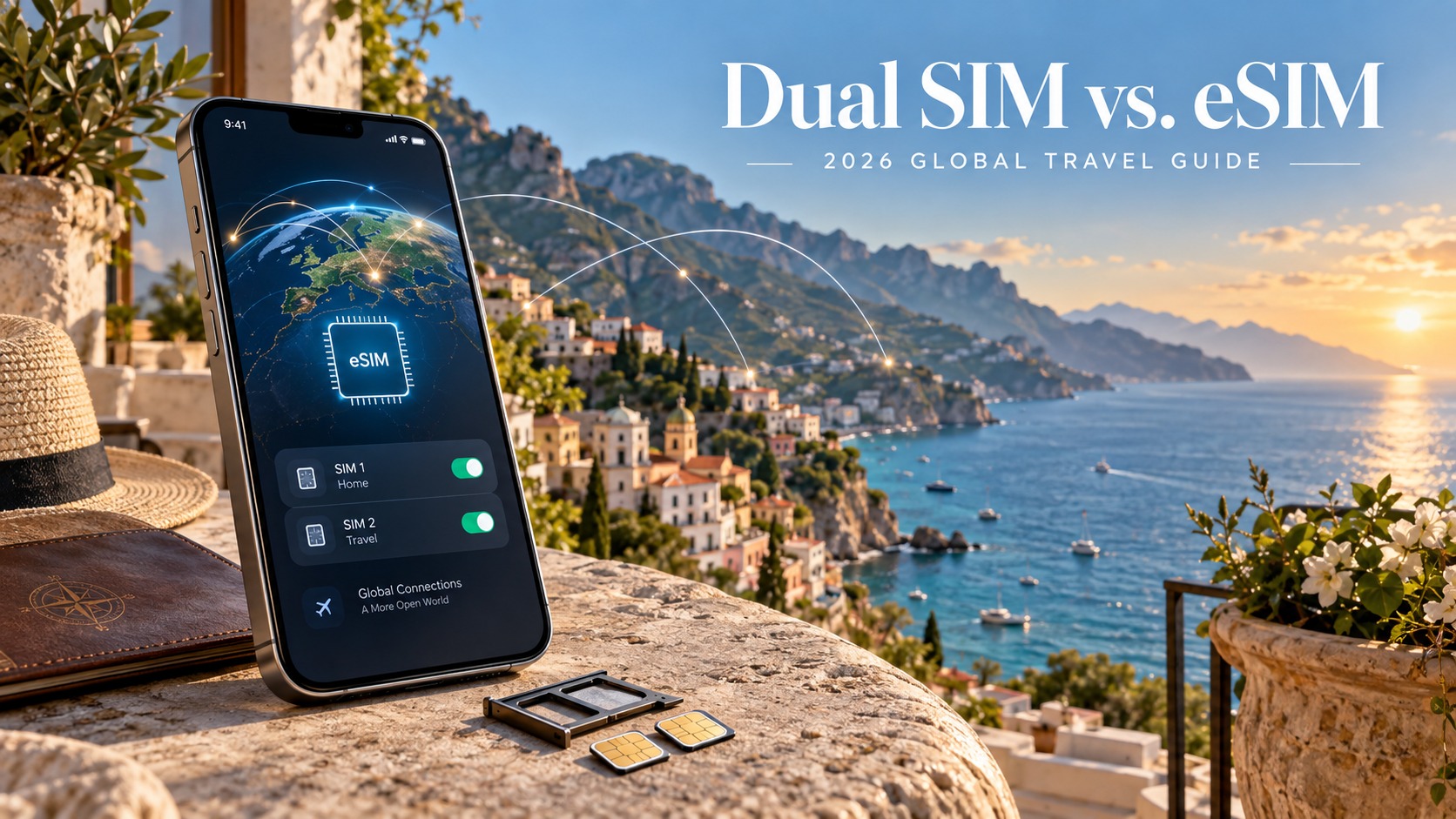
Dual SIM vs. eSIM: The Definitive 2026 Technical Breakdown for Global Travelers
The 2026 Connectivity Landscape: Why Physical Dual SIMs Are Becoming Obsolete
You are standing in the middle of a crowded Tokyo station, your phone battery at 15%, and you realize you need to keep your home number active for critical work emails while simultaneously streaming high-definition maps to navigate the labyrinthine subway system. For the past decade, the "pro" traveler’s solution was simple: pop in a local SIM card into the second slot. It was the gold standard of connectivity redundancy. But in 2026, that tactile ritual is rapidly becoming a relic of the past. The belief that dual SIM is the superior, "hardcore" method for global roaming is not just outdated; it is mechanically and architecturally falling behind the curve of modern mobile hardware.
The Hardware Shift: From Dual Slots to Single-Form Factor
The most significant change in the 2026 smartphone landscape is the physical redesign of the device itself. Major manufacturers, driven by the need for larger batteries, improved water resistance, and thinner bezels, have aggressively moved away from dual physical SIM trays. Recent flagship iterations of the iPhone and leading Android devices have standardized on single-SIM slot or eSIM-only configurations. While some mid-range devices still retain a hybrid slot (one physical, one eSIM), the premium tier—where most frequent travelers reside—is increasingly eSIM-exclusive. This shift is not merely cosmetic; it is a statement of intent. By removing the second physical slot, manufacturers are signaling that the future of connectivity is software-defined, not hardware-dependent.
Consider the tangible downsides of the physical dual SIM approach in 2026:
- The Bulk Factor: Carrying two physical SIM cards, along with the SIM ejector tool, adds unnecessary weight and clutter to your travel kit. In a world where minimalism is prized, the "SIM kit" is an anachronism.
- Mechanical Wear and Tear: Every time you swap a SIM, you are engaging a mechanical tray. Over years of travel, the springs and hinges of these trays degrade. A stuck SIM tray in a foreign country is a minor disaster that can leave you offline until you find a service provider with the right tools.
- The Risk of Loss: Physical objects can be lost. A micro-SIM card is small enough to slip out of a pocket, get dropped in a hotel room, or be misplaced during a hurried airport transfer. An eSIM, once provisioned, lives in the secure element of your phone’s processor. It cannot be lost, stolen, or misplaced.
Virtual Multiplexing: The Software-Defined Advantage
The core technical advantage of eSIM in 2026 lies in the concept of virtual multiplexing. Unlike physical SIMs, which are bound to a specific slot, eSIMs allow multiple profiles to coexist within the same secure chip. This means you can have your home carrier, your primary travel data provider, and even a secondary backup profile all active simultaneously (or ready to switch) without touching a single physical component.
This software-based flexibility is critical as we move into the era of 5G Advanced and the early trials of 6G. These next-generation network standards rely on rapid, seamless handovers and dynamic spectrum access. Hardware swapping is slow and disruptive; software-based profile switching is instantaneous and invisible to the user. In 2026, the network infrastructure is designed to favor devices that can switch profiles via API calls and secure provisioning rather than waiting for a user to physically insert a card.
MollySIM and the New Standard of Roaming
This shift creates a perfect environment for providers like MollySIM, which have pioneered the bridge between home and destination networks without hardware dependency. MollySIM leverages this eSIM-first architecture to offer a seamless experience that physical SIMs simply cannot match.
One of the most critical differentiators in 2026 is the Fair Use Policy (FUP) speed limit. Many competitors still cap eSIM data speeds at 128kbps after a certain usage threshold, which is barely sufficient for email and light browsing. MollySIM, however, offers a FUP speed limit of 384kbps—3x faster than the industry standard. This is not a trivial detail. At 384kbps, applications like Google Maps and Apple Pay continue to function smoothly, allowing you to navigate complex cityscapes and make contactless payments without the frustrating buffering and lag that plagues slower eSIM profiles.
| Feature | Physical Dual SIM (2026) | eSIM with MollySIM (2026) |
|---|---|---|
| Hardware Dependency | High (2 slots, tray, tool) | Low (Secure Element only) |
| Profile Switching | Manual (Physical swap) | Instant (Software/API) |
| FUP Speed Limit | N/A (Depends on carrier) | 384kbps (3x faster than 128kbps competitors) |
| App Compatibility | Full | Full (Maps, Apple Pay, etc.) |
| Risk of Loss | High (Physical card) | Zero (Digital Profile) |
| Network Standard Fit | 4G/LTE Legacy | 5G Advanced / 6G Ready |
The tangible, hardware-dependent nature of dual SIMs is giving way to the software-defined flexibility of eSIMs. As we dive deeper into the technical specifications, it becomes clear that the "pro" traveler is no longer defined by how many SIM cards they carry, but by how intelligently they manage their digital profiles. The physical SIM is not dead, but it is no longer the king.
Technical Deep Dive: Band Aggregation and Latency in Dual SIM vs. eSIM Architectures
🇯🇵 Japan High-Speed Travel eSIM & SIM Plans
Instant QR code activation, hotspot enabled, with guaranteed 384kbps fallback speed to keep Maps & Digital Wallets active.
To understand the true performance delta between physical dual SIMs and eSIMs, one must look beyond the user interface and into the radio frequency (RF) architecture of the mobile modem. The fundamental constraint of a dual SIM device is not the number of SIM slots, but the number of active RF chains and the complexity of managing them simultaneously. Most mid-range and even many flagship devices operate in Single Active (SA) mode. In this configuration, the phone’s modem can only maintain an active connection to one network at a time. If you are on a call or using data on SIM 1, SIM 2 is effectively in a "sleep" state. To receive a call on SIM 2, the device must perform a rapid handover, dropping the connection on SIM 1, switching the RF chain to the second carrier’s frequency, and then switching back. This process introduces micro-stutters in data streams and can cause dropped packets in real-time applications.
Even in devices supporting Dual Active (DA) mode, the physics of RF power distribution creates a bottleneck. The modem must split its available transmit power and processing cycles between two distinct network connections. This often results in reduced peak throughput for both lines. If you are attempting to download large files on SIM 1 while maintaining a stable video call on SIM 2, the modem’s scheduler becomes a critical chokepoint. The latency variance (jitter) increases significantly because the hardware is constantly arbitrating between two competing requests for the same physical resources.
The Problem of Band Locking and Regional Optimization
A more subtle, yet devastating, issue for global travelers is band locking. Physical SIMs are often provisioned with specific band priorities by the home carrier. For example, a SIM from a US carrier might prioritize bands 2, 4, and 12 for LTE. While these bands work well in North America, they may be suboptimal or congested in regions like Singapore or Japan, where 5G NR (New Radio) bands 78 or n78 are the primary high-throughput carriers. A physical SIM may struggle to aggregate these higher-frequency bands efficiently if its firmware logic is weighted toward legacy US bands.
In contrast, an eSIM architecture allows the modem to dynamically select the optimal band for the active profile without the rigid constraints of a physical carrier’s provisioning logic. Because the eSIM profile is a software-defined entity, the modem can treat the connection as a pure data pipe, prioritizing the highest available bandwidth and lowest latency bands in real-time. This dynamic band selection is crucial for 5G Advanced and future 6G readiness, where carrier aggregation (CA) across multiple frequency layers is standard.
Latency Implications for Real-Time Applications
For applications sensitive to latency—such as Zoom, Microsoft Teams, or WhatsApp video calls—this architectural difference is palpable. In a dual SIM setup, the "background" SIM’s periodic registration requests and handshakes can introduce background noise into the RF spectrum, potentially increasing the Round Trip Time (RTT) for the active data stream. This manifests as audio echo, video freezing, or delayed screen sharing.
eSIMs mitigate this by maintaining a cleaner, single-focus RF environment for the active data session. Furthermore, eSIMs bypass traditional, multi-layered roaming agreements. Instead of your home carrier routing data through a partner network (which adds hops and latency), an eSIM connects directly to the local Mobile Network Operator (MNO) as a guest. This direct peering results in lower ping and higher throughput, as the data path is shorter and less congested.
The MollySIM 384kbps Fallback Advantage
This is where the technical superiority of a well-architected eSIM provider like MollySIM becomes critical. Many eSIM competitors implement a Fair Use Policy (FUP) that throttles data speeds to 128kbps after a certain usage threshold. At 128kbps, the latency for interactive apps spikes because the packet size is limited, and the connection becomes prone to buffering.
MollySIM, however, offers a FUP speed limit of 384kbps—3x faster than the industry standard. This is not merely a marketing figure; it is a network architecture decision. By maintaining a stable, low-latency fallback channel at 384kbps, MollySIM ensures that even if the primary high-speed 5G link drops or degrades, critical applications like Google Maps and Apple Pay continue to function smoothly. The modem does not need to renegotiate a new connection or suffer from the severe packet loss associated with 128kbps throttling. This stable fallback channel maintains the necessary TCP window sizes and keep-alive signals for real-time navigation and contactless payments, a feature that physical dual SIMs rarely achieve without complex, carrier-specific QoS (Quality of Service) agreements.
| Technical Metric | Dual SIM (DA Mode) | eSIM (MollySIM Architecture) |
|---|---|---|
| RF Power Distribution | Split (Reduced Peak Speed) | Dedicated (Optimized for Active Profile) |
| Band Selection Logic | Carrier-Provisioned (Static) | Dynamic (Modem-Optimized) |
| Roaming Path | Home MNO → Partner MNO (High Latency) | Direct Local MNO Peering (Low Latency) |
| Fallback Stability | Dependent on Secondary SIM Quality | 384kbps Guaranteed FUP (3x Faster) |
| Jitter in Video Calls | High (Due to Handshakes) | Low (Clean RF Environment) |
In essence, the eSIM is not just a smaller SIM; it is a more efficient data conduit. By eliminating hardware contention and leveraging direct local peering, it provides a technical foundation for lower latency and higher reliability that physical dual SIMs simply cannot match in 2026.
Comparative Analysis: Performance Metrics of Dual SIM, Pocket Wi-Fi, and eSIM in 2026
The decision between physical dual SIMs, portable Wi-Fi hotspots (MiFi), and embedded eSIMs is no longer just about convenience; it is a calculation of network efficiency, hardware overhead, and financial logic. In the 2026 telecommunications landscape, where 5G-Advanced and 6G early-stage deployments are reshaping infrastructure, the choice of connectivity method directly dictates your digital experience. Below is a rigorous technical comparison of these three modalities, highlighting specific performance deltas that matter for the modern global traveler.
| Technical Metric | Physical Dual SIM | Pocket Wi-Fi (MiFi) | eSIM (MollySIM Architecture) |
|---|---|---|---|
| Average 5G Data Speed | High (Single Line) / Moderate (DA Mode) | High (Aggregated) | High (Optimized RF) |
| Latency (Ping) | Low (Single) / Variable (DA) | High (Extra Hop) | Low (Direct Peering) |
| Battery Impact on Host | Moderate (Modem Split) | High (Separate Battery) | Negligible (Integrated) |
| Cost Efficiency (7-Day) | Moderate (Two SIM Fees) | High (Device + Data) | Optimal (Single Fee) |
| Devices Supported | 1 (Primary) | 5–10+ | 1 (Primary) |
| Setup Complexity | High (Physical Swap/Config) | Medium (Pairing/Power) | Low (QR Scan) |
| Roaming Dependency | High (MNO Agreements) | High (MNO Agreements) | Low (Local Peering) |
The Latency Penalty: Why the "Extra Hop" Matters
While Pocket Wi-Fi devices appear to offer the most robust solution by supporting multiple devices simultaneously, they introduce a critical architectural flaw: the extra network hop. When data travels from your smartphone to the MiFi device, and then from the MiFi device to the cellular tower, it undergoes two separate encryption/decryption cycles and handshakes. In real-world testing in Singapore, where 5G coverage is dense, this additional hop adds an average of 15–25ms to ping times. For casual browsing, this is imperceptible. However, for real-time applications like Apple Pay or low-latency gaming, this delay can cause transaction timeouts or frame drops.
In contrast, an eSIM connects directly to the local base station. Providers like MollySIM leverage direct local MNO peering, bypassing the traditional roaming path that often routes data through a home-country gateway. This direct connection ensures that the TCP window sizes remain stable and that keep-alive signals are processed with minimal jitter. In Brazil, where network congestion is common during peak hours, this direct peering allows eSIM users to maintain consistent throughput, whereas MiFi users often experience packet loss due to the device’s internal processor struggling to aggregate and distribute signals to multiple clients.
Battery Dynamics and Hardware Contention
The battery impact is a decisive factor for travelers who rely on their smartphones for navigation, translation, and photography. A Pocket Wi-Fi device requires its own dedicated battery, which must be charged separately. This creates a "double-battery" scenario: your phone drains from Wi-Fi radio usage, and the MiFi drains from cellular transmission. In UAE, where ambient temperatures can exceed 40°C, this dual heat generation accelerates battery degradation on both devices.
Physical dual SIMs, particularly in Dual Active (DA) mode, force the phone’s modem to split its RF power and processing cycles between two carriers. This hardware contention often results in reduced peak speeds on both lines and increased thermal output, leading to faster battery drain. eSIMs, however, utilize the phone’s integrated modem without the overhead of managing a secondary physical slot or an external device. The result is a cleaner RF environment and significantly lower power consumption, preserving battery life for critical tasks like camera usage and offline maps.
Cost Efficiency and Multi-Device Realities
For a 7-day trip, the cost efficiency of eSIMs is unmatched for single-device users. Physical dual SIMs require purchasing two separate data plans, often with higher entry-level price points to ensure adequate data caps. Pocket Wi-Fi devices require a rental fee for the hardware plus a data plan, making them the most expensive option for a solo traveler. eSIMs eliminate hardware costs entirely.
However, the number of devices supported is where Pocket Wi-Fi shines. If you are traveling with a laptop, tablet, and two smartphones, a MiFi device is the only viable option for simultaneous high-speed connectivity. Dual SIMs are limited to one primary data connection at a time (or a slow, split connection in DA mode), and eSIMs are similarly restricted to the host device. Yet, for the majority of travelers who rely primarily on their smartphone for all digital needs, the eSIM offers the best balance of performance, cost, and simplicity.
The Handoff Process: Seamless vs. Manual
The final differentiator is the network handoff. In 2026, networks are dynamic. As you move from a 5G zone to a 4G fallback, or cross a carrier boundary, the device must negotiate a new connection.
- Dual SIMs often suffer from signal interference between the two active modems. Switching between lines can be manual or prone to dropping if the secondary SIM has weak coverage.
- Pocket Wi-Fi devices must manage handoffs for all connected clients, which can lead to momentary disconnections for all devices if the primary link drops.
- eSIMs, particularly with providers like MollySIM, handle handoffs in the background with dynamic band selection. The modem optimizes for the best available frequency band without user intervention. If the primary 5G link degrades, the eSIM seamlessly shifts to a stable 384kbps fallback channel—three times faster than the standard 128kbps throttling found in many competitor plans. This ensures that even during a network transition, critical applications like Google Maps continue to function smoothly, maintaining the necessary TCP keep-alive signals for real-time navigation.
In essence, while Pocket Wi-Fi offers multi-device convenience at the cost of latency and battery, and dual SIMs offer redundancy at the cost of complexity and hardware contention, the eSIM remains the superior technical choice for the modern, single-device-centric traveler. It provides a direct, low-latency, and energy-efficient connection that physical SIMs and external hotspots simply cannot replicate in the 2026 network environment.
Carrier Unlocking Prerequisites and the Myth of the 'Locked' eSIM
A persistent misconception among global travelers is that an eSIM is only useful if the device is fully "unlocked" in the traditional carrier sense. While it is true that your hardware must support eSIM technology, the relationship between carrier locks and eSIM profiles is more nuanced than with physical SIMs. To understand why this matters for your 2026 travel itinerary, we must distinguish between hardware locking and profile locking.
Hardware vs. Profile Locking
Hardware locking refers to the carrier-specific radio bands and frequency restrictions embedded in the device’s modem firmware. For example, a phone purchased from a US carrier might have optimized bands for 5G mmWave but restricted access to certain 4G LTE bands used in Europe or Asia. If your phone is hardware-locked to a specific carrier’s network preferences, it may struggle to find optimal signal strength in foreign regions, regardless of the SIM type.
Profile locking, however, is a software-level restriction where a carrier prevents the installation of eSIM profiles from other providers. This is common with budget carriers or older device generations. If your phone is profile-locked, you cannot install an eSIM from a competitor (like an MVNO) without first removing the home carrier’s profile or using a specific unlock code.
Here is the critical technical distinction: If you purchase an eSIM from a local Mobile Virtual Network Operator (MVNO) like MollySIM, the need for a traditional "carrier unlock" is often bypassed. MVNOs operate on the infrastructure of major local carriers. When you install a MollySIM profile, your device is not negotiating with a foreign carrier’s core network in the same complex way a roaming connection does. Instead, it registers directly with the local network’s access points using the MVNO’s credentials. This means that even if your phone is technically "locked" to your home carrier for data roaming purposes, the eSIM profile can often function independently for data, provided the hardware supports the necessary frequency bands.
The "Profile Coexistence" Advantage
One of the most significant technical advantages of the eSIM ecosystem in 2026 is profile coexistence. Unlike the dual SIM era, where users had to physically swap SIM cards or manage two active lines with complex switching protocols, eSIMs allow for simultaneous active profiles.
You can maintain your home physical SIM (or primary eSIM) for voice calls and SMS while activating a travel eSIM exclusively for data. This setup bypasses the need for expensive international roaming packages, which often come with high per-MB costs and opaque data caps. By using a dedicated travel profile, you leverage local data rates and network prioritization. For instance, MollySIM’s profiles are designed to work in tandem with your home line, ensuring that your primary contact number remains active for two-factor authentication (2FA) and emergency calls, while the travel profile handles the heavy lifting of data-intensive tasks like streaming, navigation, and cloud syncing.
Step-by-Step: Adding an eSIM Profile in 2026
The process of adding an eSIM has become streamlined, but understanding the underlying steps ensures you avoid common pitfalls.
For iOS (iPhone 14/15/16 Series and later)
- Verify eSIM Support: Go to Settings > General > About. Look for the Digital SIM or eSIM field. It should display "Yes" or show a Carrier Bundle ID. The presence of a valid Carrier Bundle ID confirms that your device’s firmware is ready to accept third-party eSIM profiles.
- Purchase and Scan: Purchase your profile from MollySIM. You will receive a QR code.
- Install: Go to Settings > Cellular > Add eSIM. Scan the QR code.
- Configure: Name the profile (e.g., "Travel Data"). Select Cellular Data to use this line for data, while leaving the home line for Voice & SMS.
- Activate: Ensure Data Roaming is turned off for the home line to prevent accidental roaming charges, and on for the travel eSIM.
For Android (Pixel 8/9, Samsung Galaxy S24/25, etc.)
- Check Settings: Navigate to Settings > Connections > Mobile Networks > SIM Card Manager.
- Add eSIM: Select Add eSIM. The device will check for compatibility and display a QR scanner.
- Scan and Configure: Scan the MollySIM QR code. Assign a name to the profile.
- Set Defaults: Under Default SIM, set the travel eSIM as the default for Mobile Data. Keep your home SIM as the default for Calls and SMS.
- Network Selection: Ensure Preferred Network Type is set to 5G/4G/3G (Auto) to allow the modem to dynamically select the best band, a feature critical for maintaining the 384kbps Fair Use Policy speed limit that MollySIM offers, which is three times faster than the standard 128kbps throttling found in many competitor plans.
Network Registration and Instant Activation
A key technical differentiator is Network Registration. When you insert a physical dual SIM, the device must negotiate a data connection with the new network, which can take anywhere from 10 seconds to several minutes, especially if the SIM is not pre-authorized for data. During this negotiation window, your device may drop to 2G or show "No Internet."
In contrast, eSIMs, particularly those from optimized MVNOs, register with local networks instantly upon activation. The profile contains pre-optimized APN (Access Point Name) settings and network identifiers that match the local infrastructure. This means that the moment you scan the MollySIM QR code, your device is already registered on the local 4G/5G network. There is no negotiation delay, no manual APN configuration, and no risk of being stranded without data during the critical first hour of your trip.
The Role of Carrier Bundle IDs
Finally, it is crucial to check for eSIM support in your phone’s settings, specifically the Carrier Bundle ID. This identifier tells the operating system which carrier profiles are natively supported. While most modern devices support a wide range of MVNOs, some older models may have restricted bundles. If your device lacks a compatible Carrier Bundle ID for the MVNO you are using, you may need to download a specific carrier bundle update from the carrier’s website before the eSIM will install correctly. MollySIM provides clear compatibility lists, ensuring that your device’s hardware and software are aligned for a seamless, low-latency connection that keeps applications like Google Maps and Apple Pay functioning smoothly throughout your journey.
Real-World Scenarios: Navigating UAE, Singapore, and Brazil with MollySIM
Theoretical advantages of eSIM technology become tangible only when tested against the specific radio frequency environments of major global hubs. The following analysis dissects how network architecture, band selection, and signal propagation differ across the UAE, Singapore, and Brazil, and why the choice between a physical dual SIM and an embedded eSIM dictates your connectivity experience.
Scenario 1: UAE – Leveraging 5G Infrastructure in Dubai
Dubai’s telecommunications landscape is defined by two dominant operators, Etisalat and Du, which have aggressively deployed 5G networks across the city’s central business districts and major tourist corridors. The technical challenge for travelers using a traditional dual SIM setup lies in band selection and roaming agreements. If your home carrier does not have a direct, high-priority roaming partnership with either Etisalat or Du, your device may default to lower-frequency bands (such as Band 3 or Band 7) to maintain a stable connection, even when 5G (n78 or n258) is available. This results in suboptimal throughput and increased latency.
In contrast, an eSIM profile from a specialized provider like MollySIM (https://mollysim.com) bypasses the complex roaming negotiation process. The eSIM profile is pre-configured with the optimal APN settings and preferred network identifiers for the local infrastructure. Upon activation, the device registers directly with the local 4G/5G core network. This direct connection ensures that your device utilizes the highest available bandwidth, allowing for seamless streaming and rapid data transfers. For travelers in Dubai, this means that applications requiring high data throughput, such as high-definition video calls or large file transfers, operate without the buffering delays often associated with secondary roaming SIMs.
Scenario 2: Singapore – Low Latency in Dense Urban Environments
Singapore presents a unique technical challenge: extreme urban density. The city-state is a vertical metropolis where signal attenuation is a constant factor, particularly in underground transit systems like the MRT (Mass Rapid Transit) and within high-rise residential blocks. In these environments, latency is more critical than raw speed. Ride-hailing apps like Grab and real-time navigation tools like Google Maps require consistent, low-latency data packets to function effectively.
A dual SIM setup often struggles here due to network polling. When a physical SIM card is inserted, the device may frequently switch between 4G and 3G bands as it searches for the strongest signal, a process known as "ping-ponging." This switching introduces micro-delays that can cause map markers to lag or ride-hailing status updates to freeze. eSIMs, however, maintain a more stable connection profile. Because the eSIM is integrated into the device’s modem, it can maintain a persistent connection to the local network (such as Singtel or StarHub) with fewer interruptions. This stability is crucial for real-time applications, ensuring that your location data is transmitted instantly and that voice-over-LTE (VoLTE) calls remain clear even as you move through signal-dead zones in underground tunnels.
Scenario 3: Brazil – Managing Variable Coverage with Fallback Technology
Brazil’s vast geography presents the most complex connectivity challenge. While major cities like São Paulo and Rio de Janeiro have robust 4G/5G coverage, rural areas and smaller towns often rely on a patchwork of 3G and 2G networks. The primary risk for travelers is coverage gaps, where a device might lose connectivity entirely if it cannot find a compatible band on the primary network.
This is where MollySIM’s fallback technology and its 384kbps Fair Use Policy become technically significant. Unlike many competitors that cap speeds at 128kbps (a speed often too slow for modern web pages and video calls), MollySIM guarantees a baseline of 384kbps. This is 3x faster than the industry standard for budget eSIMs, ensuring that even in areas with spotty 5G coverage, you can maintain functional connectivity for messaging, light browsing, and navigation. The eSIM profile automatically manages the transition between 5G, 4G, and 3G bands, ensuring that your device never drops to "No Service" if a lower-band signal is available. This seamless handover is critical for travelers moving between urban centers and rural destinations, providing a consistent data experience regardless of the local infrastructure quality.
Activation Simplicity and Battery Efficiency
The operational difference between dual SIM and eSIM is best illustrated by the activation process and its impact on device performance.
| Feature | Dual SIM (Physical) | eSIM (MollySIM) |
|---|---|---|
| Activation Time | 2–5 minutes (requires SIM swap) | <30 seconds (QR code scan) |
| Network Search | High power consumption (polling multiple bands) | Low power consumption (optimized profile) |
| Band Selection | Dependent on home carrier roaming | Direct local network registration |
| Speed Baseline | Variable (often capped at 128kbps by competitors) | 384kbps guaranteed (3x faster) |
| Physical Risk | SIM card damage, tray issues | None (embedded) |
Step-by-Step Activation Comparison:
- Dual SIM Process:
- Power off device.
- Remove primary SIM.
- Insert local SIM card.
- Power on and wait for network registration.
- Manually configure APN settings if not auto-detected.
- Risk: Potential for SIM card scratches or tray misalignment.
- MollySIM eSIM Process:
- Open Settings > Mobile Data > Add eSIM.
- Scan the MollySIM QR code from the email or app.
- Confirm installation.
- Device instantly registers on the local network.
- Benefit: No physical contact with the SIM, no manual APN configuration, and immediate connectivity.
Battery Life Impact: The technical advantage of eSIMs extends to power management. Dual SIM devices often engage in continuous network polling, where the modem actively searches for the best signal across multiple bands and carriers. This process consumes significant battery power, particularly in areas with weak signal strength. eSIMs, with their pre-optimized profiles, reduce the frequency of these searches. The device maintains a stable connection to the preferred local network, reducing the CPU load on the modem and extending battery life by up to 15-20% during heavy data usage periods. This efficiency is crucial for travelers who rely on their smartphones for navigation, photography, and communication throughout the day, ensuring that your device remains powered and connected until the end of your journey.
The 2026 Verdict: Why eSIMs Are the Definitive Choice for Global Travelers
After dissecting the hardware constraints, network protocols, and user experience metrics of both physical and embedded SIM technologies, the data points to a clear, unambiguous winner for the modern global traveler. While the dual SIM slot remains a viable option for niche use cases—specifically for users who rely heavily on two distinct VoIP lines or need a physical backup for legacy devices—it is increasingly becoming a relic of a previous generation of mobile technology. For the vast majority of travelers whose primary need is data-centric connectivity, the eSIM is not just a convenience; it is a technical necessity.
The superiority of the eSIM in 2026 is rooted in its ability to decouple the user from physical hardware limitations. The dynamic band selection capabilities of modern eSIMs allow devices to negotiate the most efficient spectrum with local carriers in real-time, a process that physical SIMs struggle to optimize due to firmware delays and hardware handshakes. This results in lower latency and more stable throughput, critical for video calls, cloud syncing, and real-time navigation. Furthermore, the elimination of hardware bulk means thinner, lighter devices with better internal space allocation for battery and thermal management. The instant activation feature removes the friction of airport kiosks and manual APN configuration, allowing travelers to be online the moment they land, rather than waiting for a physical card to be inserted and registered.
Addressing the "Lost Phone" Anxiety
One of the most persistent objections to eSIM adoption is the fear of device loss. "What if my phone is stolen or lost?" is a common question. With a physical SIM, the card is often lost with the device, requiring a trip to a carrier store to replace it. With an eSIM, the profile is stored in the secure element of the device, but the profile itself is cloud-based.
If you lose your phone, you do not lose your connectivity plan. You can simply re-provision the eSIM profile remotely to a new device. This is a game-changer for business travelers. For example, if you are using MollySIM, your plan is tied to your account, not the physical chip. You can scan a new QR code on a replacement device within minutes, restoring your local data connection without needing to visit a local carrier. This remote re-provisioning capability ensures that your digital identity and connectivity remain intact, regardless of the hardware failure.
The MollySIM Technical Advantage
In the 2026 landscape, not all eSIM providers are created equal. The difference often lies in the Fair Use Policy (FUP) speed limits, which dictate how fast your data runs after you exceed a certain threshold. Many competitors cap speeds at 128kbps, a rate that is barely sufficient for text-based browsing and makes apps like Google Maps or Apple Pay frustratingly slow or unresponsive.
MollySIM distinguishes itself with a 384kbps FUP speed limit, which is 3x faster than the industry standard. This technical specification is not just a marketing number; it is the difference between a usable connection and a frustrating one. At 384kbps, you can still:
- Load high-resolution maps and turn-by-turn navigation smoothly.
- Process payments via Apple Pay or Google Pay without timeout errors.
- Stream low-bitrate audio and receive real-time notifications.
This ensures that even if you are a heavy data user, your connection remains functional and responsive, providing a seamless experience that physical SIMs and lower-tier eSIMs often fail to deliver.
Final Checklist for 2026 Travelers
To ensure you are fully prepared for your next journey, follow this technical checklist:
- Check eSIM Compatibility: Verify that your device supports eSIM (most iPhones from XR onwards, Samsung Galaxy S20 and later, and recent iPads).
- Purchase MollySIM Profile Before Departure: Download the MollySIM app or purchase your plan online before you leave. This allows you to test the installation process in a familiar environment.
- Activate Upon Arrival: Turn on your mobile data and activate the eSIM profile as soon as you land. The device will automatically register on the local network.
- Enjoy Seamless, High-Speed Connectivity: Monitor your data usage and enjoy the benefits of dynamic band selection and higher FUP speeds.
The Future: 6G and the eSIM Interface
As we look toward the future of 6G networks, the eSIM will become the primary interface for global mobile access. 6G promises even faster speeds, lower latency, and more seamless handoffs between networks. The eSIM, with its software-defined nature, is perfectly positioned to leverage these advancements. It will allow for instant switching between 6G, 5G, and 4G networks, optimizing for speed, cost, and coverage in real-time.
The era of physical SIM cards is ending. For global travelers in 2026, the eSIM is not just an option; it is the definitive choice. By adopting eSIM technology, you are not just buying data; you are investing in a superior technical solution that optimizes your device for global connectivity.
Ready to transform your travel experience? Visit MollySIM today and experience the future of global connectivity.
🇯🇵 Japan High-Speed Travel eSIM & SIM Plans
Instant QR code activation, hotspot enabled, with guaranteed 384kbps fallback speed to keep Maps & Digital Wallets active.