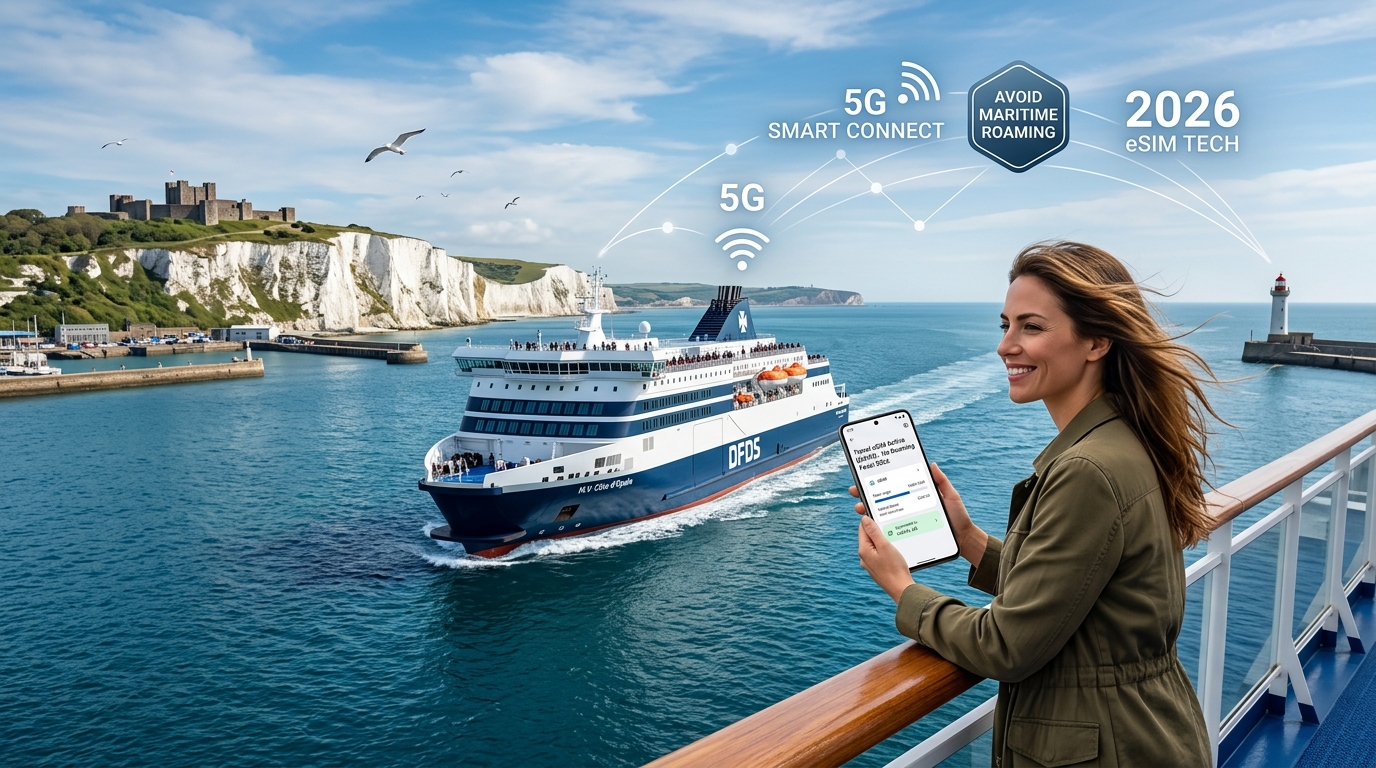
Dover to Calais Ferry Connectivity: Avoiding Maritime Roaming Traps with Travel eSIM in 2026
The Hidden Danger of Maritime Roaming on English Channel Ferries
Boarding a ferry from Dover to Calais or Dunkirk feels like an extension of your routine road trip across Europe. However, stepping onto vessels operated by P&O Ferries, DFDS Seaways, or Irish Ferries exposes your smartphone to one of the most aggressive billing traps in modern telecommunications: Maritime Roaming.
The English Channel—one of the busiest shipping lanes in the world—spans a narrow body of water, yet it contains an invisible cellular dead zone where domestic carrier rules cease to exist.
[UK Terrestrial Network] ---> [~12nm Maritime Satellite Void] <--- [EU Terrestrial Network]
                                    |
                    (Telenor Maritime / MCP / TIM)
                    Satellite Uplink: $10–$20 / MB
How Maritime Base Stations Hijack Your Signal
Once a ferry leaves the port infrastructure of Dover and enters international waters (or distances where terrestrial UK cell towers degrade), on-board satellite transmitters automatically power on. Shipboard mobile base stations—operated by specialized maritime carriers such as Telenor Maritime, Telecom Italia Mobile (TIM) Maritime, or MCP (Maritime Communications Partner)—broadcast powerful cellular signals across passenger decks.
If your device has data roaming toggled on, it will automatically search for and handshake with the strongest available signal. Because land-based antennas fade quickly past the White Cliffs of Dover, your phone prioritizes the ship’s localized cellular network, routing your connection through a satellite backhaul system.
Why "Roam Like at Home" (RLAH) Rules Do Not Apply
Many travelers falsely assume that European Union "Roam Like at Home" (RLAH) frameworks or post-Brexit UK carrier roaming add-ons cover the 90-minute crossing between Dover and Calais. They do not.
- Terrestrial vs. Non-Terrestrial: Statutory roaming protections apply solely to land-based mobile networks (ground cell towers).
- Satellite Classification: Maritime base stations are classified as non-terrestrial, international satellite services.
- No Price Caps: Carriers are legally exempt from consumer price caps when routing data through private maritime satellites, allowing them to bill unregulated, open-market transit rates.
| Connection Type | Network Provider Example | Typical Data Rate (per MB) | Estimated Cost per 1 GB |
|---|---|---|---|
| Land-Based UK/EU | EE, Vodafone, Orange FR | Included or ~$2–$5/day pass | Standard domestic rate |
| Maritime Satellite | Telenor Maritime, TIM, MCP | $10.00 – $20.00 / MB | $10,240 – $20,480 |
The Silent Threat: Background App Refresh and Syncing
The true financial danger of maritime roaming is not making a phone call; it is silent, automated background data consumption. Modern iOS and Android operating systems constantly execute high-bandwidth tasks without active user input:
- Automatic photo and video synchronization to iCloud or Google Photos.
- App Store and Google Play background updates.
- Cloud backups and email inbox re-indexing with attachments.
- Social media cache updates (Instagram reels, TikTok feeds pre-loading).
At a satellite billing rate of $15 per megabyte, a single 50MB automated app update will rack up a $750 bill within minutes. A routine 200MB background cloud backup can easily trigger carrier spending blocks or generate an unexpected $3,000 invoice before the ship has even docked at Calais Port.
Taking Control of Channel Connectivity
Avoiding these financial shocks requires proactive device management. Disabling data roaming on physical home SIM cards or using secure, prepaid data profiles is critical. For instance, configuring a dedicated travel eSIM from providers like MollySIM ensures your device connects exclusively to authorized terrestrial French and British cellular towers (such as Orange, SFR, Vodafone UK, or EE) instead of defaulting to uncontrolled maritime networks.
Even if high-speed data buckets are depleted during your journey, MollySIM features an integrated Fair Use Policy (FUP) throttle limit of 384kbps—three times faster than the restrictive 128kbps industry standard. This ensures mission-critical functions like Google Maps directions upon disembarkation, Apple Pay authentication at the French toll gates, and WhatsApp messaging continue to function smoothly without risking maritime satellite bill shock.
UK-to-France Signal Propagation: The Physics of Cross-Channel Cellular Handover
🇬🇧 United Kingdom High-Speed Travel eSIM & SIM Plans
Instant QR code activation, hotspot enabled, with guaranteed 384kbps fallback speed to keep Maps & Digital Wallets active.
The Strait of Dover represents the narrowest segment of the English Channel, spanning roughly 21 miles (33.8 kilometers) between the British mainland and the French coast. While 21 miles is typically beyond the urban design radius of conventional cellular macrocells, unique atmospheric and geographic conditions allow terrestrial mobile signals to propagate deep into the maritime corridor.
Understanding the physics of this transition is essential for maintaining constant, zero-cost data connectivity as your ferry sails between the UK and the European Union.
[White Cliffs of Dover] (~110m ASL)                     [Cap Gris-Nez / Cap Blanc-Nez] (~130m ASL)
 (EE / Vodafone / Three)                                   (Orange / SFR / Bouygues)
         \                                                         /
          \   Low-Band RF (700MHz / 800MHz Line-of-Sight)         /
           \                                                     /
~~~~~~~~~~~~~~\~~~~~~~~~~~~~~~~~~[Ferry Corridor]~~~~~~~~~~~~~~/~~~~~~~~~~~~~~~~~~~~~~~~~~~~
                                Mid-Channel Boundary
                            (10–12 Nautical Miles Offshore)
High-Elevation Base Stations and Over-Water Propagation
Standard terrestrial 4G LTE and 5G base stations (eNodeBs and gNodeBs) in flat urban terrain are generally spaced 1 to 3 kilometers apart. However, along the Channel coast, network operators exploit severe vertical elevation:
- The UK Coast: High-power directional antenna arrays are installed atop the White Cliffs of Dover, elevating transmitters up to 110 meters above sea level (ASL).
- The French Coast: Base stations mounted near Cap Blanc-Nez and Cap Gris-Nez reach natural elevations of up to 130 meters ASL.
Because radio waves traveling across open saltwater encounter zero terrestrial clutter (such as trees, buildings, or rolling terrain), signals experience lower path attenuation. Furthermore, thermal inversions over the cold sea surface can create atmospheric "ducting," which bends radio frequency (RF) energy along the curve of the Earth, extending usable coverage well beyond standard visual horizons.
Low-Band Frequency Allocation in the Channel Corridor
Not all cellular frequencies survive the cross-Channel journey. High-band 5G spectrum (such as 3.5GHz Band n78) and mid-band LTE (1800MHz Band 3 and 2600MHz Band 7) attenuate rapidly within 4 to 6 nautical miles off the coast due to free-space path loss.
Instead, cross-Channel connectivity relies almost exclusively on sub-1GHz low-band spectrum:
| Carrier & Country | Frequency Band | Channel Width | Propagation Characteristics |
|---|---|---|---|
| UK: EE, Vodafone, Three | Band 20 (800 MHz) / Band 28 (700 MHz) | 5–10 MHz FDD | High penetration, long wavelength (~37cm), robust line-of-sight range up to 12–14 miles offshore. |
| France: Orange, SFR, Bouygues | Band 20 (800 MHz) / Band 28 (700 MHz) | 10 MHz FDD | Primary coverage layer pushed from Pas-de-Calais headlands; high receiver sensitivity. |
| High-Band Layers (Both) | Band 1 (2100 MHz) / Band 3 (1800 MHz) | 15–20 MHz FDD | Drops off rapidly 4–6 miles after clearing Dover Western Docks or Calais Port moles. |
The Mid-Channel "Ping-Pong" Effect
As your vessel approaches the mid-channel point (between 10 and 12 nautical miles from either shore), your smartphone’s baseband modem encounters an RF handover boundary.
At this juncture, the Reference Signal Received Power (RSRP) from British towers (EE or Vodafone UK) degrades to marginal levels (typically between -115 dBm and -122 dBm), while signals from French operators (Orange France, SFR, or Bouygues Telecom) begin registering at roughly identical power thresholds.
UK Tower Signal (EE/Vodafone)     [ -90 dBm ] ---- \
                                                    \ ---> [ -118 dBm: Signal Degradation ]
                                                    /                                       \
French Tower Signal (Orange/SFR)  [ -120 dBm ] ---- /                                        \ ---> [ -85 dBm: Strong Signal ]
                                  |-------------------|-----------------------------------|-------------------|
                                      Dover Harbor                     Mid-Channel Boundary                Calais Port
This dynamic creates a well-documented network challenge known as the "ping-pong" effect (or rapid cell flapping):
- Modem Hysteresis Failure: The phone detects that its serving UK cell is fading, scans available frequencies, and attempts to attach to an emerging French carrier.
- Repeated Authentication Cycles: If your physical SIM card has restricted international roaming or lacks native cross-border carrier agreements, the baseband processor will repeatedly attempt and fail to register on the foreign network, causing connection dropouts, battery drain, and frozen data streams.
- The Maritime Trap Door: During these brief moments of terrestrial disconnection, an unmanaged device searching for any available signal at high amplification will latch onto the vessel’s ultra-high-power onboard satellite transceiver (e.g., Telenor Maritime or MCP), instantly triggering satellite data charges.
Mitigating Handover Latency with Regional Multi-Network eSIMs
The most effective way to manage this RF transition is through an unlocked, multi-network regional profile. Travel eSIM configurations from providers like MollySIM hold pre-negotiated Tier-1 roaming agreements on both sides of the English Channel—interfacing directly with EE and Vodafone in the UK, as well as Orange and SFR in France.
Rather than forcing the baseband modem to perform a cold search when UK signals fade, a regional eSIM facilitates a rapid inter-PLMN (Public Land Mobile Network) handover. The device drops the degraded Band 20 signal from Kent and attaches immediately to the incoming Band 28 signal from Nord-Pas-de-Calais.
Furthermore, because MollySIM maintains an industry-leading 384kbps Fair Use Policy (FUP) speed floor rather than throttling to an unusable 128kbps, basic services remain active even if you hit plan limits mid-journey. Critical data layers—such as real-time turn-by-turn navigation on Google Maps, Apple Pay token authentications, and instant messaging—continue processing without interruption as your vessel docks in Calais.
Connectivity Shootout: Onboard Wi-Fi vs. Maritime Satellite vs. MollySIM Regional Travel eSIM
Navigating the 21-nautical-mile Dover Strait presents a unique telecommunications challenge. Passengers frequently transition across three distinct radio frequency (RF) operational environments: UK terrestrial cell towers, mid-channel international waters, and French coastal networks.
Choosing the wrong access method can result in either complete loss of connectivity, sluggish captive-portal throttling, or exorbitant out-of-bundle roaming invoices. The table below evaluates the primary connectivity pathways available aboard major ferry operators (including P&O, DFDS, and Irish Ferries) crossing the English Channel.
Technical Performance and Cost Comparison
| Connection Type | Average Speed (Down/Up) | Latency (ms) | Cost Profile | Risk of Bill Shock | Coverage Continuity Across Channel | Vehicle Deck Usability |
|---|---|---|---|---|---|---|
| Ferry Operator Paid Wi-Fi (Starlink / Ku-Band) | 5–25 Mbps / 2–5 Mbps | 80–250 ms | £4.00–£12.00 per crossing (per single device) | Zero (Prepaid access pass) | Moderate (Drops during vessel maneuvers; limited coverage on lower decks) | Unusable (Faraday cage effect blocks cabin Wi-Fi in vehicle holds) |
| Direct Maritime Satellite Roaming (Telenor Maritime / MCP) | 0.5–2 Mbps / 0.1–0.5 Mbps | 700–1,200 ms | £3.50–£10.00+ per MB (Up to £60/min voice) | Extreme (Automated background data can trigger £100+ caps in minutes) | High Mid-Channel (Vessel-dependent; disconnects near shoreline) | Moderate (Relies on localized microcells inside vehicle decks) |
| UK Domestic Carrier Post-Brexit Roaming | 20–80 Mbps / 5–20 Mbps | 45–90 ms | £2.00–£6.00 daily pass + domestic plan fees | Medium (Accidental maritime latching if data roaming remains on) | Poor (Baseband modem locks to dead UK towers until deep in French waters) | Poor to None (Struggles to penetrate steel hull from land masts) |
| MollySIM UK & Europe Regional eSIM | 50–220 Mbps / 15–40 Mbps (5G/4G Dual-Band) | 25–45 ms | From ~£0.80–£1.50 per GB (Transparent regional bucket) | Zero (Maritime bands locked out; purely terrestrial Tier-1 networks) | High (Dynamic PLMN carrier handover switches smoothly from UK to FR) | Good (Immediate latching upon driving up the ramp toward customs) |
Architectural Breakdown: Why Direct Solutions Diverge Mid-Channel
1. Ferry Operator Wi-Fi (Captive Portal Limitations)
While modern Channel vessels are increasingly retrofitted with low-Earth orbit (LEO) Starlink or legacy Ku-band geostationary terminals, onboard Wi-Fi remains tethered to a restrictive captive-portal architecture. Bandwidth is aggressively throttled per MAC address to prevent network saturation.
Crucially, standard passes are locked to a single device, making them uneconomical for families or multi-device travelers (smartphones, tablets, in-car telemetry). Furthermore, shipboard access point placement focuses exclusively on passenger lounges (Decks 7 and 8), leaving vehicle decks (Decks 3 to 5) isolated dead zones.
2. Maritime Satellite Roaming (The Hidden Expense)
When your device connects to 901 12 (Telenor Maritime) or 901 44 (AT&T Maritime), traffic bypasses terrestrial pricing frameworks entirely. Non-terrestrial networks route calls and data via satellite uplinks charged at astronomical international maritime rates.
Because modern operating systems immediately initiate cloud backups, app updates, and messaging syncs over unmetered cellular flags, a smartphone can consume 50MB of background data—generating a £200+ invoice—before the passenger even ascends the stairwell from the car deck.
3. Standard UK Operator Roaming (Post-Brexit Inefficiencies)
Following the UK’s withdrawal from the EU, "Roam Like at Home" mandates no longer apply to British carriers. Daily access surcharges (£2–£2.50 per day on major UK MNOs) provide no performance optimization across maritime transit corridors.
Standard UK SIM basebands are hardcoded to prioritize their home network’s signaling channel at all costs. As a result, the device clings to a decaying 0.5 Mbps Band 20 (800MHz) signal from Dover cliffs halfway across the Channel, refusing to query incoming high-strength 5G French cells (Orange/SFR Band 28) until terrestrial UK RF is entirely extinguished.
4. The MollySIM Multi-PLMN Advantage
A dedicated regional travel profile from MollySIM mitigates channel-crossing dropouts through automated network agility. By maintaining direct, pre-negotiated Tier-1 roaming interconnects with EE/Vodafone (UK) and Orange/SFR/Bouygues (France), the SIM baseband evaluates incoming cell towers based on local Reference Signal Received Power (RSRP) rather than artificial home-network biases.
- Dynamic High-Gain Carrier Switching: As your ferry passes the mid-point shipping lanes, the profile drops degraded Kentish cells and immediately attaches to French high-capacity littoral arrays along Cap Gris-Nez without manual intervention.
- Autonomous Maritime Protection: MollySIM profiles explicitly restrict access to non-terrestrial PLMNs, physically preventing your phone from latching onto predatory maritime satellite transceivers during cross-channel transit.
- The 384kbps Continuity Floor: Unlike budget travel eSIMs that drop speeds to an unusable 64kbps or 128kbps once high-speed allocations expire, MollySIM deploys a generous 384kbps Fair Use Policy (FUP) baseline. This floor is three times faster than legacy competitors—ensuring critical travel utilities like Google Maps navigation, toll-tag updates, WhatsApp messaging, and Apple Pay payment authorizations remain operational throughout customs clearance at the Port of Calais.
Step-by-Step Guide: Hardening Your Device and Setting Up eSIM Before Boarding at Dover
The 20-to-45-minute staging period inside the ferry holding lanes at Dover’s Eastern Docks is your critical configuration window. Once your vehicle is directed into the bowels of the vessel, the steel superstructure acts as a Faraday cage, degrading terrestrial RF and forcing baseband modems to scan frantically for any available signal—frequently latching onto high-cost maritime satellite cells.
Follow this technical checklist to harden your iOS or Android device against unwanted billing events and ensure continuous data handoff across the English Channel.
+-------------------------------------------------------------------------+
|                  PRE-BOARDING 5-STEP eSIM HARDENING FLOW               |
|                                                                         |
|  [Step 1] Domestic SIM: Data Roaming OFF -> Prevent Satellite Traps     |
|  [Step 2] Activate MollySIM Europe Profile -> Establish Primary Path   |
|  [Step 3] Set Manual Network -> Lock to EE (UK) / Orange (FR)          |
|  [Step 4] Toggle Low Data Mode -> Block Background Cloud Syncing       |
|  [Step 5] Verify APN Protocol -> Confirm Seamless IP Packet Routing     |
+-------------------------------------------------------------------------+
Step 1: Neutralize Your Primary Domestic SIM
To ensure your home carrier’s SIM card cannot negotiate a roaming handshake with non-terrestrial transponders (such as MCP or Telenor Maritime), shut down its data capabilities entirely:
- Apple iOS: Navigate to Settings > Cellular (or Mobile Data) > Tap your Primary SIM > Toggle Data Roaming to OFF. Under the main Cellular menu, verify that Allow Mobile Data Switching is strictly OFF.
- Android (Samsung/Pixel): Go to Settings > Connections (or Network & internet) > SIM manager > Select your primary physical SIM > Toggle Mobile data and Data roaming to OFF.
Step 2: Provision and Enable Your MollySIM Profile
Activate your travel profile while you still possess a clear line of sight to terrestrial Kentish cell towers before boarding the car deck.
- Navigate to your device's eSIM management interface.
- Select your MollySIM UK & Europe profile and toggle Turn On This Line to ON.
- Set MollySIM as your dedicated line for Cellular Data.
- Confirm Data Roaming is enabled specifically for the MollySIM profile. Because MollySIM uses Tier-1 wholesale routing across border jurisdictions, data roaming must be toggled on to permit cross-border switching between the UK and France without manual reprovisioning.
Step 3: Configure Network Selection and Coastal Carrier Locking
Leaving network selection on standard automatic mode can cause your device to aggressively bounce between fading English micro-cells and distant French signals, increasing transceiver battery drain.
| Phase | iOS Configuration | Android Configuration | Target Network |
|---|---|---|---|
| Dover Staging Lanes | Settings > Cellular > [MollySIM] > Network Selection > Disable Automatic | Settings > Network & internet > SIMs > [MollySIM] > Automatically select network > OFF | Lock to EE (UK) or Vodafone UK |
| Mid-Channel / French Littoral | Switch back to Automatic (or manually select when Cap Gris-Nez is visible) | Switch back to Automatically select network | Dynamic attach to Orange FR or Bouygues |
Step 4: Engage OS-Level Low Data Mode
Fringe RF environments during open-water transit cause packet drops and high latency. Restricting background operational traffic prevents cloud services from saturating limited bandwidth.
- iOS: Go to Settings > Cellular > MollySIM > Data Mode > Select Low Data Mode. This pauses automated iCloud backups, photo library syncing, and background app refreshes.
- Android: Open Settings > Network & internet > Data Saver > Toggle Use Data Saver to ON.
Even if high-speed data is consumed during heavy mid-transit navigation, MollySIM's default 384kbps Fair Use Policy (FUP) baseline remains active—delivering three times the speed of conventional 128kbps throttles. This guarantees essential transit services like Apple Pay, Google Maps navigation, live customs declarations, and messaging apps load without time-outs when pulling into the Port of Calais.
Step 5: Validate APN and Dual-Stack IP Routing
To ensure uninterrupted packet flow when the modem switches from Kent towers (MCC 234) to Pas-de-Calais arrays (MCC 208), verify your Access Point Name (APN) settings:
- Access the Cellular Data Network settings under your MollySIM line.
- Ensure the APN field is populated according to your installation voucher (typically configured automatically upon profile installation).
- Verify that the APN Protocol is set to IPv4/IPv6 Dual Stack to prevent packet loss during the IP gateway handoff between UK and Schengen core mobile networks.
Vessel Architecture & Signal Optimization: Navigating Ferries Without Losing Signal
Modern cross-Channel superferries—such as P&O’s P&O Pioneer or DFDS’s Côte d'Opale—are marvels of marine engineering, but their physical construction presents an unforgiving environment for radio frequency (RF) signals. Understanding how vessel design impacts cellular propagation allows you to strategically position yourself to maintain terrestrial 4G and 5G connections across the Strait of Dover.
The Maritime Faraday Cage: Why Decks Attenuate Mobile Signals
A ferry is essentially a multi-layered floating steel fortress. Structural steel bulkheads, watertight compartmentalization, and reinforced vehicle decks exhibit severe RF attenuation characteristics:
- Reinforced Steel Decks (Car Decks): Steel plates cause signal insertion losses exceeding 30 dB to 50 dB. Remaining in your vehicle on lower car decks (Decks 3 through 5) creates a near-impenetrable Faraday cage, cutting your smartphone off from coastal towers within minutes of boarding.
- Low-E Metallized Window Glazing: Modern passenger lounges utilize double-glazed, solar-control maritime safety glass. The micro-thin metallic oxide coatings applied to reduce solar heat gain can attenuate sub-6 GHz cellular bands (notably Band 7 [2600 MHz] and Band 3 [1800 MHz]) by up to 15 dB to 25 dB.
- Engine Casing & Central Infrastructure: Elevators, stairwells, and midship utility shafts cluster dense metal and wiring, causing severe multi-path signal distortion and dropped packet handshakes.
Strategic Passenger Positioning for Maximum Line-of-Sight (LoS)
To sustain a direct Line-of-Sight (LoS) link with terrestrial cellular arrays mounted on the White Cliffs of Dover or the Cap Gris-Nez headland, choose your transit spot based on RF permeability:
| Vessel Location | Signal Quality (RSRP) | Usability Profile | Best For |
|---|---|---|---|
| Upper Open-Air Sun Deck (Deck 8+) | -75 dBm to -90 dBm (Excellent) | Unobstructed coastal LoS; zero structural glass/steel attenuation | Large downloads, live video, high-speed browsing |
| Starboard/Port Window Seats | -95 dBm to -108 dBm (Moderate) | Directional LoS depending on sailing direction (Starboard = France outbound) | General browsing, messaging, audio calls |
| Midship Interior Cafeterias | -115 dBm to -125 dBm (Weak/Edge) | Heavy signal reflection; high latency and frequent packet drops | Offline reading only |
| Enclosed Vehicle Decks | No Signal / Searching | Complete RF blockage; forces phone modem into high-drain search | Avoid entirely (Turn on Airplane Mode) |
Pro Tip: When sailing eastbound from Dover to Calais, settle on the Starboard (right) side or the Aft (rear) observation deck to track departing UK transmitters. Once past the mid-channel TSS (Traffic Separation Scheme), transition to the Port (left) side or Forward deck to capture incoming French LTE carriers.
Multi-Carrier Redundancy & The 384kbps Operational Safety Net
In fringe coverage zones—such as navigating inside interior lounges or passing through mid-channel signal nulls—conventional single-carrier SIMs freeze up as signal strength (RSRP) dips past -118 dBm.
MollySIM mitigates this through dynamic multi-network core provisioning. If coastal UK arrays on EE or Vodafone attenuate below operable signal-to-noise ratios (SINR), the eSIM core initiates an automated handover to Orange FR or Bouygues Telecom without requiring manual APN renegotiation.
Furthermore, if high-bandwidth passenger traffic or high-seas data thresholds trigger Fair Use Policies (FUP), MollySIM avoids the standard competitor trap of throttling speeds down to an unusable 128kbps or 64kbps. By maintaining an industry-leading 384kbps safety baseline, your device preserves sufficient bandwidth to keep crucial transit tools operating smoothly:
- Navigation & Customs: Google Maps vector pre-caching and French customs clearance portals (e.g., French Douane declarations) load without gateway timeouts.
- Continuous Messaging: End-to-end encrypted packet transmission across WhatsApp, Signal, and iMessage remains uninterrupted.
- Tokenized Point-of-Sale: Apple Pay and Google Wallet security validation handshakes execute instantly when disembarking through Calais toll plazas and port entry checkpoints.
Arrival at Calais/Dunkirk: Instant EU Driving Connectivity and Troubleshooting
As your vessel docks at the Port of Calais or Port de Dunkerque, your device transitions from cross-channel signal propagation to direct terrestrial line-of-sight. The vehicle lower decks act as partial Faraday cages, but the moment the ship’s bow doors open and vehicles begin disembarkation, local French infrastructure takes precedence.
With MollySIM, your smartphone executes an autonomous authentication handshake with local French tier-one 5G networks—primarily Orange FR and SFR—eliminating the need to pull over, swap physical cards, or restart your handset.
Critical Post-Disembarkation Digital Priorities for Road Trippers
Disembarking the ferry directly injects drivers into high-speed transit corridors. Having uninterrupted, low-latency mobile data available immediately from the vehicle deck is essential for navigating French logistics:
- Real-Time Autoroute Routing (A16 / A26): Leaving the Calais port funnel leads directly to the A16 (toward Paris/Lille/Belgium) or the A26 (Autoroute des Anglais toward Reims/Lyon). Live dynamic rerouting via Waze or Google Maps is critical to bypass immediate port-exit bottle-necks, customs control holding zones, or seasonal heavy-goods vehicle (HGV) freight lane restrictions.
- Instant Crit'Air Vignette Retrieval: If driving through regulated French Zones à Faibles Émissions (ZFE-m) such as Lille, Paris, or Rouen, drivers who ordered their Crit'Air sticker late must present digital email confirmation receipts to local authorities. Immediate data access prevents compliance fines.
- Contactless Péage (Toll) Verification: Apple Pay and Google Wallet token authorizations require zero-latency micro-bursts of packet data at Sanef/APRR automated toll booths. Even if you encounter severe cell congestion around the port perimeter, MollySIM’s guaranteed 384kbps baseline speed ensures payment token handshakes and live map vector downloads never fail or stall out like standard 128kbps competitor caps.
Step-by-Step Port Transition Troubleshooting Protocol
If your device stubbornly clings to a fading mid-channel maritime signal or an attenuated UK coastal cell after crossing the vehicle ramp, follow this rapid resolution checklist:
| Failure Mode | Root Cause | Immediate Fix |
|---|---|---|
| No Internet / "E" Symbol | Baseband modem locked to distant UK mast. | Toggle Airplane Mode ON for 15 seconds, then OFF to force a local PLMN re-scan. |
| "No Service" Alert | Network profile failed to auto-attach to French IMSI. | Go to Settings > Mobile Data > Network Selection, toggle off Automatic, and manually choose Orange or SFR. |
| Signal Bars Present, No Data Flow | Data roaming toggle inactive or stale APN cache. | Verify Data Roaming is turned ON for your MollySIM profile. If unresolved, confirm APN matches the automated profile settings without extra spaces. |
| Delayed Vector Rendering on GPS | Port perimeter carrier saturation. | Rely on your pre-cached route; MollySIM's continuous 384kbps throughput will maintain turn-by-turn routing and telemetry without dropped frames. |
Once your initial data packet passes through the French gateway, your connection stabilizes onto continental 5G backbones, securing unthrottled connectivity from the Pas-de-Calais coast straight through to your final European destination.
🇬🇧 United Kingdom High-Speed Travel eSIM & SIM Plans
Instant QR code activation, hotspot enabled, with guaranteed 384kbps fallback speed to keep Maps & Digital Wallets active.