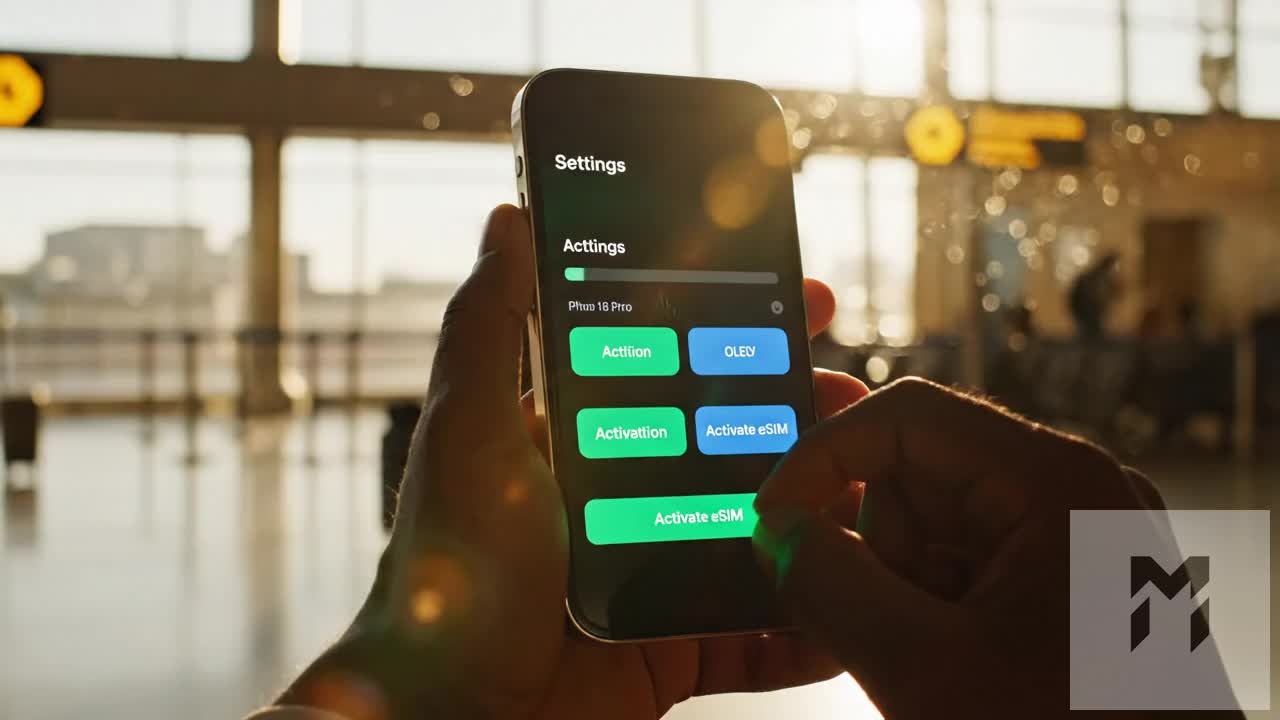
The Adriatic Highway (E65/D8) & The Non-EU Border Roaming Cliff
The Scenic Corridor: Dubrovnik Airport (DBV) to Debeli Brijeg
Departing Dubrovnik Airport (DBV) in Čilipi, the route down the Jadranska Magistrala (D8 / E65) offers one of the Mediterranean’s most breathtaking coastal drives. The asphalt snakes through the fertile Konavle valley, framed by the rugged Snježnica mountain range to the east and sheer limestone drops into the sapphire Adriatic to the west. At roughly 20 kilometers south of the terminal, the smooth, dual-lane Croatian highway narrows as it approaches the Karasovići border checkpoint.
For road-trippers navigating toward the fjord-like Bay of Kotor, this 30-minute transitional drive feels seamless. However, beneath the cinematic Mediterranean scenery lies the most punishing telecom barrier in Southern Europe: the physical border where the European Union abruptly terminates, and non-EEA territory begins.
The Regulatory Void: The Sudden Death of "Roam Like at Home"
Under European Union Regulation 2026/612, travelers holding SIM cards issued in any of the 27 EU member states (plus Iceland, Liechtenstein, and Norway) enjoy "Roam Like at Home" (RLAH) protections. While driving past Cavtat and Gruda on the Croatian side, your home data allowance functions exactly as it does in Paris, Berlin, or Rome—at zero surcharge.
The moment your vehicle crosses the demarcation line into Montenegro, that legal safety net ceases to exist.
Montenegro is an EU candidate nation, but it remains outside the European Economic Area (EEA). Consequently, major European and UK mobile operators immediately reclassify your handset’s connection from domestic zero-rate roaming to Tier 3 / Rest of the World satellite and offshore roaming zones.
| Metric / Scenario | Croatian Territory (EU/EEA) | Montenegrin Territory (Non-EU) |
|---|---|---|
| Regulatory Framework | EU RLAH (Regulation 2026/612) | Unregulated Bilateral Tariffs |
| Average Domestic Data Cost | €0.00 / Deducted from home bundle | €12.00 to €18.50 per Megabyte |
| 100 MB Background Sync | €0.00 | €1,200.00 – €1,850.00 (Subject to auto-cutoffs) |
| Primary Network Providers | HT HR, A1 Hrvatska, Telemach | One Crna Gora, Crnogorski Telekom, m:tel |
| Cross-Border Continuity | Guaranteed across EU borders | Immediate disconnect or catastrophic roaming rates |
Without an international roaming package or a dedicated regional profile, typical mobile operators bill standard data usage at eye-watering unit rates ranging from €12 to €18 per megabyte. At these prices, loading an uncompressed webpage costs upwards of €35, while a high-resolution video stream can burn through hundreds of euros in minutes.
The "No-Man's-Land" Trap: Radio Spillover and 2-Hour Border Queues
The true financial hazard rarely happens deep inside Montenegro; it catches drivers directly at the crossing points of Karasovići (Croatia) and Debeli Brijeg (Montenegro), or the coastal alternative at Kobila / Vitaljina.
During peak travel windows (June through September), clearance bottlenecks routinely stretch border crossing wait times between 90 minutes and 3 hours. As hundreds of idling vehicles creep through the neutral zone between customs posts:
- RF Bleed and Premature Handoff: Montenegrin cell towers stationed atop Mount Lovćen and the surrounding coastal ridges broadcast powerful, high-elevation cellular signals that spill 2 to 4 kilometers northward into Croatian territory. Handsets configured to Automatic Network Selection will aggressively latch onto Montenegrin networks (such as m:tel or One) while drivers are still physically queuing on the Croatian side.
- Silent Background Consumption: While you are stalled in traffic, modern smartphone operating systems continue running data-intensive background tasks: Waze recalculating queue delays, Google Maps pulling live satellite overlays, Apple Photos uploading road-trip camera rolls to iCloud, and social messaging apps pre-fetching multimedia.
- The Financial Shock: Because the device has switched to an unmetered non-EU cell tower, a single background app update of 50 MB can silently rack up over €600 in roaming fees before border officers even inspect your passport. While some carriers implement an automated €50/£45 financial safety cap, this triggers an immediate, unannounced data cutoff, stranding you without navigation precisely when entering an unfamiliar country with serpentine cliffside roads.
Eliminating the Border Shock with Seamless Multi-Network eSIMs
Navigating this transition smoothly requires a connectivity solution that spans both regulatory environments without requiring physical SIM swapping or paying astronomical non-EU roaming surcharges.
Using a multi-country travel eSIM from MollySIM allows your handset to jump from Croatian infrastructure directly onto Montenegrin tier-1 networks (Crnogorski Telekom and One) the instant you reach the border corridor, completely bypassing Tier 3 carrier pricing.
Crucially, MollySIM implements a 384kbps Fair Use Policy (FUP) speed limit on unlimited profiles. While legacy roaming solutions throttle users down to an unusable 128kbps—which causes Apple CarPlay and live GPS applications to freeze—MollySIM’s 384kbps baseline delivers 3x the standard throttling throughput. This provides uninterrupted bandwidth for turn-by-turn navigation, instant messaging, and border-side Apple Pay transactions, ensuring zero disruption as you descend from the mountains toward the waters of Kotor Bay.
Cellular Infrastructure: Croatia (HT, A1) vs. Montenegro (ONE, Telekom Crna Gora)
🇬🇧 United Kingdom High-Speed Travel eSIM & SIM Plans
Instant QR code activation, hotspot enabled, with guaranteed 384kbps fallback speed to keep Maps & Digital Wallets active.
Understanding the radio frequency (RF) ecosystem across the Dubrovnik-Kotor corridor is essential for maintaining persistent data connectivity. While the physical distance between Dubrovnik Old Town and Kotor is a modest 90 kilometers, you are traversing two distinctly different telecommunications infrastructures governed by separate regulatory regimes and spectrum allocations.
Spectrum Allocation and Carrier Landscapes
Croatia’s mobile network ecosystem is heavily developed along the southern Dalmatian coast to accommodate peak summer tourist surges. The market is dominated by Hrvatski Telekom (HT), A1 Hrvatska, and Telemach Croatia. These operators utilize a dense arrangement of LTE standard bands alongside modern 5G New Radio (NR) deployments:
- Band 20 (800 MHz): Deployed extensively across the Konavle valley and mountain passes south of Cavtat to deliver long-range coverage and deep penetration through rugged terrain.
- Band 3 (1800 MHz) & Band 7 (2600 MHz): Concentrated in urban pockets (Dubrovnik, Župa Dubrovačka) to provide capacity.
- Band n78 (3500 MHz): Powers mid-band 5G clusters around Dubrovnik’s coastal artery (D8 Highway) and Dubrovnik Airport (DBV).
Once you cross into Montenegro, the network topology transitions to three domestic operators: Crnogorski Telekom (part of the Deutsche Telekom group), ONE Crna Gora (formerly Telenor), and M:tel (Telekom Srbija group).
| Metric / Specification | Croatia (HT / A1 / Telemach) | Montenegro (ONE / Telekom / M:tel) |
|---|---|---|
| Primary LTE Bands | B20 (800 MHz), B3 (1800 MHz), B1 (2100 MHz), B7 (2600 MHz) | B20 (800 MHz), B3 (1800 MHz), B7 (2600 MHz) |
| Active 5G Deployments | Widespread Sub-6GHz (n28, n78) along the D8 corridor | Concentrated in Tivat, Kotor, Podgorica (n78/n1) |
| Regulatory Tier | EU "Roam Like at Home" (RLAH) | Non-EU Western Balkans Regional Zone (Zone 3) |
| Base Station Density | High along the Adriatic Highway (D8) | Moderate; focused on coastal settlements & ferry hubs |
Topographical Signal Attenuation in the Boka Bay Karst
The geographic profile of this drive presents severe RF engineering challenges. The highway winds beneath towering karst limestone formations of the Dinaric Alps, dropping sharply into the submerged river canyon of the Bay of Kotor (Boka Kotorska).
Limestone cliffs create significant non-line-of-sight (NLOS) shadow zones and RF reflection over open water, causing erratic handovers between cell towers across the bay. As you drive through the coastal towns of Herceg Novi, Risan, and Perast, your device will alternate rapidly between distant macro towers across the water (e.g., Luštica peninsula) and local low-power microcells tucked into narrow street canyons.
RF SIGNAL REFLECTION & SHADOWING IN BOKA KOTORSKA

  [ Mount Lovćen / Orjen ]
       /                 \
      /   Karst Shadow    \  <-- Rapid Signal Drops (Risan / Perast)
     /      Zone (NLOS)    \
    /                       \
   |  [D8 / E65 Highway]     |
  =========================================== [Bay of Kotor Water Line]
         ▲ Multipath Interference & Water Reflection
The Single-Country SIM Failure Point
A common pitfall for self-drive travelers is purchasing a local Croatian tourist SIM (such as an HT or A1 prepaid pack) at Dubrovnik Airport. While these deliver excellent performance inside Croatia, their data service terminates instantly at the Karasovići border terminal.
The moment your vehicle crosses into Montenegrin territory without a regional roaming plan, data connectivity drops completely. Drivers suddenly lose dynamic map caching on Apple CarPlay or Android Auto just as they encounter the complex, narrow intersections of Herceg Novi and the high-collision risk single-lane passages along Risan's bay-side roads.
Deploying a multi-country Adriatic eSIM from MollySIM resolves this architectural split. By provisioning active profiles on both Croatian tier-1 networks (HT/A1) and Montenegrin carriers (ONE/Telekom Crna Gora), your smartphone executes an autonomous, seamless core-network handover at the boundary line.
Furthermore, MollySIM’s generous 384kbps Fair Use Policy (FUP) speed limit—a 3x improvement over legacy 128kbps roaming throttles—guarantees that even if your high-speed bucket is fully exhausted, vector navigation tiles on Google Maps, real-time traffic updates, and border contactless payments (such as Apple Pay and Google Wallet) continue to process without interface latency or dropped sessions.
Comprehensive Cross-Border Connectivity Comparison (2026 Benchmark)
Navigating the transition from an EU-member state (Croatia) to a non-EU/non-EEA candidate country (Montenegro) exposes critical vulnerabilities in conventional connectivity setups. The following benchmark evaluates the four primary mobile data deployment strategies across the Dubrovnik–Kotor corridor.
| Technical Parameter | Home Carrier International Roaming (EU/US) | Local Croatian Physical SIM (HT/A1/Telemach) | Local Montenegrin Tourist SIM (ONE/Telekom ME) | MollySIM Balkan Multi-Destination eSIM |
|---|---|---|---|---|
| Non-EU Roaming Surcharge Risk | Extreme: $10–$15/day flat fees (US) or €5–€15/MB overage fees for standard EU plans crossing into Montenegro | High: Zero EU protections apply once crossing Karasovići; data stops or triggers tier-3 roaming rates | None inside ME: High if entering Croatia prior to setup (no pre-border connectivity) | Zero: Pre-cleared cross-border bucket covering both HR and ME with fixed, transparent pricing |
| Border Network Handover Latency | 4–12 minutes: Latency spikes during PLMN renegotiation with domestic home routing | Fails completely: Zero network attach in Montenegro without separate roaming credits | Manual swap required: Requires vehicle pullover to physically exchange nano-SIM cards | Sub-30 seconds: Autonomous eUICC profile switching between Croatian HT/A1 and Montenegrin ONE/Telekom |
| Coastal Fjord Signal Penetration | Variable: Subject to tier-3 roaming throttling on congested coastal towers | Excellent in HR; Zero in ME: Drops instantly past the border terminal | Excellent in ME; Zero in HR: No signal coverage while departing Dubrovnik Airport | Optimized: Multi-carrier fallback routes traffic via whichever local tower maintains highest RSRP levels |
| Activation Friction & ID Verification | Zero: Auto-enables on arrival (at high daily rates) | Moderate: Requires visiting a T-Centar/Tisak kiosk with physical passport registration | Moderate-to-High: Mandated passport scanning and manual SIM registration at Montenegrin kiosks | Instant: 100% digital QR code installation prior to departure; no physical passport queues |
| Average Cost per 10GB Data | $60 – $150+ via daily roaming passes | €10 – €15 (strictly limited to Croatia) | €15 – €20 (strictly limited to Montenegro) | Competitive Regional Rate (single continuous bucket for HR & ME) |
| Throttled Backup Utility (FUP) | Hard cutoff or 64–128kbps: UI elements and mapping fail to render | Hard cutoff: Data session terminated upon zero balance | Hard cutoff: High-speed bucket hard expiry | Continuous 384kbps: 3x faster than industry average; keeps live telemetry, Apple Pay, & maps functional |
Why Multi-Network eSIM Architecture Beats Physical SIM Swapping
The physical dual-SIM approach—buying a Croatian SIM at Čilipi (Dubrovnik Airport) and another at a Montenegrin Tabak shop in Herceg Novi—suffers from three operational design flaws along the Adriatic Highway:
- The Border "Blind Zone" Telemetry Loss: The no-man's-land between Croatian customs (Karasovići) and Montenegrin customs (Debeli Brijeg) stretches across several kilometers of hilly terrain. With single-country SIMs, your GPS route recalculation stalls precisely when you need to navigate lane assignments for customs clearance and border crossing queues.
- Physical Tray Mechanical Failure: Swapping nano-SIM cards inside a moving or roadside vehicle risks dropping and losing micro-hardware between car seat rails or exposing SIM trays to coastal moisture and dust.
- Bandwidth Resilience via MollySIM: Traditional roaming eSIMs throttle data to an unusable 64kbps or 128kbps once the primary data allowance is exceeded. Under 128kbps conditions, TLS cryptographic handshakes frequently time out, causing contactless border tolls, mobile banking authentication, and dynamic vector map tiles to crash. MollySIM’s built-in 384kbps Fair Use Policy (FUP) maintains continuous network integrity, preserving responsive turn-by-turn navigation and seamless mobile payments throughout the entire perimeter of the Bay of Kotor.
Coastal Dead Zones, Island Ferries, and Fjord Topography: What to Expect
The geographical transition from southern Dalmatia into the Bay of Kotor represents one of the most complex radio-frequency (RF) environments in Southern Europe. Driving down the Adriatic Highway (D8 / E65) and wrapping around the submerged river canyon of Boka Kotorska exposes your device to dramatic topographical signal shadowing, water-surface multi-path interference, and sudden cross-border cell flapping.
Understanding the specific connectivity profile of each driving sector helps you anticipate dead zones before you find yourself reversing down a blind, single-lane coastal pass in Perast.
Route Telemetry & Signal Profile Breakdown
| Route Segment | Expected Network Standards | Dominant RF Challenges | Navigation & Data Risk Level |
|---|---|---|---|
| Dubrovnik Old Town to Konavle (D8) | 5G / LTE-A (HT HR, A1, Telemach) | Minor cell sector handoffs near Župa Dubrovačka | Low: High capacity, low latency (<25ms). |
| Konavle Valley to Karasovići Pass | LTE / 3G fallback | Dense valley foliage, terrain shielding along highway bends | Moderate: Occasional drops to HSPA+ near Gruda. |
| Debeli Brijeg to Herceg Novi | LTE / 3G (Telekom ME, One, m:tel) | International roaming registration delays | High: Devices hang on fading Croatian towers. |
| Kamenari–Lepetane Ferry Crossing | LTE / LTE-A | Water surface reflection, rapid sector jumping | Moderate: Latency spikes during the 10-minute transit. |
| Inner Bay Loop (Morinj – Risan – Perast) | LTE / 3G / Edge | Sheer limestone cliff faces, non-line-of-sight (NLOS) | Critical: High packet loss; dynamic maps stall on standard SIMs. |
RF Mechanics: Why Fjord Geography Disrupts Mobile Data
The Bay of Kotor is bounded by the sheer, near-vertical limestone walls of the Orjen and Lovćen mountain massifs. This unique geology creates two distinct technical hurdles for smartphone modems:
- Non-Line-of-Sight (NLOS) Attenuation & Mountain Shadowing: Cell towers in the inner bay are positioned along narrow coastal strips or mounted high on opposite ridges. As you drive directly beneath the overhanging cliffs between Risan and Dobrota, the rock mass completely blocks direct line-of-sight to local base transceiver stations (BTS). Devices repeatedly cycle between 5G, LTE, and legacy 3G/Edge standards, draining battery life and dropping active TCP streams.
- Water Surface Multi-Path Interference: Across the Verige Strait and the coastal approach from Kamenari to Lepetane, wireless signals bounce off the saltwater surface. This creates phase-delayed reflection waves that arrive at your device alongside the direct wave, causing high jitter, dropped data packets, and momentary connection freezes while boarding or disembarking the ferry.
Mitigating Single-Lane Road Hazards with Resilient Peering
Navigating the historic inner perimeter of the bay—particularly through Perast and the narrow waterfront passages of Dobrota—requires real-time turn-by-turn precision. Meeting an oncoming tour bus on these heritage single-track corridors often requires reversing several hundred meters to the nearest passing bay. Losing navigation guidance mid-maneuver due to stalled map rendering is a major hazard.
To maintain stable data across these challenging sectors:
- Pre-Cache Vector Map Tiles: Before leaving your Dubrovnik accommodation, download offline map packages for both Dubrovnik-Neretva County and the entire coastal region of Montenegro via Google Maps or Apple Maps.
- Leverage Multi-Carrier Roaming: When cell signals drop along the mountain-shadowed inner roads, your device needs the flexibility to jump between all three Montenegrin host networks (Crnogorski Telekom, One Crna Gora, and m:tel). Single-network local SIMs trap you in carrier dead zones.
- Maintain Bandwidth Integrity with MollySIM: Standard travel eSIM providers throttle depleted accounts to 64kbps or 128kbps—speeds that cause secure TLS cryptographic handshakes to fail completely. MollySIM enforces a robust 384kbps Fair Use Policy (FUP) limit. This baseline throughput is 3x faster than standard 128kbps throttles, ensuring that vector routing tiles, parking app authentications, and Apple Pay/Google Wallet contactless transactions continue functioning without timeouts, even along the most remote stretches of the fjord.
Dual-SIM Configuration & Pre-Border Setup Guide for iOS and Android
Configuring your smartphone properly before leaving your accommodation in Dubrovnik is the only guaranteed way to avoid accidental carrier charges and border handoff blackouts. When transitioning between the EU (Croatia) and non-EU territory (Montenegro), modern operating systems can easily leak data across primary lines if automated fallbacks are left active.
Follow this step-by-step protocol to optimize your dual-SIM setup for seamless cross-border transit.
Step 1: Lock Down Your Primary Domestic SIM
Your home carrier (AT&T, Verizon, EE, Telstra, etc.) considers Montenegro a "Rest of World" or Tier-3 roaming destination. A single automated background data ping while in transit can trigger an automatic $10 to $15 daily roaming pass or astronomical pay-as-you-go per-megabyte rates.
- Go to Settings > Cellular / Mobile Service (iOS) or Settings > Network & Internet > SIMs (Android).
- Tap your Primary/Home SIM.
- Toggle Data Roaming to OFF.
- (Optional but Recommended) If you do not need emergency SMS verification codes via your home number, temporarily toggle Turn On This Line to OFF until you return to the EU.
Step 2: Assign Data Routing to MollySIM & Disable Data Switching
To ensure your phone strictly utilizes your regional data bucket, set your travel profile as the exclusive mobile data engine.
- iOS Configuration:
- Navigate to Settings > Cellular > Cellular Data.
- Select your MollySIM profile.
- Critical: Toggle Allow Cellular Data Switching to OFF. If left enabled, your iPhone will automatically revert to your home carrier whenever Montenegrin fjord topography weakens the local signal, exposing you to home-carrier roaming fees.
- Android (Samsung One UI / Google Pixel) Configuration:
- Navigate to Settings > Connections / Network & Internet > SIM Manager.
- Set Mobile Data exclusively to your MollySIM eSIM.
- Toggle Auto Data Switching (or Switch Data Automatically) to OFF.
Dual-SIM Pre-Departure Settings Matrix
| Configuration Parameter | Primary Domestic Line | MollySIM Balkan eSIM Profile |
|---|---|---|
| Line Status | Active (for 2FA/SMS) or Disabled | Active / Primary Data |
| Cellular Data Assignment | Unchecked | Checked / Selected |
| Data Roaming | OFF (Strict) | ON (Required for Cross-Border Handoff) |
| Network Selection | Automatic | Automatic (Enables multi-carrier switching) |
| Data Switching Fallback | Disabled | N/A |
Step 3: Verify APN Parameters and Enable Multi-Network Roaming
Because the MollySIM regional profile covers both Croatia and Montenegro, data roaming must be enabled on the eSIM profile itself to permit handoffs between Croatian towers (HT HR, A1) and Montenegrin networks (Crnogorski Telekom, One, m:tel).
- Tap your MollySIM profile under Cellular Settings.
- Ensure Data Roaming is switched ON.
- Check the Access Point Name (APN): In most modern operating systems, the APN configures automatically upon profile activation. If required by your installation instructions, confirm the APN field matches the profile documentation (typically set to
globaldataorinternet) and leave Username and Password blank. - Set Network Selection to Automatic. This allows the eSIM baseband to latch onto the strongest local tower automatically as you descend from the border into Herceg Novi.
Step 4: Bandwidth Preservation for Coastal Content Creators
Driving the Bay of Kotor presents non-stop panoramic vistas. Recording 4K 60fps video clips and shooting ProRAW photos will instantly trigger automatic cloud synchronization (iCloud, Google Photos, OneDrive, Dropbox), burning through multiple gigabytes of high-speed allocation in minutes.
- Activate Low Data Mode / Data Saver:
- iOS: Go to Settings > Cellular > [MollySIM Profile] and toggle Low Data Mode to ON. This halts background cloud backups and pauses automatic iOS updates.
- Android: Go to Settings > Network & Internet > Data Saver and switch to ON.
- Restrict Background App Refresh: Navigate to your application settings and disable background refreshing for high-overhead platforms like Instagram, TikTok, and YouTube.
- Failsafe Navigation Integrity: Even if you deplete your allocated high-speed data while filming the coastal route, MollySIM automatically maintains a baseline 384kbps Fair Use Policy (FUP) speed floor—3x faster than the 128kbps standard enforced by legacy travel eSIMs. This ensures essential vector map streaming on Google Maps, Apple Maps, live parking payments, and Apple Pay authentications remain fully operational through every kilometer of the fjord.
Why MollySIM Balkan Multi-Country eSIM is the Definitive Adriatic Drive Solution
Traversing the southern Adriatic corridor between Croatia, Montenegro, and Bosnia & Herzegovina exposes a major technical friction point for modern travelers: fluctuating between EU regulated roaming zones (Croatia) and non-EU territory (Montenegro and Bosnia). Conventional European travel SIMs routinely drop coverage the moment your vehicle crosses the Karasovići–Debeli Brijeg border station, exposing drivers to exorbitant non-EU satellite rates or complete data cutoffs.
The MollySIM Balkan regional profile was engineered specifically to solve this geographic bottleneck by combining hardware-level multi-carrier redundancy with a true safety-net bandwidth architecture.
[ Croatia (EU) ]           [ Border Checkpoint ]         [ Montenegro (Non-EU) ]
Hrvatski Telekom / A1  --->  Automated Over-The-Air  --->  Telekom Crna Gora / ONE
LTE / 5G Core Networks       Multi-IMSI Handover          Instant Latch, Zero Lag
Multi-IMSI Dynamic Tower Handover: Zero-Friction Border Crossings
Traditional single-network eSIMs require manual profile switching, custom APN reconfiguration, or full device restarts at every physical border. When navigating complex border queues or winding coastal switchbacks, taking your eyes off the road to troubleshoot connectivity is both frustrating and dangerous.
MollySIM eliminates manual toggling through an automated, over-the-air Multi-IMSI (International Mobile Subscriber Identity) core switching mechanism:
- Direct Tier-1 Carrier Routing: While in Dubrovnik, your device registers directly to Hrvatski Telekom or A1 Croatia for low-latency 5G/LTE access.
- Instant Border Coordinate Switching: As you clear border control at Debeli Brijeg or Kobila, the eSIM profile detects local broadcast towers and immediately re-routes your data session to Montenegro’s dominant national carriers—Telekom Crna Gora or ONE (formerly Telenor)—without dropping your active GPS session.
- Bosnia Transit Compatibility: If your coastal itinerary detours through the Neum corridor or Trebinje, the same profile transitions instantly to BH Telecom or HT Eronet, maintaining unified roaming billing across all three sovereign states.
Architectural Comparison: Coastal Driving Connectivity
| Performance Metric | Standard Home Roaming (US/UK) | Legacy Travel eSIMs | MollySIM Balkan Multi-Country eSIM |
|---|---|---|---|
| Montenegro Cross-Border Support | Expensive add-on ($10–$15/day) | Requires separate country eSIM | Seamless multi-country inclusion |
| Network Core Switching | High latency (home-routed data) | Single IMSI (requires reboot) | Multi-IMSI automated handover |
| Post-Cap Throttle Floor | Hard cutoff or 64kbps stall | 128kbps (Maps fail to render) | 384kbps Fair Use Policy (FUP) |
| Live Border Cam & GPS Usability | High overage fees | Session timeouts on SSL links | Continuous vector map rendering |
The 384kbps FUP Safety Floor: Uninterrupted Mission-Critical Data
Running out of high-speed data while navigating an unfamiliar foreign country is a critical travel failure. While competitors throttle users to an unusable 64kbps or 128kbps—speeds that cause TLS/SSL handshakes to time out and modern vector maps to fail—MollySIM guarantees an industry-leading 384kbps Fair Use Policy (FUP) speed floor.
At 384kbps, your mission-critical road trip tools remain fully functional even after high-speed data exhaustion:
- Dynamic Vector Navigation: Google Maps, Apple Maps, and Waze continue streaming live routing data, road closures, and detour notifications without visual tiling errors.
- Border Wait-Time Cams: Live video snapshot streams from HAK (Croatia) and AMCG (Montenegro) border cameras load reliably, allowing you to monitor queue lengths in real time.
- Emergency Messaging & Payments: WhatsApp, Signal, digital parking payment gateways (such as SMS/web park portals in Kotor and Herceg Novi), and Apple/Google Pay authentications execute without connectivity drops or surprise out-of-bundle roaming charges.
🇬🇧 United Kingdom High-Speed Travel eSIM & SIM Plans
Instant QR code activation, hotspot enabled, with guaranteed 384kbps fallback speed to keep Maps & Digital Wallets active.