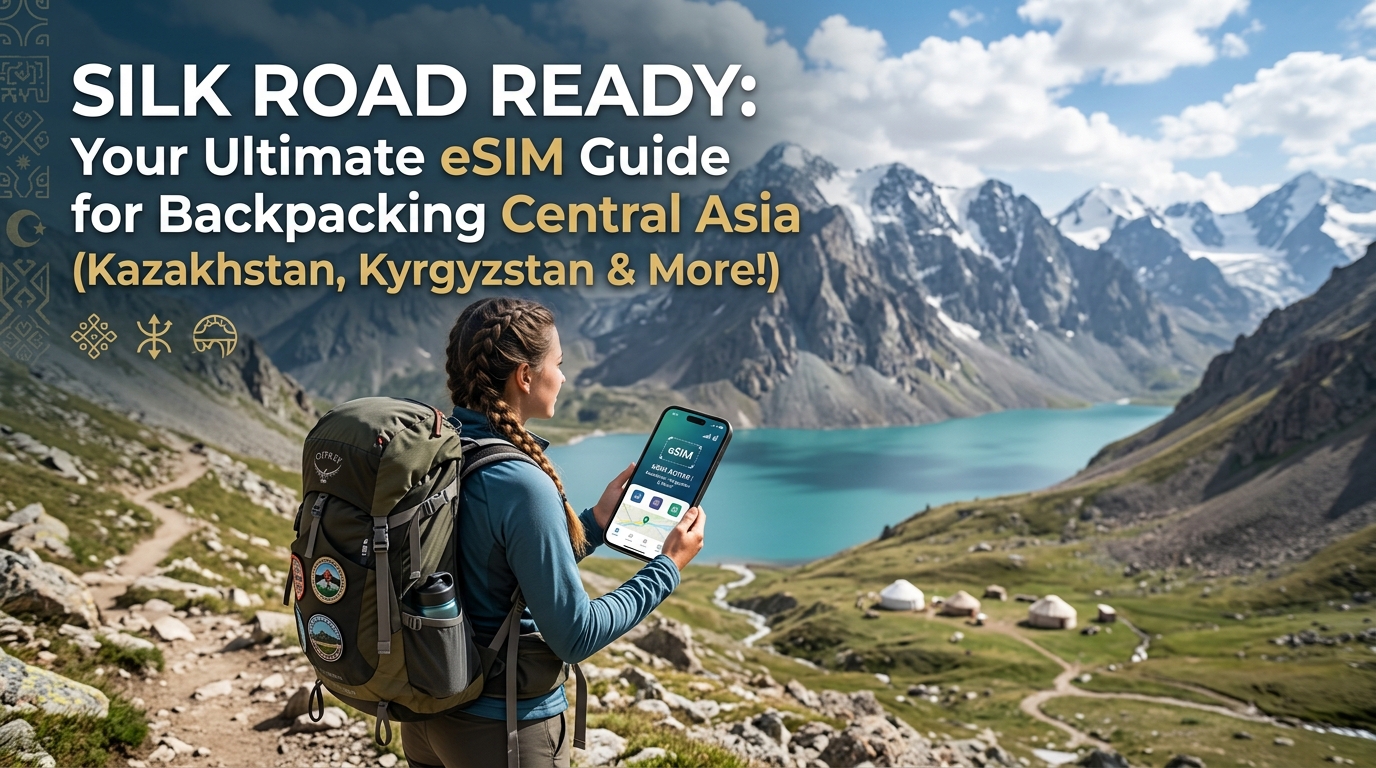
La Route de la Soie vous appelle : pourquoi la connectivité est votre allié ultime pour un voyage en sac à dos en Asie centrale
The very name "Silk Road" conjures images of ancient caravans, bustling bazaars, and a tapestry of cultures woven across vast, dramatic landscapes. Backpacking Central Asia—a journey through Kazakhstan's endless steppes, Kyrgyzstan's alpine lakes, Tajikistan's towering Pamir Mountains, Turkmenistan's desert wonders, and Uzbekistan's glittering Silk Road cities like Samarkand and Bukhara—is an adventure unlike any other. It’s an immersive dive into history, a communion with nature, and an encounter with unparalleled hospitality. Yet, beneath this romantic veneer lies a practical reality for the modern traveler: the inherent challenges of staying connected in a region renowned for its remoteness and diverse infrastructure.
The Connectivity Conundrum: Navigating Central Asia's Digital Divide
While major urban centers in countries like Kazakhstan and Uzbekistan boast impressive digital infrastructure, venturing beyond these hubs quickly reveals a different story. Backpackers often face a patchwork of varying network coverage, vast distances separating towns and cities, and inconsistent internet speeds. The logistical complexities multiply when crossing multiple international borders—a frequent occurrence for those truly exploring the heart of the Silk Road. Each border crossing traditionally meant a new hunt for a local SIM card, a new registration process, and a fresh set of data plan limitations.
The Pitfalls of Traditional SIM Cards on the Silk Road
Relying on physical local SIM cards in Central Asia quickly transforms from a minor inconvenience into a significant logistical headache. Consider the common scenario:
- The Hunt for a Vendor: Upon arrival in a new country, the first task often becomes locating a reputable mobile provider's store, which can be challenging in smaller towns or after late-night arrivals.
- Language Barriers & Registration: Activating a local SIM frequently requires presenting a passport and navigating registration forms, often in a local language, leading to potential misunderstandings or delays.
- Country-Specific SIMs: A multi-country itinerary means purchasing and managing multiple physical SIM cards—one for Kazakhstan, another for Kyrgyzstan, then Uzbekistan, and so on. This quickly clutters your wallet and complicates data management.
- Expiring Plans & Top-ups: Local plans often have strict expiry dates, requiring frequent top-ups or re-purchases, adding another layer of administrative burden to your adventure.
- Risk of Losing Your Home SIM: Swapping out your home SIM card for a local one creates the constant risk of misplacing or damaging your primary card, severing your connection to your home network.
These cumulative frustrations detract from the very essence of backpacking: freedom and spontaneity.
Connectivity: A Modern Backpacking Essential, Not a Luxury
In the vast, often sparsely populated landscapes of Central Asia, reliable internet access transcends mere convenience; it becomes an indispensable tool for safety, navigation, and enriching your travel experience.
- Navigation & Exploration: From finding your guesthouse in a labyrinthine bazaar to pinpointing a mountain trail, GPS-enabled maps (like Google Maps or Apple Maps) are critical. Without consistent data, you risk getting lost or missing out on hidden gems.
- Safety & Emergency: The ability to quickly contact emergency services, share your location with loved ones, or research local safety advisories is paramount, especially when venturing into remote areas.
- Communication & Connection: Staying in touch with family and friends, sharing your incredible journey on social media, or even booking your next hostel relies heavily on a stable internet connection.
- Logistics & Planning: Checking bus schedules, booking train tickets, translating local menus, or researching cultural nuances all become seamless with readily available data.
eSIM: The Streamlined Solution for the Modern Silk Road Traveler
This is where eSIM technology emerges as the definitive game-changer for backpacking Central Asia. An eSIM eliminates the need for physical SIM cards, allowing you to download and activate data plans digitally. This means no more hunting for vendors, no language barriers during registration, and no juggling multiple plastic cards. You can purchase and activate a data plan for an entire region or specific countries before you even depart, or on the fly from anywhere with an internet connection.
For a region like Central Asia, where seamless cross-border travel is key, an eSIM offers unparalleled flexibility and convenience. Providers like MollySIM (https://mollysim.com) are specifically designed to address these pain points, offering robust coverage across multiple Central Asian nations. MollySIM's commitment to a superior user experience is evident in its Fair Use Policy speed limit of 384kbps—a significant advantage, being three times faster than competitors' typical 128kbps. This crucial difference ensures that essential applications like Google Maps and Apple Pay function smoothly, allowing you to navigate confidently and make transactions without frustrating delays, even when your high-speed data allowance is exhausted. With an eSIM, your focus shifts from connectivity worries back to the breathtaking landscapes and profound cultural encounters that define the Silk Road journey.
eSIM vs. Traditional SIMs & Wi-Fi: Why MollySIM is the Smart Choice for Central Asia Backpackers
Navigating Central Asia's vast and varied landscapes requires a connectivity solution that's as robust as it is flexible. While traditional options might seem appealing at first glance, they often present unforeseen challenges for the modern backpacker. Let's dissect the common choices and reveal why MollySIM's eSIM technology stands head and shoulders above the rest for your Silk Road adventure.
The Traditional Gauntlet: Local Physical SIM Cards
For decades, the standard advice for international travel has been to purchase a local SIM card upon arrival. The perceived "pro" is often the lowest per-gigabyte cost for extended stays within a single country. However, this seemingly straightforward option quickly devolves into a series of logistical hurdles in Central Asia:
- Time-Consuming Vendor Hunt: Upon arrival, you'll need to locate an authorized mobile provider store (e.g., Beeline, Kcell, MegaCom). This can mean navigating unfamiliar airports or city streets, often after a long journey, just to get connected.
- Language Barriers & Bureaucracy: Expect to encounter language barriers when trying to explain your needs. More significantly, local regulations often require tedious registration processes, demanding passport copies, visa details, and lengthy forms. This isn't a quick transaction; it's a bureaucratic gauntlet.
- Border Crossing Hassle: Central Asia is a region of multiple countries. Crossing from Kazakhstan into Kyrgyzstan, or Kyrgyzstan into Uzbekistan, means repeating the entire process: finding a new vendor, battling language, filling out more paperwork, and purchasing yet another physical SIM. This constant "SIM card shuffle" is not only inconvenient but also risks losing your home SIM card.
- Lack of Cross-Border Functionality: A local SIM is, by definition, local. It offers no seamless connectivity as you traverse borders, forcing you into a cycle of disconnection and reconnection that detracts from your travel experience.
The Portable Burden: Pocket Wi-Fi Devices
Another option often considered is renting a pocket Wi-Fi device. Its primary "pro" is the ability to share an internet connection among a small group, potentially reducing individual costs. However, the cons quickly outweigh this benefit:
- Added Expense & Logistics: These devices come with rental fees, often a hefty deposit, and daily charges that can quickly accumulate. You're also responsible for picking it up and returning it, adding another layer of logistical complexity to your trip.
- Another Device to Carry & Charge: Backpackers prioritize minimalism. A pocket Wi-Fi device is yet another gadget to carry, protect, and, most importantly, constantly charge. Running out of battery means losing connectivity for everyone relying on it.
- Security Risks: Connecting to a shared, rental Wi-Fi network can pose security risks, especially if not properly secured. Your data could be vulnerable on potentially public networks.
- Poor Remote Coverage: While useful in cities, pocket Wi-Fi devices often struggle with, or completely lack, coverage in the remote, mountainous, and less populated areas where many Central Asia backpackers seek adventure. Their reliance on local cellular networks means they inherit the same coverage limitations, but with the added point of failure of the device itself.
The Modern Nomad's Advantage: MollySIM eSIM
This is where MollySIM's eSIM technology revolutionizes connectivity for Central Asia. An eSIM (embedded SIM) is a small chip built directly into your compatible smartphone or device, allowing you to download and activate cellular plans digitally, without needing a physical card. MollySIM leverages this technology to offer overwhelming advantages:
- Instant Digital Activation: Say goodbye to vendor hunts and paperwork. With MollySIM, you can purchase and activate your data plan digitally, often before you even depart for Central Asia. A simple QR code scan is usually all it takes to get connected.
- Seamless Cross-Border Travel: MollySIM offers regional plans designed for multi-country travel. This means a single plan covers multiple Central Asian nations, eliminating the need for new SIMs at every border. Your connectivity remains uninterrupted as you journey from the steppes of Kazakhstan to the peaks of Kyrgyzstan and beyond, truly making you "Silk Road Ready."
- Enhanced Security & Convenience: Without a physical card to swap, your device remains sealed, reducing the risk of damage or loss of your home SIM. It's a more secure and streamlined experience.
- Unparalleled Flexibility & Control: Easily monitor your data usage, top up your plan, or switch to a different package directly from your phone, anytime, anywhere. MollySIM puts you in complete control of your connectivity.
- Environmental Friendliness: By eliminating physical plastic SIM cards, eSIMs contribute to a more sustainable travel ecosystem.
- MollySIM's Performance Edge: Beyond the convenience, MollySIM stands out with its superior performance. Even when your high-speed data allowance is exhausted, MollySIM's Fair Use Policy maintains a speed limit of 384kbps. This is a critical advantage, being three times faster than competitors' typical 128kbps. This crucial difference ensures that essential applications like Google Maps continue to load smoothly for navigation, Apple Pay transactions remain responsive, and basic messaging apps function without frustrating delays, keeping you connected and confident throughout your journey.
For the Central Asia backpacker, MollySIM isn't just a convenience; it's an essential tool that transforms potential connectivity headaches into a seamless, stress-free experience, allowing you to focus on the adventure at hand.
Navigating the Networks: Central Asian Carriers & MollySIM's Seamless Integration
Understanding the intricate web of mobile networks across Central Asia is paramount for any backpacker aiming for uninterrupted connectivity. While the region boasts rapidly developing digital infrastructure, significant variations exist between bustling urban centers and the vast, often remote, landscapes. MollySIM (https://mollysim.com) is engineered to seamlessly integrate with these local infrastructures, automatically connecting you to the strongest available partner network in each country, eliminating the hassle of manual carrier selection and ensuring optimal, reliable connectivity throughout your journey.
Kazakhstan: Bridging Urban Hubs and Vast Steppes
Kazakhstan, the largest country in Central Asia, presents a diverse connectivity landscape. Its major mobile carriers include Kcell, Beeline, and Tele2/Altel, with Tele2 and Altel often operating on a shared network infrastructure.
- Urban Centers: In major cities like Almaty and the capital Nur-Sultan (Astana), travelers can expect excellent 4G/LTE coverage, offering high-speed internet suitable for streaming, video calls, and all modern digital needs.
- Rural & Remote Regions: As you venture into the vast steppes or the mountainous regions of the Tian Shan, coverage becomes more sporadic. While 3G is often available in larger towns and along main highways, 2G might be the norm in more remote villages, and significant stretches can have no service at all.
MollySIM partners with leading networks such as Kcell and Beeline in Kazakhstan. This strategic collaboration ensures that whether you're navigating the vibrant streets of Almaty or exploring the edges of the Charyn Canyon, MollySIM automatically connects to the strongest available signal, providing the best possible coverage without any manual intervention.
Kyrgyzstan: Conquering Mountainous Connectivity
Kyrgyzstan, renowned for its breathtaking mountains and pristine alpine lakes, presents unique connectivity challenges and strengths. The primary mobile operators are MegaCom, O!, and Beeline.
- Urban & Tourist Hubs: In Bishkek, Osh, and along the popular shores of Issyk-Kul Lake, 4G/LTE coverage is generally robust and reliable.
- Mountainous Regions & Trekking Routes: Connectivity significantly diminishes in the high-altitude regions of the Tien Shan and Pamir-Alay mountains. While some larger villages like Karakol or Naryn may offer 3G or even limited 4G, many trekking routes and remote valleys will have little to no service. O! is sometimes noted for having surprisingly good coverage in some less accessible areas compared to competitors.
MollySIM leverages its partnerships with key carriers like MegaCom and O! to maximize your connectivity, especially around populated areas and major tourist routes. Even in areas where speeds might drop due to challenging terrain, MollySIM's Fair Use Policy maintains a speed limit of 384kbps after high-speed data is exhausted. This crucial advantage, being three times faster than competitors' typical 128kbps, ensures that essential applications like Google Maps continue to load smoothly for navigation, and basic messaging apps function without frustrating delays, keeping you connected and confident even when off the beaten path.
Uzbekistan: Along the Ancient Silk Road
Uzbekistan's mobile network infrastructure has seen rapid improvements, particularly along its famous Silk Road cities. Major carriers include Ucell, UzMobile, Beeline, and Mobiuz.
- Historical Cities & Capital: In Tashkent and the iconic Silk Road cities of Samarkand, Bukhara, and Khiva, travelers will find excellent 4G/LTE coverage, enabling seamless digital experiences.
- Desert Landscapes: As you traverse the vast desert landscapes between these historical gems, coverage can become spotty. While 3G might be available in smaller towns and along major transit routes, expect stretches with limited or no service. UzMobile, being state-owned, sometimes has a broader but slower reach in certain rural areas.
MollySIM ensures seamless connectivity by partnering with major players like Ucell and Beeline. This means that as you move from the bustling bazaars of Tashkent to the ancient madrassas of Khiva, MollySIM automatically connects you to the strongest available network, ensuring reliable internet access for sharing your journey and staying in touch.
Tajikistan: The Pamir Highway Challenge
Tajikistan presents some of the most challenging, yet rewarding, connectivity experiences in Central Asia, especially along the famed Pamir Highway. Key operators are Tcell, MegaFon, and Babilon-M.
- Urban Centers: Dushanbe and Khujand offer decent 4G/LTE coverage, providing reliable internet access.
- Pamir Highway & Remote Mountains: Connectivity along the Pamir Highway is notoriously intermittent. While 2G/3G might be available in larger towns like Khorog and Murghab, there are extensive stretches with no service at all. Remote mountain areas are largely unconnected. Tcell and MegaFon are generally considered the most reliable in terms of coverage and speed where available.
For travelers tackling the Pamir, MollySIM is an invaluable tool. It automatically connects to the strongest partner network (e.g., Tcell, MegaFon) in areas where service is available, simplifying access to the internet. The ability to maintain 384kbps for navigation and messaging, even when high-speed data is exhausted, becomes critically important in these remote regions where every bit of connectivity counts for safety and planning.
Turkmenistan: Navigating a Restricted Digital Landscape
Turkmenistan's internet environment is unique, characterized by its restrictive and government-controlled nature. The primary operational mobile carrier is Altyn Asyr (TM-Cell). While MTS historically operated, its presence has been inconsistent and often problematic for foreign visitors.
- Urban Areas: In Ashgabat and other major cities, you can expect moderate 4G/LTE coverage, though speeds can be throttled.
- Rural Areas: Outside major population centers, coverage quickly degrades to 2G/3G, with many rural areas having limited or no service.
- Connectivity Nuances: Local SIM registration is complex, often requiring local sponsorship and extensive paperwork. Internet access is heavily censored, and many popular international websites and apps are blocked.
An eSIM like MollySIM offers a more straightforward connection where service exists, bypassing the significant hurdles of physical SIM registration. MollySIM will connect to the primary operational network, Altyn Asyr, providing the most direct access possible within the country's unique constraints. While an eSIM cannot circumvent government censorship, it simplifies the initial connection process, allowing you to utilize available internet services more easily.
Throughout all these diverse landscapes, MollySIM automatically scans and connects to the strongest available partner network within each country. This ensures consistent and reliable coverage without requiring any manual intervention from the user, allowing you to focus on the adventure at hand, confident that your connectivity is optimized.
Comparative Table: Central Asian Mobile Network Overview
| Country | Primary Local Carriers | Typical 4G/LTE Availability (Urban) | Typical 4G/LTE Availability (Rural/Remote) | Local SIM Registration Complexity | MollySIM Connectivity Partner(s) |
|---|---|---|---|---|---|
| Kazakhstan | Kcell, Beeline, Tele2/Altel | Excellent | Spotty (3G/2G in towns, limited elsewhere) | Moderate | Kcell, Beeline |
| Kyrgyzstan | MegaCom, O!, Beeline | Good | Challenging (2G/no service in mountains) | Low | MegaCom, O! |
| Uzbekistan | Ucell, UzMobile, Beeline, Mobiuz | Excellent | Spotty (3G in towns, limited in deserts) | Moderate | Ucell, Beeline |
| Tajikistan | Tcell, MegaFon, Babilon-M | Decent | Very Challenging (Pamir Highway, no service) | Moderate | Tcell, MegaFon |
| Turkmenistan | Altyn Asyr (TM-Cell) | Moderate | Limited (2G/3G in towns, sparse elsewhere) | High (requires local sponsorship) | Altyn Asyr |
MollySIM Regional Plans: Your Uninterrupted Silk Road Journey with 384kbps FUP
Embarking on a backpacking adventure across Central Asia's historic Silk Road demands reliable, seamless connectivity. This is precisely where MollySIM's regional eSIM plans (https://mollysim.com) shine, offering a transformative solution that eliminates the typical connectivity headaches associated with multi-country travel. Forget the days of scrambling for local SIM cards at every border crossing; MollySIM simplifies your digital life, allowing you to focus entirely on the breathtaking landscapes and rich cultures of Kazakhstan, Kyrgyzstan, Tajikistan, Turkmenistan, and Uzbekistan.
Cross-Border Simplicity: One Plan, Five Countries
The traditional approach to staying connected while backpacking Central Asia involves a tedious cycle: arriving in a new country, locating a local SIM vendor, navigating language barriers, completing often complex registration processes (which can be particularly challenging in places like Turkmenistan), and then repeating the entire ordeal upon entering the next nation. This not only consumes valuable travel time but also leads to accumulating multiple physical SIM cards, each with its own remaining data and expiry dates.
MollySIM's regional plan fundamentally redefines this experience. With a single MollySIM regional eSIM, you gain immediate and continuous connectivity across all five target countries. Imagine crossing from the vast steppes of Kazakhstan into the rugged mountains of Kyrgyzstan, or from the ancient cities of Uzbekistan to the remote Pamir Highway in Tajikistan, all without a single interruption in your mobile service. This unparalleled cross-border simplicity offers immense value:
- Seamless Transitions: Your connectivity remains active as you traverse international borders, eliminating the need to swap physical SIMs, register new numbers, or endure activation delays.
- Unrivaled Convenience: Activate your eSIM once before your trip, and you're set for the entire journey. This frees up precious time and mental energy, allowing you to immerse yourself fully in the travel experience rather than worrying about connectivity logistics.
- Significant Cost-Effectiveness: Compared to purchasing individual local SIMs in each country, which often come with varying costs, unused data expiring, and potential setup fees, a single MollySIM regional plan offers substantial savings. It also completely bypasses the exorbitant international roaming charges levied by most home network providers.
Flexible Data Packages & Effortless Top-Ups
MollySIM understands that every backpacker's data needs are unique, which is why it offers a range of flexible data packages designed to suit various trip lengths and usage patterns. Whether you're a light user primarily needing maps and messaging, or someone who occasionally streams content and makes video calls, there's a plan for you.
Typical data packages might include:
- Smaller Bundles: 1GB, 3GB (ideal for shorter trips or minimal usage).
- Mid-Range Bundles: 5GB, 10GB (suitable for longer trips or moderate usage).
- Flexible Durations: Plans are often available for 7, 15, or 30 days, allowing you to align your connectivity with your itinerary.
Choosing the right plan is straightforward:
- Assess Your Trip Length: For a multi-week expedition, a larger data bundle or a longer validity period might be more economical. Shorter excursions can benefit from smaller, more focused plans.
- Estimate Your Usage: Consider how much you typically use data for navigation, social media, communication, and research. Remember that even if your high-speed data runs out, MollySIM's robust Fair Usage Policy ensures you're never completely disconnected.
Should you find yourself needing more data mid-journey, topping up your MollySIM plan is incredibly easy and convenient. All data top-ups can be managed directly through the intuitive MollySIM app, ensuring you can add more data anytime, anywhere, even if you're currently operating on the FUP speed. There's no need to hunt for physical top-up vouchers or local stores, providing ultimate flexibility and peace of mind.
The Power of 384kbps FUP: Always Connected, Always Capable
One of MollySIM's most significant advantages for Central Asian backpackers is its generous 384kbps Fair Usage Policy (FUP) speed limit. Unlike traditional SIM cards or many competitor eSIMs that completely cut off your data or throttle you to a barely functional 128kbps once your high-speed allowance is exhausted, MollySIM ensures you remain reliably connected with a speed that is 3x faster than the industry standard 128kbps. This isn't just a number; it translates into tangible, practical benefits that can be critical in remote or unfamiliar territories.
While 384kbps isn't blazing fast for streaming high-definition video, it is remarkably functional and reliable for a wide array of essential tasks:
- Uninterrupted Navigation:
- Google Maps & Apple Maps: Crucially, 384kbps is more than sufficient for real-time GPS tracking, route recalculations, searching for points of interest, and even downloading small map segments. This ensures you can always find your hostel, navigate city streets, or track your progress on a long bus journey, preventing you from getting lost in unfamiliar environments. The enhanced speed compared to 128kbps makes a significant difference in map loading times and responsiveness.
- Maps.me: While primarily an offline mapping solution, live search, updates, and location sharing features benefit greatly from this continuous connectivity.
- Reliable Communication:
- WhatsApp, Telegram, Messenger: Send and receive text messages, make clear voice calls, and even share low-resolution photos for quick updates with family and friends. This is vital for coordinating with fellow travelers, hostel staff, or local tour guides.
- Essential Online Tasks:
- Email: Send and receive text-based emails, including light attachments, to manage bookings or stay in touch.
- Booking Confirmations: Access and display hostel, train, or bus tickets stored in your email or cloud services.
- Light Web Browsing: Quickly check bus schedules, opening hours for attractions, perform quick translations, or access critical local information.
- Banking Apps: Securely manage your finances, check balances, and even make payments using services like Apple Pay where supported by local banks and merchants.
- Enhanced Safety & Peace of Mind:
- Emergency Communication: In an unforeseen situation, having continuous connectivity for emergency calls or messages is paramount.
- Weather Updates: Crucial for planning mountain treks or long drives through varied terrain.
- Accessing Local Information: Quickly find embassy contacts, local emergency numbers, or travel advisories.
This reliable fallback connectivity is MollySIM's commitment to ensuring you're never truly offline, even when high-speed data is exhausted or in areas with less robust coverage. While a traditional SIM might leave you with a complete loss of connectivity, MollySIM provides a continuous, albeit sometimes slower, lifeline, offering unparalleled peace of mind for any backpacker venturing into the heart of Central Asia.
Activating & Mastering Your MollySIM eSIM for the Silk Road Adventure
Embarking on a Central Asian adventure with MollySIM means seamless connectivity, but a little preparation and understanding of its features will ensure a truly smooth experience. This guide provides a comprehensive, step-by-step approach to activating and managing your MollySIM eSIM, keeping you connected from the moment you land.
1. Pre-Departure Checklist: Your Connectivity Launchpad
Before you even pack your bags, a few crucial steps will set the stage for effortless connectivity.
- Device Compatibility Check: Not all smartphones support eSIM technology. Verify your device's compatibility by checking MollySIM's official website or your phone manufacturer's specifications. This is a non-negotiable first step.
- Purchase Your MollySIM Regional Plan: Visit https://mollysim.com and select the appropriate regional plan for Central Asia. Consider your expected data usage, trip duration, and the countries you'll visit (Kazakhstan, Kyrgyzstan, Uzbekistan, Tajikistan, etc.). MollySIM offers tailored packages designed for backpackers exploring this diverse region.
- Download the MollySIM App: The MollySIM mobile application (available on iOS and Android) is your command center for managing your eSIM. Download it before you leave to monitor data, top up, and access support.
- When to Install Your eSIM: You can install your MollySIM eSIM profile on your device before you depart. This allows you to test the installation process on stable home Wi-Fi. However, do not activate the data plan until you arrive in Central Asia to maximize its validity period. The installation simply adds the profile; the data plan only begins counting down once it connects to a network in the destination country.
2. Activation Guide: Bringing Your eSIM to Life
Activating your MollySIM eSIM is a straightforward process, typically completed in minutes.
### Installation Methods
- QR Code Installation (Recommended):
- Ensure you have a stable Wi-Fi connection.
- Open your phone's Settings menu.
- Navigate to Cellular or Mobile Data (iOS) / Network & Internet > SIMs (Android).
- Select "Add eSIM" or "Add Data Plan."
- When prompted, choose "Use QR Code" and scan the QR code provided in your MollySIM purchase confirmation email.
- Follow the on-screen prompts to complete the installation.
- Manual Installation:
- If QR code scanning isn't an option, select "Enter Details Manually."
- You will need to input the SM-DP+ Address and Activation Code found in your MollySIM confirmation email.
- Follow the remaining on-screen instructions.
### Best Practices for Activation
- Label Your eSIM: Immediately after installation, label your new eSIM profile something clear like "MollySIM Central Asia" or "MollySIM Data" to easily distinguish it from your home SIM.
- Wait to Activate Data: While you can install the eSIM at home, only activate the data plan once you land in your first Central Asian country. This ensures you get the full duration of your purchased plan.
- Ensure Strong Wi-Fi: Perform the installation steps while connected to reliable Wi-Fi to prevent interruptions.
3. Managing Your eSIM: Staying in Control
Once activated, managing your MollySIM eSIM is intuitive, especially with the dedicated app.
- Switching Between SIMs:
- For Data: In your phone's Cellular/Mobile Data settings, set "MollySIM Central Asia" as your primary line for Mobile Data.
- For Calls/Texts (Home SIM): You can keep your physical home SIM active for receiving calls and texts (be mindful of international roaming charges from your home provider). Your phone will typically prompt you to choose which SIM to use for outgoing calls/SMS.
- Monitoring Data Usage:
- MollySIM App: The most accurate way to track your real-time data consumption and remaining allowance.
- Phone Settings: Your device's cellular settings also provide a general overview of data usage, though the MollySIM app will be more precise for your specific plan.
- Topping Up Data:
- Running low? Open the MollySIM app, navigate to your active plan, and select the "Top Up" option. You can purchase additional data packages directly through the app, ensuring uninterrupted connectivity.
- Troubleshooting Common Issues:
- Check APN Settings: In rare cases, your phone might not automatically configure the Access Point Name (APN). In your cellular settings, navigate to the MollySIM profile and look for APN settings. It should usually be "internet" or "globaldata." If it's blank or incorrect, manually enter "internet."
- Manual Network Selection: If you have no signal, try manually selecting a network operator. Go to your MollySIM cellular settings, disable "Automatic Network Selection," and choose from the available local networks (e.g., Beeline, Kcell, MegaCom).
- Basic Diagnostics: A simple restart of your phone or toggling Airplane Mode on and off can often resolve minor connectivity glitches.
4. Tips for Optimizing Data Usage: Stretch Your Silk Road Data
Central Asia offers incredible landscapes, but network coverage can vary. Conserving data is smart.
- Disable Background App Refresh: Many apps consume data even when not actively in use. Go to your phone's settings and turn off background refresh for non-essential applications.
- Download Offline Content: Before heading into remote areas or long journeys:
- Maps: Download entire regions in Google Maps or Apple Maps.
- Entertainment: Download movies, TV shows, music, and podcasts for offline viewing/listening.
- Guides: Save travel guides, phrasebooks, and important documents offline.
- Utilize Wi-Fi Whenever Available: Take advantage of free Wi-Fi at hostels, cafes, restaurants, and airports for heavy data tasks like uploading photos, video calls, or large downloads.
- Adjust Streaming Quality: When streaming video or audio on mobile data, opt for lower resolution settings to significantly reduce data consumption.
- Disable Automatic Updates: Prevent your phone and apps from downloading large updates over mobile data.
5. Security & Privacy: A Safer Digital Journey
Using your MollySIM eSIM provides an inherent layer of security often overlooked. Unlike relying on potentially insecure and unencrypted public Wi-Fi networks, your MollySIM connection offers a private and more secure data channel. This is particularly beneficial for sensitive tasks like checking banking apps or making payments. With MollySIM's robust 384kbps Fair Use Policy speed limit (3x faster than many competitors' 128kbps), even after high-speed data is exhausted, you can still reliably use essential services like Google Maps for navigation or Apple Pay for secure transactions, minimizing your exposure to public Wi-Fi risks and ensuring peace of mind throughout your Central Asian adventure.
Beyond Connectivity: Enhancing Your Central Asian Backpacking Experience with MollySIM
While the primary function of an eSIM is to provide internet access, the true value of reliable connectivity, especially in a region as vast and diverse as Central Asia, extends far beyond simple browsing. A robust connection, like that offered by MollySIM, fundamentally transforms and enriches your entire backpacking journey, making it safer, more immersive, and ultimately, more enjoyable. It's not just about being online; it's about unlocking the full potential of your adventure.
1. Safety & Emergency Preparedness: A Digital Lifeline
Safety is paramount when exploring unfamiliar territories, and constant connectivity acts as an indispensable digital lifeline. With your MollySIM eSIM, you gain critical safety advantages:
- Emergency Location Sharing: In an emergency, your phone's GPS, powered by MollySIM's reliable data, allows you to share your precise location with trusted contacts or emergency services. Features like "Find My" or location-sharing apps become vital tools for peace of mind, both for you and your loved ones back home.
- Instant Access to Critical Contacts: Quickly contact your embassy or consulate, local emergency services (police, ambulance), or your travel insurance provider without scrambling for Wi-Fi. This immediate access can be crucial in time-sensitive situations.
- Real-time Travel Advisories: Stay informed about local news, weather warnings, road closures, or any evolving political situations that might impact your travel plans. Receiving timely updates directly to your device ensures you can make informed decisions and adjust your itinerary as needed.
Crucially, even if you exhaust your high-speed data, MollySIM's robust 384kbps Fair Use Policy (FUP) speed limit provides an essential safety net. This speed, which is 3x faster than many competitors' 128kbps FUP, is more than sufficient for sending emergency messages via WhatsApp or Telegram, loading basic map data for navigation, and accessing critical information online. This ensures you're never truly disconnected in a crisis, offering unparalleled peace of mind throughout your Central Asian adventure.
2. Cultural Immersion & Local Exploration: Deeper Connections
Connectivity acts as a powerful bridge to deeper cultural engagement, allowing you to move beyond surface-level tourism and truly connect with the heart of Central Asia:
- Seamless Communication with Locals: Language barriers can be a significant hurdle, but with apps like Google Translate or Yandex Translate at your fingertips, you can easily communicate with locals, understand menus, read signs, and engage in meaningful conversations. Real-time voice translation features can transform interactions, fostering genuine connections.
- Discovering Authentic Local Gems: Move beyond tourist traps by leveraging online reviews and local recommendations. Use Google Maps, TripAdvisor, or even local blogs to find hidden cafes, family-run guesthouses, bustling local markets, and authentic cultural events that might otherwise go unnoticed.
- Learning Basic Phrases on the Go: Quick access to online phrasebooks or language learning apps allows you to pick up essential Kazakh, Kyrgyz, Uzbek, or Tajik phrases. Even a few words can significantly enhance your interactions and show respect for local culture.
- Empowering Spontaneous Exploration: MollySIM empowers you to confidently venture off the beaten path. Whether it's a detour to a picturesque village or a spontaneous decision to attend a local festival, knowing you can navigate back, find information, or book last-minute accommodation on the fly makes for a more adventurous and rewarding journey.
3. Navigation & Logistics Mastery: Travel with Confidence
Navigating Central Asia, with its vast landscapes and often less-developed infrastructure, becomes significantly smoother and more efficient with reliable connectivity:
- Indispensable Navigation Apps: Seamlessly use essential navigation apps like Google Maps, 2GIS (highly popular in Central Asian cities for public transport routes and business listings), and Maps.me (for offline maps, but online updates are key for accuracy). Get real-time traffic updates, public transport directions, and walking routes without getting lost.
- On-the-Go Accommodation Booking: Maintain flexibility in your itinerary by booking hostels, guesthouses, or hotels directly from your phone via apps like Booking.com or Hostelworld. This is invaluable for spontaneous travel or when plans change unexpectedly.
- Real-time Transport Schedules: Avoid long waits and missed connections by checking real-time bus, marshrutka (shared taxi), or train schedules. Knowing when the next connection departs empowers you to plan your movements efficiently.
- Convenient Ride-Sharing Services: In larger cities like Almaty, Bishkek, or Tashkent, apps like Yandex Go provide safe, transparent, and often more affordable taxi services. This eliminates language barriers and the need for haggling, ensuring you reach your destination comfortably and securely.
4. Documenting & Sharing Your Journey: Staying Connected with Loved Ones
While the focus of backpacking is often on disconnecting from the digital world, staying connected with friends and family back home remains important. MollySIM ensures you can share your adventures and provide reassurance:
- Effortless Text Updates: Send text messages, photos, and short videos via WhatsApp, Telegram, or iMessage to keep loved ones updated on your whereabouts and experiences.
- Sharing Low-Resolution Moments: Even with the MollySIM 384kbps FUP, you can still send low-resolution photos and quick text updates. While high-speed data is ideal for video calls, this reliable baseline speed ensures you can share the essence of your journey without consuming excessive data or relying solely on intermittent Wi-Fi.
- Quick Social Media Posts: Post short updates or stories to your preferred social media platforms, allowing friends and followers to virtually join your Silk Road adventure.
- Peace of Mind for Family: Regular, brief updates provide immense reassurance to family and friends, letting them know you're safe and enjoying your trip.
Conclusion: MollySIM – Your Essential Companion for the Silk Road
MollySIM isn't just an eSIM; it's a key enabler for a truly memorable, safer, and more enriching Central Asian backpacking adventure. By providing reliable connectivity, MollySIM empowers you to navigate with confidence, immerse yourself deeply in local cultures, stay prepared for any eventuality, and share your incredible journey with those who matter most. The combination of consistent high-speed data and the robust 384kbps FUP (3x faster than many competitors, ensuring essential services like Google Maps and Apple Pay remain functional) means you're always connected when it counts.
Don't just travel Central Asia; truly experience it with the confidence and freedom that only reliable connectivity can provide. Visit https://mollysim.com today to secure your MollySIM eSIM and unlock your ultimate Silk Road adventure.