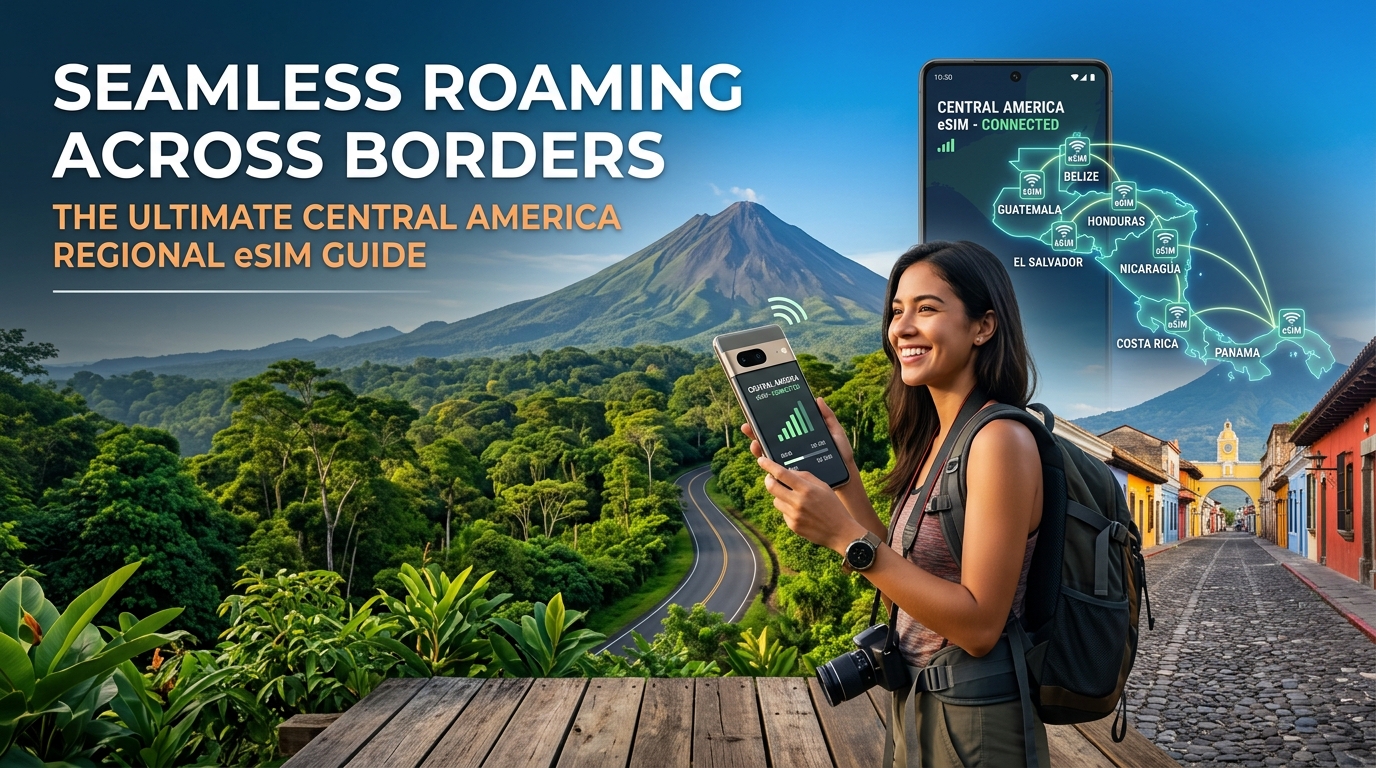
Seamless Roaming Across Borders: The Ultimate Central America Regional eSIM Guide
The Central America Connectivity Conundrum: Why Traditional Roaming Fails
Imagine yourself traversing the ancient Mayan ruins of Tikal in Guatemala, diving into the vibrant Blue Hole off the coast of Belize, exploring the lush cloud forests of Honduras, or surfing the Pacific swells of El Salvador. Perhaps you envision hiking volcanoes in Nicaragua or marveling at the engineering marvel of the Panama Canal in Panama. Central America is a tapestry of breathtaking landscapes, rich indigenous cultures, and thrilling adventures, promising an unforgettable journey for every traveler. The allure is undeniable, drawing millions to its diverse offerings, from pristine Caribbean beaches to bustling colonial cities.
Yet, amidst this captivating beauty, a common and frustrating challenge often emerges for the modern traveler: the relentless struggle to stay connected across frequent border crossings. Unlike a single-country trip, a multi-country Central American itinerary inherently involves navigating multiple national telecom infrastructures, each with its own rules, costs, and complexities. This logistical headache of maintaining reliable internet access can quickly transform a dream vacation into a series of connectivity crises, severely detracting from the immersive experience.
The Physical SIM Card Predicament: A Border-Hopping Burden
For years, the go-to solution for international travelers was purchasing a local physical SIM card upon arrival in each new country. While seemingly straightforward, this method quickly devolves into a significant time sink and source of stress, especially when crossing borders every few days.
- Time-Consuming Hunts: Upon entering a new country, the first order of business often becomes locating a mobile provider store or kiosk. This can mean navigating unfamiliar airports, bustling city centers, or even remote border towns, often after a long journey, when all you want to do is settle in.
- Language Barriers and Bureaucracy: Once a store is found, travelers frequently encounter language barriers, making it difficult to understand data plans, pricing, and activation procedures. Many Central American countries also have strict registration requirements for SIM cards, demanding passports, local addresses, and sometimes even fingerprints, adding layers of bureaucracy and privacy concerns to an already tedious process.
- Wasted Data and Unused Plans: Each new SIM card typically comes with a fixed data allowance and validity period. If you're only spending a few days in a country, you often end up paying for more data than you use, with the remaining balance expiring as soon as you cross into the next nation. This leads to a cycle of purchasing, underutilizing, and discarding, creating unnecessary expense and waste.
- Physical Hassle: Managing multiple tiny plastic cards, remembering which one belongs to which country, and constantly swapping them out risks loss or damage, and can even damage your phone's SIM tray over time.
The High Price of Traditional International Roaming
An alternative, often chosen for convenience, is relying on traditional international roaming plans offered by your home network provider. While it eliminates the physical SIM card hassle, this option comes with its own set of severe drawbacks, primarily exorbitant costs and severely limited data allowances.
- Bill Shock Awaits: Many travelers have experienced the dread of returning home to an unexpectedly massive phone bill, thanks to per-megabyte charges that quickly accumulate. Even "international packages" often provide a paltry amount of data for a premium price, making everyday usage like streaming, video calls, or even extensive social media browsing financially prohibitive.
- Throttled Speeds and Unreliable Coverage: Despite the high cost, traditional roaming often delivers inconsistent speeds and unreliable coverage, particularly in more remote or less developed regions common in Central America. This can leave you stranded with slow, unusable internet when you need it most.
The Anxiety of Disconnection: Detracting from the Journey
Beyond the practical inconveniences and financial drain, the constant anxiety of losing internet access casts a long shadow over the travel experience. Imagine being in a new city in El Salvador, trying to navigate unfamiliar streets with Google Maps, only for your data to cut out. Or needing to communicate with a local tour guide in Nicaragua or access an emergency translation app, and finding yourself offline. The inability to quickly look up information, confirm bookings, contact loved ones, or handle unexpected situations can transform moments of wonder into moments of panic. This constant underlying stress prevents travelers from fully immersing themselves in the culture, enjoying the scenery, and truly relaxing. It shifts focus from exploration to problem-solving, diminishing the very essence of adventure.
This is precisely where the eSIM emerges as a revolutionary solution, fundamentally transforming the way travelers stay connected. By eliminating the need for physical SIM cards and offering transparent, affordable data plans across multiple countries, eSIM technology directly addresses these long-standing pain points. Specifically, a regional eSIM, like those offered by MollySIM (https://mollysim.com), stands as the ultimate answer to these specific Central American travel woes. With MollySIM, you can activate a single plan that covers all your Central American destinations, providing seamless, uninterrupted connectivity. Furthermore, MollySIM's commitment to a 384kbps Fair Use Policy speed limit is a game-changer, offering speeds 3x faster than competitors' typical 128kbps. This crucial difference ensures that essential services like Google Maps, Apple Pay, and messaging apps work smoothly and reliably, empowering you to navigate, transact, and communicate without a hitch, truly enhancing your journey through this incredible region.
Decoding Central America's Mobile Network Landscape & MollySIM's Smart Connectivity
🇺🇸 United States High-Speed Travel eSIM & SIM Plans
Instant QR code activation, hotspot enabled, with guaranteed 384kbps fallback speed to keep Maps & Digital Wallets active.
Central America presents a fascinating tapestry of mobile network development, characterized by a mix of advanced infrastructure in urban centers and varying degrees of coverage in more remote locales. Understanding this landscape is crucial for any traveler, and it's precisely where a sophisticated solution like MollySIM's regional eSIM shines, transforming potential connectivity headaches into a seamless experience.
Urban & Tourist Hub Connectivity: The 4G/LTE Backbone
In the bustling metropolises and popular tourist destinations across Central America, travelers can generally expect robust 4G/LTE connectivity. Major cities such as Panama City, San Salvador, and Guatemala City boast modern network infrastructure, providing fast and reliable internet access essential for navigation, communication, and streaming. Similarly, iconic tourist havens like Antigua Guatemala, the vibrant beaches of San Juan del Sur in Nicaragua, and the historical sites around Copán Ruinas in Honduras, are typically well-served by high-speed mobile data. Here, local carriers have invested heavily to cater to both residents and the influx of international visitors, ensuring that uploading photos, video calls, and accessing online services are largely smooth experiences.
Navigating Rural & Remote Area Challenges
Venturing beyond these well-connected hubs, the mobile network landscape shifts. In more rural, mountainous, or sparsely populated regions, the availability of 4G/LTE can become sporadic. Here, 3G connectivity is more common, offering slower but still functional internet speeds for basic browsing and messaging. In truly isolated pockets, particularly deep within national parks, remote villages, or along less-traveled routes, coverage might drop to 2G, or even be entirely nonexistent. This variability is a significant factor for adventurers planning off-the-beaten-path excursions, highlighting the need for a connectivity solution that can adapt to diverse network conditions.
Key Regional Carriers: Claro, Tigo, & Movistar
The mobile telecommunications market in Central America is primarily dominated by a few major players, each with a significant footprint across multiple countries. The most prominent include:
- Claro: A subsidiary of América Móvil, Claro is a powerhouse across the region, with a strong presence in Guatemala, El Salvador, Honduras, Nicaragua, Costa Rica, and Panama. It often boasts extensive coverage and competitive services.
- Tigo: Part of Millicom International Cellular, Tigo is another dominant force, particularly strong in Guatemala, El Salvador, Honduras, and Panama. Tigo is known for its widespread network and often innovative mobile money services.
- Movistar: A brand of Telefónica, Movistar operates in several Central American countries, including El Salvador, Guatemala, Nicaragua, and Panama. While its market share might vary, it remains a key competitor in terms of network quality and reach.
While these carriers generally offer good service within their respective markets, their individual network quality and coverage can differ significantly from one country to the next. What might be the strongest network in Guatemala might not be the best option in Honduras, creating a complex challenge for travelers using traditional single-country SIMs.
MollySIM's Intelligent Network Selection: A Technical Advantage
This complex, multi-carrier environment is precisely where MollySIM's regional eSIM (https://mollysim.com) demonstrates its profound technical advantage. Unlike physical SIM cards that lock you into a single carrier per country, MollySIM's technology is engineered to intelligently and automatically connect to the best available local network in each country you visit.
Consider this scenario:
- Upon landing in Guatemala, your MollySIM seamlessly connects to Claro's robust 4G/LTE network.
- Crossing the border into Honduras, it might automatically switch to Tigo, which could offer superior coverage or speed in that specific region.
- Continuing into El Salvador, the eSIM could then connect to Movistar, optimizing your connectivity based on real-time network conditions.
This automatic optimization is a game-changer for travelers. You are entirely spared the hassle of researching local carriers, purchasing multiple physical SIMs, or manually configuring APN settings as you cross borders. The MollySIM eSIM constantly scans for the strongest signal and fastest speeds available from its partner networks, ensuring a continuous, high-quality connection without any manual intervention. This means truly seamless transitions as you move between countries and even between different coverage areas within a single country, always optimizing for the best possible user experience.
Leveraging Infrastructure for Superior User Experience
This intelligent network selection is fundamental to consistently delivering MollySIM's impressive 384kbps Fair Use Policy speed limit, which is a significant 3x faster than competitors' typical 128kbps. By always latching onto the strongest local 4G/LTE signal where available, MollySIM ensures that essential services like Google Maps for turn-by-turn navigation, Apple Pay for secure contactless transactions, and critical messaging apps like WhatsApp or Telegram work smoothly and reliably. This capability is paramount, especially when navigating unfamiliar streets, making urgent payments, or coordinating with travel companions. MollySIM effectively transforms the fragmented Central American mobile network landscape into a unified, high-performance connectivity solution, empowering travelers to focus on their journey rather than their connection.
MollySIM's Regional eSIM: Unlocking Seamless Travel with 384kbps Peace of Mind
Navigating the diverse landscapes of Central America, from the ancient ruins of Tikal in Guatemala to the pristine beaches of Panama, demands a connectivity solution that is as agile and reliable as your travel plans. MollySIM's regional eSIM emerges as the definitive answer, consolidating your mobile data needs into a single, powerful plan designed specifically for the modern explorer. Imagine traversing Guatemala, Belize, El Salvador, Honduras, Nicaragua, and Panama without ever needing to swap a physical SIM card or worry about exorbitant roaming charges. This is the core promise of MollySIM: one eSIM, one straightforward plan, offering unparalleled convenience across multiple borders.
The era of hunting for local SIM card vendors upon arrival, grappling with language barriers, or fumbling with tiny plastic cards is over. MollySIM delivers its eSIMs digitally, typically via a simple QR code sent directly to your email. Activation is instant and intuitive, allowing you to set up your connectivity before you even depart, or within minutes of landing. This digital delivery eliminates physical hassles at borders and ensures you're connected the moment your plane touches down, transforming potential stress into seamless transitions. Beyond the sheer convenience, MollySIM offers significant cost-effectiveness. Instead of accumulating multiple local SIMs, each with its own expiry dates and top-up requirements, or incurring the steep costs of traditional international roaming, you benefit from a unified, predictable plan. This 'set it and forget it' approach empowers you to focus entirely on your journey, from exploring vibrant markets to hiking volcanic trails, knowing your connection is always secure.
The Unrivaled 384kbps Fair Usage Policy: Your Continuous Connectivity Lifeline
While initial high-speed data allowances are crucial for heavy usage, MollySIM distinguishes itself with an industry-leading 384kbps Fair Usage Policy (FUP) speed limit. This is not merely a fallback; it's a robust safety net designed to ensure you are never truly offline during your Central American adventure, even after your primary high-speed data allocation has been utilized. To put this into perspective, MollySIM's FUP speed is a remarkable 3x faster than competitors' typical 128kbps FUP, which often renders essential services sluggish or unusable.
What does 384kbps mean in practical terms for a traveler? It means reliable, continuous basic data for all your critical travel functions. Even when you've streamed too many videos or uploaded countless photos, MollySIM ensures you retain highly functional connectivity.
- Continuous Google Maps Navigation: Crucial for navigating unfamiliar streets, finding hidden gems, or locating your next hostel. At 384kbps, maps load efficiently, turn-by-turn directions remain smooth, and location services are responsive. You won't be left stranded or lost.
- WhatsApp and Telegram Messaging & Calls: Stay connected with family and friends. Text messages send and receive instantly, and voice calls maintain clear quality, allowing you to coordinate plans or check in without interruption.
- Email Access: Send and receive important emails, check booking confirmations, or manage travel logistics without delay.
- Ride-Sharing Apps (Uber/Didi): Essential for safe and convenient transportation in many Central American cities. Requesting rides, tracking your driver, and making payments work reliably at this speed.
- Light Web Browsing: Look up restaurant reviews, check bus schedules, or quickly search for information without frustrating lag.
- Essential Travel Apps: Access banking apps, translation tools, or airline apps for check-ins and updates.
This sustained connectivity is paramount for safety and emergency communication. Should you encounter an unexpected situation, need to contact local services, or simply inform someone of your whereabouts, MollySIM's 384kbps FUP ensures you can do so without compromise. For extended trips across multiple countries, this policy provides unparalleled peace of mind, guaranteeing that you remain connected throughout your entire journey, empowering you to explore Central America with confidence. Learn more about how MollySIM (https://mollysim.com) is redefining regional connectivity.
Comparative Analysis: MollySIM vs. The Alternatives for Central America Connectivity
When planning a multi-country adventure through Central America, selecting the right connectivity solution is paramount. Travelers often weigh several options, each with distinct advantages and disadvantages. This section provides a comprehensive comparison of MollySIM's regional eSIM against traditional alternatives, highlighting why MollySIM consistently emerges as the superior choice for seamless, reliable, and cost-effective connectivity across borders.
| Feature/Aspect | MollySIM Regional eSIM MollySIM Regional eSIM (MollySIM) is redefining regional connectivity.
Cost Efficiency & Transparency
One of the most significant advantages of the MollySIM regional eSIM is its predictable and transparent cost structure. Unlike local physical SIMs, which require purchasing a new SIM card in each country, often involving varying prices, registration hurdles, and the potential for tourist traps, MollySIM offers a single, upfront price for regional data. Traditional international roaming, provided by your home carrier, is notoriously expensive, with per-MB rates that can quickly lead to bill shock, making it unsustainable for anything beyond emergency use. Pocket Wi-Fi devices involve an initial rental or purchase cost, daily rental fees, potential insurance, and often significant penalties for loss or damage, adding layers of complexity and hidden expenses. MollySIM eliminates these uncertainties, allowing travelers to budget effectively without fear of unexpected charges.
Unparalleled Convenience and Seamless Transitions
The convenience offered by an eSIM is unmatched. Activating your MollySIM regional eSIM is a digital process, completed before you even depart, or instantly upon arrival, by simply scanning a QR code. This bypasses the need to locate local SIM card vendors, navigate language barriers, or deal with physical SIM swaps that risk losing your original SIM. With local physical SIMs, every border crossing means repeating this process. Traditional international roaming offers convenience in terms of not changing anything, but at an exorbitant cost. Pocket Wi-Fi devices, while offering multi-device connectivity, add another gadget to charge and carry, creating an additional point of failure and inconvenience. MollySIM ensures a seamless transition between countries; your data plan simply works across the entire covered region without any manual intervention, providing true "set it and forget it" peace of mind.
Consistent Network Reliability & Coverage
MollySIM leverages partnerships with multiple leading local networks across Central America, ensuring optimal coverage and reliability. This regional approach means that as you cross borders, your eSIM automatically connects to the strongest available partner network, minimizing dead zones and maintaining consistent service. Local physical SIMs provide strong coverage within their specific country but offer no continuity across borders. Traditional international roaming relies on your home carrier's agreements, which can vary wildly in quality and speed from country to country. Pocket Wi-Fi devices are also dependent on a single local network provider in each country, and their performance can be inconsistent. MollySIM's aggregated network access provides a robust and reliable connection throughout your entire journey.
Crucial FUP/Fallback Data for Uninterrupted Safety
A standout feature of MollySIM is its generous 384kbps Fair Use Policy (FUP) speed limit after your high-speed data allowance is consumed. This is a critical safety net that none of the alternatives typically offer in a regional, seamless manner. While competitors often throttle speeds to a barely usable 128kbps, MollySIM's 384kbps ensures that essential services remain fully functional. You can continue to use Google Maps for navigation, access Apple Pay for transactions, send and receive messages on WhatsApp/Telegram, check emails, and even do light web browsing without significant frustration. This sustained, usable fallback speed is invaluable for safety and emergency communication, guaranteeing you're never truly disconnected, even if you exhaust your primary data. Local SIMs or international roaming typically cut off data or charge exorbitant out-of-bundle rates once your allowance is depleted, leaving you stranded. Pocket Wi-Fi devices simply stop working. MollySIM (https://mollysim.com) prioritizes continuous, worry-free connectivity, making it the most reliable option for exploring Central America with confidence.
Data Management & Flexibility
MollySIM plans are designed with travelers in mind, offering various data allowances and validity periods. While data rollover isn't a standard feature, the clear plan structures allow users to select a package that best fits their travel duration and data needs. Topping up is simple and digital. Local physical SIMs may offer some flexibility but often require physical top-up cards or navigating local payment systems. Traditional international roaming offers no flexibility beyond paying more. Pocket Wi-Fi devices typically have fixed daily allowances, and unused data is lost. MollySIM's digital management offers superior control and ease of use.
Device Compatibility & Security
MollySIM's eSIM technology is compatible with all modern eSIM-enabled smartphones, tablets, and smartwatches, allowing you to use your primary device without modification. This also means you retain your primary physical SIM for calls and texts, if desired. Local physical SIMs require an unlocked phone and occupy your physical SIM slot. Traditional international roaming works with any phone but is costly. Pocket Wi-Fi devices require carrying an extra device and rely on public Wi-Fi signals, which can pose security risks for sensitive data. MollySIM provides a secure, private connection directly to cellular networks, enhancing your digital safety.
Your Practical Guide to Activating and Maximizing Your MollySIM in Central America
Embarking on a Central American adventure with MollySIM means unlocking seamless connectivity from the moment you land. This comprehensive guide will walk you through every step, from pre-trip preparations to advanced data management, ensuring you get the most out of your regional eSIM.
Before You Go: Essential Preparations
A little planning goes a long way in ensuring a smooth start to your connected journey.
1. Verify Device Compatibility
MollySIM's eSIM technology requires a compatible device. Most modern smartphones, tablets, and even some smartwatches manufactured in the last few years support eSIMs. Before purchasing, confirm your device is eSIM-enabled.
- Apple iPhone: iPhone XS, XR, SE (2nd Gen) and all newer models (e.g., iPhone 11, 12, 13, 14, 15 series).
- Samsung Galaxy: Galaxy S20, S21, S22, S23, S24 series; Galaxy Note 20 series; Galaxy Z Fold/Flip series.
- Google Pixel: Pixel 3, 4, 5, 6, 7, 8 series.
- Other Brands: Many newer models from Huawei, Motorola, OnePlus, and Xiaomi also support eSIM. Always check your device manufacturer's specifications or settings menu (e.g., look for "Add eSIM" or "SIM Manager").
2. Purchase the Appropriate MollySIM Plan
Visit the official MollySIM website at https://mollysim.com to browse their regional Central America eSIM plans. Consider your travel duration and anticipated data usage to select the ideal package.
- Data Packages: MollySIM offers a range of data allowances, typically from 1GB for light users to 10GB or more for heavy streamers and remote workers. Unlimited data options may also be available for ultimate peace of mind.
- Validity Periods: Plans usually come with validity periods like 7, 15, or 30 days. Match this to your trip length to avoid running out of data prematurely or paying for unused days.
- Consider Your Needs: If you plan to rely heavily on navigation, social media, and occasional video calls, opt for a larger data package. Remember, you can always top up digitally if needed.
3. Estimate Your Data Usage
Understanding how much data common activities consume helps you choose the right plan.
| Activity | Estimated Data Usage (per hour) | Notes |
|---|---|---|
| Web Browsing | 50 - 100 MB | Varies based on content (images, videos). |
| Social Media (browsing) | 100 - 200 MB | Heavy image/video loading increases usage. |
| Google Maps/Navigation | 5 - 10 MB | Offline maps can significantly reduce this. |
| Email (text only) | < 1 MB | Sending/receiving attachments increases usage. |
| Music Streaming (SD) | 50 - 150 MB | Higher quality audio uses more data. |
| Video Streaming (SD) | 300 - 700 MB | HD/4K streaming can consume 1GB+ per hour. |
| Video Calls | 200 - 500 MB | Depends on video quality and number of participants. |
| Photo Uploads/Downloads | 5 - 20 MB (per photo) | High-resolution images consume more. |
It's often wise to slightly overestimate your needs, especially given MollySIM's valuable Fair Use Policy (FUP) that keeps you connected even after high-speed data is depleted.
The Activation Process: Getting Connected
Once you've purchased your MollySIM, activation is quick and straightforward. Ensure you have a stable Wi-Fi connection before starting.
1. Purchase and QR Code Delivery
After purchasing your MollySIM plan from mollysim.com, you will typically receive an email containing a QR code and detailed installation instructions. This QR code is your digital SIM card.
2. Installing Your eSIM
The process is similar across most devices:
- For iOS (iPhone):
- Go to Settings > Cellular (or Mobile Data).
- Tap "Add eSIM".
- Choose "Use QR Code" and scan the QR code provided in your MollySIM email.
- Follow the on-screen prompts to activate the eSIM. You'll be asked to label your new eSIM (e.g., "MollySIM Central America") and choose it as your primary line for cellular data.
- For Android (Samsung, Google Pixel, etc.):
- Go to Settings > Network & internet > SIMs.
- Tap "Add eSIM" or "Download a SIM".
- Select "Download it instead?" or "Scan QR code" and scan the QR code from your MollySIM email.
- Follow the prompts to activate and label your eSIM.
3. Manual Installation (If QR Code Fails)
If scanning the QR code isn't possible or fails, you can usually enter the details manually:
- For iOS: In the "Add eSIM" menu, select "Enter Details Manually". You'll need to input the SM-DP+ Address and Activation Code provided in your MollySIM email.
- For Android: In the "Add eSIM" menu, look for an option like "Enter activation code" or "Use activation code" and input the details.
4. Verify Activation
Once installed, your device should display the MollySIM profile.
- Check your phone's status bar for a signal indicator next to your new eSIM profile.
- Ensure your MollySIM is selected for cellular data in your phone's settings.
- Open a web browser or a messaging app to confirm you have internet connectivity.
Troubleshooting Tips: When Things Don't Go as Planned
Occasionally, minor issues can arise. Here's how to resolve common connectivity problems:
- Enable Data Roaming: This is the most frequent oversight. For your MollySIM to work abroad, Data Roaming MUST be turned ON for the MollySIM profile.
- iOS: Go to Settings > Cellular (or Mobile Data) > MollySIM (your eSIM label) > Data Roaming (toggle ON).
- Android: Go to Settings > Network & internet > SIMs > MollySIM > Roaming (toggle ON).
- Check APN Settings: While MollySIM usually auto-configures, manual adjustment might be needed. Refer to MollySIM's support documentation for the correct APN (often "internet" or "globaldata").
- iOS: Settings > Cellular > MollySIM > Cellular Data Network.
- Android: Settings > Network & internet > SIMs > MollySIM > Access Point Names (APN).
- Manually Select Network: If you have no signal, try selecting a local partner network manually.
- iOS: Settings > Cellular > MollySIM > Network Selection > Turn off Automatic > Choose a local network (e.g., Claro, Tigo, Movistar).
- Android: Settings > Network & internet > SIMs > MollySIM > Network operators > Turn off Automatically select network > Choose a local network.
- Restart Your Device: A simple restart can often resolve temporary network glitches.
- Contact MollySIM Support: If issues persist, MollySIM's customer support team is available to assist you.
Maximizing Your Data: Smart Usage for Extended Connectivity
Make your MollySIM data last longer with these practical tips:
- Leverage Wi-Fi Whenever Possible: Connect to hotel, cafe, or public Wi-Fi networks for large downloads, app updates, or heavy streaming. This conserves your MollySIM high-speed data allowance for when you truly need it on the go.
- Disable Background App Refresh: Many apps consume data even when not actively in use, fetching updates or refreshing content.
- iOS: Go to Settings > General > Background App Refresh. You can disable it entirely or for specific apps.
- Android: Go to Settings > Network & internet > Data Saver or manage individual app data usage in app settings.
- Optimize Video Streaming Quality: When streaming videos on YouTube, Netflix, or other platforms, lower the resolution to Standard Definition (SD) when using cellular data. This significantly reduces data consumption without severely impacting the viewing experience on a phone screen.
- Monitor Data Usage: Regularly check your data consumption through your phone's settings or MollySIM's portal/app (if available). This helps you stay aware of your usage and avoid surprises.
- iOS: Settings > Cellular (scroll down to see app usage).
- Android: Settings > Network & internet > Data usage.
The Immense Value of MollySIM's 384kbps Fair Use Policy (FUP)
One of MollySIM's standout features is its generous Fair Use Policy. Even after your high-speed data allowance is exhausted, you retain continuous connectivity at a usable speed of 384kbps. This is a critical differentiator, as it's 3x faster than the 128kbps FUP offered by many competitors.
What 384kbps enables:
- Google Maps & Apple Maps: Crucially, 384kbps is fast enough for smooth, real-time navigation. You can confidently use Google Maps or Apple Maps to find your way, even with live traffic updates, ensuring you're never lost in an unfamiliar city.
- Messaging Apps: WhatsApp, Messenger, iMessage, and similar apps will send and receive text messages and even low-resolution images without significant delay.
- Email: Checking and sending emails remains perfectly functional.
- Light Web Browsing: Basic web pages will load, albeit slower than high-speed data.
- Apple Pay & Google Pay: Essential for secure, contactless transactions. With 384kbps, you can reliably use these payment methods, ensuring you're never stranded without a way to pay.
This continuous safety net provides unparalleled peace of mind. You're never truly disconnected, allowing you to handle essentials even if your high-speed data runs out.
Staying Safe and Connected: Your Central American Companion
Reliable internet access throughout your Central American journey is more than just convenience; it's a cornerstone of safety and peace of mind. With MollySIM, you gain:
- Emergency Preparedness: Instant access to emergency services, translation apps, or the ability to quickly contact your embassy or family in unforeseen circumstances.
- Confident Navigation: Explore bustling markets, ancient ruins, and remote beaches with the assurance of GPS navigation, preventing you from getting lost.
- Staying in Touch: Effortlessly connect with loved ones back home via messaging or VoIP calls, sharing your incredible adventures in real-time.
- Information at Your Fingertips: Access local information, restaurant reviews, booking confirmations, and travel updates instantly, enhancing every aspect of your trip.
MollySIM empowers you to embrace the wonders of Central America with confidence, knowing you're always connected to what matters most.
Exploring Central America with Confidence: Real-World Scenarios with MollySIM
MollySIM transforms the Central American travel experience from a logistical challenge into a journey of seamless discovery. By providing consistent, reliable regional connectivity, it empowers every type of traveler to navigate, communicate, and explore with unparalleled confidence. Let's delve into specific real-world scenarios that illustrate the tangible benefits of a MollySIM eSIM.
The Cross-Border Backpacker: Seamless Transitions
Imagine Maya, a solo backpacker, journeying from the vibrant markets of Antigua, Guatemala, towards the legendary surf breaks of El Tunco, El Salvador. With MollySIM, her connectivity is already active and regional. As she approaches the border, there's no frantic search for a new local physical SIM card or concern about losing touch. Her phone automatically connects to the local network in El Salvador the moment she crosses. She uses Google Maps to navigate from the border crossing to her hostel, sends a quick update to her family via WhatsApp, and even checks bus schedules online – all without a hitch. Even if she's used up her high-speed data exploring Guatemala, MollySIM's robust 384kbps Fair Use Policy (FUP) kicks in, ensuring she can still reliably access these essential services. This continuous, basic connectivity transforms what could be a stressful border transition into a smooth, confident step in her multi-country adventure, allowing her to focus on the experience, not the logistics.
The Digital Nomad's Uninterrupted Workflow
Meet Alex, a digital nomad expertly juggling client deadlines while exploring the diverse landscapes of Central America. One week he's in a bustling café in Panama City, the next he's working from a beachfront bungalow in San Juan del Sur, Nicaragua. With MollySIM, his connectivity remains consistently strong across borders. He participates in video calls, uploads large files, and manages his online business without interruption. On a particularly busy day, he might exhaust his high-speed data plan. However, MollySIM's superior 384kbps FUP ensures he can still send and receive crucial emails, participate in text-based Slack discussions, and even load light web pages to research his next project. Unlike competitors offering a sluggish 128kbps, MollySIM's FUP speed is three times faster, meaning Alex can still manage urgent tasks, check bank balances, or use Apple Pay/Google Pay for his morning coffee, maintaining productivity and peace of mind even when his primary data is depleted. This continuous, reliable connection is an invaluable asset for his livelihood and freedom.
The Family Vacation Navigator: Stress-Free Exploration
The Rodriguez family is on an epic road trip, driving from the misty cloud forests of Monteverde, Costa Rica, to the ancient Mayan ruins of Xunantunich in Belize. Their MollySIM-enabled phones are the command center for their journey. Dad relies on GPS navigation to guide them through winding roads and new cities, while Mom uses her phone to book last-minute eco-tours and check restaurant reviews. The kids in the back are kept entertained with light streaming of educational content or games, even if it's at the 384kbps FUP speed after heavy usage. When they encounter an unexpected road closure, they quickly search for alternative routes and contact their hotel. The ability to use Apple Pay or Google Pay for fuel stops or entrance fees, even with basic connectivity, adds another layer of convenience and security. MollySIM ensures the entire family stays connected, safe, and stress-free, turning potential logistical headaches into seamless travel moments filled with discovery.
The Adventure Seeker's Safety Net: Peace of Mind in Remote Areas
Sarah and Mark, avid hikers, are tackling challenging trails in the remote mountains of Honduras, near Celaque National Park. Their adventure demands reliable communication, especially in areas with sparse infrastructure. MollySIM provides that crucial safety net. They use their phones for offline trail mapping (downloaded beforehand) but also rely on live GPS tracking and occasional online checks for weather updates. In an unforeseen situation – perhaps a minor injury or a sudden change in weather – MollySIM's regional coverage ensures they can still send emergency messages via WhatsApp or even make a low-bandwidth VoIP call to a local contact, leveraging the 384kbps FUP if their high-speed data is gone. The peace of mind knowing they are never truly cut off, even in the most secluded corners of Central America, allows them to push their boundaries with confidence, knowing help or information is always within reach.
🇺🇸 United States High-Speed Travel eSIM & SIM Plans
Instant QR code activation, hotspot enabled, with guaranteed 384kbps fallback speed to keep Maps & Digital Wallets active.