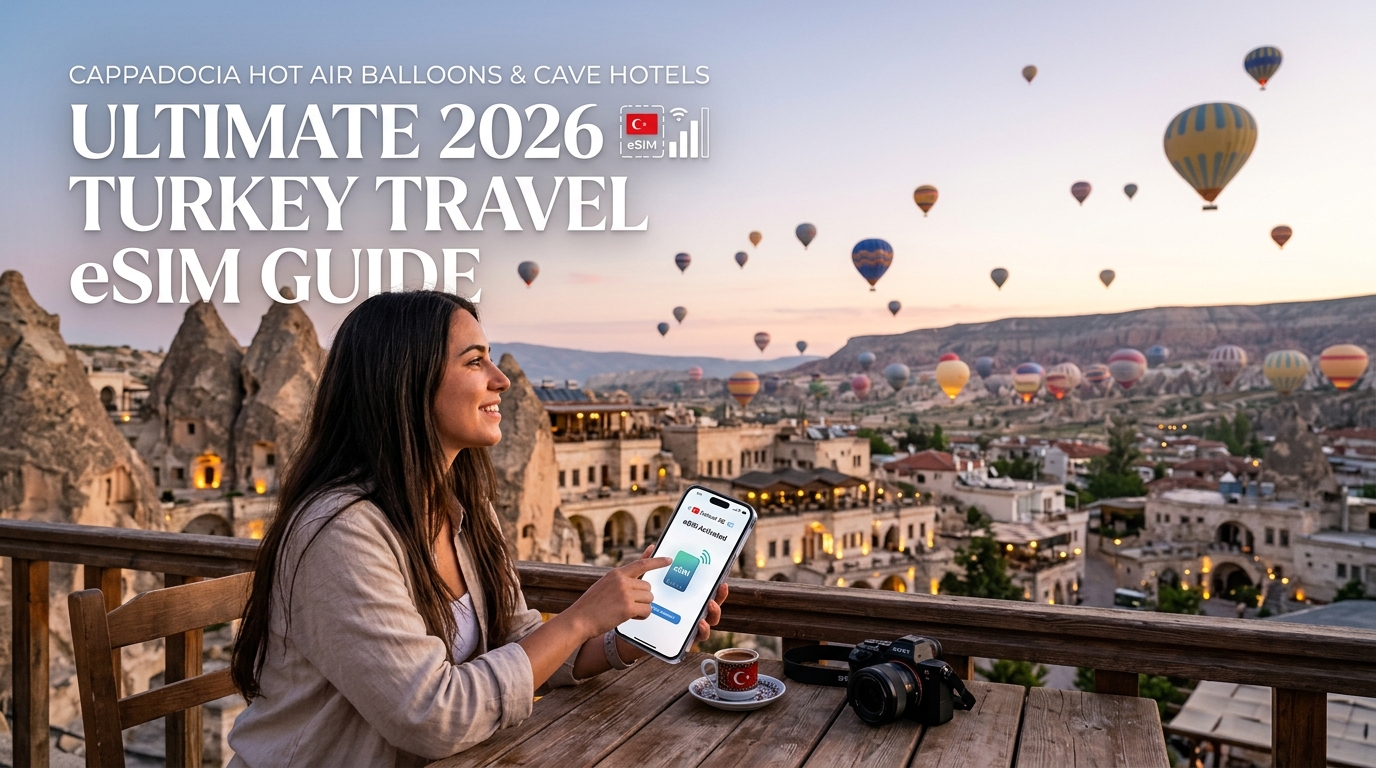
Cappadocia Hot Air Balloons & Cave Hotels: Ultimate 2026 Turkey Travel eSIM Guide
The Cappadocia Connectivity Dilemma: Volcanic Tuff Caves vs. 3,000-Foot Balloon Ascents
Navigating central Anatolia presents a telecommunications paradox found virtually nowhere else on Earth. Cappadocia’s world-famous terrain demands that your mobile device perform seamlessly across two RF (radio frequency) extremes: subterranean, mineral-heavy volcanic cave suites buried meters beneath the surface, and aerostat baskets drifting 3,000 feet Above Ground Level (AGL) at sunrise.
Understanding the physics behind these environments is essential to staying connected during your trip.
       +-------------------------------------------------------------------+
       |                   3,000 FT AGL: BALLOON FLIGHT                    |
       |  - Sector antenna downtilt misses high-altitude basket airspace   |
       |  - Rapid line-of-sight hopping causes high packet loss/drops      |
       +---------------------------------+---------------------------------+
                                         |
                                         v
       +-------------------------------------------------------------------+
       |                    GROUND LEVEL: CANYON FLOORS                    |
       |  - Standard 4G/5G terrestrial coverage (Turkcell / Vodafone)      |
       +---------------------------------+---------------------------------+
                                         |
                                         v
       +-------------------------------------------------------------------+
       |                 CAVE HOTEL SUITES (GÖREME / UÇHİSAR)              |
       |  - 1-3m carved ignimbrite tuff acts as a natural Faraday cage     |
       |  - 5GHz Wi-Fi & high-band cellular (B7/B1) heavily attenuated     |
       +-------------------------------------------------------------------+
1. The Subterranean Faraday Cage: Volcanic Tuff & Cave Hotels
Authentic cave suites across Göreme, Uçhisar, and Ürgüp are carved directly into compacted volcanic ash, known geologically as ignimbrite or tuff. While this porous rock provides natural thermal insulation, its density and mineral composition create a brutal barrier for wireless signals:
- Severe High-Band RF Attenuation: High-frequency cellular bands—such as Band 7 (2600 MHz) and Band 1 (2100 MHz), commonly used for high-speed 4G LTE/5G in Turkey—suffer extreme penetration loss when hitting 1-to-3-meter thick carved rock walls. Signal strength often drops by 20 to 35 dB within a few paces of your suite’s threshold.
- Wi-Fi Propagation Failure: Boutique cave hotels often attempt to route connectivity through standard consumer mesh routers. However, both 2.4 GHz and 5 GHz Wi-Fi frequencies reflect and absorb unevenly against hand-hewn, irregular cave walls, leaving deep dead zones in bedrooms, deep-carved bathrooms, and private plunge pools.
- Sub-Gigabit Penetration Needs: Staying connected inside a cave requires your device to lock onto lower-frequency cellular bands (like Band 20 at 800 MHz), which possess the longer wavelengths necessary to penetrate porous rock openings and deep doorways.
2. The 3,000-Foot Airspace Blackout: The Physics of Balloon Ascents
If cave walls block signals from the outside, the open skies above Love Valley and Rose Valley introduce the opposite problem: signal dispersion and cellular antenna geometry.
                  [ Hot Air Balloon: 1,500 - 3,000 ft AGL ]
                                 /         \
                                /           \  (Main lobe misses basket)
                               /             \
                              /   Sidelobes   \
                             /   (Weak/Noisy)  \
                            v                   v
     ==================================================================
                 [ Ground Cell Tower (BTS) with 2°- 8° Downtilt ]
                      \                               /
                       \==== Main Transmission Beam =/
                        \   (Engineered for Ground) /
     ------------------------------------------------------------------
During a 5:00 AM launch, as your hot air balloon ascends from the canyon floor to between 500 and 3,000 feet AGL, your phone encounters distinct transmission hurdles:
- Antenna Downtilt Optimization: Ground-based Base Transceiver Stations (BTS) across the Nevşehir province are engineered with both mechanical and electrical downtilt (typically calibrated between 2° and 8° downward). Their primary transmission lobes focus energy strictly on valley floors, roadways, and town squares—not the airspace thousands of feet above them.
- Sidelobe Interference & Packet Drop: At high altitudes, your phone loses the main transmission lobe and captures weak, scattered "sidelobes." Because your device now has an unobstructed line-of-sight to dozens of distant towers simultaneously across the Anatolian plateau, it constantly attempts aggressive handovers. This causes rapid battery drain, high jitter, and severe packet loss just as you try to livestream the sunrise.
- Valley Shadows During Low-Level Skimming: When the balloon pilot drops into canyon crevasses to show passengers the fairy chimneys up close, the towering rock spires block line-of-sight to regional towers entirely, instantly cutting off single-carrier connections.
RF Environment Comparison: Cave Suites vs. Hot Air Balloon Flight
| Connectivity Factor | Historic Cave Suites (Göreme / Ürgüp) | Hot Air Balloon Ascents (Love / Rose Valleys) |
|---|---|---|
| Primary Signal Barrier | Physical density of volcanic tuff / ignimbrite rock | Antenna downtilt angle & sidelobe signal degradation |
| Dominant Signal Path | Deep attenuation; indirect diffraction through openings | Unobstructed line-of-sight to multiple competing towers |
| Wi-Fi Availability | Highly unstable (mesh nodes blocked by rock bulkheads) | Non-existent |
| Cellular Handover State | Static, low-signal lock (often forces 3G fallback) | Rapid, continuous tower hopping causing packet loss |
| Critical Network Requirement | Low-band penetration (Band 20 / 800 MHz support) | Multi-network roaming redundancy (Turkcell + Vodafone) |
Why Multi-Network eSIM Architecture Is Non-Negotiable
Because Cappadocia’s geography pushes consumer wireless tech to its structural limits, relying on a single physical SIM or spotty hotel Wi-Fi leaves you vulnerable to frequent dropouts. If your carrier’s sole tower in Göreme is shaded by a ridge, or if its signal cannot penetrate your cave's stone arches, you are effectively offline.
The optimal solution is a dynamic, multi-network architecture. Premium travel eSIMs like MollySIM address this dilemma by partnering across major local carriers (including Turkcell and Vodafone Turkey), allowing your handset to seamlessly switch to whichever network holds the dominant line-of-sight or penetration band at that exact coordinate.
Furthermore, high-altitude photo uploads and live 4K streaming can quickly burn through base data allocations. Unlike conventional eSIM providers that throttle speeds to an unusable 128 kbps once a daily cap is reached, MollySIM maintains a generous 384 kbps Fair Use Policy (FUP) floor—3x faster than the industry standard. This ensures that even if you cap your high-speed quota mid-flight, vital background tasks like Google Maps navigation, WhatsApp location drops, and Apple Pay checkouts at valley landing sites continue running smoothly without interruption.
Turkey Network Infrastructure Breakdown: Turkcell vs. Vodafone 4G/5G Penetration in Anatolia
🌐 Global Travel High-Speed Travel eSIM & SIM Plans
Instant QR code activation, hotspot enabled, with guaranteed 384kbps fallback speed to keep Maps & Digital Wallets active.
Navigating Cappadocia’s rugged terrain requires an understanding of how Turkey’s major Mobile Network Operators (MNOs)—primarily Turkcell and Vodafone Turkey—deploy their spectrum allocations across the Anatolian plateau. While Istanbul and Ankara benefit from dense microcell layouts, Central Anatolia relies on macrocell sites mounted on elevated volcanic ridges to shoot RF (Radio Frequency) signals across expansive valleys and into deep ravine settlements.
       [Macro Tower: 800MHz (B20) + 1800MHz (B3)]
                          /             \
    Long-Wavelength B20  /               \  High-Capacity B3
     (Wide Valley + Cave)                 (Urban Core Line-of-Sight)
                       /                   \
        [Cave Hotel (Tuff)]              [Göreme Town Center]
Spectrum Allocation: Sub-1GHz Propagation vs. Mid-Band Capacity
The performance of your mobile device in Cappadocia hinges entirely on which LTE frequency band your connection latches onto:
- Band 20 (800 MHz – Low Band): This is the undisputed lifeline for Cappadocia travelers. Operating below 1 GHz, Band 20 delivers long-wavelength propagation that travels up to 15–20 kilometers from base transceiver stations (BTS). Crucially, sub-1GHz signals exhibit superior diffraction around volcanic hoodoos and penetrate porous ignimbrite (tuff) rock walls better than higher frequencies.
- Band 3 (1800 MHz) & Band 7 (2600 MHz – Mid/High Band): These mid-bands serve as high-capacity pipelines in dense nodes like central Göreme, Ürgüp, and Avanos. While they enable downlink bursts exceeding 150 Mbps, their short wavelengths suffer catastrophic attenuation when hitting cave hotel walls or descending into shadowed depressions like Love Valley or Pigeon Valley.
Turkcell vs. Vodafone: Field Performance in Central Anatolia
- Turkcell: Holds the largest allocation of low-band 800 MHz spectrum in Turkey and operates the most extensive rural tower grid across Nevşehir province. Turkcell provides the most consistent RF envelope at hot air balloon launch sites in Çavuşin and high altitudes (up to 3,000 feet AGL).
- Vodafone Turkey: Excellent capacity and throughput in commercial corridors (downtown Göreme, Uçhisar, and Nevşehir Kapadokya Airport - NAV). However, Vodafone relies more heavily on Band 3/Band 1 (2100 MHz) for urban densification, which can lead to rapid signal degradation the moment you step deep into a subterranean suite or traverse unpopulated trail networks.
Comparative Infrastructure Benchmark: Cappadocia Connectivity Options
| Performance Metric | Turkcell Direct (Tourist SIM) | Vodafone Turkey (Tourist SIM) | Pocket Wi-Fi Rentals | Multi-Carrier Travel eSIM (MollySIM) |
|---|---|---|---|---|
| Network Architecture | Single Carrier (Turkcell) | Single Carrier (Vodafone) | Single Carrier (Varies) | Dynamic Dual-Core (Turkcell + Vodafone) |
| Band 20 (800 MHz) Access | Yes (Priority LTE) | Yes (Standard LTE) | Device-dependent | Full Low-Band Access |
| Avg. Göreme Downlink / Uplink | 65 Mbps / 22 Mbps | 52 Mbps / 18 Mbps | 25 Mbps / 8 Mbps | 70+ Mbps / 25 Mbps (Auto-Optimal) |
| Hot Air Balloon Altitude Coverage | Stable up to ~3,000 ft | Variable above 1,800 ft | Intermittent (Heavy Jitter) | Stable up to ~3,500 ft (Tower Handoff) |
| Cave Interior Penetration | Moderate to High | Low to Moderate | Extremely Poor (No Line-of-Sight) | Optimized via Sub-1GHz Auto-Switch |
| Airport Purchase Markup | 200% – 350% (€40–€65 at IST/NAV) | 180% – 300% (€35–€55 at IST) | High Daily Fee + €100+ Deposit | Zero Markup (Direct Digital Provisioning) |
| Fair Use Policy (FUP) Floor | Hard cut or 64 kbps | Hard cut or 64 kbps | 128 kbps (Unusable) | 384 kbps (3x Industry Standard) |
| Average Core Latency | 35–45 ms (Local breakout) | 40–50 ms (Local breakout) | 90–140 ms (Relay overhead) | 45–60 ms (Optimized Edge Routing) |
Strategic Network Selection for the Anatolian Flyer
Because physical tourist SIM cards sold at Istanbul Airport (IST), Sabiha Gökçen (SAW), or Kayseri Erkilet (ASR) lock your device to a single carrier at exorbitant retail prices, they introduce a single point of failure. If your tour group lands in an isolated section of the Cat Valley where your physical SIM's sole carrier has a sector outage, you lose all real-time navigation and communication.
By leveraging an advanced multi-network profile like MollySIM, your handset does not operate in a silo. It evaluates local cell tower telemetry dynamically: utilizing Turkcell’s robust Band 20 footprint during high-altitude ascents and remote valley transfers, while effortlessly falling back to Vodafone’s dense Band 3/7 carrier aggregation when relaxing in central Göreme. If high-bandwidth photo streaming hits your daily quota during an extended excursion, MollySIM's 384 kbps baseline ensures critical services like Google Maps navigation, Uber calls, and Apple Pay retain full operational stability without dropping offline.
Livestreaming the Sunrise: Network Throughput & Bandwidth for 4K Aerial Broadcasts
Broadcasting a sunrise flight over the fairy chimneys of Göreme demands a network profile fundamentally different from standard mobile browsing. While scrolling social feeds relies on high downlink speeds, broadcasting real-time, high-fidelity video from a moving basket requires consistent, unthrottled uplink (UL) throughput.
Most consumer-grade tourist SIM cards sold in Turkey are configured with asymmetrical QoS (Quality of Service) profiles optimized for heavy downstream consumption (80–120 Mbps down) while capping upstream speeds to a meager 2–5 Mbps. When transmitting 4K 60fps video, this uplink bottleneck triggers immediate video artifacting, dropped frames, and stream termination.
In-Flight Broadcast Ingestion Benchmarks
To maintain an uninterrupted ultra-high-definition stream across major broadcasting and social platforms, your connection must satisfy specific upstream bitrates and latency thresholds:
| Platform & Target Format | Compression Codec | Target Bitrate (Video + Audio) | Minimum Sustained Uplink | Max Allowable Jitter / Packet Loss |
|---|---|---|---|---|
| YouTube Live (4K 60fps) | H.265 / HEVC / AV1 | 18,000 – 25,000 kbps | 25.0 Mbps sustained | < 20 ms / < 0.5% |
| YouTube Live (1440p60) | H.264 / AVC | 9,000 – 15,000 kbps | 18.0 Mbps sustained | < 30 ms / < 1.0% |
| Instagram / TikTok Live (1080p60) | H.264 (RTMP/RTMPS) | 4,500 – 8,000 kbps | 12.0 Mbps sustained | < 40 ms / < 1.5% |
| Twitch / Custom RTMP (1080p60) | H.264 / CBR | 6,000 – 8,500 kbps | 15.0 Mbps sustained | < 25 ms / < 0.5% |
Note: The sustained uplink requirement includes a mandatory 25–35% headroom buffer above target bitrates to absorb sudden radio frequency (RF) fluctuations during basket rotation.
The Altitude Radio Problem: Sidelobes and Inter-Valley Handshakes
Livestreaming from a hot air balloon introduces unique radio wave propagation challenges that grounded cell planning does not account for:
               [ Hot Air Balloon: 800m Altitude ]
                         /            \
       Fringe Sidelobe  /              \  Fringe Sidelobe
       Low RSRP / High SINR            Low RSRP / High SINR
                       /                \
                      v                  v
         [Tower A: Turkcell]        [Tower B: Vodafone]
         (Electrical Downtilt)      (Electrical Downtilt)
              \                        /
               \__ Main Lobe Coverage /
(Valley Ground Level)- Cell Tower Downtilt vs. Vertical Dispersion: Most cellular base stations (eNodeB / gNodeB) in Göreme, Uçhisar, and Çavuşin are engineered with down-tilted antennas (typically 2° to 8° electrical tilt) to blanket ground tourists inside the valleys. As your balloon climbs between 500 and 1,000 meters, your handset leaves the main beam and connects via weak vertical sidelobes, reducing the Reference Signal Received Power (RSRP).
- Topographical Shadowing: As winds push the balloon low over the ridgelines of Devrent (Imagination) Valley or Love Valley, monolithic tuff rock formations create instant line-of-sight obstructions.
- Single-Carrier Signal Freezes: On a locked single-carrier physical tourist SIM, drifting behind a basalt ridge causes your device to cling to a dying single-carrier sector (e.g., dropping to EDGE or 3G Band 8) before forcing a hard disconnect. The RTMP ingest server resets the connection, ending your broadcast to your audience.
Maintaining Broadcast Stability via Edge Routing and Multi-IMSI Handoffs
To preserve continuous 60fps telemetry without dropped frames, your handset must support fast carrier aggregation and zero-latency core switching. Dynamic connectivity through MollySIM mitigates aerial signal degradation by pairing direct access to Turkey’s top cellular tiers (Turkcell and Vodafone) with optimized edge routing:
- Sub-60ms Edge Breakouts: Bypassing slow overseas data relays prevents RTMP handshake timeouts, keeping TCP/SRT packets in continuous sync with YouTube and Meta ingest servers.
- Non-Disruptive Inter-Carrier Switching: If Turkcell’s high-band B3 (1800 MHz) signal attenuates during a low valley descent, the underlying baseband dynamically shifts downstream/upstream operations to Vodafone’s wider rural B20 (800 MHz) footprint without resetting the device's IP stack.
- Continuous Emergency Broadcast Fallback: High-resolution video feeds burn data at roughly 5 to 8 GB per hour. If a massive 4K broadcast exhausts your primary high-speed allocation mid-flight, MollySIM's 384 kbps Fair Use Policy (FUP) baseline preserves active background sessions, telemetry, and critical payment/navigation services—outperforming the industry-standard 128 kbps hard-throttles that render devices entirely inoperative.
Mastering Cave Hotel Signal Traps: Low-Band Propagation & Optimization Strategies
Carved directly into ancient volcanic tuff and compressed ignimbrite deposits, the rock-cut boutique suites of Göreme, Uçhisar, and Ürgüp present one of the most hostile RF (Radio Frequency) environments on earth. While these porous volcanic walls offer remarkable natural thermal insulation, their dense mineral composition causes severe signal attenuation, dropping cellular power levels and crippling typical hotel Wi-Fi deployments.
Understanding the physics of signal penetration through volcanic stone—and configuring your mobile operating system accordingly—is vital to maintaining high-speed connectivity inside subterranean accommodations.
The Physics of Rock Attenuation: Sub-1GHz vs. Legacy Cave Wi-Fi
Standard cave hotel Wi-Fi infrastructure relies on multi-node mesh repeaters strung through winding rock corridors. Because 2.4 GHz and 5 GHz microwave frequencies suffer attenuation rates exceeding 35 dB to 50 dB per meter of solid ignimbrite, indoor access points experience extreme multi-path interference and packet loss. When dozens of guests simultaneously upload high-resolution balloon footage in the evening, these shared backhauls throttle to a crawl.
In contrast, cellular radio waves propagate differently depending on their frequency band:
| Frequency Tier | Band Designation | Attenuation in Volcanic Tuff | Penetration Capability in Cave Rooms |
|---|---|---|---|
| Sub-1GHz Low-Band | Band 20 (800 MHz) / Band 8 (900 MHz) | Low to Moderate (~12–18 dB/m) | High: Refracts through archways, light shafts, and stone entryways. |
| Mid-Band Core | Band 3 (1800 MHz) / Band 1 (2100 MHz) | High (~28–35 dB/m) | Moderate: Functional near terrace doors and exterior windows only. |
| High-Band Capacity | Band 7 (2600 MHz) | Severe (>45 dB/m) | Poor: Absorbed within the first 30–50 cm of exterior stone. |
| Standard Mesh Wi-Fi | 2.4 GHz / 5.0 GHz UNII Bands | Catastrophic (>50 dB/m) | Unstable: High packet collision; severe ping jitter under guest load. |
By utilizing premium travel eSIM profiles from MollySIM, your device secures prioritized access to Turkey’s tier-1 low-band allocations—specifically Turkcell B20 (800 MHz) and Vodafone B20 (800 MHz). These longer wavelengths diffract through terrace portals, transoms, and courtyard openings far more effectively than standard 5 GHz Wi-Fi signals.
Step-by-Step Settings Optimization for Subterranean Suites
To eliminate connection deadlocks and prevent your handset from draining battery while cycling through unreachable high-frequency bands inside cave rooms, execute these configuration adjustments:
1. Disable Aggressive Wi-Fi Assist / Adaptive Handover
When cave hotel repeaters broadcast a strong carrier beacon without actual internet throughput, your smartphone may remain trapped on a "phantom" Wi-Fi link.
- iOS: Go to Settings > Cellular (Mobile Data) > Scroll to the absolute bottom > Toggle Wi-Fi Assist to OFF.
- Android: Go to Settings > Network & Internet > Internet > Network Preferences > Disable Switch to mobile data automatically.
2. Clear APN Routing & Enable Roaming Multipath
Ensure your eSIM APN profile is correctly aligned to prevent PDP authentication failures against local Turkish gateways:
- iOS: Navigate to Settings > Cellular > MollySIM Profile > Cellular Data Network > Verify the APN matches the direct routing string assigned in your activation voucher (set APN to dynamic auto-detect if prompted).
- Android: Go to Settings > SIMs > MollySIM > Access Point Names > Tap the active APN and ensure the APN Protocol is configured to IPv4/IPv6 dual-stack.
3. Establish an Aperture Relay Station
If your cave suite's deep sleeping alcove is shielded by more than two meters of solid rock:
- Place your primary device or a secondary travel handset on the windowsill, terrace ledge, or stone entrance arch where external Sub-1GHz line-of-sight is maintained.
- Enable Personal Hotspot over 2.4 GHz to broadcast down the interior stone corridor into your living space.
Even if you run heavy data-synchronization tasks that consume your primary high-speed bucket while working from your cave suite, MollySIM’s 384 kbps Fair Use Policy (FUP) baseline maintains reliable background performance. Operating at triple the speed of legacy 128 kbps travel throttles, this baseline ensures that critical transaction applications—including Apple Pay, Google Maps navigation caching, and WhatsApp VoIP—continue to function smoothly without leaving you stranded in a subterranean dead zone.
Off-the-Beaten-Path Anatolia: Navigating Valleys, Underground Cities, and Remote Highways
While Göreme’s tourist strip offers ubiquitous micro-cell coverage, venturing into wider Central Anatolia immediately subjects your handset to complex geographical RF attenuation. Cappadocia’s topography is characterized by deep erosion canyons, multi-tiered subterranean volcanic complexes, and windswept volcanic plateaus along intercity transit corridors. Navigating these sectors safely demands an active, resilient mobile data strategy.
       [ Hilltop Macro Cell Tower (Band 20 / 800MHz) ]
                           /       |       \
                          /        |        \
    [ Göreme Plateau ]   /         |         \   [ D300 / D765 Highways ]
         (Solid 5G/4G)  /          |          \   (Handover Zones)
                       v           |           v
           [ Ihlara Valley Gorge ] |    [ Derinkuyu / Kaymaklı ]
           (Cliff Shadow Dropout)  |    (Complete Subterranean RF Blackout)
                                   v
Subterranean Realities: Derinkuyu and Kaymaklı
The multi-level troglodyte complexes of Kaymaklı and Derinkuyu descend up to 85 meters (eight distinct levels) into compressed volcanic tuff. Solid rock of this density acts as an absolute Faraday shield against standard cellular frequencies:
- Signal Penetration Limits: Sub-1GHz cellular bands (B8/B20) degrade completely by Floor -2 (approximately 8–12 meters below surface grade).
- Pre-Descent Protocol: Before descending the entry stairwells, pre-load ticket QR codes into Apple Wallet / Google Wallet and finalize all local driver pickups on WhatsApp.
- Emergency Exit Vectors: Surface ticketing plazas and perimeter ventilation shafts feature direct line-of-sight to regional towers, allowing rapid signal re-acquisition upon egress.
Canyon Topography: The Ihlara Valley Corridor
The 14-kilometer Ihlara Valley (Ihlara Vadisi) sits inside a 100-meter-deep canyon carved by the Melendiz River. The sheer basalt cliffs create severe multipath interference and shadow zones:
- Trailhead to Belisırma: Cellular signals bounce unpredictably across canyon walls. While standard web browsing will intermittently stall, persistent background data is essential for tracking trail milestones via GPS.
- Exiting at Selime Monastery: The northern exit at Selime frequently suffers from localized rural congestion during tour bus peaks. If your rental car route recalculates due to road closures near Güzelyurt, a failed connection can leave you stranded without cached map tiles.
- Ride-Hailing & Driver Logistics: Hailing a transfer or dispatching a BiTaksi driver from rural trail exits requires uninterrupted session authentication.
Transit Corridors: Kayseri (ASR) & Nevşehir (NAV) Highways
The transit from Kayseri Erkilet Airport (ASR) (75 km east) or Nevşehir Kapadokya Airport (NAV) (40 km north) across the D300 and D765 arterial highways traverses open, high-altitude Anatolian steppe:
- High-Speed Cell Tower Handovers: Driving at speeds of 90–110 km/h across undulating plateaus forces frequent handovers between distant macro towers.
- Dynamic Rerouting: Agricultural equipment, livestock crossings, and winter black ice on the D300 require dynamic traffic telemetry via Google Maps or Waze.
- Driver Coordination: Private VIP shuttles and rental desks frequently update pick-up bays via live messaging while you are in transit.
Anatolian Outlying Region Connectivity Matrix
| Location / Corridor | Environment Type | Expected Cellular Signal | Navigation / Data Risk | Operational Recommendation |
|---|---|---|---|---|
| Derinkuyu Underground | Subterranean Tuff (-85m) | No Service below Floor -2 | High (Loss of messaging/tickets) | Cache offline maps; download museum passes before entry. |
| Ihlara Valley Floor | Deep Basalt Canyon | Intermittent 3G / 4G | Moderate (GPS drift, delayed routing) | Keep location services active; lock route before descending. |
| D300 Highway (ASR Corridor) | High-Altitude Steppe | Stable 4G / LTE | Low (Tower handover latency) | Maintain continuous dynamic traffic updates. |
| Soğanlı Valley | Remote Rural Basin | Variable 4G (Band 20) | High (Sparse taxi/driver coverage) | Pre-arrange return transport timestamps via WhatsApp. |
| Pigeon Valley Trail | Open Gorge Trail | Solid 4G / 5G Edge | Low (Minor cliff shadowing) | Live mapping fully functional along rim trails. |
Maintaining Operational Uptime with MollySIM
Losing high-speed bucket allocation in the middle of a remote Anatolian gorge can compromise your travel safety. Standard travel eSIMs throttle depleted profiles to an unworkable 64–128 kbps—a threshold that systematically causes SSL/TLS timeouts on critical navigation and ride-hailing services.
Using MollySIM mitigates this risk through its 384 kbps Fair Use Policy (FUP) baseline. Operating at 3x the speed of legacy competitor limits, this persistent fallback pipeline ensures:
- Continuous vector downloads and dynamic rerouting in Google Maps and Apple Maps.
- Frictionless two-way authentication for BiTaksi, Uber, and banking validation pop-ups (3D Secure / Apple Pay).
- Low-latency WhatsApp VoIP communication with local guides, transfer drivers, and emergency roadside services across all Turkish highway networks.
Why MollySIM is the Definitive 2026 Turkey Travel Solution: Dual Carrier Switching & 384kbps Safety Net
Navigating the unique topography of Cappadocia—from subterranean volcanic tufa cave suites to hot air balloons floating 800 meters above the fairy chimneys of Paşabağ Valley—demands an infrastructure-level cellular solution. Traditional travel eSIMs typically partner with a single local network via a wholesale roaming agreement. If that single carrier experiences an azimuth dead zone or local base transceiver station (BTS) congestion, your connection drops entirely.
MollySIM eliminates this single-point-of-failure vulnerability by integrating an intelligent, real-time multi-carrier switching core built specifically for international travelers in Turkey.
Autonomous Dual-Carrier Handover: Turkcell & Vodafone Turkey
MollySIM dynamically negotiates connections between Turkey’s two top-tier infrastructure providers: Turkcell (the country's widest national footprint with robust rural Band 20 deployment) and Vodafone Turkey (dense urban/suburban microcell capacity).
This automated profile-switching mechanism guarantees continuous data links across distinct Cappadocia environments:
- High-Altitude Flight Envelopes: As your balloon drifts between Göreme and Love Valley, signal polarization shifts rapidly. MollySIM automatically latches onto the base station offering the highest Link Quality Indicator (LQI), preventing flight live-streams from dropping mid-air.
- Cave Hotel Courtyards & Historic Suites: Carved volcanic rock severely attenuates mid-band cellular frequencies. When mid-band (1800/2100 MHz) signals degrade, the eSIM immediately prioritizes the carrier broadcasting the strongest low-band spectrum (Band 20 / 800 MHz) penetrating the stone walls.
- Remote Highway Corridors: Seamless tower handovers ensure uninterrupted routing while navigating rental vehicles along the D300 and secondary rural routes toward Derinkuyu and Ihlara.
The 384 kbps Safety Net: Preserving Critical App Functionality
The biggest vulnerability with conventional travel eSIMs is the catastrophic "data wall." Most providers either cut your connection completely once the high-speed tier runs out or throttle your bandwidth down to an unusable 64 kbps or 128 kbps. At 128 kbps, modern HTTPS-heavy travel applications fail due to SSL/TLS handshake timeouts.
MollySIM resolves this with an industry-leading 384 kbps Fair Use Policy (FUP) safety baseline—operating at 3x the throughput of legacy travel eSIM providers.
| Travel Application | Legacy Throttling (64–128 kbps) | MollySIM Safety Net (384 kbps) | Operational Impact in Cappadocia |
|---|---|---|---|
| Google Maps / Apple Maps | Fails (Vector tile load timeout) | Functional (Real-time live routing) | Never get lost traversing unmarked valley trails or remote Anatolian backroads. |
| BiTaksi & Uber Summoning | High failure rate (Socket drop) | Fully Functional | Instant driver hailing from remote open-air museums back to your hotel. |
| Banking & 3D Secure SMS/Push | Timed Out (Auth expired) | Instant Verification | Approve flight changes, hotel deposits, and museum entries on the spot. |
| WhatsApp & VoIP Calls | Audio clipping / Packet loss | Crystal Clear Voice & Text | Coordinate balloon pick-ups and transfers directly with your pilot and concierge. |
| Digital Boarding Passes | Render failure (PKPass sync fail) | Instant Refresh | Smooth boarding transitions at Nevşehir Kapadokya (NAV) and Kayseri (ASR) airports. |
Zero Bill Shock and Total Travel Autonomy
With MollySIM, your Turkish journey remains entirely free from unexpected roaming surcharges and sudden operational lockouts. Even if you completely exhaust your primary high-speed data tier while uploading 4K reels from a panoramic terrace in Uçhisar, your critical travel stack remains online. You can top up additional high-speed gigabytes through the portal without ever needing to search for unsecured public Wi-Fi networks.
🌐 Global Travel High-Speed Travel eSIM & SIM Plans
Instant QR code activation, hotspot enabled, with guaranteed 384kbps fallback speed to keep Maps & Digital Wallets active.