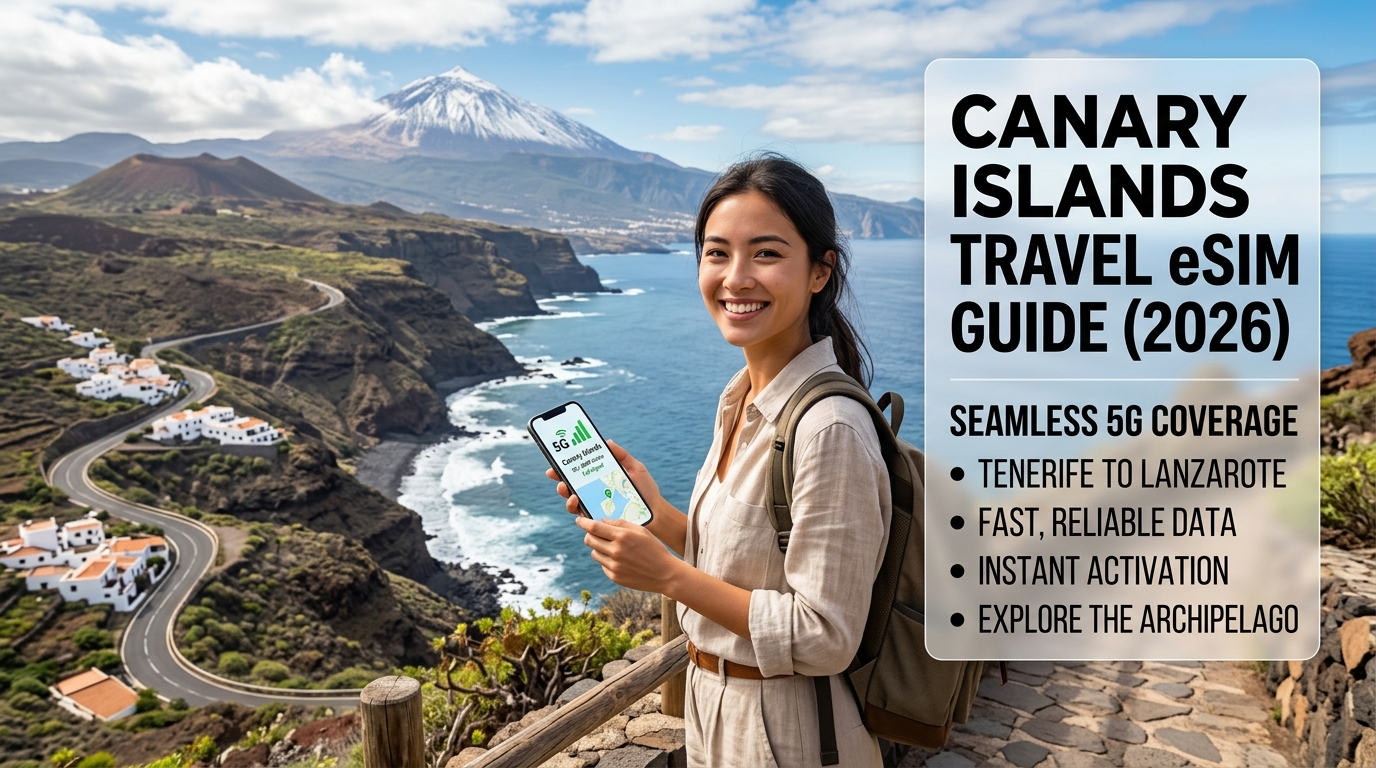
Canary Islands Travel eSIM Guide (2026): Seamless 5G Coverage from Tenerife to Lanzarote
Navigating the Canary Islands Cellular Landscape: Topography, 5G Infrastructure, and Carrier Realities
Deploying reliable mobile connectivity across the Canary archipelago involves navigating one of the most geographically complex environments in Spanish territory. While mainland Spain enjoys contiguous terrestrial backbones, the seven primary islands—Tenerife, Gran Canaria, Lanzarote, Fuerteventura, La Palma, La Gomera, and El Hierro—rely on a hybrid network of undersea fiber cables (such as the Canalink system) and high-capacity microwave links to interface with mainland Tier-1 exchanges in Cádiz and Seville.
Understanding how local carriers deploy spectrum across this unique landscape is critical for maintaining uninterrupted 5G data during inter-island travel.
Spanish Tier-1 Operators: Spectrum and Island Deployment
The Spanish telecommunications market is dominated by three major infrastructure owners, each operating distinct radio access networks (RAN) across the islands:
| Operator | Primary 5G Bands | Coastal/Resort Coverage | Mountain & Rural Interior Coverage | Best Use Case |
|---|---|---|---|---|
| Movistar (Telefónica) | n78 (3.5 GHz), n28 (700 MHz) | 99% (Excellent) | 94% (Superior rural footprint) | Hiking remote trails, inter-island ferries, Teide National Park |
| Orange (MasOrange) | n78 (3.5 GHz), n28 (700 MHz), n1 (2.1 GHz) | 98% (High throughput) | 88% (Solid road corridor coverage) | High-speed urban downloads, remote work hubs in Las Palmas/Santa Cruz |
| Vodafone Spain | n78 (3.5 GHz), n28 (700 MHz) | 97% (Very Good) | 82% (Patchy in deep ravines) | Major resort towns (Playa de las Américas, Maspalomas) |
- Movistar holds the historical infrastructure monopoly. Its deployment of 700 MHz (Band n28) spectrum gives it the best non-line-of-sight signal propagation through basalt rock and deep ravines (barrancos).
- MasOrange (the merged entity of Orange España and MásMóvil) operates a dense network of 3.5 GHz (n78) microcells across the major metropolitan belts of Las Palmas de Gran Canaria and Santa Cruz de Tenerife, delivering gigabit-level peak download speeds in urban cores.
- Vodafone Spain offers solid standalone 5G pockets in southern tourism corridors but drops to legacy 4G/LTE faster than Movistar when traversing winding mountain passes.
Volcanic Topography vs. RF Signal Propagation
The Canary Islands present severe physical barriers to radio frequency (RF) propagation. The archipelago's volcanic origin creates micro-climates, massive elevation deltas, and dense basalt formations that disrupt conventional cell planning:
- High-Altitude Attenuation (Mount Teide & Roque de los Muchachos):
At 3,718 meters, Mount Teide creates substantial radio shadows across Tenerife’s interior. Cell towers placed along the TF-21 highway cannot penetrate deep caldera depressions, forcing devices onto low-band 700/800 MHz frequencies or causing total signal dropouts behind sheer volcanic rims.
- The "Barranco" Multipath Trap (Masca Valley & Guayadeque):
Deep ravines (barrancos) carved through volcanic rock cause extreme multipath interference. Cellular signals bounce off vertical canyon walls, degrading signal-to-noise ratios (SNR). In locations like Masca (Tenerife) or the Guayadeque ravine (Gran Canaria), a single-carrier SIM often locks onto a degraded reflection, draining device battery through aggressive power escalation.
- Low-Density Volcanic Plains (Timanfaya & Corralejo Dunes):
Lanzarote’s Timanfaya National Park and Fuerteventura’s sand plains suffer from low cell tower density due to environmental conservation regulations. Signals rely on long-distance propagation from peripheral macro-sites, where mid-band 5G (3.5 GHz) quickly attenuates, leaving users reliant on 4G LTE fallback.
The EU Roaming Paradox and Roaming Throttles
While the Canary Islands are an autonomous community of Spain and officially part of the EU "Roam Like at Home" (RLAH) statutory framework, relying on a domestic mainland EU SIM or a fixed single-carrier profile introduces operational friction:
- Fair Use Policy (FUP) Caps: EU-based travelers often discover that their "unlimited" domestic plans are strictly capped under RLAH formulas when roaming in the islands, triggering steep per-gigabyte surcharges or hard throttling down to unusable speeds once threshold allocations (often 15–30 GB) are met.
- Non-EU Roaming Blocks: Travelers from the UK, North America, and Asia frequently experience high carrier day-pass fees ($10–$15/day) that route traffic through home-country packet gateways (PGWs), introducing 150ms+ latency penalties.
The Multi-Network Travel eSIM Advantage
To overcome single-carrier blind spots and geographic signal shadows, modern travel connectivity relies on multi-network dynamic switching.
Instead of binding your phone’s baseband modem to a single local MNO's cell sites, advanced solutions like MollySIM provision multi-IMSI and dynamic profile capabilities. Your device seamlessly roams between Movistar and Orange, attaching to whichever base transceiver station (BTS) provides the highest Reference Signal Received Power (RSRP) at any given coordinate.
Furthermore, remote island exploration carries the risk of exhausting high-speed data buckets in areas without public Wi-Fi. While legacy travel eSIMs throttle users to an unusable 64kbps or 128kbps—breaking navigation and payment apps—MollySIM implements a 384kbps Fair Use Policy (FUP) speed limit. This speed is roughly three times faster than standard competitor throttles, ensuring essential vector map rendering on Google Maps, WhatsApp voice messaging, and contactless Apple Pay / Google Wallet authorizations remain fully operational, even if high-speed data is fully consumed in the volcanic interior.
Island-by-Island Connectivity Guide: From Remote Volcanic Beaches to Open-Sea Ferry Crossings
🌐 Global Travel High-Speed Travel eSIM & SIM Plans
Instant QR code activation, hotspot enabled, with guaranteed 384kbps fallback speed to keep Maps & Digital Wallets active.
The diverse geography of the Canary Islands—ranging from multi-thousand-meter volcanic peaks to sea-level coastal plains—creates stark micro-climates for cellular radio frequencies (RF). While urban coastal hubs boast continuous multi-gigabit Sub-6 GHz 5G, inland topography requires intelligent carrier switching to maintain low latency.
┌─────────────────┬──────────────────────────┬─────────────────────────┬────────────────────────┐
│ Island          │ Primary Network Lead     │ Challenging Terrains    │ Average Expected Speed │
├─────────────────┼──────────────────────────┼─────────────────────────┼────────────────────────┤
│ Tenerife        │ Orange (Urban) /         │ Anaga Rural Park,       │ 120–450 Mbps (Urban)   │
│                 │ Movistar (Highlands)     │ Masca Gorge, Mount Teide│ 15–40 Mbps (Interior)  │
├─────────────────┼──────────────────────────┼─────────────────────────┼────────────────────────┤
│ Gran Canaria    │ Movistar & MasOrange     │ Tejeda Caldera,         │ 150–500 Mbps (Coast)   │
│                 │ (Equal Coverage)         │ Fataga Ravine           │ 25–60 Mbps (Highlands) │
├─────────────────┼──────────────────────────┼─────────────────────────┼────────────────────────┤
│ Lanzarote       │ Movistar                 │ Timanfaya Badlands,     │ 80–250 Mbps (Coast)    │
│                 │                          │ La Geria Vineyards      │ 10–30 Mbps (Basalt)    │
├─────────────────┼──────────────────────────┼─────────────────────────┼────────────────────────┤
│ Fuerteventura   │ Orange                   │ Cofete Peninsula,       │ 70–200 Mbps (North)    │
│                 │                          │ Tindaya Open Plains     │ 5–20 Mbps (Off-grid)   │
├─────────────────┼──────────────────────────┼─────────────────────────┼────────────────────────┤
│ La Gomera       │ Movistar (Band 20 Focus) │ Garajonay Cloud Forest, │ 30–90 Mbps (Valleys)   │
│                 │                          │ Valle Gran Rey Basalt   │ Edge/3G in dense mist  │
└─────────────────┴──────────────────────────┴─────────────────────────┴────────────────────────┘
Tenerife: High-Density 5G vs. Deep Ravine Attenuation
Tenerife represents the archipelago's most polarized connectivity environment. The metropolitan corridors spanning Santa Cruz de Tenerife and San Cristóbal de La Laguna, down through the tourist strips of Los Cristianos and Costa Adeje, feature dense small-cell deployments delivering standalone 5G speeds exceeding 450 Mbps.
However, moving toward the northeast into the ancient laurel forests of Anaga Rural Park (TF-12 route) or the sheer cliffs of the Masca Gorge, signal propagation degrades sharply:
- The Anaga Shadow: Steep basalt ridges block line-of-sight (LoS) to coastal base transceiver stations (BTS). Devices lock onto lower-frequency Band 20 (800 MHz) or Band 28 (700 MHz) LTE carriers to punch through foliage.
- Mount Teide Plateau (TF-21): The volcanic crater (Las Cañadas) sits above the cloud line at 2,000+ meters. Coverage is surprisingly broad due to unobstructed line-of-sight to high-altitude repeaters on Izaña, but data throughput drops under heavy weekend tourist loads.
Using MollySIM allows your handset to pivot from Orange’s high-capacity urban bands to Movistar’s deeply entrenched rural 700/800 MHz towers without manual network restarts.
Gran Canaria: Digital Nomad Hubs and Desert Signal Scattering
Gran Canaria functions as Europe’s premier winter digital nomad destination. Las Palmas de Gran Canaria (specifically the Las Canteras and Guanarteme tech corridors) provides low-latency (<25ms) 5G, ideal for bandwidth-intensive remote workflows.
- Maspalomas & Playa del Inglés: The southern dune system creates an open RF environment, though shifting sands and lack of direct mast infrastructure right on the beachfront can cause minor multipath fading.
- The Central Caldera (Tejeda & Roque Nublo): Driving the GC-60 leads into deep vertical canyons where single-carrier travel eSIMs often drop into continuous hunting mode, draining battery life. Dual-carrier access ensures continuous handshakes between village micro-cells.
Lanzarote: Volcanic Basalt Mineral Absorption
Lanzarote’s stark, lunar terrain presents a unique telecommunications hurdle: volcanic rock attenuation. High concentrations of basaltic lava fields (malpaís) in areas like Timanfaya National Park and the sunken vine pits of La Geria absorb and scatter RF waves more aggressively than standard sedimentary soil.
- Coastal Resorts (Playa Blanca, Puerto del Carmen): Strong 5G coverage powered by micro-sites along the maritime promenades.
- La Geria Wine Region (LZ-30): Signal levels fluctuate between 5G and 3G as low-profile cell towers are intentionally disguised to comply with strict Biosphere Reserve aesthetic regulations.
Fuerteventura: Offshore Trade Winds and Off-Grid Dirt Tracks
As the flattest island, Fuerteventura benefits from extensive line-of-sight propagation, but it suffers from severe micro-edge dead zones along remote coastal fringes.
- Corralejo and El Cotillo: Excellent high-speed 5G despite persistent trade winds. Coastal towers handle high concurrent user counts from kite and windsurfers streaming high-definition video from the water's edge.
- The Cofete Wilderness Track: Reaching the isolated western beach of Cofete requires traversing an unpaved mountain pass. Cellular service is intermittent to nonexistent along the lower beach floor. If you exhaust your high-speed quota while navigating offline maps back to Morro Jable, MollySIM’s 384kbps FUP floor provides enough sustained bandwidth to pull live routing telemetry and execute contactless mobile payments at local mountain checkpoints—far outperforming the 64–128kbps limits enforced by standard roaming providers.
La Gomera: Cloud Forests and Deep Barrancos
La Gomera’s terrain is defined by radial valleys (barrancos) carved into a central volcanic plateau. The dense, high-humidity cloud forest of Garajonay National Park causes significant signal attenuation for high-frequency bands.
- San Sebastián Port & Valle Gran Rey: Reliable 4G/5G coverage supported by localized hillside base stations.
- Interior Hiking Trails: RF propagation is heavily reliant on Movistar’s sub-1GHz spectrum. Expect data speeds to dip to 10–25 Mbps when trekking under thick, moisture-laden laurel canopies.
Maritime Inter-Island Ferry Connectivity (Fred. Olsen & Naviera Armas)
Traveling between islands via high-speed trimaran (Fred. Olsen Express) or conventional roll-on/roll-off ferry (Naviera Armas) presents a distinct technical hurdle: maritime RF path loss.
[ Island A: Coastal BTS ]
         \
          \ ~12-15 km Line-of-Sight Limit
           \
~~~~~~~~~~~~[ Ferry in Open Channel: Signal Drop / Roaming Zone ]~~~~~~~~~~~~
                                                              \
                                                               \
[ Island B: Target BTS ]- The Terrestrial Line-of-Sight (LoS) Limit: Standard coastal cell towers project radio signals approximately 12 to 15 kilometers out to sea, depending on mast elevation and atmospheric ducting.
- The Mid-Channel Blind Spot: During crossings such as the Tenerife (Los Cristianos) to La Gomera (San Sebastián) or Playa Blanca (Lanzarote) to Corralejo (Fuerteventura) routes, your device loses terrestrial signal in the central maritime channel. Onboard commercial satellite Wi-Fi is notoriously congested, high-latency (>600ms), and expensive.
- Dynamic Port Landfall Re-association: As the vessel nears the destination island's coastal shelf, your phone encounters competing signals from new base stations. Single-network eSIMs frequently lock onto faint, unreachable towers from the departure island. A dynamic multi-network profile like MollySIM automatically evaluates the downstream RSRP metrics, cleanly shedding the degraded signal and attaching to the strongest local cell tower before the ferry finishes docking.
Connectivity Methods Compared: Local Airport SIMs vs. Pocket Wi-Fi vs. MollySIM Travel eSIM
Selecting the right connectivity medium determines whether you enjoy continuous navigation across the winding switchbacks of Gran Canaria or find yourself stranded with zero signal when your carrier drops coverage. International visitors landing in the archipelago typically choose between four distinct data solutions.
| Feature / Metric | MollySIM Travel eSIM | Local Airport SIM (Movistar / Vodafone) | Home Carrier Roaming (US / UK / CA) | Portable Pocket Wi-Fi Rental |
|---|---|---|---|---|
| Initial Cost / Rates | Low prepaid rate; zero hidden airport surcharges | €20–€40 upfront with steep airport retail markup | $10–$15/day flat fees or aggressive pay-as-you-go rates | €8–€12/day + high security deposit & return shipping |
| 5G Access & Performance | Uncapped low-latency 5G/4G LTE on tier-1 partner towers | Direct 5G access (subject to single-carrier network load) | Throttled international roaming profiles; heavy latency | Limited to 4G LTE cat-4/cat-6 shared over 2.4/5GHz Wi-Fi |
| Multi-Carrier Redundancy | Yes (Automated fallback between Movistar & Orange) | No (Locked to one physical carrier's infrastructure) | Varies (often locked to a single foreign partner agreement) | No (Single local SIM pre-installed inside device) |
| Setup & Identity Mandates (KYC) | Instant setup: Zero passport scans or bureaucratic delays | Mandatory physical passport registration via Spanish kiosk agents | Zero setup, but requires roaming pre-authorization | Physical pickup/drop-off counters, hardware charging |
| Hardware & Battery Impact | Zero hardware footprint; optimal native modem efficiency | Requires physical SIM tray swapping & ejector tool | Native device efficiency | High battery drain on phone via Wi-Fi; requires charging 2 devices |
| Inter-Island Transit Stability | High (dynamically re-associates to strongest regional base station) | Poor inland/marine fallback if primary carrier lacks local mast | Moderate to poor (high packet loss during cell reselection) | Single-network dropouts; extra wireless hop increases packet loss |
| Post-Data Cap Policy | Uninterrupted 384 kbps safety net (Google Maps & Apple Pay remain active) | Complete data termination or complex top-up portals | Severe throttle (often 64–128 kbps) or expensive overages | Hard cutoff or heavy daily throttling after 1–2 GB |
The Terminal Bottleneck: Spanish eKYC Laws vs. Digital Instant Activation
Under Spain’s Ley 25/2007 de Conservación de Datos Relativos a las Comunicaciones Electrónicas, anonymous prepaid telecommunications are strictly illegal. Buying a local physical SIM card upon landing at Tenerife South Airport (TFS) or Gran Canaria Airport (LPA) requires an in-person, manual identity verification check:
During peak European holiday arrivals, the retail lines at TFS and LPA kiosk desks frequently exceed 30 to 45 minutes. If flight delays push your landing past standard retail operating hours (typically 21:00 or 22:00), physical kiosk options disappear entirely, leaving travelers dependent on spotty, unencrypted airport Wi-Fi to book ground transportation.
By deploying an eSIM architecture via MollySIM, your profile bypasses Spanish retail counter queues entirely. Installation takes under a minute using an automated profile push or QR code scan, allowing your device to negotiate an immediate, secure connection with the nearest coastal cell tower while your plane is still taxiing to the gate.
Multi-Carrier Failover and the 384 kbps Safety Net
Physical local SIMs lock your device to a single carrier’s infrastructure. If you buy a physical Vodafone SIM at the airport and head into the deep volcanic valleys of Valle Gran Rey (La Gomera) or the high-elevation caldera of El Teide (Tenerife), your connectivity drops the moment Vodafone's local infrastructure encounters a terrain shadow—even if a Movistar base station is operating within clear line of sight.
MollySIM provisions a multi-carrier roaming profile capable of dynamically jumping between Spain's primary cellular operators (Movistar and Orange), ensuring continuous coverage across microclimates and isolated volcanic barrancos.
Furthermore, standard travel SIMs impose an immediate, hard data cutoff the second your quota hits zero, instantly disabling live navigation, rideshare apps, and payment verification. MollySIM integrates an always-on 384 kbps Fair Use Policy (FUP) safety net. Unlike legacy roaming solutions that throttle speeds down to a non-functional 64 kbps or 128 kbps, a sustained 384 kbps data pipeline delivers enough throughput to keep:
- Google Maps & Apple Maps actively streaming real-time vector routing data,
- WhatsApp and Signal processing text messages, voice notes, and coordinate pins,
- Apple Pay and Google Wallet completing cloud tokenization handshakes at point-of-sale terminals without timing out.
Digital Nomads, Co-Living, and Remote Work: Bandwidth Demands in the Macaronesian Tech Hub
The Canary Islands have evolved into Europe’s premier winter tech hub. Neighborhoods like Guanarteme in Las Palmas, the surf-and-work strips of Corralejo (Fuerteventura), and the colonial corridors of Puerto de la Cruz (Tenerife) host thousands of software engineers, founders, and distributed teams operating on Central European Time (CET) and GMT.
However, remote production environments impose rigorous network demands that standard tourist data packs cannot sustain.
+-----------------------------+------------------------------------+----------------------------------+
| Workload / Task             | Minimum Bandwidth (Down/Up)        | Latency Sensitivity              |
+-----------------------------+------------------------------------+----------------------------------+
| 1080p Video Calls (Meet)    | 3.0 Mbps / 3.0 Mbps (Symmetric)    | High (<50ms jitter tolerance)    |
| Cloud IDE / SSH Sessions    | 0.5 Mbps / 0.5 Mbps                | Critical (Packet loss drops CLI) |
| WireGuard / IPSec VPN       | 5.0 Mbps / 2.0 Mbps + Overhead     | High (Keepalive packet timeout)  |
| Heavy Git Push / Docker Pull| 25.0 Mbps / 10.0 Mbps              | Low (Throughput-bound)           |
+-----------------------------+------------------------------------+----------------------------------+
The Pitfalls of Shared Co-Living Wi-Fi
Relying exclusively on co-living or café Wi-Fi in the archipelago introduces significant operational risks:
- Peak-Hour Contention & Bufferbloat: Between 18:00 and 22:00, local fiber routers face severe bandwidth contention as co-working spaces transition to residential streaming, driving ping spikes that break active UDP video streams.
- Subsea Cable & Island Grid Instability: While mainland Spain boasts world-class FTTH (Fiber to the Home), local distribution on volcanic terrain relies on localized aerial cabling and older island power substations. Brief brownouts or physical line faults can knock out a neighborhood’s landline internet for hours.
- Aggressive Firewalling: Public and shared networks in hospitality hubs frequently block specialized ports used for custom SSH tunnels, raw database connections, and proprietary corporate VPN protocols.
Mobile Hotspot Redundancy and 5G Failover
To maintain continuous deployment pipelines and client commitments, professionals treat their mobile connection as an enterprise-grade failover. MollySIM unlocks unthrottled personal hotspot and tethering across all Canary Island profiles, enabling dual-SIM smartphones to bridge laptops, tablets, and secondary devices directly to high-speed Sub-6 GHz 5G bands (including n78 for high throughput and n28 for indoor penetration).
Because MollySIM leverages multi-carrier roaming across Movistar and Orange, remote workers can bypass localized network congestion by simply toggling their cellular network operator if a specific tower experiences heavy localized traffic.
The 384 kbps FUP Advantage During Production Sprints
Exceeding your primary high-speed data allocation in the middle of a release sprint or client presentation can break an entire workday if your provider enforces a hard cut-off or drops you to a frozen 64 kbps or 128 kbps tier.
Standard Travel eSIM (128 kbps)  [===>------------------------] High Packet Loss, Timed-out APIs
MollySIM Safety Net (384 kbps)   [=========>------------------] 3x Throughput: Continuous Slack & Auth
At 384 kbps—exactly 3x faster than legacy 128 kbps competitor limits—MollySIM’s continuous Fair Use Policy (FUP) prevents workflow termination:
- Real-Time Communication: Slack, Microsoft Teams, and Discord maintain active WebSocket connections, processing live text chat, system mentions, and code snippets without drops.
- Authentication Pipelines: Cloud-based Two-Factor Authentication (2FA) apps, Okta verify pushes, and hardware security token handshakes resolve instantly without gateway timeout errors.
- Lightweight Terminal Sync: Secure Shell (SSH) sessions and Git command-line commits (
git push,git status) transmit cleanly without packet fragmentation. - Core Logistics: Emergency email dispatch, Google Docs text synchronization, and secure web banking authentication remain fully functional until you choose to top up your high-speed quota.
Step-by-Step Guide: Installing, Activating, and Optimizing Your Canary Islands eSIM
Setting up your mobile connectivity should happen before you board your flight to Tenerife (TFS/TFN), Gran Canaria (LPA), or Lanzarote (ACE). Configuring Dual SIM Dual Standby (DSDS) properly ensures zero disruption to essential two-factor authentication (2FA) codes while preventing your home carrier from charging accidental daily roaming penalties ($10 to $15 per day).
Step 1: Pre-Departure Installation via Secure Wi-Fi (T-24 Hours)
Provisioning an eSIM profile requires an uninterrupted exchange with the remote SM-DP+ (Subscription Manager Data Preparation) server. Always perform this initial download on a stable home or office Wi-Fi network before departure.
On iOS (iPhone 11 through 16 Pro Max):
- Navigate to Settings > Cellular (or Mobile Data).
- Tap Add eSIM > Use QR Code.
- Scan the activation QR code delivered to your inbox from MollySIM. (Alternatively, tap "Enter Details Manually" and paste the provided SM-DP+ Address and Activation Code).
- Assign a custom label to the new profile (e.g., "Canaries Travel" or "MollySIM") to avoid confusing it with your domestic line.
- Set your Default Voice Line to your domestic carrier, but leave the eSIM toggled OFF until you begin your descent into the archipelago.
On Android (Google Pixel, Samsung Galaxy S20–S25, Foldables):
- Open Settings > Connections (or Network & internet) > SIMs / SIM Manager.
- Tap Add eSIM > Scan QR code from service provider.
- Scan your activation code and confirm the profile installation.
- Rename the card to "MollySIM Canaries".
Step 2: In-Flight Dual SIM Configuration & Roaming Shielding
As your aircraft approaches Spanish airspace, adjust your operating system’s routing tables to ensure data traffic uses the travel profile exclusively.
| Setting | Domestic / Home Carrier SIM | MollySIM Travel eSIM |
|---|---|---|
| SIM Status | ON (Active for SMS & Incoming Calls) | ON (Primary Data Pipe) |
| Mobile / Cellular Data | Deselected | Selected as Primary |
| Data Roaming Toggle | OFF (Blocks predatory daily carrier passes) | ON (Enables local multi-network roaming) |
| Allow Cellular Data Switching | OFF (Crucial to prevent silent data leakages) | N/A |
| Wi-Fi Calling | ON (Enables domestic calls over eSIM data) | N/A |
Critical Roaming Shield: Disabling "Allow Cellular Data Switching" (iOS) or "Auto Data Switching" (Android) is vital. If this setting remains active, your phone may silently route background data to your primary home SIM whenever your travel eSIM encounters a momentary signal dip in a volcanic ravine, instantly triggering home-carrier roaming fees.
Step 3: Enabling Automated Multi-Carrier Handover
MollySIM operates with non-steered multi-IMSI access across Spain's tier-1 national infrastructure—including Movistar, Orange, and Vodafone España.
To verify automatic network handover:
- Go to Settings > Cellular > select your MollySIM profile.
- Select Network Selection.
- Ensure the toggle is set to Automatic.
If you hike into an isolated valley (such as Masca in Tenerife or Barranco de Guayadeque in Gran Canaria) and encounter latency on one network, toggle Automatic to Manual, wait 10 seconds for the scan, and manually lock onto Movistar for optimal low-band (800 MHz Band 20) penetration.
Step 4: Terrain-Specific Optimization for the Canary Islands
The extreme topography of volcanic islands creates dramatic micro-climates and RF shadow zones. Implement these technical configurations to maximize battery life and preserve high-speed bandwidth:
+-----------------------------------------------------------------------------------+
| Canary Islands Travel Optimization Checklist                                      |
+-----------------------------------------------------------------------------------+
| [X] Cache Offline Google Maps / AllTrails zones (Teide, Anaga, Timanfaya)         |
| [X] Switch Radio Mode from "5G On" to "5G Auto" or "LTE" in remote barrancos       |
| [X] Set Cloud Photo Backups (iCloud / Google Photos) to "Wi-Fi Only"              |
| [X] 384 kbps FUP Active: Critical navigation and Apple Pay remain 100% operational |
+-----------------------------------------------------------------------------------+- Mitigate Transceiver Battery Drain in Barrancos: In steep ravines, your phone’s baseband modem ramps up transmission power to negotiate high-frequency 5G signals. Navigate to Cellular Data Options > Voice & Data and select 5G Auto or lock to LTE. This prevents rapid battery drain caused by continuous high-band NR searches.
- Pre-Cache High-Altitude Topographic Maps: Cell signal drops off in remote sections of Mount Teide National Park, Garajonay (La Gomera), and the Caldera de Taburiente (La Palma). Download offline map rectangles via Google Maps or AllTrails over your hotel Wi-Fi prior to departure.
- Background Data Quarantine: Prevent background sync tasks from consuming your high-speed quota by setting iCloud Photos, Google Photos, and OneDrive to sync over Wi-Fi only.
- Zero-Interruption Safety Floor: If you run through your high-speed allowance mid-trek, MollySIM's built-in 384 kbps Fair Use Policy safety net provides 3x the standard throughput of legacy 128 kbps options. This ensures live turn-by-turn navigation on Google Maps, emergency instant messaging via WhatsApp, and POS transactions via Apple Pay/Google Wallet continue working without interruption.
Zero Connectivity Blackouts: Why MollySIM is the Ultimate 2026 Travel Companion for the Canaries
Navigating the unique geography of the Canary Islands demands a connectivity solution that adapts to extreme topographic shifts. Between deep volcanic ravines (barrancos), high-altitude microclimates, and remote ocean-facing cliffs, standard travel SIMs often fail when you need them most. MollySIM eliminates the vulnerabilities of legacy travel data options, delivering enterprise-grade mobile infrastructure tailored for holidaymakers, remote workers, and cross-island explorers.
1. Eradicate Spanish Carrier Bureaucracy and Surprise Roaming Fees
Traditional Spanish prepaid SIM cards (like those sold by Movistar, Vodafone, or Orange at airport kiosks) still require mandatory passport registration, complex SMS-based activation codes, and strict local verification laws (Ley 25/2007). If you exhaust your balance mid-trip, recharging requires navigating Spanish-language web portals that frequently reject non-Spanish credit cards or apply punitive foreign transaction fees.
With MollySIM's Spain and Canary Islands eSIM, activation happens instantly over the air:
- Zero ID Paperwork: Skip passport scanning queues at Tenerife South (TFS) or Gran Canaria (LPA) airports.
- Transparent Pricing: No auto-renewing hidden subscriptions or unexpected currency conversion fees.
- Instant Multi-Island Profile: Landing in Lanzarote and catching a ferry to Fuerteventura requires zero profile reconfiguration; your data profile switches local cell towers seamlessly.
2. The 384 kbps Safety Net: Mission-Critical Data That Never Dies
The defining hazard of generic travel eSIMs is the hard data cliff—the moment your high-speed quota runs out, your internet access is severed entirely. If this happens while navigating the serpentine cliffside switchbacks of Gran Canaria’s GC-200 or driving through the desolate lava fields of Lanzarote's Timanfaya, you lose real-time routing, radar alerts, and communication channels.
While budget competitors throttle speeds to a non-functional 64 kbps or 128 kbps, MollySIM enforces an industry-leading 384 kbps Fair Use Policy (FUP) baseline.
| Feature / App | Generic eSIM (128 kbps Cutoff) | MollySIM (384 kbps Safety Floor) |
|---|---|---|
| Google Maps / Waze | Stalls indefinitely; cannot load vector tiles | Fully operational real-time routing & traffic updates |
| WhatsApp / Signal / Telegram | Text only; voice notes and media timeout | Instant voice messaging & stable VoIP audio calls |
| Apple Pay / Google Wallet | Frequent gateway timeouts at POS terminals | 100% reliable authorization at local restaurants and gas stations |
| Uber / Cabify / Bolt | App fails to render local driver positions | Loads dispatch routes and processes ride hailing |
This 384 kbps failsafe guarantees that even if your high-speed data runs dry on an isolated trek through Tenerife's Anaga Rural Park or Fuerteventura's Cofete Beach, you are never stranded without functional navigation or emergency communication.
3. Deploy Your Canary Islands eSIM Before Takeoff
Do not waste precious vacation hours hunting down physical SIM card counters or deciphering airport Wi-Fi captive portals.
- Select Your Plan: Head to MollySIM and pick your high-speed data tier based on your itinerary length.
- Scan the QR Code: Install the eSIM profile on your iPhone, Samsung Galaxy, or Google Pixel before boarding your flight.
- Touchdown to Instant 5G: Toggle your eSIM data line "On" as your flight approaches the tarmac at Santa Cruz, Las Palmas, or Arrecife. Your device will automatically latch onto the strongest local high-speed 5G network before you even step off the plane.
Secure your Canary Islands eSIM at MollySIM.com and experience uninterrupted, high-speed connectivity from the peak of Mount Teide to the shores of Papagayo.
🌐 Global Travel High-Speed Travel eSIM & SIM Plans
Instant QR code activation, hotspot enabled, with guaranteed 384kbps fallback speed to keep Maps & Digital Wallets active.