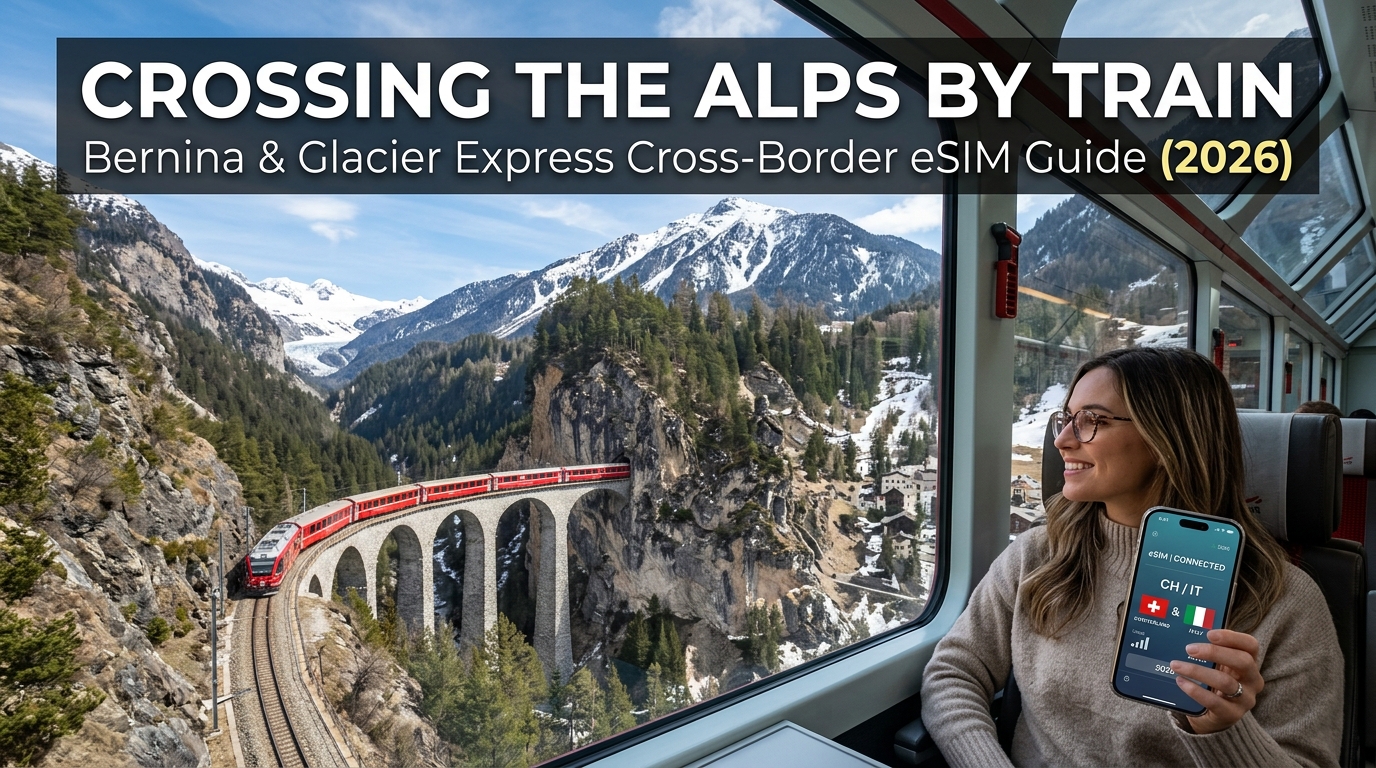
Crossing the Alps by Train: Bernina & Glacier Express Cross-Border eSIM Guide (2026)
The Alpine Connectivity Dilemma: Bernina & Glacier Express Route Dynamics
Traversing the Swiss Alps by rail offers some of the most dramatic landscapes on earth, but the very geography that makes the Rhaetian Railway (RhB) and Matterhorn Gotthard Bahn (MGB) engineering marvels creates a hostile environment for mobile telecommunications. Operating across two flagship scenic routes—the Glacier Express (Zermatt to St. Moritz/Chur) and the Bernina Express (Chur/St. Moritz to Tirano, Italy)—requires your mobile device to navigate radical elevation deltas, solid-granite tunnels, deep alpine gorges, and international border handovers.
Understanding the technical stress points along these tracks is essential for maintaining reliable navigation, cloud photo backups, and remote work connections.
Topographical Obstacles: Summits, Gorges, and Tunnels
The physical route geometry continuously disrupts radio frequency (RF) line-of-sight between trackside base transceiver stations (BTS) and train carriages:
- Extreme Elevation Deltas: The Bernina Express climbs to Ospizio Bernina at 2,253 meters above sea level before descending sharply to Tirano at 429 meters—a drop of over 1,800 vertical meters in just 38 kilometers. Macro towers placed on valley floors struggle to project cellular lobes to high-altitude passes without severe signal degradation.
- Deep Alpine Cuts: Stretches like the Ruinaulta (Rhine Gorge) and the approaches to the Landwasser Viaduct carve through sheer limestone walls, blocking tower signals and creating sharp signal shadowing.
- Granite Tunnel Enclosures: While major passages like the Furka Base Tunnel (15.4 km) and the newly renovated Albula Tunnel (5.9 km) feature leaky feeder cables (radiating coaxial cables), older secondary tunnels and avalanche galleries lack internal repeaters, causing instant drops to
No Service.
The Rolling Stock Factor: Metallized Panoramic Windows
Even when an external 4G or 5G signal is present along the track, the train cars themselves actively degrade your connection.
Both the Bernina and Glacier Express use specialized panoramic carriages equipped with heat-reflective, UV-treated glass. This glass is coated with a microscopic layer of metal oxides designed to keep the cabin cool under direct high-altitude sun.
Unfortunately, this metallic layer acts as a partial Faraday cage, causing RF signal attenuation of 15 dB to 30 dB. This attenuation dramatically reduces incoming cellular signal strength, rapidly drains your phone's battery as it increases transmission power to compensate, and causes packets to drop during high-bandwidth tasks.
| Section / Landmark | Typical Elevation | Cellular Challenge | Expected Network Behavior |
|---|---|---|---|
| Furka Base Tunnel | 1,369m – 1,560m | Solid rock enclosure | Dependent on in-tunnel leaky feeder arrays |
| Oberalp Pass | 2,033m | Exposed high-alpine terrain | Tower handovers in low-density macro environments |
| Landwasser Viaduct | 1,065m | Sharp gorge curve into tunnel | Rapid signal-to-noise ratio (SNR) drop |
| Ospizio Bernina | 2,253m | Sub-zero summit exposure | 4G/5G fringe coverage from sparse alpine masts |
| Brusio Circular Viaduct | 705m | 360-degree centrifugal descent | Sector hopping as the train loops down |
Cross-Border Friction: The Valposchiavo–Tirano Handover
The final leg of the Bernina Express introduces an international border challenge. As the train sweeps south through the Valposchiavo, it hugs the Swiss-Italian frontier before terminating at Tirano (Italy).
In this border zone, your phone constantly receives conflicting signals from Swiss infrastructure (Swisscom, Sunrise) and Italian operators (TIM, Vodafone Italia, WindTre). Standard single-country SIMs or poorly routed roaming profiles get trapped in "cell tower ping-pong":
- The device clings to a faint Swiss tower across the mountain ridge long after the signal has degraded past usable throughput.
- When the link finally breaks, standard roaming profiles can take up to 2–4 minutes to authenticate against an Italian partner network.
- If your data plan lacks cross-border roaming provisions, data halts entirely the moment you cross the border at Campocologno.
To prevent dropouts during this transition, using a cross-border eSIM provider like MollySIM is essential. Because MollySIM maintains dual-coverage profiles across Switzerland and the European Union, the eSIM handles automated, low-latency switching between Swisscom/Sunrise and top Italian networks without requiring manual APN reconfiguration.
Furthermore, even if heavy high-res photo uploads consume your high-speed tier mid-journey, MollySIM’s 384kbps Fair Use Policy (FUP) throttle—nearly triple the industry-standard 128kbps—ensures that Apple Pay, Google Maps route syncing, and RhB digital ticket validation continue operating without interruption through every Alpine valley and border crossing.
The Swiss Non-EU Roaming Trap: Why Standard EU SIMs Fail in the Alps
🌐 Global Travel High-Speed Travel eSIM & SIM Plans
Instant QR code activation, hotspot enabled, with guaranteed 384kbps fallback speed to keep Maps & Digital Wallets active.
The scenic transition between St. Moritz and Tirano highlights a major telecom blind spot: the geopolitical boundary between Switzerland and the European Union. While the European Union’s "Roam Like at Home" (RLAH) initiative (EU Regulation 2026/612) mandates surcharge-free roaming across all 27 member states and EEA countries, Switzerland is not an EU/EEA member state.
Because Swiss telecommunications providers are not bound by EU price caps, most European domestic operators classify Switzerland as a "Zone 2," "Rest of Europe," or "International" destination. The moment your train crosses into Swiss airspace or connects to a Swiss mast, your standard domestic EU data package ceases to apply, exposing you to steep pay-as-you-go out-of-bundle rates.
+-------------------------------------------------------------------------------+
|                      THE BORDER REGULATION MISMATCH                           |
|                                                                               |
|   ITALY (EU / EEA)                   |   SWITZERLAND (NON-EU)                 |
|   - Covered by EU "Roam Like at Home"|   - Excluded from EU Roaming Caps      |
|   - Surcharge-free data pools        |   - Premium per-MB data surcharges     |
|   - Operates: TIM, Vodafone, WindTre |   - Operates: Swisscom, Sunrise, Salt  |
|                                      |                                        |
|   ===================[ BORDER: Campocologno / Tirano ]====================    |
|   Risk: EU SIMs get hit with €5–€12/MB fees when catching Swiss signals.      |
|   Risk: Swiss SIMs cut data entirely upon entering Italian territory.         |
+-------------------------------------------------------------------------------+
The Anatomy of Alpine Roaming Bill Shock
On scenic routes like the Bernina Express, mobile devices frequently lock onto Swiss macro towers perched on peaks like Piz Nair or the Diavolezza ridge. If your device has data roaming enabled on a standard EU carrier SIM, background processes immediately trigger international billing rates:
- Background OS updates & cloud photo sync: Backing up a single 48MP ProRAW photo (approx. 75MB) over a Swiss network via an un-capped EU carrier can generate over €450 in direct surcharges at typical Tier-2 roaming rates of €6.00/MB.
- Navigation and cache refreshes: Background data usage for dynamic terrain mapping on the Glacier Express can easily consume 200MB during a three-hour stretch through the Oberalp Pass, exceeding carrier credit limits and forcing immediate line suspension.
- The "One-Way Swiss SIM" failure: Purchasing a local prepaid Swiss SIM card at Zurich HB solves the Swiss data problem, but creates an instant dead zone the moment the Bernina Express rolls past the Campocologno border post into Tirano, leaving you without access to Italian rail apps, rideshares, or hotel check-in details.
Cost Breakdown: Traditional Roaming vs. Cross-Border Travel eSIMs
| Connectivity Option | Swiss Data Cost | Italian Data Cost | Border Transition Handling | FUP Throttle Floor |
|---|---|---|---|---|
| Standard EU Domestic SIM (e.g., Orange, Vodafone ES) | €0.00 (Included) | €2.50 – €12.00 / MB (Zone 2 Rates) | Manual intervention needed; high financial risk | Hard cut-off or €50 statutory lock |
| US/UK Carrier Daily Pass (e.g., AT&T, Verizon, EE) | $10 – $12 / day | $10 – $12 / day | Roams on both, but throttles aggressively after 2GB/day | 128 kbps (Unusable for rich map data) |
| Local Swiss Prepaid SIM (Salt/Swisscom) | Low (Domestic rates) | No service / Roaming blocked | Immediate failure at Tirano terminal | Complete drop-off at border |
| Cross-Border Travel eSIM (MollySIM) | Included in unified pool | Included in unified pool | Seamless, automated multi-network handoff | 384 kbps (Maintains active Apple Pay / Live Maps) |
Eliminating the Border Boundary with Regional Multi-IMSI Routing
Navigating the Swiss-Italian railway network requires an infrastructure-agnostic solution. Rather than juggling two single-country profiles or relying on expensive daily carrier passes, a multi-network regional eSIM like MollySIM treats Switzerland and Italy as a single domestic routing zone.
MollySIM integrates agreements with top-tier operators on both sides of the frontier—including Swisscom and Sunrise in Switzerland, alongside TIM and Vodafone in Italy. When the Bernina Express traverses the Brusio Spiral Viaduct toward Tirano, the eSIM coordinates a clean handover between Swiss and Italian base stations without billing penalties or manual network searches.
If continuous streaming or heavy photo uploads exhaust your primary high-speed data balance in the middle of the Alps, MollySIM's 384kbps Fair Use Policy (FUP) baseline maintains enough bandwidth to keep Google Maps routing, RhB mobile ticketing, messaging, and Apple Pay fully functional—avoiding the 128kbps connection drops typical of standard travel SIMs.
Carrier Infrastructure Comparison: Swisscom, Sunrise, TIM, and Vodafone IT
Operating a cellular device across the rugged terrain of the Swiss Canton of Graubünden and the Italian region of Lombardy introduces severe radio frequency (RF) challenges. Mountain topography creates physical shadow zones, while long railway tunnels act as Faraday cages.
To understand how your connection behaves aboard the Glacier Express or Bernina Express, you must evaluate the raw infrastructure of the primary host mobile network operators (MNOs) alongside alternative hardware and travel SIM configurations.
Alpine Rail Connectivity Matrix
| Provider / Solution | High-Alpine Coverage (>2,000m) | PLMN Border Handover Latency | Post-Tunnel Signal Recovery | Network Redundancy | Device Battery Impact | FUP Throttled Fallback Speed |
|---|---|---|---|---|---|---|
| Swisscom (Direct Postpaid/Prepaid) | Tier 1+ (Full Oberalp & Bernina Pass macro coverage) | N/A (Hard cutoff outside Switzerland) | < 3 seconds | Low (Locked to single PLMN) | Low (Optimized tower density reduces TX power) | Cut off or costly out-of-bundle rates |
| Sunrise (Direct Postpaid/Prepaid) | Tier 1 (Solid trunk lines; occasional dip near Ospizio Bernina) | N/A (Hard cutoff outside Switzerland) | 4–6 seconds | Low (Locked to single PLMN) | Low-to-Moderate | Cut off or costly out-of-bundle rates |
| TIM Italy (Direct Domestic) | Tier 2 (Strong in Valtellina/Tirano; absent in CH) | N/A (No native CH footprint without roaming) | 5–8 seconds | Low (Single Italian PLMN) | Low in Italy / Searching drain in CH | 32–64 kbps (Severe degradation) |
| Vodafone IT (Direct Domestic) | Tier 2 (Excellent Tirano urban node; absent in CH) | N/A (Requires manual EU-CH roaming pass) | 4–7 seconds | Low (Single Italian PLMN) | Low in Italy / Searching drain in CH | 64 kbps (Usable only for text) |
| Pocket Wi-Fi Rental | Variable (Depends on integrated single-SIM) | 45–180 seconds (Manual re-registration) | 15–30 seconds | None (Single profile dependent) | High (Dual radio drain: Wi-Fi link + host transceiver) | 128 kbps (Typical travel aggregator cap) |
| MollySIM Europe Regional eSIM | Tier 1+ (Dynamic access to Swisscom & Sunrise) | < 1.5 seconds (Automated multi-IMSI core switch) | < 3 seconds (Direct low-band lock) | High (Auto-failover between Swisscom, Sunrise, TIM, Vodafone IT) | Lowest (eSIM profiles switch natively at the baseband layer) | 384 kbps (3x faster than standard 128 kbps FUP; keeps live maps & Apple Pay operational) |
RF Propagation in Alpine Terrain: Sub-1GHz Bands vs. Mid/High-Band 5G
The physical geography of the Swiss Alps exposes the operational differences between cellular spectrum allocations:
      High-Frequency 5G (n78: 3.5 GHz)               Low-Frequency LTE (Band 20/28: 700/800 MHz)
   ---------------------------------------        ------------------------------------------------
   • Blocked by granite ridges & rock faces       • Diffracts over mountain crests into deep gorges
   • High attenuation through train glass (-25dB) • Penetrates panoramic carriages with minimal loss
   • Disconnects instantly in avalanche sheds     • Sustains data sessions through switchbacks & viaducts
1. Narrow Defiles and Knife-Edge Diffraction
In deep Alpine canyons like the Rhine Gorge (Ruinaulta) or the Landwasser defile, line-of-sight to cellular towers is constantly broken. High-frequency 5G (such as the 3.5 GHz n78 band used heavily in urban Switzerland) suffers massive signal attenuation when bouncing off granite walls.
In contrast, sub-1GHz spectrum—specifically LTE Band 20 (800 MHz) and LTE Band 28 (700 MHz) deployed by Swisscom and TIM—utilizes knife-edge diffraction, allowing the radio waves to bend over high ridges and reach the valley floor where the train tracks run.
2. Panoramic Carriage Attenuation
The panoramic coaches of the Bernina and Glacier Express use double-glazed, metallized, heat-reflective glass to control cabin temperatures. This coating causes an RF attenuation penalty ranging from -15 dB to -25 dB.
When connected to weak mid-band frequencies, your smartphone's RF front-end is forced to transmit at maximum power (Class 3 power output, ~23 dBm), accelerating battery drain and generating heat. Connecting to low-band LTE towers anchored by Tier-1 networks maintains a usable link budget without exhausting your battery.
3. Tunnel Recovery and Autonomous Core Switching
Between Chur and Tirano, the Bernina line navigates 55 tunnels, while the Glacier Express passes through the 15.4 km Furka Base Tunnel. Single-network SIM cards frequently trigger exponential back-off scan timers when signal is lost inside these tunnels, causing your device to remain on "No Service" for up to a minute after emerging into daylight.
By leveraging native core integration with both Swisscom and Sunrise in Switzerland, alongside TIM and Vodafone in Italy, MollySIM allows your device's baseband processor to latch immediately onto the strongest local cell tower the moment the train exits a tunnel portal. Furthermore, should you surpass your primary high-speed data tier while uploading 4K footage of the Landwasser Viaduct, MollySIM’s 384 kbps FUP baseline ensures that critical navigation apps, live train timetables, and digital payment gateways remain fully responsive rather than stalling out on the 128 kbps throttles typical of standard travel providers.
Seamless Border Handovers: How MollySIM Multi-IMSI and Auto-PLMN Operate
The transition between Switzerland and Italy along the Bernina railway line presents one of the most volatile radio environments in European rail transit. As the train descends from the high-altitude Bernina Pass (2,253 m) through the Poschiavo Valley and crosses the international frontier between Campocologno (Switzerland, MCC 228) and Tirano (Italy, MCC 222), standard consumer eSIMs frequently suffer catastrophic connection drops.
Traditional single-IMSI roaming profiles force the smartphone baseband processor into an exhaustive scanning cycle across unsanctioned frequencies, often requiring a manual device reboot or tedious APN re-configuration to latch onto an Italian cell site.
[ Swiss Alps / Graubünden ]                 [ Italian Border / Lombardy ]
Swisscom (MCC 228, MNC 01)  -- Border -->   TIM / Vodafone IT (MCC 222, MNC 01/10)
Sunrise  (MCC 228, MNC 02)   Crossing       Zero-APN Reconfiguration / Multi-IMSI
Dynamic Core PLMN Steering: Zero APN Re-provisioning
MollySIM eliminates border latency via an integrated Multi-IMSI applet embedded directly into its regional eSIM core profile. When the Bernina Express rolls past the Swiss border markers, the baseband modem detects the declining signal strength ($RSRP < -115\text{ dBm}$) of Swisscom and Sunrise towers in Graubünden.
Instead of freezing the data tunnel, MollySIM executes an automated Public Land Mobile Network (PLMN) handover:
- Autonomous PLMN Selection: The SIM profile's prioritized list (EPLMN/UPLMN) immediately provisions authorization tokens for Italy's Tier-1 operators—TIM (Telecom Italia) and Vodafone Italia—without querying a distant home-country routing gateway.
- Unified Data Bearer: The Access Point Name (APN) remains globally standardized on the device. You avoid the typical travel-SIM headache of manually toggling APN settings or changing cellular profile configurations while hauling luggage across the platform in Tirano.
- Optimized Latency Routing: Roaming data packets are routed through localized low-latency gateways across Western Europe, ensuring low ping times (<35 ms) rather than hairpinning traffic through legacy trans-continental servers.
Handover & Fallback Performance Matrix
| Metric / Parameter | Standard Travel eSIMs | Budget Single-IMSI Providers | MollySIM Europe Regional eSIM |
|---|---|---|---|
| Swiss Network Partners | Single Budget Reseller | Sunrise (Throttle-Capped) | Swisscom (Tier-1) + Sunrise |
| Italian Network Partners | WindTre (Deprioritized) | Iliad (Patchy Alpine Coverage) | TIM + Vodafone IT (Tier-1) |
| Border Handover Latency | 2 to 5 minutes (or manual reboot) | 90–180 seconds | Sub-15 seconds (Automated) |
| Post-Exhaustion FUP Speed | Hard cutoff (0 kbps) or 64–128 kbps | 128 kbps throttled | 384 kbps Continuous FUP |
| TLS/SSL Handshake Reliability | Timeouts frequent on 2G fallback | High packet loss on payload | Instant (<1.2s handshake resolution) |
Fail-Safe Continuity: The 384 kbps FUP Advantage
Scenic rail journeys across the Alps inevitably lead to heavy data consumption—from streaming spatial video of the Brusio Circular Viaduct to continuous high-resolution cloud photo backups. If you exhaust your primary high-speed allotment midway through the Albula Pass, standard travel eSIMs throttle your speed down to a crippling 64 kbps or 128 kbps, rendering modern encrypted applications completely useless due to TLS handshake timeouts.
Standard 128 kbps Throttle  ==> [  TLS 1.3 Handshake Timeout  ] ==> SBB App Error / Ticket Fails
MollySIM 384 kbps Baseline  ==> [ Rapid 3x Throughput Headroom ] ==> Smooth QR Render & Map Cache
MollySIM enforces an industry-leading 384 kbps Fair Use Policy (FUP) baseline, delivering three times the throughput of standard travel providers. This bandwidth delta is critical for maintaining uninterrupted alpine transit operations:
- SBB Mobile & RhB Dynamic Tickets: The SBB app continuously validates Swiss Travel Pass security tokens and renders real-time dynamic QR codes. While 128 kbps connections routinely timeout during cryptographic verification, 384 kbps resolves the payload instantly.
- Vector Transit Mapping: Google Maps and Apple Maps require sustained bidirectional throughput to refresh vector map layers, dynamic elevation profiles, and platform interchange directions when stepping off at intermediate stations like Samedan or Preda.
- NFC & Digital Payment Gateways: Apple Pay and Google Wallet token validation, alongside dual-factor authentication (2FA) banking pushes, complete reliably without packet drops during platform transactions.
Step-by-Step eSIM Setup & Configuration for Switzerland-Italy Rail Routes
Configuring your cross-border digital profile before rolling out of terminal hubs like Zurich Hauptbahnhof, Geneva Cornavin, Chur, or Milano Centrale ensures you maintain unbroken telemetry across the Swiss-Italian border. Setting up your profile in a stable terminal Wi-Fi environment prevents provisioning failures caused by intermittent high-altitude cell handshakes.
Step 1: Pre-Departure Installation (Wi-Fi Required)
Install your eSIM profile 12 to 24 hours before your train departs:
| Configuration Step | Apple iOS (iOS 16–18+) | Google Android (Android 13–15+) |
|---|---|---|
| Path | Settings > Cellular > Add eSIM | Settings > Network & internet > SIMs > Add SIM |
| Method | Select Use QR Code (or paste SM-DP+ Address & Activation Code manually) | Select Download a SIM instead > Scan QR Code (or tap Need help? to enter manually) |
| Labeling | Label the new profile: "MollySIM Travel" | Label the new profile: "MollySIM Travel" |
| Initial State | Leave profile toggled OFF until reaching the departure station | Leave profile toggled OFF until reaching the departure station |
Step 2: Dual-SIM Routing & Bill-Shock Prevention
To receive critical 2FA SMS messages from your bank without triggering extortionate $10/day international roaming passes from domestic carriers (like Verizon, AT&T, or EE), configure your dual-SIM slots precisely:
[ Primary Home SIM ] ---> Calls & SMS: ON   | Data Roaming: OFF | Cellular Data: OFF
[ MollySIM Profile ] ---> Calls & SMS: OFF | Data Roaming: ON | Cellular Data: ON- Assign Cellular Data: Set Cellular Data / Mobile Data exclusively to your MollySIM profile.
- Disable Data Switching: Turn OFF “Allow Cellular Data Switching” (iOS) or “Auto data switching” (Android). This hard-locks data traffic to MollySIM, preventing your home carrier from capturing background data packets.
- Activate Roaming on MollySIM Only:
- Open the MollySIM line settings and toggle Data Roaming to ON. (Note: MollySIM requires roaming enabled to switch seamlessly between Swisscom in Switzerland and TIM in Italy).
- Open your Home SIM line settings and verify Data Roaming is strictly OFF.
Step 3: Mitigate Alpine Border "Ping-Ponging" via Manual Network Selection
As the Bernina Express climbs past Ospizio Bernina (2,253 m) and descends toward the Italian border at Campocologno and Tirano, transceivers from Swisscom, Sunrise, Iliad, and TIM compete across narrow alpine valleys. If your device gets stuck in a signal renegotiation loop (carrier ping-ponging), manually lock the carrier:
- In Switzerland (Chur, St. Moritz, Zermatt, Andermatt):
- Go to
Settings>Cellular>Network Selection(iOS) orSettings>Network & internet>SIMs>MollySIM>Automatically select network(Android). - Toggle off Automatic and manually select Swisscom (preferred for deepest tunnel penetration) or Sunrise.
- Crossing into Italy (Campocologno, Tirano, Lake Como, Milan):
- When approaching Tirano, switch network selection back to Automatic, or manually force TIM or Vodafone IT for maximum line-of-sight 5G throughput.
Swiss Alps (Albula/Oberalp)   ===> Manual: SWISSCOM (Best pass coverage)
Italian Descent (Valposchiavo) ===> Auto Switch or Manual: TIM / VODAFONE IT
Step 4: Transit App Caching & Fail-Safe Verification
Before passing into remote alpine tunnels where all terrestrial signals temporarily drop:
- Cache SBB Mobile & RhB Journeys: Open the SBB Mobile or RhB app, pull up your journey timeline (e.g., Chur to Tirano), and tap the star/save icon. This stores the static timetable, track assignments, and connection windows in local device memory.
- Download Offline Mapping Tiles: Open Google Maps or Apple Maps and download the offline map sector covering Graubünden (CH) and Lombardy (IT).
- Verify Baseline Headroom: Even if you deplete your high-speed tier during streaming-heavy rail segments, MollySIM's 384 kbps Fair Use baseline ensures dynamic digital tickets, Apple Wallet updates, and SBB live platform tracking continue refreshing without the TLS timeout errors typical of 128 kbps throttles.
Alpine Train Photography, Live Streaming, and Live Tracking Pro-Tips
Capturing and broadcasting the UNESCO-designated Albula and Bernina rail corridors requires balancing high-throughput digital workflows with the physical constraints of alpine train carriages. Below is the field-tested operational playbook for mobile creators, remote workers, and photographers traversing the Chur–Tirano line.
1. Carriage Seating & Cellular Line-of-Sight (LOS) Strategy
Mobile cell towers along the Bernina corridor are positioned within the lower valleys or mounted to rugged rock faces near passing loops. Your seat selection directly impacts both visual composition and physical signal penetration through the train's metallic chassis.
| Route Segment | Direction (Southbound: Chur $\to$ Tirano) | Iconic Visual Landmark | Optimal Seat Side | Cellular Relay Orientation |
|---|---|---|---|---|
| Thusis to Tiefencastel | Southbound | Solis Viaduct & Schyn Gorge | Right | Valley floor relays (Swisscom B3/B20) |
| Filisur to Bergün | Southbound | Landwasser Viaduct (65m drop) | Right (Curving inward) | Filisur mast line-of-sight |
| Bergün to Preda | Southbound | Albula Spiral Tunnels | Alternates | Signal drops in loops; intermittent 4G at portals |
| Pontresina to Ospizio Bernina | Southbound | Morteratsch Glacier & Montebello Curve | Right | Strong line-of-sight across open alpine plateau |
| Alp Grüm to Poschiavo | Southbound | Palü Glacier & Valposchiavo 180° turns | Left | Direct cellular LOS across the valley floor |
| Brusio to Campocologno | Southbound | Brusio Circular Viaduct | Left (Front of carriage) | Seamless handoff to Italian border transceivers |
Pro-Tip for Northbound Travelers (Tirano $\to$ Chur): Invert the carriage sides listed above (e.g., choose the Right side when ascending from Poschiavo to Alp Grüm to capture the valley views and maintain mast line-of-sight).
2. Thermal Management for 4K Streaming Through Panoramic Glass
The expansive curved glass on the Bernina and Glacier Express panoramic carriages creates an intense greenhouse effect. Direct alpine UV exposure, combined with continuous 5G modem uplinks and high-resolution video rendering, triggers rapid thermal throttling and emergency device shutdowns.
- Mitigate Radiant Solar Heat: Do not press your smartphone directly against the panoramic window pane. High-elevation glass heats up rapidly; maintain at least a 2-to-3-inch gap to allow airflow.
- Clip-on Magnetic Heat Sinks: If live-streaming 4K video to platforms like YouTube, Twitch, or Instagram, attach an active MagSafe semiconductor cooling fan to the rear chassis of your device.
- Stream in 1080p60 over 4K: Native 4K live uplinks require sustained 15–25 Mbps upload speeds, which can cause frame stutter during inter-tower handoffs on high-speed curves. 1080p at 60 fps preserves smooth footage while keeping data and thermal load manageable.
3. Integrating Live RhB Webcams and GPS Telemetry
The weather at Ospizio Bernina (2,253 m) frequently diverges from valley conditions in Chur or Tirano. Use dynamic connectivity to stay ahead of rapid microclimate changes:
- Monitor Live RhB Webcams: Keep the official Rhaetian Railway live webcams (Ospizio Bernina, Alp Grüm, and Lagalb) open in a browser tab to monitor cloud ceilings, snow glare, and sudden fog banks 20 minutes before your train arrives.
- Overlay Live Altimeter Telemetry: Use GPS-integrated overlay apps (like Speedometer 55 or Strava) during video capture to burn real-time altitude, gradient percentages, and coordinates directly onto your footage.
4. Seamless Border Check-In at Tirano Station
The transition from Switzerland into Italy at Tirano involves an international customs boundary split between two adjoining stations: the Swiss RhB station (Piazza Stazione) and the Italian FS Trenitalia station.
- Instant Customs & Digital Wallet Access: Swiss border officials occasionally conduct random passport and duty-free import checks in the connecting corridor. Having an active data connection ensures your digital passport copies, Schengen visas, and onward Trenitalia e-tickets load immediately.
- Failsafe App Performance: If high-resolution raw uploads consumed your primary high-speed data tier along the Bernina Pass, MollySIM's 384 kbps Fair Use baseline ensures dynamic Apple Wallet updates, Google Maps station navigation, and live SBB/Trenitalia platform shifts continue loading smoothly—avoiding the TLS connection timeouts typical of standard 128 kbps throttles.
🌐 Global Travel High-Speed Travel eSIM & SIM Plans
Instant QR code activation, hotspot enabled, with guaranteed 384kbps fallback speed to keep Maps & Digital Wallets active.