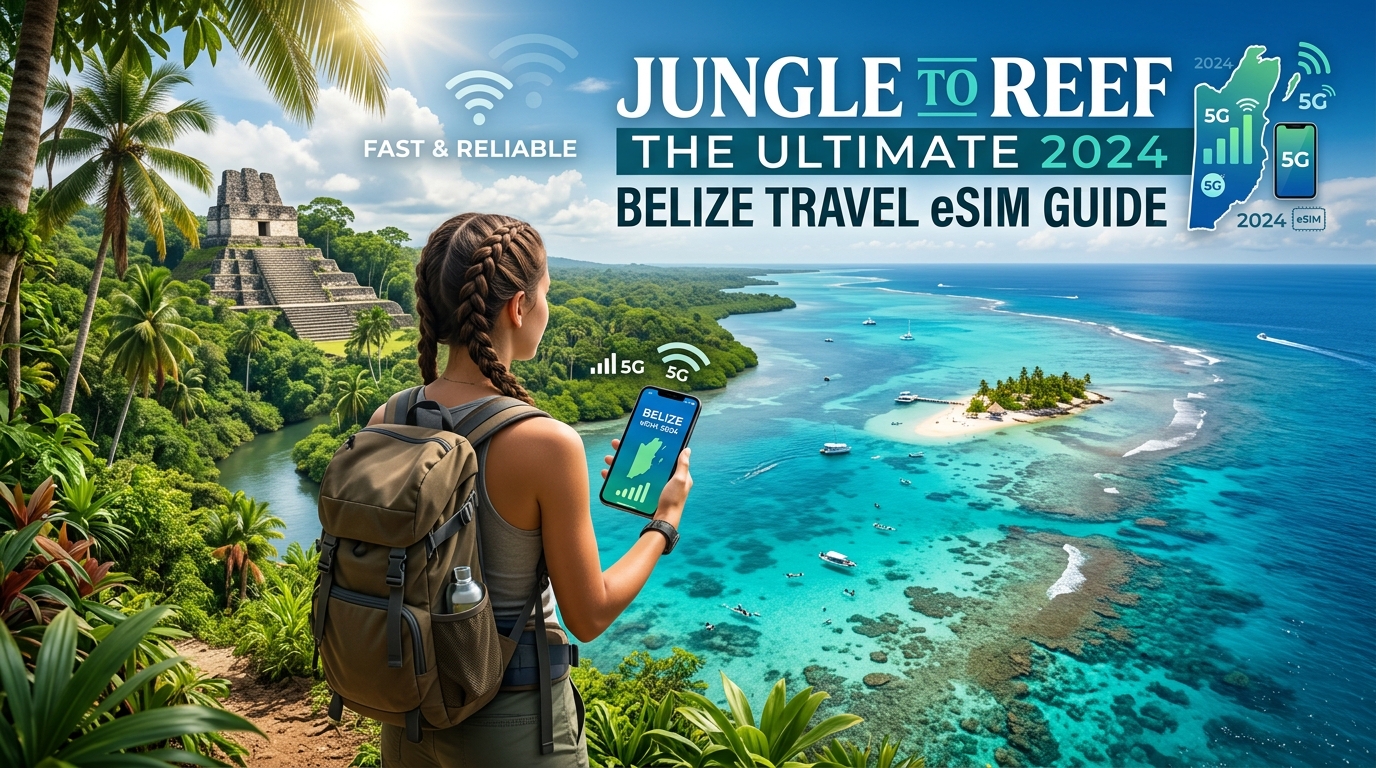
Belize Travel eSIM Guide 2026: Reliable Data from Caye Caulker Coral Reefs to San Ignacio Jungles
Belize Travel Connectivity in 2026: From Caribbean Atolls to Mayan Jungles
Belize presents one of the most geographically diverse terrains in Central America. Within a single travel itinerary, you can move from sun-bleached barrier reef atolls to dense, unpaved tropical rainforests. While this ecological variety creates an unforgettable travel experience, it also poses unique communication challenges. Navigating Belize today requires continuous, reliable data to manage real-time transport, remote excursions, and unexpected logistics.
       BELIZE CONNECTIVITY CORRIDORS
┌──────────────────────────────────────────────────┐
│  CARIBBEAN ATOLLS (Caye Caulker / Ambergris)     │
│  • Water Taxi Ticketing  • Marine Reserve Passes │
└────────────────────────┬─────────────────────────┘
                         │ Transit via BZE / Belize City
┌────────────────────────▼─────────────────────────┐
│  INLAND CORRIDORS (Cayo / Mountain Pine Ridge)   │
│  • Topo Maps (Caracol)  • WhatsApp Guide Booking │
└──────────────────────────────────────────────────┘
Navigating the Reef: Maritime Logistics in San Pedro and Caye Caulker
Island-hopping between Ambergris Caye (San Pedro) and Caye Caulker demands immediate access to dynamic travel information. Marine logistics in Belize operate on flexible schedules dictated by weather and passenger volume:
- Water Taxi Operations: Services like the San Pedro Belize Express frequently adjust departure gates and timetables based on tidal conditions and maritime advisories. Having active data ensures you can verify digital tickets and monitor schedule updates from the dock.
- Marine Park Compliance: Accessing the Hol Chan Marine Reserve and Shark Ray Alley often requires digital confirmation vouchers and environmental fee receipts on your smartphone.
- Local Commerce: While beachfront spots on Front Street accept cards, independent golf cart rentals, dock transfers, and local water taxis frequently coordinate via WhatsApp.
The Interior Frontier: San Ignacio and Mountain Pine Ridge
Heading west along the Western Highway toward the Guatemalan border shifts the connectivity environment dramatically. In the Cayo District, mobile data is an indispensable safety tool rather than just a convenience:
- Remote Navigation: Driving the rugged unpaved roads into the Mountain Pine Ridge Forest Reserve to reach spots like Rio On Pools, Big Rock Falls, or the Caracol Archaeological Reserve requires real-time GPS tracking. Road conditions can change rapidly after heavy rain, making live mapping vital.
- Archaeological Excursions: World-renowned expeditions—such as the Actun Tunichil Muknal (ATM) Cave or deep jungle treks near the Macal River—require licensed local guides. Coordinating rendezvous points in San Ignacio or arranging 4x4 pickups relies heavily on mobile data connections.
- Coastal Transit in the South: Driving the scenic Hummingbird Highway down to Hopkins or the Placencia Peninsula requires uninterrupted navigation to monitor fuel stops, bridge clearances, and detour notices.
| Region | Primary Connectivity Need | Typical Risk Without Data |
|---|---|---|
| Ambergris Caye & Caye Caulker | Water taxi schedules, digital reservations, split-pay apps | Missed boat connections, stranded luggage transfers |
| San Ignacio & Cayo Jungles | Topographical GPS, emergency SOS, guide coordination | Navigation errors on unpaved logging roads |
| Placencia & Hopkins | Real-time weather alerts, coastal shuttle logistics | Delays during flash-flood road diversions |
| Archaeological Reserves (Caracol/ATM) | Offline map updates, checkpoint check-ins | Getting turned around in low-signage park perimeters |
Digital eSIMs: The Modern Standard for Belize Travel
Relying on traditional physical SIM cards at Philip S.W. Goldson International Airport (BZE) often means waiting in long queues at local telecom kiosks, dealing with passport registration protocols, and swapping out tiny plastic chips.
Modern travelers bypass these friction points by deploying a digital Belize eSIM before touchdown. International eSIM providers like MollySIM connect your device directly to top-tier Belizean cellular infrastructure the moment your flight lands.
A major operational benefit of MollySIM is its built-in 384kbps Fair Use Policy (FUP) standard. While legacy roaming passes and standard travel SIMs throttle expired data buckets to an unusable 128kbps, MollySIM’s 384kbps safety net provides three times that speed. This ensures critical travel applications—including Google Maps navigation, Apple Pay / Google Wallet transactions, and WhatsApp messaging—remain fully operational even if your primary high-speed data allowance runs low in the middle of the Cayo jungle.
Evaluating Belize's Carrier Infrastructure: Digi (BTL) vs. Smart Belize
🇺🇸 United States High-Speed Travel eSIM & SIM Plans
Instant QR code activation, hotspot enabled, with guaranteed 384kbps fallback speed to keep Maps & Digital Wallets active.
The telecommunications landscape in Belize is an effective duopoly operated by Digi (Belize Telemedia Limited) and Smart Belize (Speednet). For international travelers navigating between offshore atolls and dense inland rainforests, understanding the technical differences between these two carriers' spectrum allocations and tower topologies is essential for maintaining reliable connectivity.
                    ┌────────────────────────────────────────────────────────┐
                    │            Belize Cellular Spectrum Layout             │
                    └────────────────────────────────────────────────────────┘
                                 │                                │
                 ┌───────────────┴──────────────┐ ┌───────────────┴──────────────┐
                 │       Digi (BTL) Network     │ │         Smart Belize         │
                 ├──────────────────────────────┤ ├──────────────────────────────┤
                 │ • Band 17/12 (700 MHz Lower) │ │ • Band 2 (1900 MHz PCS)      │
                 │ • Band 2 (1900 MHz PCS)      │ │ • Band 4 (1700/2100 MHz AWS) │
                 │ • Band 4 (AWS 1700/2100 MHz) │ │ • High-density urban micro-  │
                 │ • Sub-1GHz long-range reach  │ │   cells in commercial hubs   │
                 └──────────────────────────────┘ └──────────────────────────────┘
Spectrum Allocation and Frequency Bands
The operational capability of each network depends heavily on its deployed LTE spectrum bands:
- Digi (BTL): Deploys 4G/LTE primarily across Band 17/12 (700 MHz lower block), supplemented by Band 2 (1900 MHz) and Band 4 (AWS 1700/2100 MHz). The primary operational advantage comes from its sub-1GHz 700 MHz frequency. Low-band spectrum experiences significantly lower free-space path loss, allowing cellular signals to travel expansive geographic distances and penetrate physical obstructions more effectively than higher frequencies.
- Smart Belize: Operates its LTE footprint primarily on mid-band frequencies, utilizing Band 2 (1900 MHz) and Band 4 (AWS). While these mid-band frequencies deliver strong data throughput in built-up environments, they exhibit high propagation loss over long distances and struggle to penetrate dense natural barriers without a high density of physical base transceiver stations (BTS).
Network Topology: Maritime Reach vs. Urban Microcells
The geographic deployment strategies of Digi and Smart diverge significantly based on terrain:
| Metric / Region | Digi (BTL) Network Architecture | Smart Belize Network Architecture |
|---|---|---|
| Primary LTE Bands | Band 12/17 (700 MHz), Band 2 (1900 MHz) | Band 2 (1900 MHz), Band 4 (AWS) |
| Offshore & Cayes | Superior line-of-sight propagation over water up to 15+ miles offshore | Spotty beyond major hubs (San Pedro / Caye Caulker village cores) |
| Urban Centers | Uniform coverage across Belize City and Belmopan | Dense microcell grids with high localized data capacity |
| Inland Jungles (Cayo) | Deep coverage along highway corridors via low-band 700 MHz | Fast drop-off outside municipal borders and paved roadways |
Offshore & Maritime Line-of-Sight
Digi leverages high-elevation coastal macro-sites combined with 700 MHz spectrum to achieve line-of-sight (LOS) propagation over open water. This provides sustained cellular reception across the Belize Barrier Reef, the outer perimeter of Ambergris Caye, Caye Caulker, and the length of the Placencia Peninsula. Water acts as a reflective plane for RF signals, enabling Digi’s low-band frequencies to connect vessels several nautical miles offshore. Smart's reliance on mid-band frequencies results in rapid signal degradation once boats move outside harbor limits.
Urban High-Density Performance
In commercial municipal districts like Belize City, Orange Walk Town, and the capital city of Belmopan, Smart deploys high-density microcell arrays. In these compact built environments, Smart's Band 4 capacity frequently matches or exceeds Digi's peak download speeds by distributing user load across localized small cells.
The Cayo Rainforest Dilemma: Microwave Backhauls and Canopy Absorption
Moving west toward San Ignacio, the Mountain Pine Ridge Forest Reserve, and the Macal River basin introduces severe RF obstacles.
- RF Canopy Attenuation: Dense, moisture-rich broadleaf rainforest canopies cause severe radio frequency absorption and scatter, especially on 1900 MHz and AWS bands.
- Backhaul Vulnerabilities: Inland cell towers in rugged terrain rely on point-to-point microwave backhauls rather than physical fiber-optic runs. Heavy convective rainfall and tropical storms create "rain fade," degrading tower-to-core network links and causing sudden throughput drops or elevated latency.
- Terrain Shadowing: Deep karst limestone valleys block direct RF line-of-sight, leaving deep coverage shadows along unpaved logging routes and remote cave access points.
Solving Coverage Gaps with Multi-Network Dynamic Switching
Locking your device to a single local physical SIM ties your connection to one carrier's tower grid. If a localized microwave backhaul fails in the Cayo District or mid-band signal drops along an unpaved road, your connectivity cuts out completely.
Deploying an international eSIM like MollySIM resolves this single-point-of-failure risk. Multi-network roaming profiles dynamically evaluate Reference Signal Received Power (RSRP) and Reference Signal Received Quality (RSRQ), automatically initiating core tower handoffs to the strongest available local infrastructure—whether that is a Digi low-band macro-tower on the water or a Smart microcell in town.
Furthermore, if high-speed data buckets expire while navigating remote jungle tracks, MollySIM’s integrated 384kbps Fair Use Policy (FUP) baseline maintains continuous data transmission. Delivering three times the bandwidth of standard 128kbps throttling, this 384kbps throughput keeps vector map rendering on Google Maps, real-time GPS telemetry, and merchant mobile transactions fully operational without disruption.
Comparative Analysis: Local Physical SIMs vs. Roaming vs. MollySIM eSIM
Navigating connectivity options in Belize requires weighing bureaucratic hurdles, infrastructure access, and cross-border utility. Travelers landing at Philip S.W. Goldson International Airport (BZE) in Ladyville generally face three traditional connectivity pathways—local prepaid plastic SIMs, domestic carrier roaming packages, or rental pocket Wi-Fi units—before considering modern digital eSIM deployments.
The Friction Points of Local Physical SIM Acquisition
Purchasing a physical SIM card from Belize Telemedia Limited (Digi) or Smart upon arrival presents immediate logistical bottlenecks:
- Mandatory Telecom KYC Registration: Under the Belize Telecommunications (Registration of Prepaid Mobile Cellular Mobile Services) Regulations, anonymous SIM card activation is illegal. Vendors must take a physical photocopy of your passport, record your local hotel address, and log your device's international IMEI number. This manual data entry creates long processing queues at retail counters.
- Airport Retail Availability Bottlenecks: The telecom kiosks in the BZE arrivals hall operate on restricted schedules tied loosely to scheduled flights. If your flight lands late, encounters customs delays, or arrives during weekend regional holidays, carrier desks are frequently shuttered, forcing you to navigate taxi transit into Belize City or water taxi terminals entirely disconnected.
- Currency Conversion & Top-Up Friction: Physical SIM packages require cash or credit card transactions in Belize Dollars (BZD) or USD. Local top-up systems still heavily rely on scratch-off cards or proprietary retail merchant terminals ("Direct TopUp"), introducing unexpected transaction fees and friction when venturing outside municipal centers.
Carrier Roaming Traps vs. Hardware Rental Drawbacks
Defaulting to your domestic carrier’s international roaming pass (such as AT&T International Day Pass or Verizon TravelPass) incurs a steep daily fee—typically $10 to $15 per day per line. Over a two-week itinerary across Caye Caulker, Placencia, and the Mountain Pine Ridge Forest Reserve, roaming charges can add $140 to $210 to your trip expenses for data that is often deprioritized by local towers during peak network loads.
Conversely, pocket Wi-Fi rentals introduce distinct operational headaches:
- You must charge and carry an extra lithium-ion battery device exposed to Belize’s high ambient humidity and jungle heat.
- If you separate from your travel group on a cave tubing excursion or dive expedition, only the person carrying the hub retains a connection.
- Logistics require physical pickup and return drop-offs, risking severe deposit penalties if damaged by tropical downpours or salt spray.
Cross-Border Mobility & Fallback Architecture
Many Belize itineraries incorporate overland day trips or transfers to the Mayan ruins of Tikal in Guatemala or cross the northern border at Santa Elena into Chetumal, Mexico. A local Belizean SIM cuts off data immediately upon crossing the Mompiche or Subteniente López border control points.
Using an international digital SIM from MollySIM bypasses physical registration lines, hardware dependencies, and border dead-zones. Furthermore, while competitive travel eSIMs throttle speeds down to a non-functional 128kbps or shut down connectivity entirely once a primary data allotment runs out, MollySIM provides an integrated 384kbps Fair Use Policy (FUP) baseline. This sustained 384kbps throughput keeps vector tile rendering on Apple Maps and Google Maps fluid, guarantees continuous WhatsApp voice functionality, and ensures contactless payments process reliably anywhere in the field.
Direct Solution Comparison
The following matrix evaluates the operational, technical, and commercial differences between the four primary connectivity methods available for Belize travel:
| Evaluation Metric | Local Physical SIM (Digi / Smart) | Carrier International Roaming | Pocket Wi-Fi Rental | MollySIM Belize Travel eSIM |
|---|---|---|---|---|
| Setup Time | 30–60 mins (in-store queue & registration) | Instant (auto-connect upon landing) | 15–30 mins (airport desk pickup/setup) | Instant (digital installation via QR/app before departure) |
| ID / KYC Requirement | Mandatory (Passport scan, physical registration form) | None (handled via existing home plan) | Passport + major credit card security deposit | None (Immediate anonymous provisioning) |
| Hardware Dependency | Physical SIM tray access (SIM ejector tool needed) | None (uses primary SIM) | Additional physical hub & charging cables | Zero (embedded secure eUICC chip) |
| Regional Cross-Border Coverage | Belize only (dead immediately at Guatemala/Mexico borders) | Costly extra add-on or restricted | Country-locked unless expensive regional unit rented | Seamless (multi-country regional profiles available) |
| Personal Hotspot / Tethering | Supported (carrier plan dependent) | Often restricted or throttled | Built-in (up to 5–10 devices) | Fully Supported at high-speed data rates |
| Latency & Routing Optimization | Local edge breakout (Low latency locally) | Home-country breakout loop (High ping: 250ms–500ms) | Dependent on embedded local SIM | Cloud-optimized routing profiles for reduced latency |
| Fallback Data Guarantee | Hard cutoff when balance hits zero | Hard cutoff or exorbitant overage fees ($2.05+/MB) | Dependent on provider fair-use limits | Uncapped 384kbps FUP (3x standard market speed; map-ready) |
| Average Cost Profile | $15–$30 USD for basic data allotments | $10–$15 USD per day ($100–$150+ per trip) | $8–$12 USD per day + deposit/shipping fees | Low, predictable upfront pricing (no overages) |
Real-World Field Guide: Staying Connected in Caye Caulker, Placencia, and San Ignacio
Belize’s geography spans narrow limestone islands, open marine atolls, and dense sub-tropical river valleys. Cellular propagation varies drastically between the coastal tourism hubs and the interior Mayan mountains. Deploying the right operational connectivity plan ensures your devices stay functional whether you are booking a water taxi or navigating unpaved forestry reserves.
1. The Cayes & Barrier Reef: Caye Caulker, Ambergris Caye, and Offshore Waters
The offshore cayes boast dense cellular tower infrastructure along populated corridors, but marine excursions quickly test line-of-sight limits.
- Caye Caulker & San Pedro Town: Both islands feature full 4G/LTE coverage via local towers. Speeds easily handle remote work, video calls, and instant uploads around the Split or Ambergris Caye’s barrier lagoon.
- Hol Chan Marine Reserve & Shark Ray Alley: Situated roughly 4 miles south of San Pedro, Hol Chan maintains solid line-of-sight LTE reception. You can reliably stream live navigation or message your tour operator directly from the boat.
- The Outer Atolls (Lighthouse Reef & The Great Blue Hole): Located 40–50 miles off the mainland, the Great Blue Hole and Half Moon Caye sit well beyond terrestrial macro-towers. Expect a total blackout once your boat travels roughly 8 to 12 nautical miles east of Caye Caulker.
Pro Field Tip: Cache your marine charts on Navionics or offline map layers before boarding your morning charter from the San Pedro Belize Express Water Taxi terminal.
2. The Southern Coast: Placencia Peninsula & Hopkins Village
The 16-mile Placencia Peninsula benefits from uninterrupted line-of-sight connectivity along the main paved road, providing dependable high-speed data from Maya Beach down to Placencia Village.
- Lagoon vs. Sea Coverage: Whether kayaking through the Placencia Lagoon or relaxing on the beach, signal degradation is minimal.
- Hummingbird & Southern Highway Transit: The overland drive from Belize City through Belmopan down to Hopkins or Placencia winds through the Maya Mountains. Valleys along the Hummingbird Highway feature intermittent 5–10 minute signal drops. Always maintain active offline vector maps for navigation if you rent a vehicle.
3. The Jungle Interior: San Ignacio, Mountain Pine Ridge, and Maya Outposts
The Cayo District serves as the staging ground for Belize’s archaeological and spelunking expeditions, where rugged topography and dense canopy create severe RF attenuation.
┌────────────────────────┬─────────────────────┬────────────────────────────────────────┐
│ Destination / Route    │ Signal Availability │ Operational Connectivity Strategy      │
├────────────────────────┼─────────────────────┼────────────────────────────────────────┤
│ San Ignacio Town       │ Strong 4G/LTE       │ Full connectivity; ideal for tethering │
│ ATM Cave Reserve       │ No Signal           │ Cache pickup points & permits offline  │
│ Mountain Pine Ridge    │ Intermittent Edge   │ Download GPS vector maps in advance    │
│ Caracol Ruins          │ Near Total Blackout │ Complete off-grid navigation required  │
│ Barton Creek Outpost   │ Weak / Patchy       │ Keep SMS/low-bandwidth telemetry open  │
└────────────────────────┴─────────────────────┴────────────────────────────────────────┘- San Ignacio Hub: High-speed data is robust across town, enabling quick hotel check-ins, ride coordination with local taxi collectives, and digital nomad workflows in local cafés.
- Actun Tunichil Muknal (ATM) Cave & Barton Creek: The Teakettle Village turnoff into Tapir Mountain Nature Reserve marks the end of reliable cellular signals. The jungle canopy completely blocks high-frequency cellular bands at the ATM parking lot and inside the cave system.
- Caracol & Chiquibul Forest: Driving south through the Mountain Pine Ridge Forest Reserve toward Caracol places you in dead zones for hours. Do not rely on streaming GPS engines—pre-load route files over Wi-Fi or high-speed mobile data before leaving San Ignacio.
4. Zero-Data Safety Net: MollySIM’s 384kbps Fallback Architecture
Exhausting your high-speed quota in the middle of a remote jungle corridor or while coordinating boat transfers can derail your itinerary. Most international roaming add-ons and budget travel SIMs either sever your data connection instantly or downgrade your throughput to an unusable 64kbps–128kbps—speeds that cause modern apps to time out.
MollySIM solves this operational risk with an uncapped 384kbps Fair Use Policy (FUP) safety net:
- 3x Industry-Standard Bandwidth: While 128kbps fails to render essential web protocols, 384kbps maintains enough pipe bandwidth to keep core travel utilities fully functional without paying emergency top-up fees.
- Turn-by-Turn GPS Telemetry: Vector-based map rendering in Google Maps, Apple Maps, and Waze updates continuously without map-tile dropouts.
- Critical Communication: End-to-end encrypted messaging, location pings, and two-way voice notes over WhatsApp, Signal, and iMessage remain fully operational.
- Contactless Payments & Verification: Authentication pings for Apple Pay, Google Wallet, and bank 2FA push notifications clear smoothly, ensuring you never get stranded at a remote fuel pump or water taxi kiosk.
Step-by-Step Installation & Configuration Guide for Belize Travel eSIMs
Setting up an eSIM for Belize requires precise configuration to avoid accidental home-carrier roaming fees while ensuring immediate connectivity the moment your flight touches down at Philip S.W. Goldson International Airport (BZE).
Phase 1: Pre-Departure Profile Installation (Wi-Fi Required)
Always install your eSIM profile 12 to 24 hours before departure while connected to a stable home or office Wi-Fi network. Ensure your device is factory carrier-unlocked before proceeding.
Settings > General > About > Carrier Lock -> Must show "No SIM restrictions" (iOS)
Settings > Network & internet > Mobile Network (Android)
Method A: Instant QR Code Scan
- iOS: Open Settings > Cellular (or Mobile Data) > Add eSIM > Use QR Code. Scan the QR voucher issued by your provider.
- Android (Samsung/Google Pixel): Open Settings > Connections (or Network & internet) > SIM manager > Add eSIM / Download a SIM instead. Point your camera at the digital code.
Method B: Manual SM-DP+ Address Input
If scanning from the same screen isn't possible, use direct text entry:
- SM-DP+ Address: (Supplied in your purchase confirmation)
- Activation Code: (Unique alpha-numeric string)
- Confirmation Code: (Leave blank unless explicitly provided)
Profile Labeling
Assign a distinct label to the new profile to prevent operational mix-ups:
- Label Name:
Belize TravelorMollySIM - Existing SIM: Rename to
Home / Primary
Phase 2: Dual-SIM Architecture & Roaming Protection
To receive bank two-factor authentication (2FA) SMS codes without incurring predatory international roaming fees from domestic carriers (such as Verizon's $10/day TravelPass or AT&T's International Day Pass), configure your dual-SIM settings precisely as follows:
| Dual-SIM Setting | Required Configuration | Operational Purpose |
|---|---|---|
| Cellular Data | Belize eSIM (MollySIM) | Directs all internet traffic through your prepaid data pool. |
| Allow Cellular Data Switching | DISABLED / OFF | Prevents your phone from silently using home data if the Belize signal dips. |
| Default Voice Line | Primary (Home SIM) | Keeps incoming carrier SMS routes open for banking and authentication. |
| Data Roaming (Home SIM) | OFF | Blocks background data usage and push notifications on your domestic plan. |
| Data Roaming (Belize eSIM) | ON | Required. Authorizes the travel profile to bridge local cellular routing. |
CRITICAL RULE: Never enable "Cellular Data Switching" on iOS or "Auto data switching" on Android.
Leaving this on allows your phone to silently route data over your domestic carrier if local signals fluctuate,
instantly triggering expensive daily carrier roaming fees.
Phase 3: Touchdown at BZE (APN & Carrier Handshake)
When your aircraft taxis at BZE:
- Disable Airplane Mode.
- Confirm your travel profile is toggled ON and Data Roaming is enabled for that specific profile.
- APN Configuration: Most providers, including MollySIM, inject APN parameters automatically via remote OTA (Over-The-Air) provisioning. If data does not register within 60 seconds, navigate to:
- iOS: Cellular Data Network > Under the Travel eSIM, verify the APN string matches the instructions from your setup email (typically
globaldataorinternet). - Android: Access Point Names > Tap
+to add and set the required APN name and string.
- Manual Network Override: If your phone remains on "No Service," open Network Selection, switch from Automatic to Manual, and select Digi (BTL) or Smart based on local signal strength.
Cross-Border Extensions: Tikal (Guatemala) & Chetumal (Mexico)
Many travelers use San Ignacio as a springboard for day trips across the western border to the Tikal Maya ruins in Guatemala, or take the San Pedro water taxi north into Chetumal, Mexico.
- Single-Country Belize Profiles: If you purchased a Belize-only plan, cellular data terminates immediately upon crossing the border control posts at Melchor de Mencos (Guatemala) or Subteniente López / Chetumal (Mexico).
- Multi-Country Regional Routing: If your itinerary covers the Ruta Maya, select a Central America regional plan via MollySIM. These regional profiles swap handshakes automatically to Claro / Tigo in Guatemala and Telcel / AT&T in Mexico without manual re-installation or APN reconfiguration—all while maintaining the 384kbps fallback safety net so your border transit navigation and translation tools never go dark.
Pro Tips: Optimizing Data Usage and Device Battery Life in Tropical Belize
Navigating Belize’s humid coastal cayes and dense interior rainforests presents dual challenges for mobile devices: heavy background data consumption draining finite gigabytes, and extreme tropical temperatures accelerating battery degradation and hardware throttling. Implementing strict device-level optimizations preserves your data balance and protects your smartphone from the Caribbean elements.
1. Taming Background Bandwidth Leaks
High-resolution photo backups and background syncing can deplete a 5GB travel eSIM balance within hours if left unchecked. Prevent hidden data drainage by configuring these core settings prior to departure:
- Pre-Download Offline Navigation Zones: Before leaving Wi-Fi coverage, download offline maps in Google Maps or Apple Maps covering the entire country—specifically the Belize City–Belmopan corridor, the Hummingbird Highway, and the Cayo District out to the Guatemalan border. Offline vector maps drop navigational data usage to near zero while retaining turn-by-turn GPS functionality.
- Toggle System-Level Low Data Mode:
- iOS: Navigate to Settings > Cellular > Cellular Data Options and switch Low Data Mode to On. This pauses automatic iCloud photo uploads, background app refreshes, and automatic iOS app updates.
- Android: Go to Settings > Network & internet > Data Saver and toggle Use Data Saver. Add essential messaging tools (e.g., WhatsApp) to the unrestricted data whitelist while locking down social media auto-play.
- Halt Cloud Photo & Video Syncing: Tropical excursions to Shark Ray Alley or the ATM Cave produce massive 4K video files. Explicitly configure Google Photos, Apple iCloud, and Dropbox to sync Only Over Wi-Fi.
2. Mitigating Tropical Heat & Hotspot Thermal Throttling
Belize routinely experiences ambient temperatures exceeding 33°C (91°F) paired with 80%+ relative humidity. Continuous cellular transmission—especially when hosting a personal hotspot for companions—generates substantial internal processor heat.
- Prevent Modem Overheating on Water Taxis and Boats: Keep your device shielded from direct sunlight when riding the open-deck water taxis between Belize City, Caye Caulker, and San Pedro. Direct solar radiation combined with active LTE searching will force modern smartphones into thermal protection shutdowns.
- Lock Network Selection to 4G/LTE: In rural jungle sectors like the Mountain Pine Ridge Forest Reserve, devices expend massive power switching radios to search for non-existent 5G signals. Manually lock your cellular voice/data mode to LTE/4G to stabilize modem temperature and extend daily battery life by up to 25%.
- Avoid Simultaneous Charging and Tethering: Never plug a smartphone into a high-wattage power bank while actively broadcasting a mobile hotspot in non-air-conditioned environments. Charge the device separately in shaded, ventilated spaces.
3. Real-Time Consumption Auditing & Safety-Net Speeds
Track your usage directly within your operating system by resetting your cellular statistics on the day of arrival (Settings > Cellular > Reset Statistics). This gives you an unskewed, real-time audit of which apps are consuming megabytes.
| Travel Function | Typical Data Draw | Recommended Setting |
|---|---|---|
| WhatsApp Text Messaging | < 5 MB / day | Unrestricted |
| Turn-by-Turn GPS Navigation | 20–50 MB / hour (Online) | Zero MB with Offline Maps |
| Social Media Browsing (Reels/TikTok) | 500–800 MB / hour | Restrict to Accommodation Wi-Fi |
| VoIP Voice Calling (WhatsApp/FaceTime) | 0.5–1.5 MB / min | Standard Cellular |
If your data allocation runs low while exploring remote ruins or navigating off-grid coastal roads, provider policy makes a critical difference. While budget travel eSIMs throttle speeds down to an unusable 128kbps (which times out modern secure protocols), MollySIM implements a 384kbps Fair Use Policy (FUP) limit—a speed 3x faster than the industry baseline. This continuous 384kbps throughput ensures Apple Pay authorizations, bank authentications, WhatsApp text routing, and real-time map pings continue functioning without stranding you mid-transit.
4. Wi-Fi Offloading & VPN Best Practices in Belize
Public Wi-Fi networks in high-density tourist areas—such as beach bars on Caye Caulker, open-air cafes in Placencia, and remote jungle eco-lodges—frequently operate on open, unencrypted routers with shared management passwords.
- Deploy a Lightweight WireGuard VPN: When offloading heavy downloads or checking financial accounts on public lodge networks, route your traffic through a VPN configured with the WireGuard or IKEv2 protocol. These modern protocols minimize handshake packet overhead, preserving both data speed and battery life compared to legacy OpenVPN connections.
- Digital eSIM Recharges: Ensure your chosen eSIM platform allows digital top-ups directly via an app or web portal without requiring local SMS verification codes, keeping your connection uninterrupted from the barrier reef to the Maya Mountains.
🇺🇸 United States High-Speed Travel eSIM & SIM Plans
Instant QR code activation, hotspot enabled, with guaranteed 384kbps fallback speed to keep Maps & Digital Wallets active.