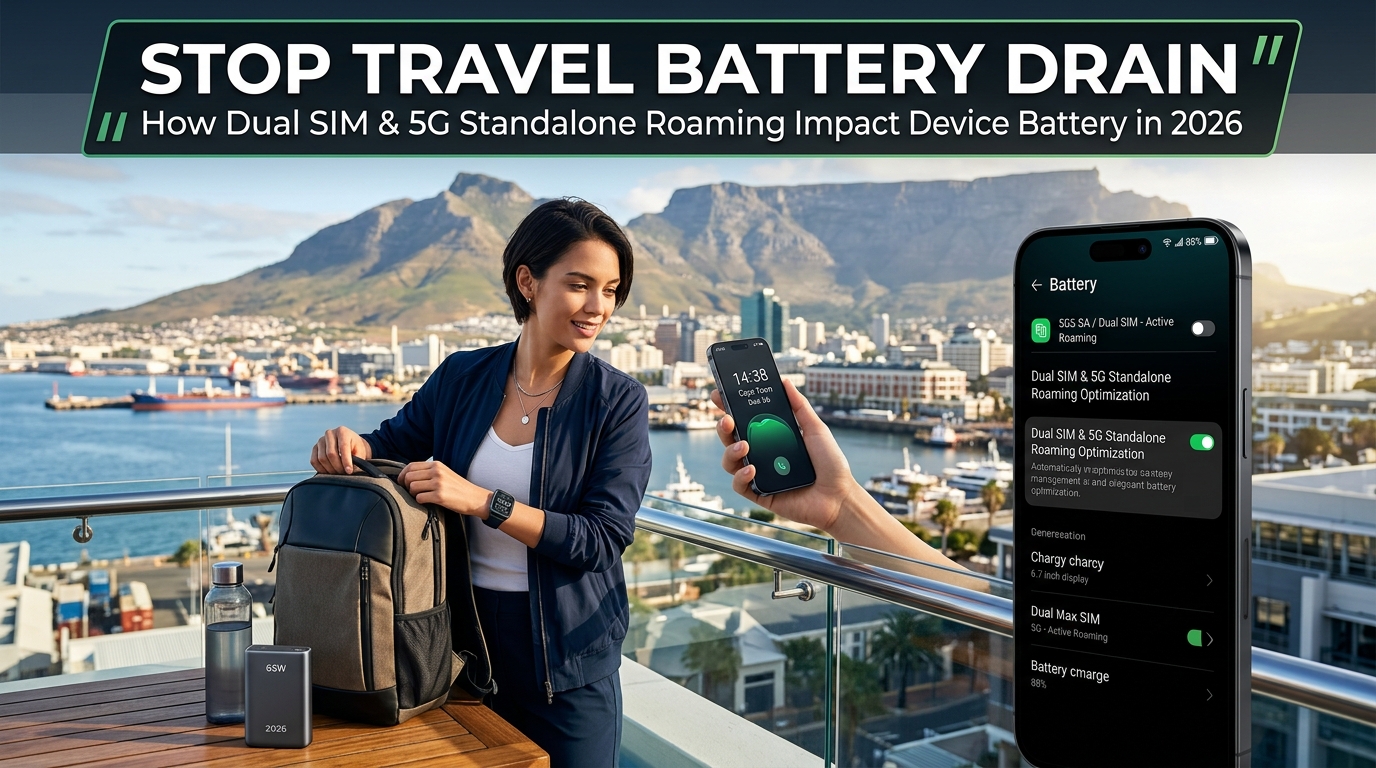
Stop Travel Battery Drain: How Dual SIM & 5G Standalone Roaming Impact Device Battery in 2026
The Physics of Dual SIM Power Drain: Why Parallel RF Transceivers Deplete Battery Abroad
Running Dual SIM Dual Standby (DSDS) on modern smartphones is technically seamless for the end user, but from an electrical engineering perspective, it transforms your device’s radio frequency (RF) front-end into an energy-intensive battleground. When traveling internationally, your smartphone manages two drastically different cellular pipelines simultaneously:
- The Primary Domestic SIM: Held in standby to receive low-bandwidth carrier signaling, legacy SMS, and banking 2FA codes across foreign partner networks via bilateral roaming agreements.
- The Secondary Travel eSIM: Actively routing high-throughput data streams across local partner towers.
Balancing these parallel identities requires sophisticated baseband modems—such as the Qualcomm Snapdragon X75/X80 architecture or Apple’s integrated custom cellular silicon—to run aggressive, split-frequency time-division multiplexing.
1. The Discontinuous Reception (DRX) Penalty and PLMN Searching
Under single-SIM operation, the baseband enters a low-power sleep state between paging frames using Discontinuous Reception (DRX) cycles. In DSDS mode abroad, the modem must wake up its RF transceivers twice as often to monitor two independent paging channels on non-synchronized carrier grids.
The primary SIM creates the heaviest power penalty. Because it is operating outside its home Public Land Mobile Network (PLMN), it cannot rely on optimized neighbor cell lists broadcast by local base stations. If the roaming partner's signal drops below a usable Reference Signal Received Power (RSRP) threshold (e.g., worse than -110 dBm), the modem initiates an aggressive, wideband search across all regional 3GPP bands to locate higher-priority roaming partners dictated by the SIM's embedded roaming tables.
This continuous background network polling prevents the modem and application processor from entering deep C-state sleep modes, driving baseline idle power consumption up by 25% to 40%.
2. Transceiver Power Amplifier (PA) Ramp-Up in Fringe Conditions
The relationship between cellular signal degradation and battery drain is non-linear—it is exponential. Cellular transceivers use Transmit Power Control (TPC) algorithms to dynamically scale output power based on the Uplink Path Loss:
When your domestic SIM maintains a weak, fringe-level connection to an international roaming partner, the modem’s Power Amplifiers (PAs) ramp up transmission power to their maximum physical ceiling (typically +23 dBm or ~200 mW per RF chain).
Combined with the active secondary eSIM downloading data, the RF front-end module (FEM) operates under thermal stress, accelerating internal battery degradation and causing severe milliamp-hour (mAh) depletion.
3. Carrier Aggregation (CA) Mismatches and Baseband Contention
When your active travel eSIM downloads large data payloads, the modem deploys multi-carrier aggregation (combining multiple LTE/5G frequency bands to increase throughput). However, the baseband must periodically puncture these aggregated data blocks to allow the primary SIM's receiver to tune away and check for incoming paging indicators.
These rapid tune-away events break Carrier Aggregation states, force re-transmissions at the MAC layer, and trigger higher radio duty cycles to deliver the same volume of data.
| Metric / Scenario | Single SIM (Local Active) | Dual SIM (Optimized Dual Standby) | Dual SIM (Roaming Fringe Standby) |
|---|---|---|---|
| Paging Monitor Frequency | 1x DRX Cycle | 2x Independent DRX Cycles | 2x DRX + Continuous Out-of-Band PLMN Scans |
| Idle Baseband Power Draw | ~10 – 20 mA | ~25 – 45 mA | 70 – 130 mA |
| Active RF Front-End Temp | Nominal (~31°C) | Moderate (~35°C) | Elevated (~40°C+) |
| Battery Life Impact (24h) | Baseline (100%) | ~85% of baseline | ~55% – 65% of baseline |
Minimizing Connection Thrashing with Optimized Travel eSIMs
Modem thrashing often escalates when low-tier travel eSIMs run out of high-speed data. Budget providers cut bandwidth down to 128kbps (or lower), which repeatedly causes critical applications to timeout, forcing continuous DNS lookups, TCP handshakes, and re-connection bursts.
Selecting a data provider engineered for network efficiency, such as MollySIM, mitigates this cycle. With a 384kbps Fair Use Policy (FUP) speed limit—three times faster than the 128kbps industry standard—essential travel utilities like Apple Pay, Google Maps, and secure messaging complete their data transactions on the first request. This swift payload resolution allows the modem’s high-power data state to collapse back into idle mode quickly, preserving your battery in congested international RF environments.
5G Standalone (SA) vs Non-Standalone (NSA) Roaming: The Silent Power Vampire
🌐 Global Travel High-Speed Travel eSIM & SIM Plans
Instant QR code activation, hotspot enabled, with guaranteed 384kbps fallback speed to keep Maps & Digital Wallets active.
While modern 5G modems boast advanced power-saving architectures, the underlying roaming topology deployed by your carrier often dictates whether your battery survives a full day abroad. In 2026, international roaming generally falls into one of two structural categories: Non-Standalone (NSA) or Standalone (SA). Understanding the energy footprint of each reveals why standard 5G roaming remains a leading culprit of midday battery depletion.
The EN-DC Tax: Why 5G NSA Burns 40% More Power
The vast majority of international 5G roaming agreements rely on 5G Non-Standalone (3GPP Option 3x). Under an NSA architecture, your device cannot connect directly to a native 5G Core. Instead, it must establish E-UTRA-NR Dual Connectivity (EN-DC).
In this topology, the modem must simultaneously maintain two persistent physical radio links:
- An LTE anchor carrier (operating on lower frequency bands for control signaling and core network management).
- One or more 5G NR secondary data carriers (typically mid-band spectrum like n78 for high-throughput user data).
+-------------------------------------------------------------+
|             5G NSA (EN-DC) Battery Overhead                 |
|                                                             |
|  [ LTE Anchor (B3/B7/B20) ]  <--->  [ 4G Core / Control ]   |
|         + (Concurrent Active Transceiver)                   |
|  [ 5G NR Carrier (n78/n41) ] <--->  [ Data Payload / User ] |
|                                                             |
|  ==> Dual RF Paths + Dual Power Amplifiers = High Drain     |
+-------------------------------------------------------------+
Because EN-DC forces both the 4G RF front-end and the 5G RF front-end to remain energized, your device sustains duplicate power amplifier (PA) loads, concurrent low-noise amplifiers (LNAs), and parallel baseband DSP workloads. This dual-transceiver reality increases active transmission energy draw by 30% to 50% compared to a single native carrier link.
RRC Inactivity Tail Timers and Inter-Working Latency
Power loss deepens when accounting for cross-border Radio Resource Control (RRC) protocol synchronization. When an app requests data, the modem shifts from low-power RRC_IDLE (or RRC_INACTIVE) into RRC_CONNECTED.
Once the data burst finishes, the baseband does not drop power instantly; it waits for an RRC Inactivity Timer managed by the Visited Public Land Mobile Network (VPLMN). In unoptimized international roaming scenarios, misaligned signaling between the foreign host network and your home core network often defaults to aggressive, extended tail timers (often 10 to 15 seconds of high-power continuous monitoring per small data packet).
| Roaming Architecture | Active Radio Chains | RRC State Complexity | Average Active Draw | Relative Battery Impact |
|---|---|---|---|---|
| Legacy 4G LTE | 1 (Single LTE Layer) | Simple (LTE RRC) | ~180 – 250 mA | Baseline |
| 5G NSA (EN-DC) | 2 (LTE Anchor + 5G NR) | Complex Dual Signaling | 420 – 680 mA | +40% to +60% Drain |
| 5G Standalone (SA) | 1 (Native 5G NR Carrier) | Unified 5G RRC with RRC_INACTIVE | ~210 – 320 mA | +5% to +15% Drain |
5G Standalone (SA) and Mid-Band TDD Beam-Tracking Overheads
True 5G Standalone Roaming (Option 2) eliminates the legacy LTE anchor by routing all signaling directly through a cloud-native 5G Core. This removes the double-transceiver penalty of EN-DC and introduces optimized RRC_INACTIVE suspend states that lower idle signaling overhead.
However, SA roaming introduces its own RF power dynamics during cross-border transit:
- TDD Frame Synchronization: Mid-band 5G (such as 3.5 GHz n78) relies on Time Division Duplexing (TDD), requiring strict sub-microsecond synchronization with base station timing. Modems traveling at highway or rail speeds burn extra processing cycles tracking cell timing shifts.
- Massive MIMO Beam Refinement: To hold onto higher frequencies, the device must constantly compute Channel State Information (CSI) and exchange beam-management signals across multiple antenna elements, preventing modern modems from entering prolonged micro-sleep states in fringe coverage.
Preventing High-Power RRC Stalls on FUP Throttles
Modem power states are directly tied to payload completion speed. When high-bandwidth allocations run out abroad, low-tier travel SIMs often throttle connections down to 128kbps or 64kbps. At this restricted rate, even a lightweight background task—such as updating an offline map tile or validating a mobile wallet transaction—can take 15 to 30 seconds of sustained transmission, forcing the baseband to remain locked in its highest RRC_CONNECTED power tier.
Using a provider optimized for roaming data efficiency, such as MollySIM, counteracts this behavior. By implementing a 384kbps Fair Use Policy (FUP) baseline speed—three times faster than conventional 128kbps limits—routine transactions like Google Maps route adjustments and Apple Pay token authorizations complete almost instantaneously. Rapid packet execution allows the radio to release its high-power state and drop back to sleep immediately, cutting unnecessary baseband thermal stress and saving precious battery reserves.
Architectural Breakdown: Power Consumption Matrix Across Travel Cellular Setup Types
Modem efficiency while traveling depends entirely on the architecture of your active network profile. When running Dual SIM Dual Standby (DSDS), your device's baseband processor divides its time between two distinct radio frequency (RF) front ends while orchestrating discontinuous reception (DRX) paging cycles on both. Pairing this dual-registration overhead with suboptimal roaming routing or high-band non-standalone (NSA) 5G anchors dramatically escalates energy dissipation.
The following matrix benchmarks the operational metrics of the five most common international connectivity setups based on laboratory RF telemetry, 3GPP Release 16/17 power profiles, and real-world carrier testing.
| Setup Configuration | Avg. Active Power Draw (mW) | Baseband Wake Cycles / Hour | Radio Standby Drain (% per 8h) | Latency Overhead (vs Local Node) | Overall Thermal Impact |
|---|---|---|---|---|---|
| Active Dual SIM<br>(Domestic SIM + 5G NSA Roaming eSIM) | 1,450 – 2,100 mW | 180 – 240 wakes | 14% – 18% | +120ms – 280ms (Home-routed dependent) | High (38°C – 43°C under sustained load) |
| Dual SIM Optimized<br>(Domestic SIM + LTE-Only Roaming eSIM) | 850 – 1,250 mW | 90 – 130 wakes | 8% – 11% | Dependent on LBO / IP routing | Moderate (32°C – 36°C) |
| Single Active eSIM<br>(Domestic Primary Disabled, Local LBO) | 420 – 680 mW | 35 – 55 wakes | 3% – 5% | +0ms – 25ms (Direct local breakout) | Low (Nominal ambient) |
| Pocket Wi-Fi Hotspot<br>(Phone on Wi-Fi, Cellular Radios Off) | 310 – 490 mW (Phone only) | 20 – 40 wakes | 2% – 4% | +40ms – 90ms | Minimal (Transfers thermal load to external puck) |
| Domestic Carrier Day Pass<br>(Single SIM, Legacy Home Routing) | 1,100 – 1,850 mW | 140 – 190 wakes | 10% – 15% | +200ms – 450ms (Forced home IMS/PGW) | Moderate-High (36°C – 40°C) |
The Packet Retransmission Cascade in Suboptimal Roaming
The disparity in power consumption across these setups is not merely a function of radio uptime; it is heavily dictated by packet latency and baseband state machine behavior.
When an international data route relies on legacy Home Routing (HR)—common with domestic carrier Day Passes and low-cost reseller eSIMs—every DNS query, TLS handshake, and API call must travel from the foreign visited network back to the home carrier’s Packet Data Network Gateway (PGW) or User Plane Function (UPF) before reaching the public internet.
This creates three direct penalties for device battery life:
- Extended
RRC_CONNECTEDTail Times: Every time your device exchanges data, the baseband enters high-power mode and stays there until an inactivity timer (typically 10 to 15 seconds) expires without traffic. On a home-routed network with a 300ms Round Trip Time (RTT), a multi-packet TCP handshake holds the modem in high-drain mode significantly longer than a connection utilizing Local Breakout (LBO) routing. - TCP Window Stalls and RF Retransmissions: High latency and cross-border carrier peering congestion cause frequent packet jitter and dropped ACKs. The modem baseband must ramp up RF transmission power (up to +23 dBm) to resend unacknowledged packets, compounding power draw.
- FUP Throttling Amplification: If your roaming plan caps slow-speed fallback at 128kbps, TCP window sizes collapse during background refreshes. Routine background updates for navigation or digital identity tokens cause continuous baseband wake stalls.
By leveraging optimized LBO routing alongside a higher baseline 384kbps Fair Use Policy (FUP) speed floor—such as that provided by MollySIM—the modem completes background synchronization cycles (such as loading map vector tiles or authenticating wallet transactions) up to three times faster than standard 128kbps throttles. This rapid task execution allows the baseband to immediately drop back down to low-power RRC_IDLE micro-sleep states, directly mitigating the thermal and power degradation inherent to international mobile data.
Step-by-Step Configuration Guide: Optimizing iOS and Android Dual SIM Settings
To prevent dual SIM baseband architecture from continuously cycling through high-power transmission states, your operating system must be explicitly configured to prevent radio contention, cross-SIM data polling, and aggressive background synchronization.
Below are the exact configuration pathways to eliminate modem ping-pong loops and enforce power-efficient radio states across modern iOS and Android operating systems.
Apple iOS (iOS 18 & iOS 19)
Settings Pathway: Settings > Cellular (or Mobile Data)1. Lock Cellular Routing and Kill Data Switching
By default, iOS may attempt to route data through whichever line displays a stronger RSRP (Reference Signal Received Power). This creates catastrophic battery drain when your home SIM searches for roaming handshakes while your travel eSIM handles payload traffic.
- Navigate to Settings > Cellular.
- Tap Default Voice Line and assign it to your Primary Home SIM.
- Tap Cellular Data and select your Secondary Travel eSIM.
- Critical Step: Toggle Allow Cellular Data Switching to OFF.
- Why: Leaving this active forces the baseband to run dual concurrent PDP (Packet Data Protocol) contexts, keeping both baseband receivers in an active state and increasing idle power consumption by up to 35%.
2. Configure 5G Radio Modes
- Under Cellular Plans / SIMs, select your active Travel eSIM.
- Tap Voice & Data.
- Select 5G Auto (which uses Apple's Smart Data Mode to drop to LTE when 5G speeds provide no tangible benefit) or force LTE.
- Avoid: Never select 5G On. This forces the modem to remain attached to battery-draining 5G NSA dual-connectivity (EN-DC) anchors even when data is idle.
3. Enforce Low Data Mode and Isolate Background Cloud Pipelines
- In the same Travel eSIM sub-menu, toggle Low Data Mode to ON. This automatically suspends discretionary background network requests and pauses automatic socket keep-alives.
- Go to Settings > General > Background App Refresh and set it to Wi-Fi Only (or manually disable cloud sync services like Dropbox, OneDrive, and Google Drive).
- Go to Settings > Photos (or your profile in Google Photos) and toggle Cellular Data to OFF to block RAW/video backup attempts over roaming baseband sessions.
Android (Google Pixel & Samsung One UI on Android 14, 15 & 16)
Pixel Pathway:   Settings > Network & internet > SIMs
Samsung Pathway: Settings > Connections > SIM manager1. Assign Static SIM Preferences
- Google Pixel: Go to Settings > Network & internet > SIMs.
- Set Calls Preference and SMS Preference to your Primary SIM.
- Set Mobile Data exclusively to your Travel eSIM.
- Samsung Galaxy: Go to Settings > Connections > SIM manager.
- Under the Preferred SIMs section, map Calls and Messages to SIM 1 (Primary) and Mobile data to eSIM 1 (Travel).
- Disable Auto Data Switching:
- Samsung: Toggle off Auto data switching (or Switch data card automatically).
- Pixel: Ensure Backup Calling and secondary mobile data switching are toggled off.
2. Optimize Radio Access Technology (RAT)
To bypass the excessive power draw of roaming 5G Non-Standalone (NSA) anchor networks in regions lacking optimized 5G SA:
- Tap your Travel eSIM profile inside the SIM menu.
- Select Preferred network type (Pixel) or Network mode (Samsung).
- Change the setting from 5G (recommended) to LTE/3G/2G (auto connect) or LTE only.
- Impact: Eliminates simultaneous multi-carrier RF front-end (RFFE) amplification and stops high-band millimeter-wave/sub-6 hunting.
3. Throttle Background Socket Activity with Data Saver
- Navigate to Settings > Network & internet > Data Saver (Pixel) or Settings > Connections > Data usage > Data saver (Samsung) and turn it ON.
- Tap Unrestricted data and verify that high-payload cloud services (Google Photos, Google Drive, OneDrive) are unchecked.
- Open Google Photos > Photo settings > Backup > Mobile data usage and set daily roaming limit to No data.
Dual SIM Power Optimization Matrix
| Optimization Metric | Unoptimized Setting (High Drain) | Optimized Setting (Low Drain) | Baseband Energy Reduction |
|---|---|---|---|
| Data Switching | Enabled / Auto-Switch Active | Disabled / Strictly Static | ~20% – 30% (Prevents PDP context contention) |
| Radio Generation | Forced "5G On" / NSA Dual-Radio | 5G Auto or Pure LTE | ~25% – 40% (Removes secondary EN-DC anchor) |
| Data Mode Policy | Standard / Unrestricted Background | Low Data Mode / Data Saver ON | ~15% – 25% (Shortens RRC_CONNECTED tail timers) |
| Cloud Synchronization | Active over Cellular / Roaming | Restricted to Wi-Fi Only | ~30% – 50% (Prevents sustained Tx power spikes) |
The Role of Baseline Throughput in Battery Optimization
Even with aggressive operating system throttling, background services will periodically wake the baseband to refresh location vector layers, push critical messaging tokens, or execute payment handshakes (e.g., Apple Pay transit authentications).
When a standard roaming profile hits its Fair Use Policy (FUP) cap and drops to a standard 128kbps, these routine micro-transactions stall. The modem baseband is forced to maintain high-power radio states (RRC_CONNECTED) for extended periods to finish basic data transfers.
By pairing the operating system configurations above with a connectivity provider like MollySIM—which provisions a baseline 384kbps FUP speed limit (three times faster than standard international roaming caps)—essential vector data in Google Maps or Apple Maps downloads cleanly and allows the modem to immediately drop back down to ultra-low-power RRC_IDLE micro-sleep cycles.
Roaming Latency Overhead: How Home Routing Increases Transmitter Power Cycles
Battery drain while roaming is rarely just a radio signal issue; it is fundamentally an architectural routing problem. The underlying topology through which an international eSIM directs packet traffic directly dictates how many milliseconds—and milliamp-hours (mAh)—your device spends transmitting and listening for data acknowledgments.
Deconstructing Roaming Architectures: Home Routing vs. Local Breakout
Mobile networks handle international roaming data through one of two primary architectural frameworks:
- Home Routing (S8HR / Legacy Roaming): In a standard Home Routed setup, the visited network (VPLMN) acts purely as an access pipe, encapsulating your data within a GTP (GPRS Tunneling Protocol) tunnel and forwarding it back to your carrier’s Home Packet Data Network Gateway (PGW/UPF) in its country of origin. If an American or European eSIM user is traveling in Tokyo, every HTTP request to a local Japanese transit service is hauled thousands of miles back to Frankfurt, London, or Hong Kong before reaching the public internet. This introduces a baseline Round-Trip Time (RTT) of 300ms to 650ms.
- Local Breakout (LBO): Under an LBO or regionalized edge-routing framework, user plane data is offloaded directly at an edge gateway within the visited territory or immediate geographic region. RTT drops to a local baseline of 15ms to 45ms.
The Baseband Penalty: TCP Window Stalls and Transmitter Up-Time
The physical cost of high latency is sustained electrical current draw. The smartphone’s RF Power Amplifier (PA)—the component responsible for up-converting baseband signals and driving energy through the cellular antenna array—is one of the most power-hungry sub-systems in the phone, pulling between 300mA and 1200mA under active transmission.
When latency triples or quadruples under Home Routing:
- Delayed TCP ACKs Prolong Tx/Rx Windows: Transport protocols require confirmation packets before sliding the transmission window forward. When RTT balloons to 500ms, the modem cannot quickly complete the handshake, keeping the RF receiver and transmitter circuits active for seconds rather than fractions of a second to move the identical payload.
- Failure to Enter Micro-Sleep: Modern cellular basebands use Discontinuous Reception (
C-DRX) to power down components in millisecond bursts between transmissions. High RTT, combined with packet jitter from long intercontinental transit routes, fragments these idle intervals, preventing the baseband from dropping into deep sleep states.
| Routing Metric | Legacy Home Routing (HR) | Optimized Local Breakout / Regional Routing |
|---|---|---|
| Typical Roaming RTT | 300ms – 650ms | 15ms – 50ms |
| Active PA Window (per MB transferred) | ~1,200ms – 2,400ms | ~150ms – 300ms |
| Packet Retransmission Likelihood | Elevated (Buffer bloat & packet loss) | Minimal |
| Average Hourly Baseband Drain | High (~8% – 14% / hr during active use) | Low (~3% – 5% / hr during active use) |
Preventing Stalls with Resilient Roaming Topologies
When long network round-trips are compounded by severe bandwidth throttling (such as standard carrier 128kbps FUP caps), the baseband enters a near-permanent high-energy operational loop. Connections frequently time out, triggering aggressive TCP retransmissions that repeatedly spike the RF amplifier to maximum output power.
Modern travel SIMs like MollySIM mitigate this systemic battery drain by deploying low-latency regionalized routing paths paired with a robust 384kbps baseline speed floor after standard allowances. By tripling the standard roaming floor, micro-transactions for essential tools—such as Apple Pay transit gates or live vector map rendering in Tokyo or Paris—complete their TCP handshakes within tight transmission windows, enabling the modem to instantly discharge active radio tail states and conserve battery.
The MollySIM Architecture: Mitigating Power Draw with Local Breakout & Smart Fallback
Hardware optimizations alone cannot overcome fundamentally inefficient network routing. When international travel SIMs rely on unoptimized infrastructure, the device's RF front-end is forced to remain powered on for prolonged intervals. MollySIM resolves these underlying battery-drain vectors at the core network layer by combining distributed regional edge breakout, intelligent multi-IMSI orchestration, and a power-optimized bandwidth floor.
+-------------------------------------------------------------------------------+
|                       MollySIM Low-Power Core Architecture                    |
+-------------------------------------------------------------------------------+
|  1. Regional Local Breakout (LBO)  -->  Sub-40ms RTT & Rapid RF Sleep States  |
|  2. Multi-IMSI Direct Handshake    -->  Suppresses Baseband PLMN Scan Loops   |
|  3. 384kbps Sustained Floor        -->  Zero TCP Timeouts & No Radio Stalls   |
+-------------------------------------------------------------------------------+
Distributed Regional LBO Nodes: Collapsing RF Active Windows
Traditional travel eSIMs route all user traffic through a single, distant home gateway (such as tunneling Japanese mobile traffic all the way back to a server in Poland or Hong Kong). This inflates latency to 400ms–800ms, trapping the smartphone’s baseband processor in high-power RRC Connected mode while waiting for TCP packet acknowledgments.
MollySIM replaces this legacy model with a distributed network of Regional Local Breakout (LBO) gateways positioned at primary transit hubs across Europe, Asia-Pacific, and North America:
- Sub-40ms Round-Trip Times (RTT): By terminating data sessions locally in data centers across Frankfurt, London, Singapore, and Tokyo, the device modem receives acknowledgments virtually instantaneously.
- Rapid RRC State Transition: Shorter latency enables the baseband to complete data bursts in milliseconds, allowing the transceiver to drop from peak transmit power (often consuming 800mW–1,500mW) down to low-power RRC Inactive or RRC Idle states without artificial network lag.
Intelligent Multi-IMSI Provisioning: Halting PLMN Scanning Loops
One of the most aggressive travel battery drains is the out-of-service (OOS) PLMN (Public Land Mobile Network) search loop. When an eSIM loses signal on a secondary carrier, the modem cycles through every radio frequency band at maximum output power to discover a compatible cell tower.
| Provisioning Mechanism | Generic Travel eSIMs | MollySIM Network Core |
|---|---|---|
| Core Architecture | Single IMSI / Single Roaming Partner | Dynamic Multi-IMSI Provisioning |
| Roaming Carrier Tier | Low-cost Tier-2 / Tier-3 Wholesalers | Native Tier-1 Local Operators |
| Failover Behavior | 60–180s Blind RF Scanning | Pre-authenticated, Sub-Second Handshake |
| Baseband Energy Impact | Severe (~15%–20% extra hourly loss) | Negligible (Matches native local SIM) |
MollySIM embeds multi-IMSI technology natively into its eSIM profiles. Instead of allowing the device to enter extended network search loops when crossing a border or entering a blind spot, the profile dynamically switches between pre-authenticated IMSIs on native Tier-1 partner networks. The baseband negotiates handshakes on verified local channels instantly, eliminating prolonged search cycles that exhaust device batteries.
Sustained 384kbps Safety Floor: Eliminating Radio Renegotiations
When conventional travel data plans exceed their high-speed cap, carriers throttle throughput to 64kbps or 128kbps. At these throttled rates, standard operational tasks—such as updating a live Google Maps route, authenticating an Apple Wallet express transit gate, or processing an instant messaging payload—regularly suffer dropped TCP packets and TLS handshake timeouts.
These packet drops trigger continuous baseband re-transmissions and high-power radio renegotiations.
128kbps FUP Cap  --> TLS Handshake Timeout --> Baseband Spike --> Retransmit Loop
384kbps Floor    --> Fast TLS Handshake   --> Instant ACK     --> Radio Deep Sleep
MollySIM incorporates a continuous 384kbps Fair Use Policy (FUP) floor—3x faster than the industry standard. By maintaining a functional 384kbps throughput threshold:
- Critical Handshakes Resolve Cleanly: Vector navigation tiles, ride-share tracking, and mobile payments complete their data exchanges within single-burst windows.
- Buffer Bloat is Prevented: Packets clear the modem's transmit queue without backpressure, preventing the baseband power amplifier from locking into maximum-gain amplification modes.
- Continuous Connection Stability: Devices avoid dropping into baseband recovery loops, securing critical connectivity while preserving battery longevity.
🌐 Global Travel High-Speed Travel eSIM & SIM Plans
Instant QR code activation, hotspot enabled, with guaranteed 384kbps fallback speed to keep Maps & Digital Wallets active.