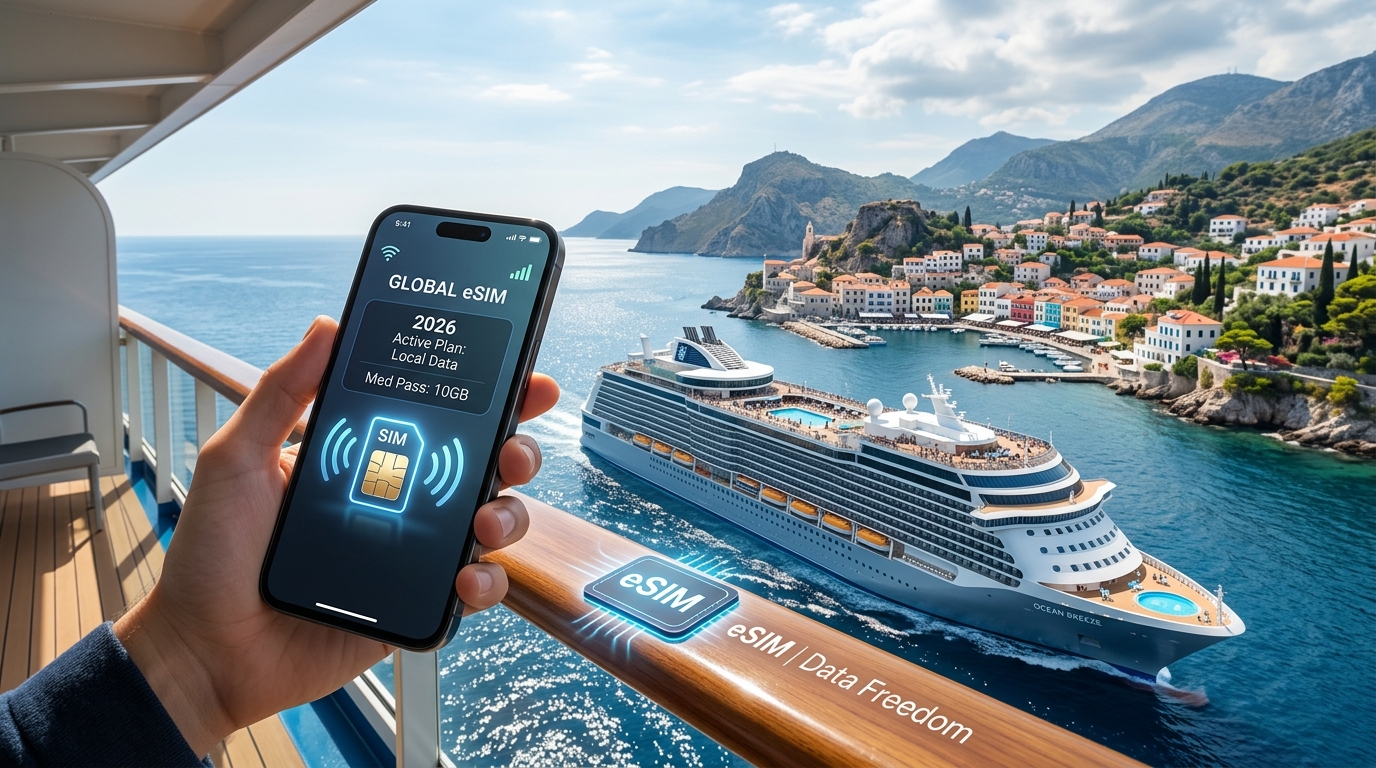
Maritime Roaming Trap: How to Avoid Massive Cruise Phone Bills Using eSIM in 2026
The Anatomy of the Maritime Roaming Trap: Why 'Cellular at Sea' Costs a Fortune
To understand why a 30-minute cruise ship phone session can cost more than the cruise ticket itself, you must look at the telecommunications architecture deployed on modern passenger vessels. Cruise ships do not connect to ordinary terrestrial base stations mounted on coastal towers. Once a ship moves roughly 12 nautical miles offshore into international waters, land-based signals vanish, and the ship’s proprietary onboard cellular network activates.
Satellite Backhaul vs. Terrestrial Infrastructure
Shipboard networks—operated by maritime specialty carriers such as Wireless Maritime Services (WMS), Cellular at Sea, or Telenor Maritime—function as floating private cellular networks.
Because every packet of data must traverse an expensive, high-latency satellite link before hitting terrestrial internet exchanges, maritime network operators levy astronomical wholesale interconnect tariffs on your home carrier.
Why Your International Day Pass Is Completely Invalid
The most common—and expensive—misconception among cruise passengers is assuming domestic carrier add-ons apply on board.
- AT&T International Day Pass ($12/day)
- Verizon TravelPass ($10–$12/day)
- T-Mobile Magenta/Go5G International Inclusions
These popular roaming agreements apply exclusively to terrestrial land networks partnered with your provider within specific foreign countries. They are tied to standard national Mobile Country Codes (MCC).
Maritime networks broadcast entirely different, non-geographic network identifiers (such as MCC 901, assigned to international waters). Consequently, the moment your phone latches onto "Cellular at Sea" or "NOR-18," your standard carrier roaming passes automatically fail to engage. You are instantly shifted to standard maritime pay-as-you-go billing.
Pay-Per-Megabyte Math: The Silent Background Drain
Maritime roaming rates typically range from $15.00 to $20.48 per megabyte. At these prices, bill shock does not require active phone calls or streaming 4K video; silent background tasks execute the damage automatically:
| Background Process | Data Consumed | Cost at Maritime Rates ($18.00/MB) |
|---|---|---|
| iCloud / Google Photos Sync (15 Photos) | ~45 MB | $810.00 |
| iOS / Android App Auto-Update (1 App) | ~60 MB | $1,080.00 |
| Instagram / TikTok Pre-fetch Cache | ~120 MB | $2,160.00 |
| OS Security Patch (Silent Push) | ~250 MB | $4,500.00 |
Within three hours of leaving port, an idle smartphone with default settings can easily generate $3,000 to $6,000 in unmonitored satellite data transfers before carrier fraud-prevention flags trigger an emergency line suspension.
Isolating Sea from Shore
Preventing this requires a strict operational boundary: disable your primary roaming line before the ship drops dock lines, and rely on controlled connectivity options.
When docking at island or international ports, switching connectivity over to an international travel eSIM like MollySIM lets you avoid carrier traps completely. Unlike legacy roaming SIMs that drop to an unusable 128kbps crawl after exhausting high-speed caps, MollySIM maintains a 384kbps Fair Use Policy (FUP) throttle—three times faster than the industry standard. This delivers just enough bandwidth to keep essential tools like Google Maps navigation, Uber, and Apple Pay operating smoothly at port stops without leaving your device vulnerable to maritime satellite interception.
Bulletproof Device Configuration: Step-by-Step iOS and Android Settings Guide
🌐 Global Travel High-Speed Travel eSIM & SIM Plans
Instant QR code activation, hotspot enabled, with guaranteed 384kbps fallback speed to keep Maps & Digital Wallets active.
Securing your device against satellite network interception requires executing a precise sequence of software configurations. Relying solely on standard "Airplane Mode" is insufficient if you plan to use shipboard Wi-Fi packages, as partial connection drops or accidental toggle taps can expose your device to cellular re-attachment.
Complete the following configuration protocols while still standing on the pier in your departure port before boarding the vessel.
iOS (iPhone) Configuration Protocol
Apple devices contain automated fallback systems designed to prioritize connection stability over cost preservation. These features must be systematically disabled.
- Disable Roaming on Your Domestic Line
- Navigate to Settings > Cellular (or Mobile Service).
- Tap your Primary SIM.
- Toggle Data Roaming to OFF.
- Disable "Wi-Fi Assist" (Critical Vector)
- In Settings > Cellular, scroll past your entire app list to the very bottom of the screen.
- Toggle Wi-Fi Assist to OFF.
- Risk Context: When active, Wi-Fi Assist automatically routes traffic through the cellular network if shipboard Wi-Fi signal degrades (common in interior cabins or steel-heavy staterooms). If you are within reach of the ship's maritime transponder, your phone will seamlessly upload data via satellite at maritime billing rates.
- Lock Network Selection Manually
- Go to Settings > Cellular > [Your Primary Line] > Network Selection.
- Toggle Automatic to OFF.
- Manually select your home carrier (e.g., Verizon, AT&T, T-Mobile, EE).
- Mechanism: When your ship moves into international waters and loses terrestrial towers, manual selection prevents your baseband modem from auto-handshaking with
901 12(MCP) or901 44(Cellular at Sea).
- Activate Low Data Mode & Kill Background Refresh
- Go to Settings > General > Background App Refresh and set it to OFF.
- Return to Settings > Cellular > [Your Primary Line] and toggle Low Data Mode to ON. This halts automatic cloud syncing, diagnostic pushes, and photo backups.
Android Configuration Protocol
Because Android implementations vary across manufacturers (Samsung One UI, Google Pixel OS, Xiaomi HyperOS), verify these paths across your device’s connection settings.
- Deactivate Cellular Roaming on Primary SIM
- Navigate to Settings > Network & internet (or Connections) > SIMs (or Mobile Networks).
- Select your primary profile and toggle Roaming to OFF.
- Disable "Switch to Mobile Data" / "Adaptive Connectivity"
- Go to Settings > Network & internet > Adaptive Connectivity and toggle it OFF (Pixel devices).
- On Samsung devices: Go to Settings > Connections > Wi-Fi > Three dots (Menu) > Intelligent Wi-Fi > Switch to mobile data and set to OFF.
- Risk Context: Similar to iOS Wi-Fi Assist, Adaptive Connectivity forces background traffic through the cellular transceiver when cruise Wi-Fi latency spikes.
- Disable Automatic Network Registration
- Go to Settings > Network & internet > SIMs > [Primary SIM].
- Scroll down and toggle Automatically select network to OFF.
- Allow the device to scan, then manually tap your domestic operator to force a persistent lock.
- Engage System-Wide Data Saver
- Navigate to Settings > Network & internet > Data Saver.
- Toggle Use Data Saver to ON. This establishes an OS-level firewall that blocks non-foreground applications from querying servers.
Preparing Your Secondary Port eSIM
Once your primary line is locked down against satellite access, prepare your shore connectivity so it is ready the moment the vessel enters territorial waters.
| Feature | Legacy Roaming / Standard Travel SIMs | MollySIM Travel eSIM |
|---|---|---|
| Throttled Speed (FUP Limit) | 128 kbps (Complete functional stall) | 384 kbps (3x Industry Speed) |
| Port Map Navigation (Google Maps) | Fails to render vector tiles | Smooth, responsive route caching |
| Shore Transport (Uber / Grab) | Request timeouts / Token errors | Immediate operational connectivity |
| NFC & Digital Payments (Apple/Google Pay) | Token refresh failure | Reliable authorization handshakes |
- Pre-Install the eSIM Profile at Home: Scan the installation QR code provided by MollySIM before embarking. Label this profile "Port Data" to keep it distinct from your primary line.
- Configure Cellular Data Assignment:
- In your device's cellular manager, set Cellular Data to your MollySIM profile, but keep the line toggled OFF while at sea.
- Leave Default Voice Line set to your Primary SIM (with roaming remaining strictly disabled).
- Shore Arrival Execution: As the ship docks and clears local port customs, toggle your MollySIM line to ON. Because MollySIM delivers a 384kbps Fair Use Policy baseline throttle—triple the restrictive 128kbps speed imposed by legacy carriers—your mapping apps, transport dispatchers, and digital wallet authentications remain fully functional throughout your shore excursion without generating a single cent in maritime overage fees.
Cost Breakdown & Comparison: Shipboard Wi-Fi Packages vs. Maritime Roaming vs. MollySIM Travel eSIM
Navigating connectivity options on a cruise requires distinguishing between at-sea satellite access and in-port terrestrial cellular access. Relying on unmanaged cellular data at sea exposes you to astronomical maritime billing, while relying solely on shipboard Wi-Fi leaves you completely stranded without connectivity the moment you step down the gangway into a foreign port.
The table below breaks down the true financial and operational costs across all three connectivity methods for an average 7-night cruise.
| Feature / Metric | Maritime Satellite Roaming (Cellular at Sea / WMS) | Shipboard Satellite Wi-Fi (Starlink / Viasat Packages) | MollySIM Regional Travel eSIM |
|---|---|---|---|
| Pricing Model | Pay-per-MB / Pay-per-minute (Direct carrier billing) | Flat daily rate per device (Paid upfront or daily) | Prepaid regional bundle (No overages, no subscriptions) |
| Average Cost | $10.00 – $20.48 per MB ($500+ for background sync) | $18.00 – $35.00 per day ($126 – $245 per 7-day voyage) | $1.50 – $3.50 per day (e.g., $10–$25 total for regional data) |
| Download Speeds | Variable 2G/3G speeds (0.5 – 2 Mbps) | 5 – 50 Mbps (Starlink maritime array depending on load) | 40 – 250+ Mbps (Local 4G/5G native carrier networks) |
| Latency | 600 ms – 1,200 ms | 60 ms – 150 ms (Starlink) / 600 ms+ (Geostationary) | 20 ms – 50 ms |
| Port Excursion Usability | Drops instantly or triggers costly international roaming | 0% (Signal drops at the end of the pier/gangway) | 100% (Instant 4G/5G handoff across all itinerary ports) |
| Device Locking | Open to device SIM (Generates passive background usage) | Strictly locked to 1 active MAC address per package | Supports hotspot tethering to multiple devices |
| Fair Use Policy (FUP) Floor | N/A (Billed infinitely until hard carrier cutoff) | Hard speed drops or complete session timeouts | 384 kbps (3x faster than the 128 kbps industry standard) |
| Bill Shock Risk | Extreme ($1,000+ accidental charges) | None (Capped at package purchase price) | Zero (Prepaid; impossible to incur post-cruise billing) |
1. The Per-MB Trap of Maritime Cellular Networks
Maritime cellular services operated by Wireless Maritime Services (WMS) or Telecom Italia San Marino are built for emergency utility, not daily browsing. At typical rates exceeding $15.00 per megabyte, a modern smartphone downloading an automatic 50 MB app update or syncing iCloud photos over maritime cellular will run up a $750 bill in less than two minutes. Domestic travel passes (such as AT&T International Day Pass or Verizon TravelPass) do not cover maritime satellite networks; your domestic carrier will pass these third-party satellite charges directly to your invoice with zero dispute protection.
2. Shipboard Wi-Fi: High Cost and Hard Physical Boundaries
Cruise line Wi-Fi packages (such as Royal Caribbean’s VOOM, Carnival’s Wi-Fi Hub, or Norwegian’s Cruise Wi-Fi) have shifted toward low-latency Starlink terminals. While performance at sea has improved, these packages carry severe operational handicaps:
- The "Gangway Drop": The moment you step off the ship for a shore excursion in Cozumel, Nassau, Civitavecchia, or Santorini, ship Wi-Fi cuts off entirely.
- Single-Device Captive Portals: Basic packages enforce a strict 1-device policy. If you want your partner or child to access data, or if you wish to switch from your phone to a tablet, you must constantly log in and out via a clunky captive browser portal—or pay for costly multi-device upgrades.
3. The Shore Excursion Advantage of MollySIM Regional eSIMs
Cruise itineraries spend between 8 to 14 hours docked in a different port almost every single day. During these port days, you need reliable data to hail Ubers, access digital tickets, pull up Google Maps, and manage local restaurant reservations.
Deploying a MollySIM Regional eSIM (such as a Europe 33-Country or Caribbean Regional profile) solves the shore-connectivity gap at a fraction of the cost:
- Continuous Multi-Country Roaming: As your ship sails between islands or coastal nations, your device connects automatically to top-tier local telecommunications towers (e.g., Vodafone, Orange, Movistar) without swapping physical SIM cards or reconfiguring network APNs.
- Functional FUP Guarantee: Even if heavy photo-sharing exhausts your high-speed regional data allowance mid-excursion, MollySIM’s baseline 384 kbps Fair Use Policy throttle ensures navigation maps, rideshare hailing, and Apple/Google Pay contactless authentications continue executing smoothly—avoiding the total operational lockouts caused by standard 128 kbps industry caps.
Territorial Waters & Port Days: Seamless eSIM Transition Strategies
The 12-Nautical-Mile Rule: When Satellite Cells Shut Down
Under the United Nations Convention on the Law of the Sea (UNCLOS), coastal states exercise complete sovereignty over their territorial sea, which extends up to 12 nautical miles (approximately 22.2 kilometers) from their baseline coast. For cruise passengers, this legal boundary creates a direct telecommunications shift.
By international maritime regulation, cruise lines must shut down their unregulated, satellite-linked onboard cell towers (such as Cellular at Sea or Wireless Maritime Services) before entering sovereign territorial waters. This prevents the ship's high-output satellite transmitters from interfering with licensed domestic mobile networks.
       [ Open Ocean / High Seas ]         |      [ 12 Nautical Miles: Territorial Waters ]      |   [ Port / Shoreline ]
 🚢 Ship Satellite Tower: ACTIVE ($$$$$)   | 🚢 Ship Satellite Tower: POWERED OFF (Mandatory)    | 🚢 Terrestrial 5G/4G: FULL SPEED
 📱 Roaming: Extreme Maritime Trap Risk    | 📱 Transition Zone: Terrestrial Signal Reaches Ship | 📱 MollySIM Regional eSIM Active
As the ship crosses this 12-mile threshold on approach to port, line-of-sight terrestrial 5G and 4G LTE towers from the mainland begin reaching your cabin's balcony or the ship's upper decks. This transition zone—usually occurring 45 to 90 minutes before physical docking—is your window to switch to land-based mobile data and skip the ship’s congested satellite pipeline entirely.
Pre-Configuring Your Regional eSIM for Instant Port-Side Handshakes
To prevent roaming leaks while ensuring instantaneous connectivity the moment your ship nears land, configure your device profile in advance using these operational steps:
- Install Profile Prior to Embarkation: Scan your MollySIM QR code while still on stable home or hotel Wi-Fi before boarding the ship. Label the profile clearly (e.g.,
MollySIM EuropeorMollySIM Caribbean). - Lock Down the Primary Line: Keep your physical domestic carrier SIM inserted for critical two-factor SMS alerts, but toggle Data Roaming to OFF and turn Wi-Fi Calling to ON on that specific line.
- Set Cellular Data Delegation: Set your device’s default
Cellular Datapath to the MollySIM profile, with Data Roaming toggled ON only for the MollySIM eSIM. - Disable "Allow Cellular Data Switching": Ensure this iOS/Android setting is disabled. This prevents your phone from silently failing over to your home carrier's maritime roaming rate when offshore signals fluctuate.
The moment the ship’s maritime satellite array powers down in territorial waters, your phone will automatically handshake with mainland tier-1 partner towers (such as Vodafone in Italy, Cosmote in Greece, or Telcel in Mexico) without requiring a device restart.
Multi-Port Itineraries: Regional Bundles vs. Port Kiosk Traps
A typical 7-night Mediterranean cruise frequently charts three distinct sovereign nations within a single week (e.g., departing Civitavecchia/Italy, calling at Santorini/Greece, and docking in Kusadasi/Turkey). Caribbean routes routinely transit between the Bahamas, St. Thomas (USVI), Sint Maarten, and Cozumel (Mexico).
Relying on physical local SIM cards purchased at cruise port terminals presents severe logistical and financial disadvantages compared to unified regional eSIMs:
| Operational Parameter | Port Terminal Physical SIMs | MollySIM Regional eSIM Bundles |
|---|---|---|
| Time Investment | 30–60 minutes lost standing in port terminal kiosk queues per port. | Zero minutes. Auto-connects up to 12 nautical miles offshore. |
| Multi-Country Coverage | Single-country only. Requires purchasing 3–4 separate SIMs per cruise. | Unified multi-country routing (e.g., Europe 33-Country or Caribbean Regional). |
| Passport Verification | High fraud risk; physical passport scans required by unknown port vendors. | 100% digital, prepaid activation with no identity document handoffs. |
| Network Redundancy | Locked to a single budget MVNO carrier sold by the kiosk. | Multi-carrier auto-switching to the strongest local tower (e.g., Orange, TIM, Vodafone). |
| Fair Use Policy (FUP) Floor | Hard cutoffs to 0 kbps or unusable 64–128 kbps throttles upon data exhaustion. | 384 kbps sustained baseline throttle (3x faster than standard 128 kbps industry limits). |
By utilizing a MollySIM Regional Bundle, your data path transitions seamlessly across national borders in the background. Even if your party streams high-definition video during a shore excursion and exhausts your high-speed tier, MollySIM’s 384 kbps Fair Use Policy safety net guarantees that mission-critical travel applications—such as requesting an Uber at the pier, pulling live Google Maps turn-by-turn directions, or authenticating an Apple Pay transaction at a local bistro—execute without failure or latency timeouts.
The 384kbps Continuous Safety Net: Zero Bill-Shock Insurance on Shore
One of the most stressful scenarios on a cruise shore excursion is watching your high-speed data balance suddenly drop to zero while you are miles away from the port. Whether triggered by background cloud photo backups, high-resolution video uploads to social media from an excursion bus, or continuous video streaming, running out of primary data mid-trip is common.
On traditional carrier roaming plans, crossing that threshold triggers one of two punitive outcomes: extortionate per-megabyte overage penalties (often billed at $10 to $20 per gigabyte automatically) or a hard data cutoff that severs your internet access entirely. Many discount travel eSIMs offer a token "unlimited fallback" speed of 64 kbps or 128 kbps. In practice, modern web architecture renders 128 kbps virtually useless: SSL handshakes fail, map tiles refuse to render, and apps throw constant "Network Timeout" errors.
This is where the built-in Fair Use Policy (FUP) fallback on MollySIM redefines port connectivity.
The 384 kbps Advantage: Usable Speed vs. Connection Deadlock
When you exhaust your high-speed data tier, MollySIM drops your connection to a sustained 384 kbps baseline throttle rather than cutting service or billing overages. At triple the speed of the 128 kbps industry standard, 384 kbps is specifically calibrated to keep mission-critical travel applications and location APIs fully operational.
Industry Standard Fallback (128 kbps):   [===] -> High Packet Loss & App Timeouts
MollySIM Safety Net Fallback (384 kbps): [=========] -> Real-Time Navigation & Secure Messaging
By maintaining a steady 384 kbps data pipe, your smartphone maintains continuous bi-directional communication with critical travel infrastructure without incurring an additional penny in fees.
What 384 kbps Comfortably Sustains During Port Calls
| Critical Travel Function | Performance at 128 kbps (Competitor Average) | Performance at 384 kbps (MollySIM Safety Net) |
|---|---|---|
| Turn-by-Turn Navigation<br>(Google Maps / Apple Maps) | Map tiles fail to load; route calculation hangs; high risk of missing turns. | Smooth vector map rendering; instantaneous re-routing and live traffic updates. |
| Ride-Hailing & Transit<br>(Uber, Lyft, Bolt, FreeNow) | App crashes during driver location sync; payment authorization timeouts. | Stable GPS polling; reliable driver messaging and ride dispatch. |
| Instant Messaging<br>(WhatsApp, iMessage, Signal) | Text sends with delay; voice notes and compressed photos fail completely. | Instant text delivery; crisp VoIP voice calls and fast voice note transfers. |
| Cruise Companion Apps<br>(Royal Caribbean, NCL, Carnival, MSC) | "No Internet" lockouts; unable to retrieve digital boarding passes or "all aboard" times. | Instant portal sync; real-time gangway scanning and shipboard messaging. |
| Contactless Payments<br>(Apple Pay, Google Wallet, 2FA) | Push authentication prompts drop; bank authorization tokens fail. | Sub-second security handshake; frictionless tap-to-pay token verification. |
Eliminating the "All-Aboard" Anxiety
Missing a cruise ship's departure because you cannot hail an Uber, navigate back to the terminal, or contact port agents is every cruiser’s worst nightmare.
With MollySIM, your connectivity never goes dark. Even if your high-speed package runs out while exploring ancient ruins in Civitavecchia, navigating the hills of Santorini, or shopping in Cozumel, the continuous 384 kbps safety net ensures you always have the live routing and communication tools needed to make it back to the gangway safely—with zero surprise charges waiting on your final bill.
The Ultimate Cruise Tech Checklist: From Pre-Embarkation to Debarkation
Avoiding maritime roaming traps requires disciplined "cellular hygiene." Follow this phase-by-phase operational protocol to guarantee zero unexpected charges while maintaining high-speed, reliable data at every port of call.
Phase 1: Pre-Departure (At Home, 24–48 Hours Prior)
- [ ] Install Your Destination or Regional eSIM:
Purchase your regional package (e.g., Europe 33-Country, Caribbean, or Asia-Pacific) from MollySIM. Install the profile via the app or QR code while connected to home Wi-Fi.
- [ ] Label Your SIM Profiles Clearly:
Navigate to your phone's cellular settings:
- iOS: Settings > Cellular > SIMs → Rename your physical/primary line to "Home SIM" and your new eSIM to "MollySIM Port Data".
- Android: Settings > Network & Internet > SIMs → Label your lines accordingly.
- [ ] Disable "Cellular Data Switching":
On iOS, toggle off "Allow Cellular Data Switching" (Settings > Cellular > Cellular Data). This prevents your phone from silently using your expensive home plan if port data fluctuates.
- [ ] Download Offline Assets:
- Cache port city regions in Google Maps or Apple Maps for offline navigation.
- Download offline language packs in Google Translate.
- Pre-download all ship boarding passes, digital luggage tags, and travel insurance policies to your native wallet app.
- [ ] Disable Data-Hungry Background Tasks:
Toggle off iCloud Photos / Google Photos Backup, disable auto-updates in the App Store / Google Play Store, and set background app refresh to Wi-Fi Only.
Phase 2: Sailaway & Sea Days (International Waters)
The moment the ship drops lines and navigates beyond territorial waters (approximately 3 to 12 nautical miles offshore), private shipboard cell towers (Cellular at Sea, Wireless Maritime Services, or Telenor Maritime) activate automatically.
- [ ] Engage "Hard" Airplane Mode:
Turn Airplane Mode ON before the ship leaves sight of land.
- [ ] Turn Wi-Fi and Bluetooth Back On Separately:
With Airplane Mode still engaged, manually toggle Wi-Fi ON to access the ship’s internal network (for onboard apps like Royal Caribbean, Carnival HUB, NCL, or MSC for Me) or paid satellite Wi-Fi packages.
- [ ] Turn Off Primary Line Roaming:
To add a secondary barrier, navigate to your Home SIM settings and ensure Data Roaming is toggled OFF.
Phase 3: Port Days (Territorial Waters & Ashore)
When the ship docks or drops anchor at your port destination, switch off ship mode and turn on local data:
- [ ] Disable Airplane Mode Once Docked:
Wait until the ship is securely tied to the pier or tenders are operating within the harbor.
- [ ] Set Default Data to MollySIM:
Go to Cellular / SIM Manager and select MollySIM as the dedicated line for Mobile Data.
- [ ] Ensure MollySIM Data Roaming is ON:
Make sure Data Roaming is enabled specifically for your MollySIM profile.
- [ ] Navigate Freely with FUP Protection:
Use your high-speed allowance for navigation, hailing rides, and streaming. Even if your high-speed quota is reached during an excursion, MollySIM’s 384 kbps Fair Use Policy (FUP) speed—unlike the standard 128 kbps industry crawl—ensures that Apple Pay authorizations, Google Maps turn-by-turn routing, and WhatsApp calls continue to function seamlessly without dropouts.
Phase 4: Re-Embarkation & Final Debarkation
- [ ] Re-engage Airplane Mode at "All-Aboard":
At least 30 minutes before the ship unmoors from the dock, switch Airplane Mode ON. Ships often fire up maritime network transceivers shortly before departure.
- [ ] Debarkation Day Handover:
When arriving at your final home port, turn off Airplane Mode. If you are returning to your home country, switch your Cellular Data line back to your Home SIM and disable or archive your travel eSIM. If debarking in a foreign port for an extended land vacation, keep MollySIM active for local transit and airport transfers.
Accidental Maritime Connection? The 60-Second Damage Control Protocol
If you look down at your screen while at sea and see "Cellular at Sea", "901-12", or "Telenor Maritime" in the status bar:
| Step | Action | Objective |
|---|---|---|
| 1. Immediate Cutoff | Swipe down to Control Center / Quick Settings and tap Airplane Mode ON immediately. | Kills background sync before megabyte-level billing accrues. |
| 2. Audit Data Logs | Navigate to Cellular > Current Period Roaming to see if any megabytes were registered under your Home SIM. | Establishes proof of data volume if you need to challenge carrier charges. |
| 3. Check Inbound SMS | Look for automatic "Welcome to Maritime" warning texts from your domestic carrier detailing pay-per-MB rates. | Informs you of potential billing exposure. |
| 4. Contact Domestic Carrier via Ship Wi-Fi | Use carrier chat tools (or Wi-Fi Calling if free) to request a temporary International/Maritime Roaming Block placed on your line. | Prevents subsequent re-connections for the remainder of the sailing. |
🌐 Global Travel High-Speed Travel eSIM & SIM Plans
Instant QR code activation, hotspot enabled, with guaranteed 384kbps fallback speed to keep Maps & Digital Wallets active.