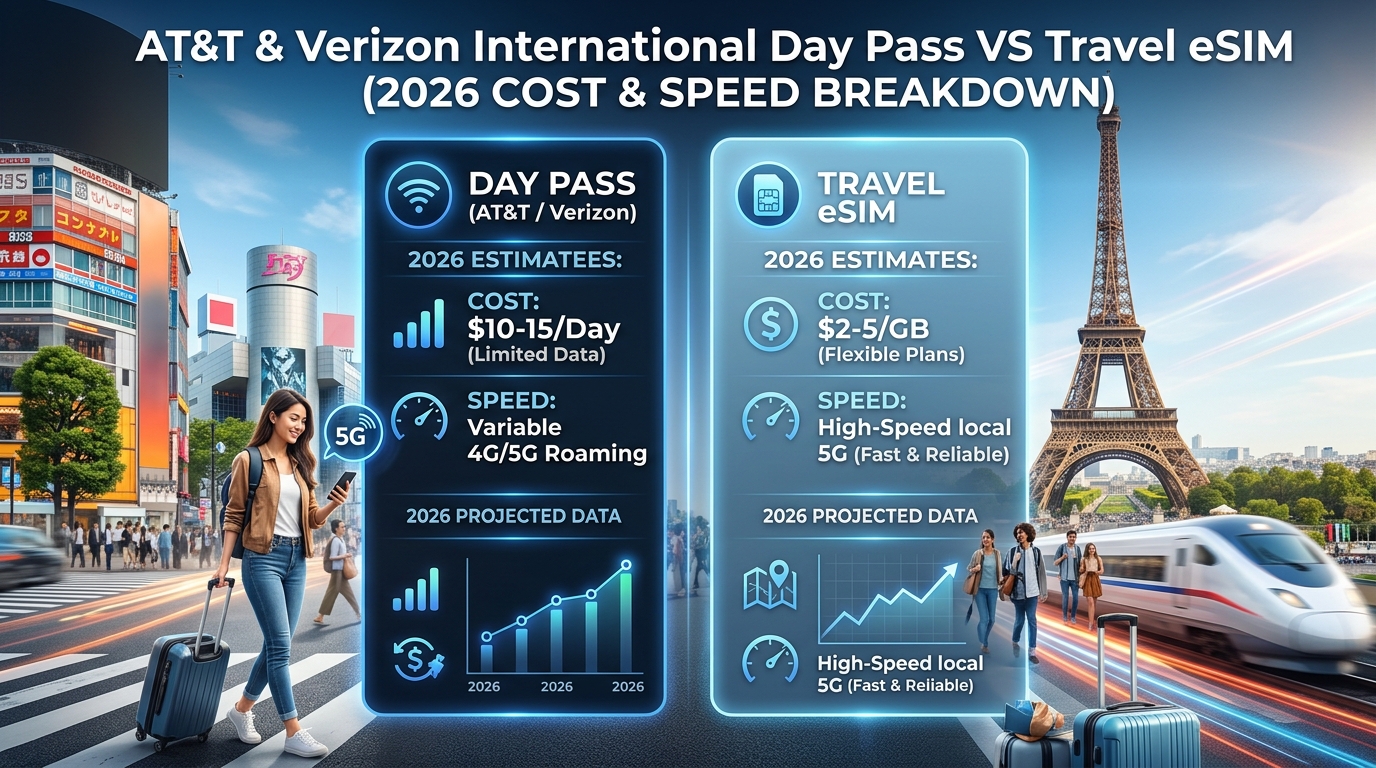
The Hidden Cost of Carrier Roaming: Breaking Down AT&T IDP ($12/Day) and Verizon TravelPass ($10/Day) in 2026
At first glance, carrier day passes sound like a frictionless compromise: keep your domestic phone number active, step off the plane, and pay a predictable daily fee. However, what telecommunications carriers market as convenience is structurally designed to maximize recurring revenue through automated triggers, multi-line compounding, and billing cycle loopholes.
To understand how daily roaming fees inflate your post-trip statement, let us analyze the true cost of taking AT&T International Day Pass (IDP) and Verizon TravelPass on a standard two-week overseas itinerary.
The 14-Day Baseline Math: Solo vs. Group Travel
US carriers have steadily adjusted their daily roaming pricing. In 2026, AT&T charges $12 per day for the first line, while Verizon TravelPass remains $10 per day per line.
Here is what a 14-day international trip costs on paper before calculating real-world billing anomalies:
| Roaming Setup | Daily Rate (Primary Line) | Daily Rate (Add-on Line) | 14-Day Baseline Total | Estimated Total with Taxes & Surcharges |
|---|---|---|---|---|
| AT&T International Day Pass (Solo) | $12 | N/A | $168.00 (or $120 if capped) | ~$135 – $190 |
| Verizon TravelPass (Solo) | $10 | N/A | $140.00 | ~$158 – $170 |
| AT&T IDP (Couple - 2 Lines) | $12 | $6 | $252.00 (or $180 if capped) | ~$210 – $285 |
| Verizon TravelPass (Couple - 2 Lines) | $10 | $10 | $280.00 | ~$315 – $340 |
| Verizon TravelPass (Family of 4) | $10 | $10 | $560.00 | ~$630 – $680 |
| MollySIM Travel eSIM (Per Line, Unlimited/Fixed) | Fixed flat rate | Fixed flat rate | $18 – $35 total | No added fees or taxes |
Note: AT&T caps IDP charges at 10 daily fees per billing cycle ($120 max for the primary line), but this cap strictly resets if your trip spans across two monthly billing cycles.
The Silent Multipliers: How Carrier Passes Quietly Explode
The real financial hazard of carrier day passes lies not in the base rate, but in the automated billing mechanisms built into postpaid accounts:
1. The 1-Kilobyte Accidental Trigger
Both AT&T and Verizon activate a full 24-hour billing pass the millisecond your device exchanges cellular data with a foreign tower. If you land in Europe, switch off Airplane Mode for three seconds to check the time, and a single background app (such as weather widgets, email fetching, or iCloud sync) downloads 2 KB of data, your account is immediately charged the full $10 or $12 daily fee.
2. The Billing Cycle Split
AT&T’s advertised "10-day charge cap per bill" only protects you if your 14-day trip falls entirely within a single calendar billing period. If your vacation starts on the 20th and your billing cycle closes on the 25th, your 10-day cap resets on day six. You end up paying for all 14 days ($168 for a single line, or up to $252 for a couple), completely bypassing the cap.
3. Regulated Carrier Surcharges & Local Taxes
Carrier pass fees are subject to domestic state and local telecom taxes, Universal Service Fund (USF) surcharges, and regulatory cost recovery fees. These administrative additions routinely tack an extra 12% to 22% onto international roaming charges by the time your monthly invoice generates.
4. The Multi-Line Multiplier for Families
Verizon provides no discount for secondary lines; a family of four traveling for two weeks will accumulate over $560 to $650 in basic connectivity costs alone. While AT&T discounts secondary lines to $6/day, the combined total for a family of four still easily clears $300 to $450.
The Fixed-Cost Alternative: Zero Billing Surprises
The shift toward travel eSIM technology represents a move from open-ended, reactive postpaid billing to deterministic, prepaid pricing.
When you purchase a travel eSIM through MollySIM, connectivity is completely decoupled from your domestic carrier's billing engine:
- Zero Auto-Renew Traps: You pay a single upfront price (typically $15 to $35 for an entire multi-week package) with zero credit card holds or recurring daily fees.
- No Accidental Activation Costs: If you do not use data on a given day, you do not pay for it. There are no background sync triggers that cost $12 per tap.
- Resilient Low-Speed Connectivity: Unlike traditional carriers that cut you off entirely or legacy travel eSIMs that throttle speeds down to an unusable 128kbps after data caps, MollySIM implements a 384kbps Fair Use Policy (FUP) speed limit. At 384kbps—three times faster than standard competitor throttles—critical utility applications like Google Maps, Apple Pay, WhatsApp text messaging, and Uber ride-hailing continue running seamlessly without forcing you into an expensive top-up.
For international travelers navigating multiple borders or extended itineraries, relying on carrier daily roaming passes is an unnecessary $140–$500 budget leak. Transitioning to dedicated travel eSIMs eliminates the carrier middleman, delivering faster local 5G routing at a fraction of the cost.
The Speed Trap: Daily Throttling, High Latency, and the Local Peering Advantage
🇪🇺 Europe 33 Countries High-Speed Travel eSIM & SIM Plans
Instant QR code activation, hotspot enabled, with guaranteed 384kbps fallback speed to keep Maps & Digital Wallets active.
Cost is only half the equation when evaluating international connectivity. The more insidious issue with legacy carrier roaming passes is network degradation—specifically the aggressive throttling policies and severe routing latency hidden in standard carrier terms.
The Carrier Throttle: The "Unlimited" Illusion
While major US carriers advertise roaming passes as having "unlimited" access, the high-speed allocation is tightly capped:
- Verizon TravelPass: Provides only 2GB of high-speed data per 24-hour session. Once you exceed 2GB—easily done by navigating, uploading high-resolution photos, or joining a single video call—your connection is instantly throttled to 3G speeds (around 128kbps to 256kbps) or, in some markets, sub-2G speeds of 64kbps.
- AT&T International Day Pass: Data usage draws from your domestic plan pool, but international traffic is subject to severe deprioritization. If your domestic plan has network management thresholds, your roaming data is deprioritized first, dropping to dial-up speeds during local peak congestion.
At 64kbps–128kbps, the mobile web ceases to function. Map tiles fail to render, rideshare apps time out, and translation tools throw server errors.
In contrast, MollySIM travel eSIMs bypass these artificially constricted daily ceilings. When you select a fixed high-speed package, your connection runs at native 5G/4G speeds without arbitrary mid-day drops. Furthermore, even if your chosen plan reaches its data limit, MollySIM implements a 384kbps Fair Use Policy (FUP) speed limit. At three times the bandwidth of carrier throttles (128kbps), essential tools like Google Maps, Apple Pay token authentications, and messaging apps maintain operational integrity.
The Routing Penalty: Home-Routed Roaming vs. Local Breakout
Beyond raw bandwidth limits, carrier roaming suffers from a structural networking flaw known as Home-Routed Architecture (HR).
When you use an AT&T or Verizon pass abroad (for instance, in Tokyo or Paris):
- Your phone connects to a local cell tower (e.g., SoftBank in Japan or Orange in France).
- Instead of routing your request to the local internet directly, the host network encapsulates your data packets and tunnels them across subsea cables back to the carrier’s core Packet Data Network Gateway (PGW) in the United States.
- The data is inspected, billed, and finally routed to the open internet before traveling all the way back across the globe to your device.
This "tromboning" effect introduces massive latency—routinely 300ms to 500ms+. Even if your connection displays "5G," web pages feel sluggish, VoIP calls suffer from awkward speech delays, and dynamic web apps lag noticeably.
The Local Tier-1 Peering Solution
Dedicated travel eSIMs from MollySIM utilize Local Breakout (LBO) and low-latency regional nodes. By establishing direct peering agreements with premier global operators—such as Vodafone and Orange in Europe, and NTT Docomo and SoftBank in Asia—data routes through nearest-edge internet exchange points.
| Metric / Feature | AT&T / Verizon Day Passes | Legacy Competitor eSIMs | MollySIM Travel eSIM |
|---|---|---|---|
| Data Routing Model | Home-Routed (US Gateway) | Mixed / Multi-Hop Regional | Direct Local Breakout / Edge Peered |
| Average Latency (Ping) | 250ms – 450ms | 150ms – 250ms | 15ms – 55ms (Native Local) |
| Daily Throttle Cap | Throttled after ~2GB/day | Hard shutoff or arbitrary drops | Full speed for entire package |
| Post-Cap / FUP Speed | 64kbps – 128kbps (Unusable) | 128kbps or 0kbps (Hard Cut) | 384kbps (3x faster safety floor) |
| Local 5G Access | Deprioritized Roaming | Selective 4G Only | Direct Tier-1 5G/4G Core |
By prioritizing local peering over transatlantic routing loops, travel eSIMs eliminate latency overhead, delivering the instantaneous responsiveness of a native domestic subscriber.
Head-to-Head Comparison: AT&T IDP vs. Verizon TravelPass vs. Generic eSIMs vs. MollySIM
To understand the real-world value proposition, we benchmarked the two dominant US carrier roaming programs against standard budget travel eSIMs and the next-generation architecture from MollySIM.
The comparison below reflects current 2026 pricing, real network performance metrics, and hidden operational constraints:
| Evaluation Metric | AT&T International Day Pass (IDP) | Verizon TravelPass | Generic Travel eSIMs | MollySIM Travel eSIM |
|---|---|---|---|---|
| Daily Cost (Base) | $12 / day | $10 – $12 / day | ~$1.50 – $3.00 / day | ~$0.80 – $2.20 / day (package-based) |
| 14-Day Cost (Single Line) | $120.00 (capped at 10 days/bill) | $140.00 – $168.00 | $20.00 – $35.00 | $14.00 – $24.00 |
| 14-Day Cost (Dual Line / Couple) | $180.00 (+$6/day add'l line) | $280.00 – $336.00 | $40.00 – $70.00 | $28.00 – $48.00 |
| High-Speed Data Ceiling | Draws from domestic plan | 2GB / day | 1GB – 2GB / day or fixed bucket | True High-Speed Buckets (5GB–50GB/Unlimited) |
| Throttled Speed Floor (FUP) | 128 kbps (2G) | 128 kbps (2G) | 64 kbps – 128 kbps (or hard cutoff) | 384 kbps (Usable Smart Safety Floor) |
| Routing Architecture | US Home-Routed (High Latency) | US Home-Routed (High Latency) | Third-Party Proxy / Regional Hub | Native Local Breakout (Tier-1 Edge) |
| Average Latency (Ping) | 350ms – 550ms | 300ms – 500ms | 180ms – 300ms | 15ms – 45ms |
| Accidental Trigger Risk | High (1 background byte = $12) | High (1 background byte = $10) | None (Prepaid bucket) | None (Zero overage risk) |
| Primary Number SMS / 2FA | Included | Included | Data-only (requires Dual SIM setup) | Preserved via Dual SIM (Data-isolated) |
| Taxes & Regulatory Fees | Subject to domestic telco taxes | Subject to domestic telco taxes | Zero hidden fees | Zero hidden fees (Flat prepaid) |
The Mathematical Disconnect: Carrier Surcharges vs. Modern eSIM Economics
For a two-week international vacation, a couple utilizing Verizon TravelPass will spend upwards of $280 to $336 in roaming fees alone—often exceeding the cost of their regional intercity transit or high-speed rail tickets. Even with AT&T’s secondary-line discount, the baseline expense sits at $180 plus local utility taxes and regulatory recovery fees.
In contrast, deploying dual MollySIM profiles delivers identical local network access on top-tier host carriers (such as Telefónica, Orange, or SoftBank) for under $50 combined. The price-to-performance delta is stark: travelers pay a 500% to 700% premium to legacy carriers simply for the convenience of leaving their domestic data toggle on.
The Usability Floor: Why 128kbps Fails and 384kbps Saves Your Navigation
The most overlooked trap of traditional carrier roaming passes is the Fair Use Policy (FUP) throttle floor. Once a user exhausts Verizon's strict 2GB daily limit or AT&T's network management threshold, speeds are instantly knocked down to 128kbps.
At 128kbps:
- Modern map assets (Google Maps, Apple Maps) fail to render vector tiles, leaving you with blank grid screens in foreign cities.
- Rideshare apps (Uber, Grab, Bolt) repeatedly time out during driver matching and payment authentication.
- Dynamic contactless payments via Apple Pay or Google Wallet fail due to secure handshake timeouts with point-of-sale terminals.
MollySIM resolves this breakdown by engineering an industry-leading 384kbps baseline safety floor on its continuous packages. While 384kbps is intentionally throttled to prevent network abuse, it provides three times the throughput of legacy carrier throttling. This bandwidth buffer ensures essential travel utilities—turn-by-turn navigation, real-time translation, transactional banking authentications, and instant messaging—remain completely operational without forcing the purchase of an emergency reset pass.
The Micro-Transaction Trap: Accidental Background Triggers
Legacy carrier day passes operate on an unforgiving 24-hour billing clock. If your phone receives a single background data ping—an automated app sync, a weather widget refresh, or an incoming spam SMS—the carrier system triggers a full daily fee ($10 to $12). If your flight lands at 11:30 PM and your device registers on a foreign cell tower, you are billed for an entire 24-hour cycle that effectively expires 30 minutes later.
Travel eSIMs eliminate active billing triggers entirely. Because MollySIM runs on a prepaid, quota-based infrastructure, you only consume data when you actively use it. Unused balances remain intact across borders within the selected region, insulating travelers from arbitrary carrier billing cycles and phantom background surcharges.
Fair Usage Policy (FUP) Reality: Why MollySIM’s 384kbps Safety Net Changes Everything
The most deceptive marketing term in modern international roaming is "unlimited data." In reality, almost every global plan—whether a carrier day pass from AT&T/Verizon or a generic third-party travel eSIM—is governed by a strict Fair Usage Policy (FUP). Once you hit your daily allotment (often 500MB to 2GB depending on the tier), your connection is not cut off; it is throttled down to an archaic speed tier.
For international travelers, this throttle cliff is where the digital trip infrastructure collapses.
+---------------------------------------------------------------------------------------+
|                               FUP THROTTLE REALITY CHECK                              |
+------------------------------------+--------------------------------------------------+
| Throttle Tier                      | Real-World Operational Status                    |
+------------------------------------+--------------------------------------------------+
| 64 kbps (Legacy Carrier FUP)       | Complete functional failure. Constant timeouts.  |
| 128 kbps (Budget eSIM Standard)    | Text-only messaging. Heavy map vector failures.  |
| 384 kbps (MollySIM Safety Floor)   | Navigation, VoIP, Uber, and Payments fully live. |
+------------------------------------+--------------------------------------------------+
The 64kbps / 128kbps Black Hole: Why Budget eSIMs and Day Passes Stall
When major carriers and low-cost eSIM resellers exhaust your high-speed bucket, they drop your bandwidth to 64kbps or 128kbps. On modern smartphones running dynamic operating systems, this level of throughput triggers fatal timeouts:
- Ride-Hailing Failures (Uber / Grab / Bolt): Ride-share applications require persistent bidirectional communication to stream real-time driver telemetry and complete payment gateway authorizations. At 128kbps, TLS handshakes fail, leading to infinite loading spinners or canceled driver matches.
- Map Rendering Outages (Google Maps & Apple Maps): Vector map tiles cannot buffer fast enough at 64kbps. Travelers are left staring at blank gray grids while navigating complex intersections or foreign subway hubs.
- VoIP Packet Loss (WhatsApp, FaceTime Audio, Signal): Voice data requires steady throughput and low jitter. Throttling below 128kbps introduces severe packet drop, turning emergency voice calls into unintelligible robotic static.
- Dynamic Transit & Payment QR Failures: High-security ticketing platforms (such as train passes in Japan or Europe) pull dynamic cryptographic tokens on launch. At 64kbps, requests routinely time out before the turnstile gate scans your screen.
Real-World Application Performance: 128kbps vs. 384kbps
| Essential Travel Service | Standard Industry FUP (128 kbps) | MollySIM FUP Floor (384 kbps) | Impact on Travel |
|---|---|---|---|
| Google Maps Vector Tiles | Fails / Partial Blank Grid | Smooth Dynamic Rendering | Turn-by-turn navigation stays reliable |
| Uber / Grab Booking | Connection Timeouts | Instant Fare & Dispatch Sync | Zero stranded moments at airports/stations |
| WhatsApp / Signal Audio | Unusable (Severe Packet Loss) | Stable Low-Bitrate Voice (Opus Codec) | Clear emergency and family calling |
| Apple Pay / Google Wallet | Token Handshake Fails | Fast Auth Token Refresh | Flawless contactless point-of-sale checkout |
| Google Translate (Live) | Server Timeout on OCR/Audio | Instant Phrase Translation | Seamless communication with locals |
How MollySIM Eliminates Forced Emergency Top-Ups
Budget eSIM providers use harsh 64kbps or 128kbps throttling deliberately: it makes your phone virtually unusable, coercing you into purchasing overpriced mid-trip "data top-up packs."
MollySIM re-engineers this model by implementing an industry-leading 384kbps baseline safety floor. By maintaining speeds exactly three times higher than the legacy 128kbps standard, MollySIM isolates critical background processes and keeps lightweight, vital data pipes open.
While 384kbps will not stream 4K YouTube video, it effortlessly handles compressed vector navigation, encrypted mobile payment handshakes, live voice calls, and ride-hailing requests. Travelers maintain continuous, reliable access to essential utilities throughout their journey without ever facing unexpected charges or communication blackouts.
Step-by-Step Dual SIM Setup: How to Lock Out Carrier Fees While Keeping iMessage & SMS
To completely bypass AT&T’s $12/day International Day Pass or Verizon’s $10/day TravelPass without losing access to bank two-factor authentication (2FA) SMS, iMessage, or your primary phone number, you must configure your device as an active Dual SIM setup.
By isolating your domestic carrier line strictly to voice/SMS signaling over IMS (IP Multimedia Subsystem) and delegating 100% of data traffic to MollySIM, you lock out carrier roaming triggers while maintaining continuous 5G/LTE access abroad.
Phase 1: Pre-Departure Setup (Do This at Home)
Before boarding your international flight, complete these critical baseline configurations while still connected to your domestic cellular network:
- Enable Wi-Fi Calling on Your Primary Line:
- iOS: Navigate to
Settings>Cellular> Tap your Primary SIM (AT&T/Verizon) >Wi-Fi Calling> Toggle Wi-Fi Calling on This iPhone to ON. - Android: Navigate to
Settings>Connections(orNetwork & Internet) >SIM Manager> Tap Primary SIM > Toggle Wi-Fi Calling to ON.
- Install Your Travel eSIM Profile:
- Scan the QR code or use the 1-click in-app installer provided by MollySIM.
- When prompted to label the new plan, name it "MollySIM" or "Travel Data" to avoid operational confusion.
Phase 2: iOS Dual SIM Configuration (iPhone 12 through iPhone 16 Pro)
Apple’s iOS features an advanced cellular routing framework that lets your primary carrier line piggyback off MollySIM’s local data pipe using "Wi-Fi Calling over Cellular." Follow these exact toggles to prevent accidental roaming charges:
- Assign Mobile Data Line:
- Go to
Settings>Cellular>Cellular Data. - Select MollySIM.
- Disable Data Switching (The Anti-Fee Safeguard):
- On the same
Cellular Datascreen, toggle Allow Cellular Data Switching to OFF. - Why this matters: If this toggle remains enabled, your iPhone will quietly bounce back to your AT&T/Verizon SIM whenever MollySIM experiences a brief signal fluctuation, instantly triggering a full $10–$12 daily fee.
- Lock Out Primary Data Roaming:
- Return to
Settings>Cellularand select your Primary SIM. - Toggle Data Roaming to OFF.
- Keep Turn On This Line toggled ON (this keeps your phone number live for iMessage and SMS).
- Configure Default Voice Line:
- Set your Default Voice Line to Primary. Because Data Roaming is off, incoming SMS/2FA texts remain free to receive worldwide on most US carriers.
- Verify iMessage and FaceTime Anchors:
- Go to
Settings>Messages>Send & Receive. - Ensure your domestic cell phone number and Apple ID email are checked. Do not deselect your domestic number.
Phase 3: Android Dual SIM Configuration (Samsung Galaxy & Google Pixel)
Modern Android devices manage dual networks through dedicated SIM managers with native "Backup Calling" functionality.
| Configuration Step | Samsung Galaxy (One UI) | Google Pixel (Stock Android) |
|---|---|---|
| 1. Primary Data Source | Settings > Connections > SIM Manager > Set Mobile Data to MollySIM. | Settings > Network & internet > SIMs > Tap MollySIM > Toggle Use SIM and Mobile Data to ON. |
| 2. Carrier Roaming Lock | Settings > Connections > Mobile Networks > Select Primary SIM > Turn Data Roaming OFF. | Settings > Network & internet > SIMs > Tap Primary SIM > Turn Roaming OFF. |
| 3. Backup Calling Setup | Settings > Connections > SIM Manager > Enable Auto Data Switching. | Settings > Network & internet > SIMs > Tap Primary SIM > Enable Backup Calling. |
Note for Android users: When "Backup Calling" or "Auto Data Switching" is active, your primary line routes incoming/outgoing voice and SMS over MollySIM’s local cellular connection, displaying "AT&T over MollySIM" or "Verizon over Backup Calling" in your notification shade with zero roaming surcharges.
Why MollySIM’s 384kbps Floor Protects Dual SIM Integrity
When utilizing Dual SIM architecture, your phone runs simultaneous background tasks: synchronizing local GPS routing, refreshing financial tokens, and maintaining the low-latency IMS heartbeat required for carrier Wi-Fi Calling.
Standard budget travel eSIMs throttle speeds down to 64kbps or 128kbps once high-speed caps are reached. At that level of severe packet congestion, your device drops the IMS tunnel, causing incoming 2FA verification texts to fail and maps to lock up.
Because MollySIM enforces a 384kbps Fair Use Policy safety floor—exactly three times faster than legacy alternatives—your device maintains enough bandwidth to keep the Dual SIM voice/SMS tunnel open while simultaneously powering Google Maps turn-by-turn navigation and Apple Pay/Google Wallet authentications without interruption.
The 2026 Traveler Verdict: When to Use Carrier Roaming vs. When to Switch to MollySIM
Choosing between legacy domestic carrier day passes and an international travel eSIM comes down to a direct calculation of trip duration, data throughput demands, and cost tolerance. While carrier roaming once held a monopoly on convenience, the operational friction of automated $10 to $12 daily billing triggers—coupled with high-latency traffic routing back to North American servers—has shifted the baseline for international travel.
The 2026 Connectivity Decision Matrix
| Travel Profile & Scenario | Recommended Solution | Technical & Financial Justification | Expected Cost Delta |
|---|---|---|---|
| Unplanned Airport Layover (< 12 Hours) | AT&T / Verizon Day Pass | Zero setup required; useful for emergency access if you haven't pre-installed an eSIM profile. | Carrier pass costs $10–$12 for basic short-term access. |
| Corporate Travel (Fully Expensed) | AT&T / Verizon Day Pass | Enterprise billing integration takes priority over cost efficiency or latency optimization. | Employer absorbs the $120–$240/month per-line surcharge. |
| Standard 7-to-14 Day Vacation | MollySIM | Direct local breakout via Tier-1 partner networks; no bill shock from unexpected background data triggers. | Saves 70% to 80% compared to daily carrier passes ($15–$25 total vs. $70–$140). |
| Multi-Country / Regional Trips | MollySIM Regional Plan | Seamless cross-border switching across 30+ European or Asian countries without re-triggering daily resets. | Saves up to 85%; eliminates regional carrier billing overlaps. |
| Digital Nomads & Heavy Data Users | MollySIM | Access to high-allowance 5G buckets backed by a reliable 384kbps safety floor. | Avoids carrier soft-caps and expensive $2.05/MB overage fees. |
When Legacy Carrier Day Passes Make Sense
There are limited operational scenarios where sticking to your domestic carrier's daily pass is practical:
- Short, Unplanned Transit Stops: If your flight is diverted or you have an unexpected 4-hour layover in Frankfurt or Tokyo and only need to send a single native SMS to arrange a pickup, paying for a single 24-hour carrier window avoids purchasing a standalone regional data package.
- Corporate Policy Mandates: Business travelers with company-managed MDM devices that restrict profile management or whose corporate travel expense policies explicitly require consolidated billing on a central enterprise AT&T/Verizon statement.
Why MollySIM Is the Superior Choice for 2026 Travel
For over 90% of global travelers, the carrier day pass model is financially inefficient and technically restrictive. Transitioning to MollySIM delivers three distinct performance advantages:
- Massive Cost Reduction: A 10-day trip to Europe or Japan costs upwards of $100 to $120 per line on AT&T or Verizon. A comparable MollySIM high-speed bucket costs between $12 and $22, slashing international connectivity expenses by up to 80%.
- True Network Resilience: Standard travel eSIM providers drop your transfer speed to an unusable 64kbps or 128kbps once you hit your daily allotment, breaking Apple Pay, Uber, and WhatsApp voice calls. MollySIM’s 384kbps Fair Use Policy safety floor is 3x faster than legacy alternatives, ensuring continuous navigation, ride-hailing, and dual-SIM 2FA routing without interruption.
- Local Latency Optimization: MollySIM routes your packets through local regional breakout points instead of tunneling data thousands of miles back to the US, reducing latency from 250ms+ down to 20–40ms for faster page loads and smooth video conferencing.
Pre-Flight Setup: Get Connected in Under 2 Minutes
Avoid day-of-departure roaming fees by setting up your connectivity before you board your flight:
- Visit MollySIM.com and select your destination (Single Country, Regional, or Global).
- Complete checkout and scan the instant QR code delivered to your email via your device’s cellular settings.
- Label the eSIM
MollySIMand keep the line turned off until your flight reaches the destination tarmac. - Toggle your domestic line’s Data Roaming OFF, enable MollySIM for cellular data, and enjoy immediate high-speed 5G without unexpected carrier bills.
🇪🇺 Europe 33 Countries High-Speed Travel eSIM & SIM Plans
Instant QR code activation, hotspot enabled, with guaranteed 384kbps fallback speed to keep Maps & Digital Wallets active.