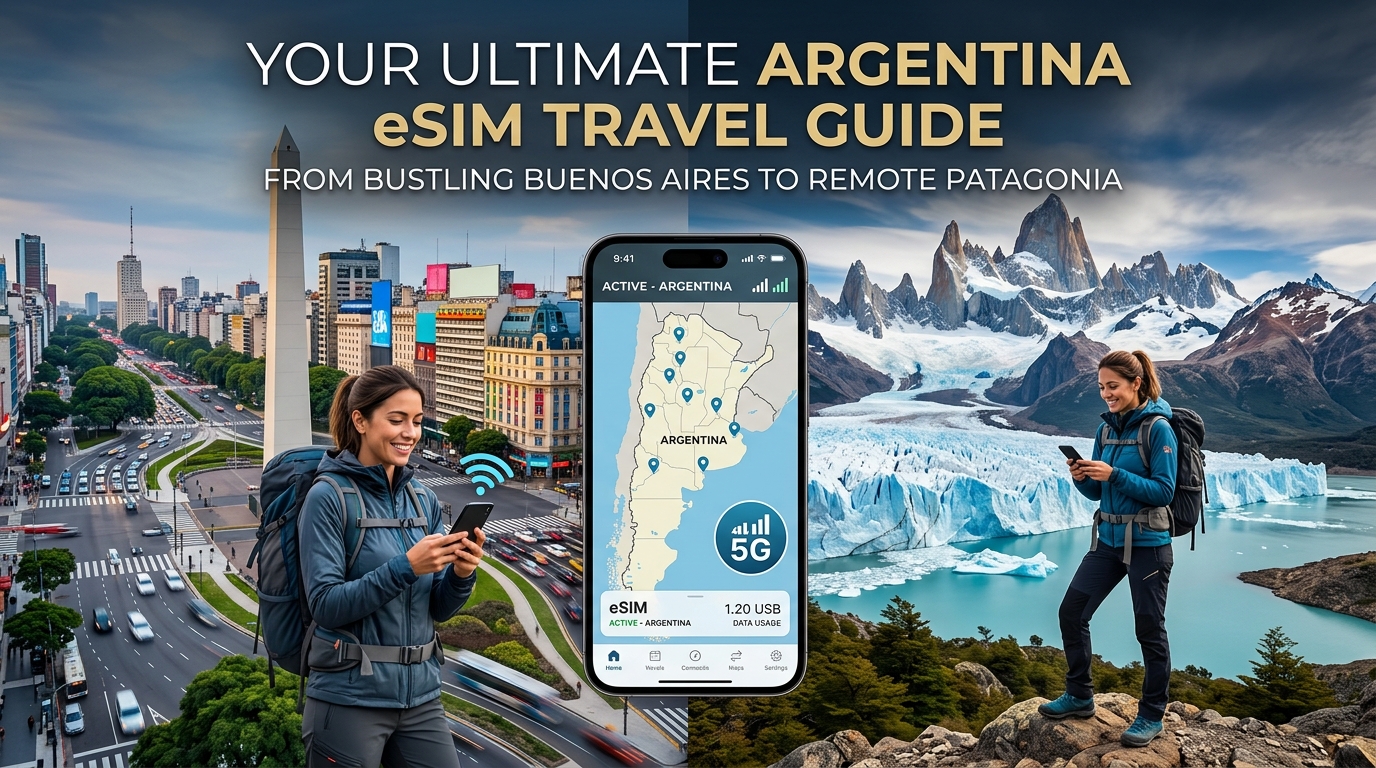
Du rythme urbain au rugissement sauvage : le défi de la connectivité en Argentine
Argentina is a land of breathtaking contrasts, a country that beckons with the vibrant, European-infused energy of Buenos Aires and then plunges you into the raw, untamed majesty of Patagonia. Imagine navigating the bustling avenues of Recoleta one day, using your phone for real-time public transport updates or a quick restaurant reservation, only to find yourself days later trekking through the glacial landscapes near El Chaltén or exploring the "End of the World" in Ushuaia, where reliable data becomes a lifeline rather than a luxury. This incredible diversity, while a traveler's dream, presents a unique and often underestimated challenge: maintaining seamless, reliable connectivity across such a vast and varied terrain.
The sheer scale of Argentina, stretching from the subtropical north to the subpolar south, means that connectivity infrastructure can vary dramatically. While major cities generally offer good coverage, venturing into the remote expanses of the Andes, the vast Patagonian steppe, or the isolated reaches of Tierra del Fuego can quickly expose the limitations of traditional communication methods. For the modern traveler, reliable data isn't just about sharing stunning photos; it's absolutely critical for navigation, ensuring you don't get lost on a remote hiking trail or miss a crucial bus connection. It's essential for emergency communication, providing a vital link to assistance in areas where cell towers are few and far between. Moreover, it facilitates booking last-minute tours—be it a glacier trek, a whale watching excursion, or a tango show—and generally enhances safety, especially when exploring less-traveled paths.
The Costly Traps of Traditional Connectivity
Before the advent of modern solutions, travelers often faced a dilemma: either pay exorbitant rates or endure significant inconvenience.
Prohibitive International Roaming Costs
For many years, the default for international travel was relying on your home carrier's international roaming services. While convenient in theory, the reality is often a stark and unwelcome surprise upon receiving your bill. These plans are notoriously prohibitively expensive, often charging per megabyte of data used, leading to costs that can quickly spiral out of control. Hidden fees, unpredictable charges, and a general lack of transparency make international roaming a budget-killer, forcing travelers to ration data usage, which severely limits the utility of their smartphone for essential tasks. In a country like Argentina, where you might need data for everything from translating a menu in Salta to checking weather forecasts before a hike in Torres del Paine (just across the border, but often accessed from Argentine Patagonia), restricting usage due to cost is simply not practical.
The Hassle of Local Physical SIM Cards
The alternative, purchasing a local physical SIM card upon arrival, also comes with its own set of frustrations and inconveniences:
- Finding Stores and Language Barriers: Upon landing in Buenos Aires, your first task might be to locate a mobile carrier store (Claro, Movistar, Personal). This often means navigating an unfamiliar airport or city, potentially with limited or no Wi-Fi, and then attempting to communicate your needs in Spanish, which can be a significant language barrier for many.
- Activation Delays and Bureaucracy: The process isn't always instant. You'll need your passport for registration, and sometimes even a local address. Activation can take anywhere from a few minutes to several hours, or even a full day, leaving you disconnected during a critical initial period of your trip.
- Device Locking: Some older or carrier-locked phones might not be compatible with local SIM cards, leaving you stranded without service.
- Physical Inconvenience: Swapping out your home SIM card means carefully storing it to avoid loss, and then repeating the process when you leave. It's a small but persistent hassle that detracts from a seamless travel experience.
eSIM: The Modern Traveler's Essential Solution
This is precisely where the eSIM emerges as the modern, flexible, and truly essential solution for travelers seeking seamless connectivity across Argentina's diverse terrain. An eSIM eliminates the need for physical SIM cards entirely, allowing you to download and activate a data plan digitally. This means no more hunting for stores, no language barriers, no activation delays, and no fumbling with tiny plastic cards.
The benefits are immediate and profound: you can purchase and activate your plan before you even land, ensuring you have data the moment your plane touches down. This instant connectivity is invaluable for ordering a ride-share, navigating to your accommodation, or simply letting loved ones know you've arrived safely. Furthermore, eSIMs offer unparalleled flexibility, allowing you to switch between plans or top up data effortlessly, all from your phone's settings.
For a vast and varied country like Argentina, where reliable data is paramount for everything from urban navigation to remote emergency communication, an eSIM provides peace of mind. Platforms like MollySIM (https://mollysim.com) are leading the charge in this space, offering robust plans tailored for international travel. A key advantage of MollySIM, for instance, is its generous Fair Use Policy (FUP) speed limit of 384kbps, which is a remarkable three times faster than many competitors' standard 128kbps throttling. This seemingly technical detail has a significant real-world impact: at 384kbps, essential applications like Google Maps and Apple Pay continue to function smoothly, even if your high-speed data allowance is exhausted. This ensures you can still navigate unfamiliar streets, check bus routes, or make contactless payments without frustrating delays, a critical feature whether you're exploring the vibrant streets of Palermo or needing directions to a remote estancia. The ability to maintain functional connectivity, even at reduced speeds, underscores why an eSIM is not just a convenience, but a critical tool for a safe, efficient, and enjoyable Argentine adventure.
eSIM vs. The Old Guard: Why Digital Connectivity Wins in Argentina
Navigating Argentina's diverse landscapes, from the urban sprawl of Buenos Aires to the remote glaciers of Patagonia, demands reliable and efficient connectivity. While traditional methods have served travelers for years, they often come with significant drawbacks. Understanding these limitations highlights why eSIM technology, particularly from providers like MollySIM, represents a superior solution for the modern Argentine adventurer.
The Pitfalls of Traditional Connectivity Options
International Roaming: The Costly Convenience Trap
For many travelers, the default option is simply to use their home provider's international roaming service. While undeniably convenient in its automatic activation, this convenience comes at an exorbitant price. International roaming is notorious for its high costs, often leading to dreaded "bill shock" upon returning home. Data allowances are typically meager, and exceeding them results in punitive per-MB charges that can quickly accumulate into hundreds of dollars. Furthermore, speeds can be throttled aggressively, making essential tasks like video calls or large file downloads impractical. For a country as vast as Argentina, where relying on data for navigation, translation, and communication is paramount, the financial risk and limited utility of international roaming make it an unsustainable choice.
Local Physical SIM Cards: The Activation Gauntlet
Purchasing a local physical SIM card upon arrival in Argentina might seem like a cost-effective alternative. Indeed, local plans often offer more generous data at lower prices than roaming. However, the process is far from seamless. Travelers must first locate a mobile provider store, often at airports or specific retail outlets, which can be time-consuming after a long flight. The activation process typically involves paperwork, presenting your passport, and navigating potential language barriers if you're not fluent in Spanish. Crucially, your phone must be unlocked by your home carrier to accept a foreign SIM card – a requirement many travelers overlook until they're already abroad. The physical act of swapping SIM cards also carries the risk of losing your small home SIM, and if your itinerary includes neighboring countries, you'll have to repeat this entire cumbersome process for each new destination, making it a single-country focused solution.
Pocket Wi-Fi Devices: The Extra Burden
Pocket Wi-Fi devices, or portable hotspots, offer the ability to connect multiple devices to a single data source. This can be appealing for groups. However, they introduce their own set of inconveniences. A pocket Wi-Fi device is yet another gadget to carry and charge daily, adding to your travel tech burden. Their battery life can be a limiting factor, potentially leaving you stranded without internet if it runs out. There's also the potential for loss or damage, turning it into a single point of failure for your group's connectivity. Rental costs, often daily, can accumulate, and the logistics of picking up and returning the device add unnecessary complexity to your travel plans.
eSIM: The Digital Revolution for Argentine Travel
In stark contrast to these traditional methods, eSIM technology offers a streamlined, flexible, and cost-effective solution perfectly suited for a trip to Argentina.
Seamless Digital Activation and Multi-Country Flexibility
The primary advantage of an eSIM is its instant digital activation. There's no physical card to swap, no stores to visit, and no paperwork to fill out. You simply purchase a plan online, receive a QR code or activation details, and set it up directly from your phone's settings – often before you even leave home. This means you land in Buenos Aires already connected. Furthermore, eSIMs boast unparalleled multi-country flexibility. You can store multiple eSIM profiles on a single device, allowing you to switch between plans for different countries with a few taps, ideal for those exploring beyond Argentina's borders into Chile or Uruguay.
Cost-Effectiveness and Uninterrupted Connectivity
eSIM plans are highly cost-effective, often providing competitive data packages at prices significantly lower than international roaming, and without the hassle of local SIM acquisition. Providers like MollySIM (https://mollysim.com) exemplify this, offering robust plans tailored for international travelers. A standout feature of MollySIM is its generous Fair Use Policy (FUP) speed limit of 384kbps. This is a remarkable three times faster than many competitors' standard 128kbps throttling. This isn't just a technical detail; it has profound real-world implications. Even if your high-speed data allowance is exhausted, essential applications like Google Maps and Apple Pay continue to function smoothly at 384kbps. This ensures you can still navigate unfamiliar streets in Palermo, check bus routes in Mendoza, or make contactless payments without frustrating delays – a critical safety net whether you're in a bustling city or needing directions to a remote estancia in Patagonia.
Enhanced Security and Convenience
With an eSIM, your primary physical SIM card remains securely in your phone, preventing loss and allowing you to receive calls/texts on your home number (if your phone supports dual SIM functionality). This no physical swapping aspect significantly enhances convenience. Moreover, eSIMs offer enhanced security as they are less susceptible to physical tampering or theft compared to a physical SIM card.
Comparative Overview: eSIM vs. The Old Guard
To illustrate the stark differences, here's a detailed comparison:
| Feature | eSIM (e.g., MollySIM) | Feature | eSIM
Navigating Argentina's Digital Landscape: Network Coverage & Reliability
Venturing through Argentina, from the sprawling urban grid of Buenos Aires to the isolated peaks of Patagonia, demands a clear understanding of its mobile network infrastructure. While the country has made significant strides in digital connectivity, the experience can vary dramatically depending on your location. For travelers relying on eSIMs, comprehending this landscape is crucial, as your eSIM service, like MollySIM, operates by leveraging these very local networks.
Argentina's Major Mobile Network Operators: The Big Three
Argentina's mobile connectivity is primarily dominated by three major carriers: Movistar, Personal, and Claro. Each offers a distinct footprint across the vast nation.
- Movistar (Telefónica): Often considered to have the most extensive coverage, particularly in rural and less populated areas, Movistar is a strong contender for travelers prioritizing reach. While its speeds are generally good in urban centers, its strength lies in its broader geographical presence, which can be a lifeline in more remote regions.
- Personal (Telecom Argentina): Personal boasts robust 4G LTE coverage in major cities and towns, often delivering excellent speeds. Its network tends to be very reliable in urban and semi-urban environments, making it a solid choice for city-centric itineraries. However, its reach can diminish more rapidly than Movistar's as you move into truly remote territories.
- Claro (América Móvil): Claro provides competitive coverage and speeds, particularly strong in the northern and central regions of Argentina, including major cities like Córdoba and Mendoza. It offers a good balance of urban performance and decent, though sometimes less extensive than Movistar, coverage in some rural corridors.
Regional Coverage Deep Dive: Urban vs. Wilderness
The disparity in network reliability across Argentina is perhaps the most critical factor for travelers.
Urban Hubs: Seamless Connectivity
In Buenos Aires, Mendoza, Córdoba, and other major provincial capitals, you can expect excellent and highly reliable 4G LTE coverage from all three carriers. High-speed data is generally available, enabling smooth streaming, video calls, and instant access to information. This robust urban infrastructure ensures that tasks like real-time map navigation (Google Maps, Apple Maps), ride-sharing apps, and digital payments (Apple Pay, Google Pay) function seamlessly.
The Patagonian Frontier: A Test of Connectivity
As you venture south into the breathtaking, yet often isolated, landscapes of Patagonia, the digital landscape shifts dramatically. Coverage becomes increasingly sparse and variable. In popular, albeit remote, towns like El Calafate (gateway to Perito Moreno Glacier) and Ushuaia (the "End of the World"), you will typically find decent 4G LTE in the town centers. However, once you leave these settlements and head towards national parks like Los Glaciares or Tierra del Fuego, or even closer to border areas like those leading to Torres del Paine in Chile, connectivity can quickly degrade to 3G, 2G, or disappear entirely.
This variability is not merely an inconvenience; it can impact safety and planning. Imagine navigating a remote mountain pass, checking critical weather forecasts before a hike, or needing to make an emergency call – reliable data becomes paramount.
How eSIMs Bridge the Gap: Leveraging Local Infrastructure
An eSIM, such as those offered by MollySIM (https://mollysim.com), does not operate its own independent network. Instead, it intelligently connects to the strongest available local network from one of these major carriers (Movistar, Personal, or Claro) through roaming agreements. This means your eSIM's performance directly reflects the underlying infrastructure of the local provider it's connected to at any given moment.
This is where the quality of your eSIM provider truly matters. MollySIM, for instance, offers a significant advantage with its 384kbps Fair Use Policy speed limit, which is 3x faster than many competitors' standard 128kbps. This enhanced speed, even when operating on a local network, makes a tangible difference. While 128kbps might struggle with anything beyond basic messaging, MollySIM's 384kbps ensures that essential travel applications like Google Maps or Apple Pay work smoothly, allowing for efficient navigation and transactions without frustrating delays. This speed can be the difference between confidently finding your way through a new city or getting lost due to slow-loading maps.
The Indispensable Role of Reliable Data for Travelers
In a country as diverse and expansive as Argentina, reliable mobile data is not a luxury but a fundamental travel tool:
- Real-time Map Navigation: Whether using Google Maps in Buenos Aires or offline maps like Maps.me in a national park (where you might still need data for initial downloads or updates), accurate navigation is non-negotiable.
- Checking Weather Forecasts: Especially crucial for outdoor activities in Patagonia, where conditions can change rapidly and unpredictably.
- Translating on the Go: Instant translation apps bridge language barriers, making interactions with locals smoother and more enriching.
- Emergency Calls and Communication: In unforeseen circumstances, the ability to make an emergency call or contact family/friends is vital.
- Securing Last-Minute Bookings: From finding an available hostel in a bustling city to booking a tour in a remote Patagonian town, reliable data allows for flexibility and spontaneity, particularly when off the beaten path.
Understanding Argentina's network landscape and choosing an eSIM provider like MollySIM that prioritizes both coverage and usable speeds ensures you remain connected, informed, and safe throughout your incredible journey.
MollySIM: Your Ultimate Connectivity Partner for Argentina's Adventures
Navigating Argentina's vast and varied landscapes, from the urban sprawl of Buenos Aires to the rugged wilderness of Patagonia, demands a connectivity solution that is both robust and reliable. This is where MollySIM (https://mollysim.com) distinguishes itself as an indispensable travel companion, offering not just high-speed data but also a uniquely valuable Fair Usage Policy (FUP) that ensures you're never truly disconnected. MollySIM's commitment to seamless global connectivity makes it an ideal choice for travelers seeking peace of mind and uninterrupted access throughout their Argentine journey.
Seamless Activation: Getting Started with Your MollySIM eSIM
One of MollySIM's primary advantages is the sheer simplicity of its activation process. Gone are the days of searching for local SIM card vendors, dealing with language barriers, or fumbling with tiny physical cards. With MollySIM, getting connected is a streamlined, digital experience designed for the modern traveler.
Here’s a step-by-step guide to installing and activating your MollySIM eSIM:
- Purchase Your Plan Online: Visit the MollySIM website (https://mollysim.com) and select an Argentina-specific or global data plan that suits your travel duration and data needs. The process is intuitive, allowing you to choose from various data allowances and validity periods.
- Receive Your QR Code: Immediately after purchase, you'll receive an email containing a unique QR code and detailed installation instructions. This digital delivery means you can set up your eSIM even before you depart or upon arrival.
- Scan and Install:
- On iOS (iPhone): Go to Settings > Cellular/Mobile Data > Add eSIM. Choose "Use QR Code" and scan the code provided by MollySIM. Follow the on-screen prompts to label your new cellular plan (e.g., "MollySIM Argentina").
- On Android: Go to Settings > Network & internet > SIMs > Add more. Select "Download a SIM instead?" or "Scan QR code" and proceed to scan.
- Configure Settings: Once installed, ensure your MollySIM eSIM is turned on and set as your primary data source for your trip. You might need to enable data roaming for the eSIM, though MollySIM plans are designed for international use. Keep your home SIM active for calls/texts if desired, but direct data usage through MollySIM.
- Activate and Connect: Your MollySIM eSIM will typically activate automatically upon connecting to a supported network in Argentina. You'll instantly gain access to high-speed data, ready for all your travel needs.
The entire process takes just a few minutes, allowing you to land in Argentina and be connected almost instantly, avoiding airport Wi-Fi hassles or local SIM queues.
Beyond High-Speed: The Power of MollySIM's 384kbps Fair Usage Policy (FUP)
While initial high-speed data is crucial, MollySIM offers a significant advantage that truly sets it apart: its 384kbps Fair Usage Policy (FUP) speed limit. This means that even after you've used up your high-speed data allowance, you're not cut off. Instead, your data speed is throttled to a still-highly-functional 384 kilobits per second.
To put this into perspective, many competitor eSIM providers throttle speeds down to a mere 128kbps or even less. MollySIM's 384kbps is 3x faster than the industry standard for throttled speeds, making a monumental difference in practical usability.
What 384kbps Means in Real-World Terms:
- Essential Communication: Sending and receiving WhatsApp messages, iMessages, or other instant messages, including photos, remains smooth and responsive. You can stay in touch with family and friends without frustrating delays.
- Email Access: Checking and sending emails, even with attachments, is perfectly feasible. Important travel confirmations, booking updates, or work communications won't be missed.
- Basic Web Browsing: While not lightning-fast, you can comfortably browse websites for information, check news, or look up restaurant reviews. Pages will load, albeit with a slight delay.
- Navigation Apps: This is where 384kbps truly shines. Google Maps and Apple Maps continue to function effectively, allowing you to search for directions, load routes, and track your location in real-time. While initial map tile loading might be marginally slower, the core navigation experience remains reliable – a critical feature for finding your way in bustling Buenos Aires or tracking your progress on a remote Patagonian road. This speed also ensures services like Apple Pay or Google Pay can process transactions smoothly.
- Safety and Emergency: In remote areas of Patagonia, where connectivity can be sparse, having a usable data speed for emergency calls (via VoIP apps), sending your location, or accessing critical information is a lifesaver. You're never truly isolated.
Lifesaving Scenarios in Remote Argentina:
Imagine these common travel situations in Argentina where MollySIM's 384kbps FUP becomes invaluable:
- Lost in El Chaltén: You've hiked all day in Los Glaciares National Park near El Chaltén, and your high-speed data is depleted. You need to find your way back to your hostel or check bus schedules. With MollySIM's FUP, Google Maps still guides you, and you can quickly message your travel companions.
- Unexpected Detour on Route 40: Driving Argentina's legendary Route 40 through Patagonia, you encounter a road closure. You need to find an alternative route or the nearest town for accommodation. Your 384kbps data allows you to load maps, search for information, and contact a local tour operator or hotel.
- Last-Minute Booking in Ushuaia: After a day exploring Tierra del Fuego, you decide to book a last-minute boat tour to the Beagle Channel. Your high-speed data ran out, but MollySIM's FUP enables you to access booking websites, check availability, and secure your spot without needing to find Wi-Fi.
- Emergency Communication in the Andes: While trekking in the Andean foothills, you or a companion experiences a minor injury. You need to contact a local ranger station or emergency services. The consistent connectivity, even at 384kbps, ensures your message or VoIP call goes through, providing a vital safety net.
MollySIM's superior FUP speed ensures that even when your primary data allowance is exhausted, you retain a highly functional level of connectivity, providing unparalleled peace of mind and practical utility throughout your Argentine adventure.
Maximizing Your eSIM Experience: Practical Tips for Argentina Travel
To truly unlock the potential of your eSIM and ensure a seamless, connected journey from the vibrant streets of Buenos Aires to the remote reaches of Patagonia, a little pre-planning and smart usage can go a long way. Here’s how to maximize your eSIM experience in Argentina, leveraging the robust features of providers like MollySIM.
Pre-Trip Setup: Seamless Connectivity Before You Land
The golden rule for eSIMs is activate before you arrive. Purchasing and setting up your eSIM while still in your home country or a location with reliable Wi-Fi eliminates potential stress upon landing.
- Purchase Your eSIM Early: Visit a reputable provider like MollySIM days or even weeks before your departure. This gives you ample time to review data plans, understand the terms, and complete the purchase without rush.
- Device Compatibility Check: Before purchasing, confirm your smartphone supports eSIM technology. Most modern smartphones (iPhone XS/XR and newer, Samsung Galaxy S20 and newer, Google Pixel 3 and newer) are compatible. MollySIM provides a comprehensive compatibility list on its website. Ensure your device is also unlocked from your home carrier.
- Activation Process: Once purchased, you'll typically receive a QR code or manual activation details via email.
- Scan QR Code: Go to your phone's cellular settings, select "Add Cellular Plan," and scan the provided QR code.
- Manual Entry: If scanning isn't possible, you can manually enter the SM-DP+ Address and Activation Code.
- Label Your eSIM: Immediately label your new eSIM (e.g., "Argentina Travel" or "MollySIM") to easily distinguish it from your primary SIM.
- Test Connectivity (Optional but Recommended): If your plan allows for activation before travel, a quick test call or data check can confirm everything is working. Otherwise, simply ensure the eSIM profile is installed and ready to be enabled upon arrival in Argentina.
Device Compatibility: Is Your Smartphone eSIM-Ready?
Not all smartphones support eSIM technology. Verifying your device's compatibility is a critical first step to avoid disappointment.
- Check Your Phone Model: As a general guideline, iPhones released after 2018 (iPhone XS, XR, and newer), Samsung Galaxy S20 series and later, and Google Pixel 3 and later models typically support eSIMs. However, regional variations exist.
- Carrier Lock Status: Your phone must be unlocked by your home carrier to use an eSIM from another provider. If you purchased your phone through a contract, contact your carrier to confirm its unlock status.
- Consult Provider Lists: Always refer to the compatibility list provided by your chosen eSIM provider, such as the detailed list on MollySIM's website, to ensure your specific model is supported.
Smart Data Management: Optimize Your Usage in Argentina
Even with generous data plans, smart management can extend your connectivity and prevent unexpected depletion, especially when exploring remote areas.
- Monitor Data Usage Regularly: Both iOS and Android offer built-in tools to track data consumption. Regularly check which apps are using the most data and adjust their settings accordingly.
- Prioritize Wi-Fi Whenever Possible: Connect to free Wi-Fi networks in hotels, hostels, cafes, and airports. This conserves your eSIM data for when you truly need it, such as navigating unfamiliar streets or communicating on the go.
- Optimize App Settings:
- Disable Background App Refresh: Prevent apps from consuming data when not actively in use.
- Download Offline Maps: Before venturing into areas with potentially spotty reception (like parts of Patagonia), download offline maps for Google Maps or Maps.me. This is a lifesaver for navigation without active data.
- Download Streaming Content: Download movies, TV shows, and music on Wi-Fi before you leave, rather than streaming them on mobile data.
- Adjust Video Quality: Lower the default video quality on streaming platforms when using mobile data.
- Disable Auto-Updates: Turn off automatic app updates and system updates over cellular data.
- Leverage MollySIM's FUP: This is where MollySIM truly shines. Even if your high-speed data allowance is exhausted, MollySIM's 384kbps Fair Use Policy (FUP) speed limit ensures you retain a highly functional level of connectivity. This is 3x faster than the 128kbps offered by many competitors. At 384kbps, you can still:
- Navigate with Google Maps/Apple Maps: Essential for finding your way back to your hostel in El Chaltén or locating an alternative route on Route 40.
- Send and Receive Messages: Stay in touch with travel companions or family via WhatsApp, iMessage, or other messaging apps.
- Check Emails: Handle essential communications.
- Light Web Browsing: Access critical information like bus schedules or emergency contacts.
This consistent, usable FUP speed provides unparalleled peace of mind, ensuring you're never truly disconnected, even in the most remote corners of Patagonia or Tierra del Fuego.
Troubleshooting Common eSIM Issues
While eSIMs are generally reliable, occasional connectivity issues can arise. Here are basic troubleshooting steps:
- Restart Your Device: Often, a simple restart can resolve temporary network glitches.
- Toggle Airplane Mode: Turn airplane mode on for a few seconds, then off. This forces your phone to re-establish a network connection.
- Check eSIM Settings: Ensure your MollySIM profile is enabled as your primary data source and that data roaming is turned on (if required by your plan, though many eSIMs include roaming).
- Manual Network Selection: If automatic network selection fails, try manually selecting a network operator from your phone's cellular settings.
- Contact Support: If problems persist, reach out to MollySIM's customer support. Have your eSIM details and device information ready.
Security Considerations: Protecting Your Data
When traveling, especially when relying on public Wi-Fi, data security is paramount.
- Use a VPN on Public Wi-Fi: Public Wi-Fi networks in cafes, airports, and hotels are often unsecured and vulnerable to eavesdropping. Always use a Virtual Private Network (VPN) to encrypt your internet traffic when connected to public Wi-Fi. This protects your personal information, banking details, and communications from potential threats.
- Be Wary of Suspicious Links: Exercise caution with unsolicited emails or messages, especially those asking for personal information.
- Strong, Unique Passwords: Use strong, unique passwords for all your online accounts, and consider a password manager.
- MollySIM as a Secure Alternative: While not a security feature itself, MollySIM's reliable and consistent connectivity, even under its FUP, means you're less reliant on potentially insecure public Wi-Fi for critical tasks. You can confidently use your own secure data connection for sensitive transactions or communications, reducing your exposure to public network risks.