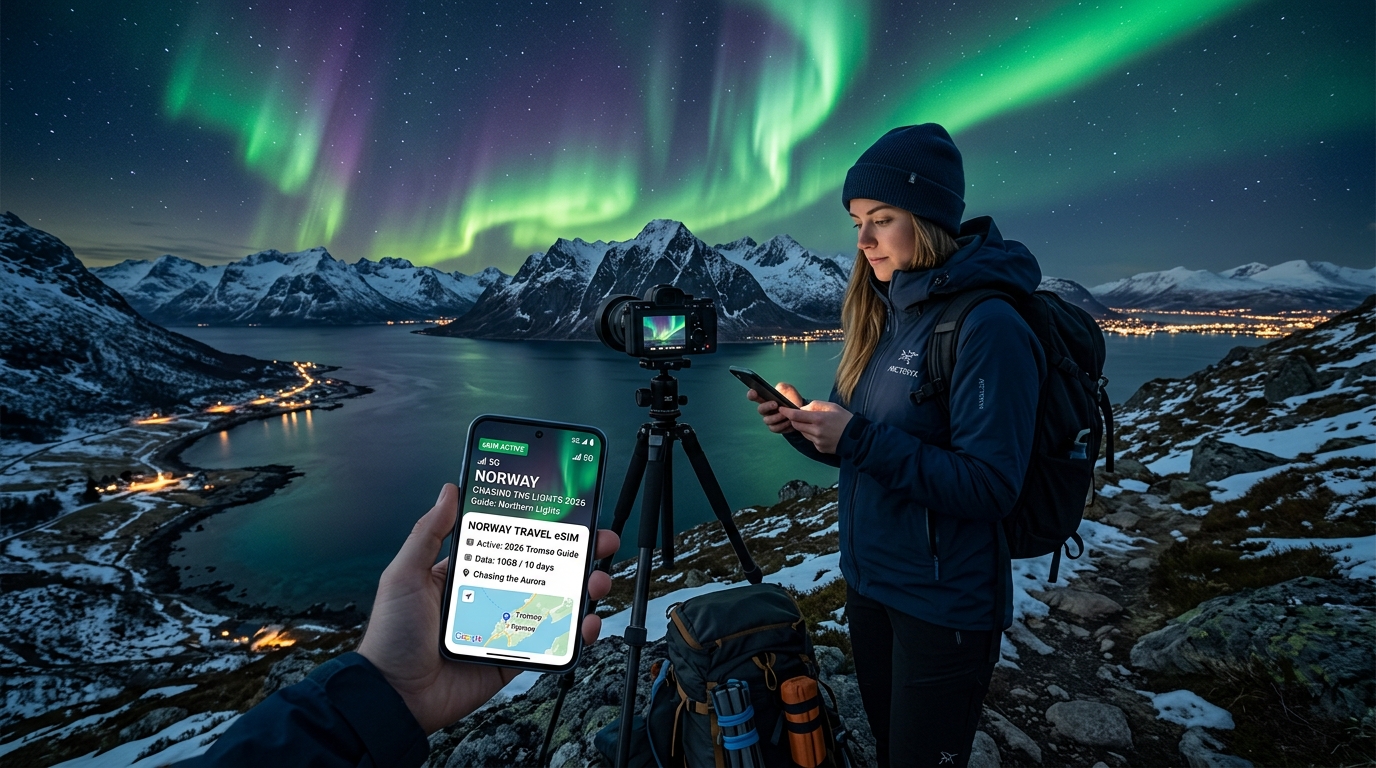
Chasing the Northern Lights: 2026 Tromsø & Arctic Norway Travel eSIM Survival Guide


The Arctic Connectivity Challenge: Why Sub-Zero Blizzards Break Traditional SIMs

Chasing the Aurora Borealis across Tromsø, the jagged peaks of Senja, and the windswept tundra of the Finnmarksvidda plateau requires venturing into some of the most unforgiving terrain in Europe. Between November and April, Arctic Norway operates in near-total darkness (the Polar Night) with ambient temperatures routinely plunging between -20°C and -35°C (-4°F to -31°F). Add gale-force polar maritime winds off the Norwegian Sea, and the effective wind chill easily drops past -45°C.

Under these conditions, mobile connectivity ceases to be a mere digital convenience—it is a critical element of cold-weather survival. Yet, standard physical SIM cards introduce severe physical and mechanical vulnerabilities that traditional travel guides fail to address.

`` ARCTIC HAZARDS TO HARDWARE & PLASTIC SIMs ┌────────────────────────────────────────────────────────┐ │ -30°C Wind Chill ──► Brittle SIM Trays Snap │ │ Condensation Cycle ──► Internal Port Corrosion │ │ Bare-Hand Exposure ──► Rapid-Onset Frostnip in <60s │ │ Powder Snow Ingress──► Permanent Micro-Chip Loss │ └────────────────────────────────────────────────────────┘ ``

The Physics of Polar Battery Failure and Mechanical SIM Risks

Sub-zero temperatures trigger immediate physical degradation in standard consumer electronics:

  1. Lithium-Ion Voltage Collapse: Extreme cold drastically slows the electrochemical reactions inside your smartphone's lithium-ion battery. Internal resistance spikes, causing operating voltage to plummet. A phone displaying 75% battery can shut down instantly when exposed to the open air for just two minutes.
  2. Thermal Shock and Moisture Condensation: Transitioning repeatedly between a heated rental 4x4 (around +20°C) and the freezing exterior tundra causes internal air inside the phone to condense. Ejecting a physical SIM tray in these conditions breaks the water-resistant rubber gaskets, allowing microscopic ice crystals and moisture to settle on the internal contact pins, leading to short-circuits.
  3. The "Glove-Off" Failure Scenario: Handling a 12.3 × 8.8 mm nano-SIM and an ejector tool with bare fingers in -25°C weather carries an immediate risk of frostnip within 60 seconds. Dropping a translucent SIM card into deep, uncompacted polar powder snow makes recovery virtually impossible. Moreover, sub-zero temperatures turn plastic SIM trays brittle, dramatically increasing the risk of mechanical snaps inside the logic board.
Risk VectorTraditional Physical SIM CardOver-The-Air Travel eSIM
Field Installation RiskExtreme; requires bare hands and ejector pin in snowZero; fully digital profile pre-installed before departure
Water/Ice Gasket CompromiseHigh; tray opening allows moisture ingressZero; device chassis remains factory-sealed
Mechanical FragilityHigh; brittle plastics snap below -15°CNone; solid-state embedded chip on motherboard
Network Swapping AgilityCumbersome; physical card handling requiredInstant; seamless switching between local roaming profiles

Mission-Critical Connectivity on the Polar Frontier

Modern aurora hunting is data-intensive. Navigating coastal fjords requires tracking localized cloud dissipation on high-resolution radar models (Yr.no and Windy), monitoring the interplanetary magnetic field (IMF $B_z$ vector and Solar Wind Speed via SpaceWeatherLive), and plotting safe routing through treacherous mountain passes prone to sudden whiteouts and road closures (Statens vegvesen).

`` CRITICAL DATA STREAMS IN THE FIELD ├── Auroral Telemetry ──► Real-time IMF Bz vector / Solar Wind speed ├── Polar Micro-Met ──► High-resolution cloud cover modeling (Yr.no) └── Arctic Route Safety ──► Live mountain pass closure alerts (Statens vegvesen) ``

If you deplete your high-speed data tier while parked on an isolated mountain plateau, standard international roaming profiles throttle your bandwidth to an unusable 128kbps—a speed that completely fails to render vector-based maps or process emergency telemetry.

This operational hurdle is why selecting an Arctic-optimized provider like MollySIM is essential for polar expeditions. Even after exhausting a primary data allowance, MollySIM enforces an industry-leading 384kbps Fair Use Policy (FUP) speed limit—three times faster than standard competitor caps. This reliable 384kbps throughput ensures critical applications like Google Maps navigation, live location pings, and Apple Pay/contactless banking continue to function reliably across the High Arctic, preserving both navigation safety and communication lines without physical field interventions.

Arctic Telecom Infrastructure: Telenor vs. Telia 5G Across Northern Norway and Svalbard

Instant QR Delivery • Native 5G • 384kbps FUP Protection

🇪🇺 Europe 33 Countries High-Speed Travel eSIM & SIM Plans

Instant QR code activation, hotspot enabled, with guaranteed 384kbps fallback speed to keep Maps & Digital Wallets active.

View Europe 33 Countries Plans & Pricing ➔Orange Europe SIM ➔

Operating mobile devices north of the 69th parallel presents extreme radio frequency (RF) engineering challenges. Norway’s jagged coastal topography—characterized by steep metamorphic peaks dropping directly into deep saltwater fjords—creates severe signal refraction, shadow zones, and multipath interference. To maintain uninterrupted connectivity while chasing the Aurora Borealis through dynamic microclimates, understanding how the two primary infrastructure giants, Telenor and Telia, engineer their high-latitude networks is vital.

`` SUB-1GHz ARCTIC PROPAGATION (LONG-RANGE REACH) ┌─────────────────────────────────────────────────────────────┐ │ 700 MHz (Band n28) / 800 MHz (Band 20) Macro Cell │ └──────────────┬───────────────────────────────┬──────────────┘ │ ~15–30km Line-of-Sight │ Fjord Signal Bounce ▼ ▼ ┌──────────────────┐ ┌──────────────────┐ │ Coastal Plateau │ │ U-Shaped Valley │ │ Stable Connection│ │ RF Shadow Zone │ └──────────────────┘ └──────────────────┘ ``

Sub-1GHz Spectrum Allocation and Polar Topography

In metropolitan hubs like Tromsø (69°39′N) or Alta, both carriers deploy mid-band 3.5 GHz (Band n78) spectrum to deliver gigabit-class 5G speeds. However, as soon as you navigate into rural tracking corridors—such as the Lyngen Alps, Senja’s national tourist routes, or the Skibotn inland valley—high-frequency spectrum degrades rapidly due to terrain blockage.

Survival in these peripheral zones depends entirely on low-band spectrum deployments:


Arctic Carrier Infrastructure Comparison

Carrier / Profile TypeFjord & Mountain CoverageTromsø Urban 5G SpeedsLofoten & Senja Wilderness ReachSvalbard (Longyearbyen 78°N)Autonomous Carrier Failover
Telenor Norway (Direct Native)Dominant (Extensive coastal & offshore relay array)450–850 Mbps (n78/n28 aggregated)High (Strong coverage on outermost sea arches)Native 5G (Fiber backhaul to mainland)❌ Locked to Telenor BTS only
Telia Norway (Direct Native)Strong (Heavy inland valley macro penetration)400–800 Mbps (n78/n28 aggregated)Moderate to High (Occasional shadow pockets)Native 4G/5G (Excellent town core reach)❌ Locked to Telia BTS only
Ice.net / Lyse (Third Network)Moderate (Relies heavily on national roaming)150–350 MbpsModerate (Falls back to Telia in valleys)Roaming Only⚠️ Complex roaming handshakes
MollySIM Arctic eSIM (Dynamic Multi-Carrier)Maximum (Dynamically bridges Telenor & Telia)400–850 Mbps (Auto-selects strongest BTS)Maximum (Eliminates single-provider dead zones)Full Arctic Support (Seamless roaming profile)Instant automated BTS handover

The Operational Hazard of Single-Carrier Lock-in

Aurora chasing is fundamentally nomadic. Cloud cover frequently forces guides and independent chasers to cross localized weather divides within minutes—shifting from the coastal fjords of Kvaløya over to the Finnish-Norwegian border corridor near Kilpisjärvi.

`` AURORA CHASE TERRAIN DIVIDE: THE CARRIER BLIND SPOT [Kvaløya Coastal Ridge] ────► Telenor Strong / Telia Degraded │ (Transit) ─────────────► RF Dead Zone for Single-Carrier SIMs ▼ [Skibotn Inland Basin] ────► Telia Strong / Telenor Degraded ``

Because single-carrier subscriptions lock the baseband modem to a solitary Public Land Mobile Network (PLMN), entering an RF shadow zone managed by the competing carrier results in total telemetry blackout. A vehicle trapped behind a mountain ridge with a dead Telenor mast cannot access an adjacent, active Telia tower without an alternative IMSI profile.

Deploying a multi-network solution like MollySIM removes this systemic failure point. MollySIM interfaces with tier-one underlying host networks across Scandinavia, enabling the device's baseband modem to register automatically with whichever base transceiver station (BTS)—Telenor or Telia—delivers the highest Reference Signal Received Power (RSRP). Even if an expedition exhausts its high-speed primary quota in the field, MollySIM’s non-throttling 384kbps FUP floor preserves unbroken map vector updates and financial transaction protocols without leaving you stranded in an Arctic RF void.

High-Bandwidth Aurora Chasing: Data Demands of Live Radars, Space Weather, and Cloud Forecasts

Modern aurora chasing in Arctic Norway has evolved from passive skywatching into a high-bandwidth, telemetry-driven pursuit. Successfully capturing a geomagnetic substorm requires continuous microclimate tracking across complex fjord topographies, where a localized temperature inversion can close a clear sky window within twenty minutes.

Operating an effective mobile chase dashboard demands running multiple resource-intensive mapping, meteorological, and space-weather data feeds simultaneously over cellular links while moving at highway speeds along the E8 or E69 corridors.

`` ┌────────────────────────────────────────────────────────────────────────┐ │ MOBILE AURORA TELEMETRY DATA PIPELINE │ │ │ │ [NOAA / DSCOVR Satellites] ──► Real-Time IMF Bz / Solar Wind Feeds │ │ [MET Norway AROME-Arctic] ──► High-Resolution Cloud Base Layers │ │ [Ground All-Sky Cameras] ──► Low-Latency HD Verification Feeds │ │ │ │ │ ▼ │ │ Active Field Chase Decision Matrix │ └────────────────────────────────────────────────────────────────────────┘ ``

The Mission-Critical Arctic Chasing Stack

Navigating Arctic microclimates requires balancing three concurrent data streams:

  1. Atmospheric & High-Resolution Cloud Models: Standard weather apps are insufficient for Tromsø’s microclimates. Chasers rely on Yr.no (powered by the localized MET Norway AROME-Arctic 2.5 km grid model) and Ventusky or Windy for live infrared satellite layers and multi-altitude cloud tiers (low stratus vs. high cirrus). Continuous panning and zoom rendering across these high-resolution raster and vector map layers consumes massive chunks of cellular data.
  2. Real-Time Magnetometer & Solar Wind Telemetry: Predicting an auroral substorm before it becomes visible to the naked eye requires monitoring real-time telemetry from apps like SpaceWeatherLive. Chasers track live deep-space data from the DSCOVR and ACE spacecraft—specifically the Interplanetary Magnetic Field (IMF) $B_z$ vector (which must tip strongly negative/southward) and solar wind speed/density graphs.
  3. Live Arctic Webcam Telemetry: Ground truth verification is essential before burning fuel on a 100 km detour. Dedicated chasers continuously pull live webcam feeds from stationary observatories—including the Skibotn Observatory, coastal cams at Sommarøy, and border webcams along Kilpisjärvi—to confirm horizon clarity in real time.

Field Bandwidth Consumption Breakdown

The table below outlines the network throughput and dynamic payload requirements for standard aurora chasing applications over an active 6-hour expedition:

Application / ServiceTelemetry FunctionTypical Data ConsumptionBandwidth Profile
Ventusky / WindyMulti-layer cloud radar, ECMWF & GFS overlays, infrared satellite tiles120 – 200 MB / hourBursty, high-payload tile rendering
Yr.no (AROME-Arctic)High-res localized precipitation & low-cloud base tracking60 – 100 MB / hourFrequent API polling & vector sync
SpaceWeatherLiveLive ACE/DSCOVR solar wind, magnetometers, dynamic Kp index updates20 – 40 MB / hourContinuous low-payload telemetry
All-Sky Live WebcamsVisual ground-truth confirmation (Skibotn, Sommarøy, Senja)300 – 600 MB / 30 minsHigh-bandwidth progressive video/snapshots
Live Navigation VectorsDynamic rerouting, topographical offline map syncing (Google/Apple Maps)40 – 80 MB / hourContinuous background telemetry

The Risk of Exhausted High-Speed Quota on Unlit Arctic Corridors

Exhausting your data allowance mid-chase presents a serious safety and operational risk. Tromsø’s backcountry routes—such as the unlit mountain passes through Lavangsdalen or the exposed coastal curves of Kattfjordeidet—are prone to sudden black ice, rapid whiteout conditions, and wandering reindeer herds.

If your travel eSIM runs out of primary data and drops the connection completely, your navigation maps freeze, real-time weather radar cuts out, and your ability to pull localized road condition reports from Statens vegvesen (Vegvesen Trafikk) vanishes.

``` TYPICAL COMPETITOR THROTTLE: [128kbps Cap] ──► SSL Handshake Timeout ──► Blank Map Tiles ──► Telemetry Blackout

MOLLYSIM 384kbps FUP FLOOR: [384kbps Cap] ──► Stable TLS Sessions ──► Vector Maps Load ──► Active GPS & Radar Intact ```

While many conventional travel eSIM providers drop your baseband speed to an unusable 64kbps or 128kbps throttle—rates that routinely fail basic SSL handshakes for mapping APIs—MollySIM implements a robust 384kbps Fair Use Policy (FUP) floor. Operating at three times the standard emergency bandwidth, this 384kbps speed ensures that even if you completely deplete your primary high-speed data tier while out in the wilderness, critical vector-based GPS navigation in Google Maps, text-based space weather alerts, and contactless emergency financial transactions via Apple Pay continue functioning reliably.

Arctic Tech Survival Guide: Device Optimization and Step-by-Step eSIM Setup

Executing an aurora chase in sub-zero Arctic conditions demands rigorous hardware and software preparation. Cold ambient temperatures degrade battery capacity exponentially, while misconfigured background data transfers can burn through your roaming allowance within hours. Follow this technical guide before venturing beyond Tromsø’s municipal grid.


1. Hardware Thermal Management Protocols

Lithium-ion batteries rely on liquid electrolytes whose internal resistance spikes when exposed to Arctic temperatures (typically between -5°C and -25°C in Northern Norway). This causes rapid voltage drops, prompting modern smartphones to shut down unexpectedly even when displaying 30% to 50% remaining charge.


2. Operating System Setup: iOS & Android Configuration

Install your travel eSIM prior to departure while connected to a stable home or airport Wi-Fi network to avoid field activation delays.

`` +-------------------------------------------------------------------------------+ | RECOMMENDED DUAL-SIM TOPOLOGY | +-------------------------------------------------------------------------------+ | PRIMARY SIM (Home Carrier) │ TRAVEL eSIM (MollySIM) | | - Voice & SMS: ON (Emergency) │ - Mobile Data: ACTIVE | | - Data Roaming: OFF │ - Data Roaming: ON | | - Cellular Data: DISABLED │ - Allow Data Switching: OFF | +-------------------------------------------------------------------------------+ ``

Apple iOS (iPhone 11 through 16 Series)

  1. Profile Installation: Go to Settings > Cellular (or Mobile Service) > Add eSIM. Scan the QR code provided by MollySIM or enter the SM-DP+ Address and Activation Code manually.
  2. Labeling: Designate your home line as Primary and your newly added eSIM as MollySIM / Norway.
  3. Data Routing: Set Cellular Data to MollySIM.
  4. Prevent Bill Shock: Toggle OFF Allow Cellular Data Switching. This hard-locks data usage to your travel profile, ensuring your home carrier cannot trigger expensive domestic roaming rates.
  5. Enable Roaming on the eSIM: Tap your MollySIM line under SIMs, toggle Data Roaming to ON, and verify that the APN fields populate automatically as instructed in your confirmation email.

Android (Samsung Galaxy, Google Pixel, OnePlus)

  1. Profile Installation: Navigate to Settings > Connections (or Network & Internet) > SIM Manager > Add eSIM. Scan the setup QR code.
  2. Designate Preferred SIM: Set Mobile data to your MollySIM profile while keeping Calls/Messages assigned to your physical home SIM if you require incoming verification SMS codes.
  3. Disable Secondary Roaming: Tap your primary SIM and ensure Data roaming is toggled OFF. Disable Auto data switching.
  4. Enable eSIM Roaming: Tap the MollySIM profile, toggle Use SIM to ON, toggle Data Roaming to ON, and ensure your Access Point Names (APN) match the provisioned network parameters.

3. Bandwidth Conservation Checklist

High-resolution cloud sync utilities can silently drain gigabytes of data in the background while your phone is locked. Apply these bandwidth restrictions:

Feature / SettingPlatformTarget ActionPurpose
Low Data ModeiOSSettings > Cellular > MollySIM > Turn ONSuspends background tasks & automatic updates
Data Saver ModeAndroidSettings > Network & Internet > Turn ONBlocks background app transmissions
iCloud Photos / DriveiOSSettings > Photos > Cellular Data > Turn OFFStops RAW photo uploads over cellular
Google Photos BackupBothApp Settings > Backup > Mobile data usage > Set to No dataPreserves high-speed allotment
App Auto-UpdatesBothApp Store / Google Play Settings > Select Over Wi-Fi onlyPrevents large payload downloads
Wi-Fi Assist / Network SwitchiOS / AndroidCellular > Wi-Fi Assist > Turn OFFStops device from falling back to primary SIM

4. Cold-Zone Navigation & Telemetry Caching

Cellular handoffs between macro base stations can experience intermittent latency along narrow fjords such as Ersfjordbotn or mountain passes near the Finnish border (Kilpisjärvi corridor).

  1. Pre-Cache Offline Map Areas: In Google Maps, tap your profile icon > Offline maps > Select your own map. Download an offline bounding box that spans from Sommarøy in the west to Skibotn in the east, and up through Lyngen.
  2. Download Topographic Vectors: For off-road navigation, download regional topo tiles in Norgeskart Outdoors or Maps.me while on hotel Wi-Fi.
  3. Telemetry Resilience: Even if heavy app usage depletes your high-speed allowance mid-chase, MollySIM’s unthrottled 384kbps FUP floor provides sufficient throughput to keep live vector mapping, instant messaging coordinates, and payment rails like Apple Pay responsive without dropped TLS sessions.

Wilderness Safety Redundancy: Why Multi-Network Access and MollySIM's 384kbps FUP Save Lives

In sub-zero Arctic environments, reliable digital connectivity is not merely a convenience for uploading aurora photos—it is active survival equipment on par with studded winter tires, emergency thermal bivvys, and avalanche transceivers. When chasing the Northern Lights through microclimates across Kvaløya, Senja, or the desolate mountain corridors of the E8 toward Kilpisjärvi, weather conditions can deteriorate from clear skies to a zero-visibility ground blizzard within minutes. If a rental vehicle slides into a snowdrift or suffers an alternator failure at -25°C, real-time telemetry and communication become your immediate lifeline.


Dual-Carrier Infrastructure: Dynamic Switching Between Telenor and Telia

The geography of Arctic Norway—characterized by deep fjords flanked by sheer granite massifs—creates severe radio shadow zones. Single-network eSIMs or local prepaids locked to a single infrastructure provider leave travelers vulnerable:

`` [ Arctic Highway / Mountain Fjord ] │ ┌───────┴───────┐ ▼ ▼ [Telenor Tower] [Telia Tower] (Coastal/Sea) (Inland/Passes) │ │ └───────┬───────┘ ▼ [ MollySIM Dynamic Handover ] Automatic connection to the strongest live RSRP/RSRQ tower ``

MollySIM&#39;s Norway eSIM profiles feature unrestricted access to both Telenor and Telia base stations. If high-latitude atmospheric interference or terrain obstruction degrades the RSRP (Reference Signal Received Power) on one carrier, the eSIM automatically negotiates a handover to the alternative network, bypassing the dead zones that leave single-carrier tourists stranded without emergency coverage.


The 384kbps Safety Floor: The Difference Between Emergency Coordination and Total Blackout

Most budget travel eSIMs enforce a crippling Fair Usage Policy (FUP) throttle of 64kbps to 128kbps once your high-speed data allowance runs out. In modern network environments, a 128kbps link results in fatal TCP timeout errors, failing to maintain standard TLS/SSL cryptographic handshakes. To the user, a 128kbps connection functions identically to a total service blackout.

In contrast, MollySIM implements a continuous 384kbps unthrottled FUP safety floor across its entire coverage footprint. This 3x throughput advantage provides just enough sustained bandwidth to keep mission-critical wilderness tools fully operational even if your primary high-speed allocation is completely exhausted mid-expedition.

Critical Emergency FunctionStandard eSIM Throttle (64–128kbps)MollySIM Safety Floor (384kbps)Survival Impact
WhatsApp / Signal Live Location❌ Fails (Continuous TLS Timeouts)Instant Delivery (<2 sec)Transmits exact GPS coordinates to rescue contacts
Google Maps / Apple Maps Vectoring❌ Fails to render map tilesSmooth Dynamic CachingPrevents blind driving in whiteout blizzards
Yr.no / Windy Real-Time Radars❌ Network request abortsLoads within 8–12 secondsTracks incoming polar low-pressure systems
Emergency VoLTE / VoIP Audio❌ Extreme jitter / dropped callsStable low-bitrate voice codecEnables clear communication with Norwegian 112 services
Apple Pay / Contactless Authentication❌ Token handshake dropsInstant Token ClearanceSecures emergency fuel at automated 24/7 Arctic pumps

Maintaining an active 384kbps pipeline guarantees that you are never cut off from live topographic positioning, automated road closure updates from Statens vegvesen, or direct text communication with roadside assistance teams across the Arctic Circle.

Instant QR Delivery • Native 5G • 384kbps FUP Protection

🇪🇺 Europe 33 Countries High-Speed Travel eSIM & SIM Plans

Instant QR code activation, hotspot enabled, with guaranteed 384kbps fallback speed to keep Maps & Digital Wallets active.

View Europe 33 Countries Plans & Pricing ➔Orange Europe SIM ➔