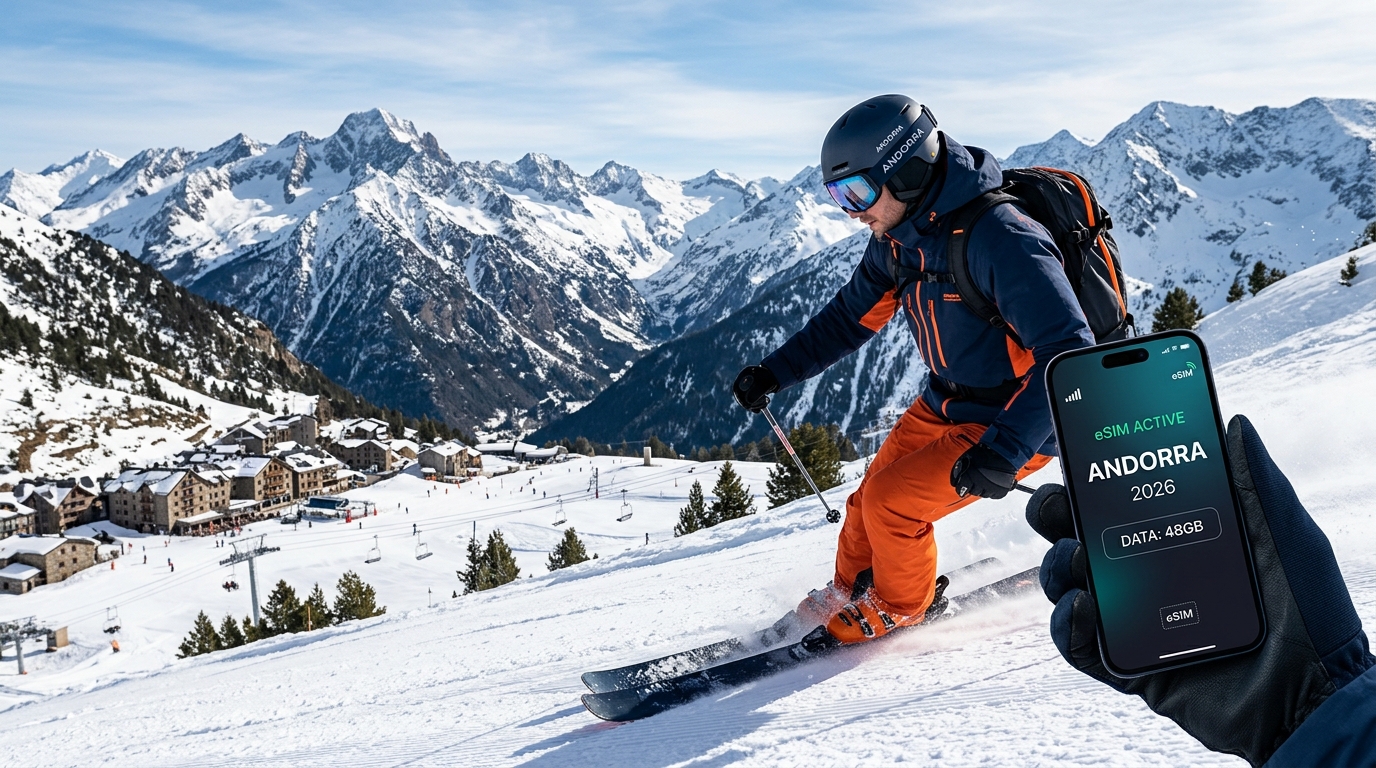
Andorra Pyrenees Skiing & Border Roaming: The Essential 2026 eSIM Guide
The Andorra Roaming Trap: Why EU 'Roam-Like-at-Home' Fails at the Pyrenees Border
For European travelers and international tourists accustomed to seamless border crossings within the Schengen Area, traveling into the Principality of Andorra presents a sudden and costly telecommunications shock. Despite being sandwiched directly between France and Spain, Andorra is neither a member of the European Union (EU) nor the European Economic Area (EEA). Consequently, the European Union's landmark Roam Like at Home (RLAH) regulations—which mandate free, domestic-rate roaming across all 27 member states—simply do not apply once your device registers on an Andorran network.
This regulatory independence is compounded by a strict domestic monopoly. All telecommunications infrastructure within the co-principality is owned and operated by a single state entity: Andorra Telecom (commercially branded as Som). Without competitive market pressure or EU tariff caps, Andorra Telecom levies massive wholesale interconnect fees on foreign network operators.
+-----------------------------------------------------------------------------------+
|                     THE ANDORRA DATA SHOCK PROFILE (2026)                         |
+----------------------+------------------------------------------------------------+
| Regulatory Status    | Non-EU / Non-EEA Microstate (RLAH Exempt)                  |
| Sole Infrastructure  | Andorra Telecom (Som) Monopoly                             |
| Standard PAYG Rate   | €6.00 – €12.50 per Megabyte (MB)                           |
| Average Daily Trap   | 100MB Background Sync = €600 – €1,200 Bill Shock           |
+----------------------+------------------------------------------------------------+
The Pay-As-You-Go Cost Reality: €6 to €12+ per Megabyte
When your home carrier does not have a specialized regional roaming bundle active for Andorra, your phone defaults to international pay-as-you-go (PAYG) rates. In 2026, most mainstream European, UK, and North American carriers charge between €6.00 and €12.50 per single Megabyte of consumed data.
To put this in perspective:
- Loading a standard high-resolution ski trail map via your browser (~15 MB) costs €90 to €180.
- An automated 30-second cloud photo backup (~35 MB) triggers €210 to €420 in surcharges.
- Streaming music along the mountain pass (~50 MB) can run up a bill exceeding €600.
Because modern smartphones execute high-bandwidth background processes (e.g., iOS iCloud syncing, app telemetry, firmware updates), unconfigured devices routinely hit regulatory credit cut-offs (often €50 or €60 caps) within three minutes of crossing the frontier, leaving drivers with suddenly bricked GPS navigation mid-mountain.
The Border Spillover Hazard: Pas de la Casa and La Farga de Moles
The financial danger is not restricted to the physical interior of Andorra. High-altitude telecommunication masts operated by Andorra Telecom project powerful radio frequencies down the steep glacial Pyrenean valleys, creating severe border signal spillover.
  FRANCE (RN22)                       ANDORRA FRONTIER                   PAS DE LA CASA
  [EU RLAH Zone]                                                          [Som Network]
  -------------------------\                                /---------------------------
                            \                              /  <-- Som Masts broadcast
                             \     SIGNAL OVERLAP ZONE    /       down the valley
                              \  (Devices latch miles    /
                               \  before the border)    /
  --------------------------------------------------------------------------------------
Your smartphone is engineered to connect automatically to the strongest available cellular tower. This creates two notorious "roaming traps" long before you clear customs:
- The Northern French Corridor (RN22 to Pas de la Casa): Approaching from L'Hospitalet-près-l'Andorre, devices frequently drop French networks (Orange FR, SFR) and lock onto Som transmitters stationed high above the Port d'Envalira pass while you are still kilometers away on French asphalt.
- The Southern Spanish Corridor (N-145 from La Seu d’Urgell to La Farga de Moles): Driving north along the Valira river canyon, the topography forces Spanish signals (Movistar, Vodafone ES) to attenuate rapidly, prompting handsets to latch onto Andorran cell towers near Sant Julià de Lòria well before reaching the border checkpoint.
Drivers relying on active smartphone navigation frequently accumulate hundreds of euros in unauthorized roaming charges before even unbuckling their seatbelts at the ski resort parking lot.
Eliminating the Trap with Purpose-Built eSIM Architecture
To bypass the state monopoly's punitive tariff structure, smart travelers install a dedicated regional or local travel eSIM before departing for the Pyrenees. Pre-configuring your cellular profile ensures your phone connects through wholesale data pipes negotiated specifically for the microstate.
Modern providers like MollySIM mitigate this risk entirely by offering fixed-cost Andorra and cross-border Pyrenees packages. Unlike standard providers that cut connectivity entirely or drop speed to a dead 128kbps throttle once high-speed caps are reached, MollySIM provides a 384kbps Fair Use Policy (FUP) baseline. This sustained 384kbps transfer rate is three times faster than legacy competitors, providing sufficient operational bandwidth to keep live Google Maps navigation, WhatsApp calls, and Apple Pay/Google Wallet authentication functioning smoothly throughout the ski domain without generating a single cent of out-of-bundle debt.
Pyrenees Alpine Signal Analysis: Grandvalira, Pal-Arinsal, and High Mountain Passes
🇬🇧 United Kingdom High-Speed Travel eSIM & SIM Plans
Instant QR code activation, hotspot enabled, with guaranteed 384kbps fallback speed to keep Maps & Digital Wallets active.
Navigating the jagged glacial topography of Andorra requires an understanding of how alpine conditions influence cellular radio frequency (RF) propagation. The microstate features extreme vertical relief—ranging from 840 meters in Sant Julià de Lòria to 2,942 meters at Coma Pedrosa—which creates severe RF shadowing across ski cirques, high-altitude ridges, and narrow mountain passes.
       [ Cell Tower / Transceiver: 800 MHz (B20) ]
                      /            \
                     /  Snow Scatter \
                    /   Attenuation   \
               [ Ridge ]               \
                  |                     \
          [ RF Shadow Zone ]       [ Open Piste ]
          (Deep Valley Base)       (Direct LOS / 5G n78)
Topographical Attenuation and Frequency Band Allocation
Andorra Telecom's physical network relies on a multi-tier spectrum strategy to deliver cellular coverage across alpine zones:
- Low-Band (800 MHz / Band 20): Acts as the backbone for high-alpine coverage. Band 20 provides superior diffraction around granite ridges and long-distance propagation, penetrating deep into remote bowls like Grau Roig and Coma de Ransol.
- Mid-Band (1800 MHz / Band 3 & 2600 MHz / Band 7): Deployed around high-density base stations, mid-mountain restaurants, and major gondola hubs (e.g., Funicamp, Soldeu Espiolets) to handle concurrent user loads.
- High-Band (3.5 GHz / 5G Band n78): Concentrated in resort villages (Pas de la Casa, Arinsal) and primary lift terminals. While delivering gigabit speeds, n78 signals degrade rapidly when line-of-sight (LOS) is broken by terrain or heavy snowfall.
Atmospheric attenuation increases significantly during heavy snowstorms. Dense flakes cause scattering and dielectric absorption of microwave frequencies (particularly above 2 GHz), dropping mobile devices back to 800 MHz Band 20 LTE. Concurrently, sub-zero temperatures depress smartphone lithium-ion battery voltage, which throttles cellular modem transmission power and can cause dropped handoffs between ski lift transceivers.
Sector-by-Sector Ski Network Breakdown
| Ski Sector / Pass | Elevation Range | Dominant Spectrum Bands | Typical Coverage & Speeds | Common Deadzones / Micro-Climates |
|---|---|---|---|---|
| Pas de la Casa & Port d'Envalira | 2,000m – 2,408m | B20 (800MHz), B3 (1800MHz), n78 (5G) | 4G/5G (85–220 Mbps): High capacity, robust cross-border transmission. | Border cut line; sudden handover attempts to French Orange/SFR near the pass summit. |
| Grau Roig & Montmalús | 2,120m – 2,640m | B20 (800MHz), B3 (1800MHz) | 4G LTE (25–70 Mbps): Strong on groomed pistes; drops on back bowls. | Cirque de Pessons and low tree-line gullies experience 1-bar Band 20 fallback. |
| Soldeu & El Tarter (Espiolets / Riba) | 1,710m – 2,560m | B20, B3, B7, n78 | 5G / 4G+ (110–340 Mbps): Dense microcell placement along World Cup runs. | Dense pine forests flanking the "Àliga" downhill course create brief packet loss. |
| Canillo & Encamp (Funicamp) | 1,300m – 2,502m | B20 (800MHz), B3 (1800MHz) | 4G LTE (30–90 Mbps): Continuous line-of-sight across the Funicamp ridge. | Deep within the Cortals valley where sheer rock faces block direct tower LOS. |
| Pal-Arinsal (La Massana Sector) | 1,550m – 2,560m | B20 (800MHz), B3 (1800MHz), n78 (5G) | 4G/5G (60–180 Mbps): Excellent coverage along the Setúria connection. | Arinsal base bowl suffers from steep mountain wall multipath interference. |
| Ordino Arcalís | 1,940m – 2,625m | B20 (800MHz) | 4G LTE (15–45 Mbps): Pure coverage-optimized Band 20 deployment. | La Coma backside off-piste zones; signal drops rapidly past mountain ridges. |
Critical Connectivity: Piste Rescue, Lift Status, and Avalanche Feeds
Maintaining uninterrupted mobile data on the slopes is not just about social media uploads—it is a critical safety requirement. Real-time access to the Grandvalira and Pal-Arinsal apps provides live notifications on wind-related lift closures, temperature shifts, and updated European Avalanche Warning System (EAWS) risk levels (Scale 1–5).
In the event of an off-piste accident or navigation error in low-visibility "whiteout" conditions, your handset must be able to resolve high-accuracy GPS coordinates and broadcast them to ski patrol (Pistas de Esquí Emergencias: 112 or +376 877 722).
This makes resilient roaming connectivity critical. Standard travel eSIMs that throttle to 128kbps or drop service entirely once a data tier is reached will fail to render vector-based mountain maps or route emergency VoIP packets. Using an infrastructure-grade solution like MollySIM ensures your device maintains a constant, stable connection. Even after consuming primary high-speed allowances, MollySIM’s 384kbps Fair Use Policy (FUP) baseline delivers three times the throughput of standard 128kbps limits. This ensures critical services—such as topographic GPS maps, WhatsApp location pings, live avalanche telemetry, and Apple Pay authentication at high-altitude mountain huts—continue operating reliably across all Pyrenean peaks.
Connectivity Comparison: Andorra Telecom Tourist SIM vs. Pocket Wi-Fi vs. MollySIM
Navigating data connectivity across the Pyrenean peaks requires balancing network resilience, sub-zero hardware endurance, cross-border handoffs, and administrative convenience. Skiers and snowboarders visiting Andorra typically weigh four distinct connectivity methods: purchasing a local physical SIM from the national monopoly (Andorra Telecom), renting a portable Pocket Wi-Fi puck, enabling a home carrier international daily pass, or deploying a digital travel eSIM.
The following matrix compares how each option handles the logistical and environmental demands of high-altitude alpine travel.
| Feature / Performance Metric | Andorra Telecom Prepaid Physical SIM | Rented Pocket Wi-Fi Puck | Home Carrier Roaming Add-On (e.g., AT&T / Vodafone) | MollySIM Andorra & Regional Europe eSIM |
|---|---|---|---|---|
| Typical Cost (7–10 Days) | €15–€30 for 5GB–15GB | €60–€100 + hardware deposit | $10–$12/day (€70–€120 total) | Cost-effective dynamic data tiers |
| ID / KYC Registration | Mandatory in-store passport scan & address filing | Identity verification & credit card security hold | Pre-existing carrier account (No extra KYC) | Zero KYC; instant email/app delivery |
| Cross-Border Continuity (FR/ES ⇄ AD) | ❌ Drops at the border; no data in Spain or France | ⚠️ Route-dependent; often requires multi-country fee | ⚠️ Varies; carrier may exclude Andorra from EU plans | Seamless auto-switch between France, Spain & Andorra |
| Sub-Zero Battery Survival (-5°C to -15°C) | Handset native battery drain only | ❌ Rapid puck battery drain (shuts off in 1–3 hours) | Handset native battery drain only | Handset native battery drain only |
| Piste Usability & Portability | Requires opening SIM tray with cold fingers | Heavy pocket bulge; prone to drops on ski lifts | Built into phone | 100% digital; zero physical footprint |
| Post-Allowance Throttle (FUP) | Hard stop (Data cuts off completely) | Throttled to 64–128kbps or cut off | Hard stop or dropped to unusable 64kbps | 384kbps baseline (Runs Maps, WhatsApp & Apple Pay) |
Hardware Vulnerability in Sub-Zero Alpine Conditions
Hardware-based alternatives introduce significant points of failure on the mountain:
- Pocket Wi-Fi Pucks: External Wi-Fi hotspots rely on standalone lithium-ion batteries that experience accelerated voltage drops when exposed to sub-zero temperatures at elevations like Grau Roig (2,120m) or Pic Blanc (2,600m). When kept in an outer jacket pocket, these devices frequently suffer sudden thermal shutdowns, severing your connection mid-piste. Additionally, Wi-Fi tethering drains your smartphone's battery faster due to the continuous background polling required to maintain the local WLAN bridge.
- Physical SIM Swaps: Replacing a nano-SIM on a ski lift, shuttle bus, or crowded mountain lodge introduces physical risks: dropped SIM ejector tools, frozen SIM trays snapping, or lost primary SIM cards.
Digital eSIM profiles bypass physical hardware failure entirely by utilizing your device's internal, thermally insulated modem circuitry without adding bulk to your ski gear.
Administrative Bureaucracy & The KYC Bottleneck
Andorran telecommunication law requires strict identity verification (Know Your Customer / KYC) for all local prepaid physical SIM cards. Purchasing an Andorra Telecom tourist SIM involves locating an official agency (Agència Andorra Telecom in Andorra la Vella) or finding an authorized kiosk during limited operating hours, waiting in line with ski equipment, and submitting your passport for manual scanning.
In contrast, MollySIM can be provisioned digitally via QR code or direct app profile installation prior to departure. No identity checks, paper forms, or store visits are required.
Cross-Border Roaming Handoffs: France, Spain, and the Envalira Corridor
Most Pyrenean ski trips involve landing at Barcelona-El Prat (BCN) or Toulouse-Blagnac (TLS) and driving through the Pyrenean foothills before crossing into the Principality.
- Local Andorran SIMs do not provide coverage on French (A66/N20) or Spanish (C-16/C-14) approach highways, leaving you without GPS navigation during the drive to the border.
- Home Carrier Plans that include "Europe" frequently trigger exorbitant pay-as-you-go rates (often exceeding €10–€15/MB) the moment your phone registers on Mobiland (Andorra Telecom), because Andorra is an independent microstate outside the European Union / EEA "Roam Like at Home" zone.
MollySIM's regional Europe and Andorra configurations maintain uninterrupted multi-IMSI connectivity. Your smartphone automatically roams across tier-1 networks in France (Orange/SFR) and Spain (Movistar/Orange), executing a smooth network handover to Andorra Telecom as you pass through the Port d'Envalira tunnel or the Sant Julià de Lòria border checkpoint—all without manual APN reconfiguration.
Pre-Border Dual-SIM Configuration: Step-by-Step Guide for iOS and Android
To avoid instantaneous, unauthorized carrier charges the microsecond your handset connects to an Andorran cell tower, complete your Dual-SIM staging prior to reaching the border crossings at Pas de la Casa (France) or Sant Julià de Lòria (Spain).
The primary objective is to maintain your home carrier SIM exclusively for incoming two-factor authentication (2FA) SMS messages—which are free to receive globally on almost all carriers—while routing 100% of data packets through your dedicated travel profile.
iOS Configuration Protocol (iPhone 12 through 16 Series)
Execute this exact menu sequence before passing the final toll plazas on the French A66 or Spanish C-16:
- Route Cellular Data to eSIM:
- Go to Settings > Cellular (or Mobile Data).
- Tap Cellular Data at the top of the menu and select your MollySIM profile.
- Prevent Accidental Network Leaks:
- In the same Cellular Data sub-menu, toggle Allow Cellular Data Switching to OFF.
- Warning: Leaving this switch active permits iOS to automatically switch data back to your primary home carrier if the local mountain signal experiences momentary packet loss, triggering instant out-of-plan roaming fees.
- Lock Down the Primary Home Line:
- Under the SIMs section, tap your Primary carrier line.
- Toggle Data Roaming to OFF.
- Keep Turn On This Line toggled ON to ensure transactional SMS and banking verification codes arrive unhindered.
- Enable eSIM Roaming:
- Return to Settings > Cellular, tap the MollySIM line, and toggle Data Roaming to ON.
Android Configuration Protocol (Samsung One UI, Google Pixel, Xiaomi HyperOS)
Because Android skins vary slightly, adhere to the standard multi-SIM routing path:
- Set Default Data SIM:
- Navigate to Settings > Connections (or Network & Internet) > SIM Manager (or SIMs).
- Under Preferred SIM (or Mobile Data), tap to select MollySIM.
- Disable Automatic Carrier Switching:
- Locate the toggle for Auto Data Switching or Switch Data Automatically and turn it OFF.
- On Google Pixel devices, disable Backup Calling under your primary SIM settings.
- Secure the Primary Carrier:
- Select your Primary SIM, tap Mobile Networks (if applicable), and ensure Data Roaming is explicitly turned OFF.
- Set Calls and Messages defaults to your Primary SIM.
- Activate Data on MollySIM:
- Select the MollySIM profile and toggle Mobile Data and Data Roaming to ON.
Quick-Reference Dual-SIM Matrix
| Setting Field | Primary Home Carrier SIM | MollySIM Travel eSIM |
|---|---|---|
| SIM Status | ON (Active for SMS/Calls) | ON (Active) |
| Mobile Data Default | DISABLED | ACTIVE (Default Line) |
| Data Roaming Switch | OFF (Prevents €10–€15/MB leaks) | ON |
| Data Switching / Fallback | OFF | OFF |
| Primary Use Case | 2FA Banking Tokens & Emergency Calls | High-speed 5G/4G Data, VoIP, GPS |
Troubleshooting: Deep Pyrenean Valleys & APN Overrides
Glacial valleys around Soldeu, Arinsal, and Grau Roig can occasionally cause multi-IMSI chips to cling to distant, degraded French or Spanish border signals. If your device displays signal bars but fails to load data:
1. Manual Network Selection (MNS Override)
- iOS: Go to Settings > Cellular > MollySIM > Network Selection > Toggle off Automatic > Select Mobiland or Andorra Telecom.
- Android: Go to Settings > Connections > Mobile Networks > Network Operators > Turn off Select Automatically > Select Mobiland.
2. Manual APN Verification
While MollySIM utilizes zero-touch remote provisioning, manually verify the Access Point Name if connection handshakes fail:
- Set the APN field to:
globaldata(or the specific APN string provided in your MollySIM activation voucher). - Leave the Username and Password fields blank.
3. Continuous Connectivity Protection
Unlike standard budget travel SIMs that hard-disconnect data upon reaching bucket caps or throttle down to an unusable 128 kbps, MollySIM provides an optimized 384 kbps Fair Use Policy (FUP) safety tier. This provides triple the throughput of typical fallback networks, ensuring mission-critical mapping via Google Maps, resort lift-status dashboards, and Apple Pay/Google Wallet authentications never freeze on the mountain.
Optimizing Ski Data: Grandvalira Apps, Emergency 112 Protocols, and MollySIM Safety Nets
Operating digital navigation and performance tracking tools across Andorra’s 300+ kilometers of skiable terrain demands a resilient cellular configuration. High-altitude environments, freezing temperatures (which accelerate lithium battery voltage drop), and variable ridge-line connectivity require a strategic approach to data management and safety.
High-Altitude App Optimization: Grandvalira, Slopes & Strava
Modern winter sports applications place dual strain on your device: continuous GPS polling alongside background data synchronization. To preserve battery and maintain optimal data throughput on the slopes:
- Grandvalira Resorts App: Keeps skiers updated with real-time lift openings, avalanche risk levels, wind holds at high cols (such as Port d'Envalira), and interactive 3D piste routing. Configure background refresh to update over cellular so critical lift closures sync instantly before you drop into isolated sectors like Grau Roig or Pas de la Casa.
- Slopes & Strava: While raw GPS coordinates are recorded locally without consuming mobile data, live friend-tracking features ("Find My Friends on Slopes") and automated run uploads require a steady data uplink. Pre-download offline topographic maps inside FATMAP or Strava to limit live bandwidth consumption to lightweight telemetry packets.
- Cold-Weather Battery Mitigation: Cold air degrades battery performance rapidly, causing unexpected shutdowns during active tracking. Keep your device in an inside chest pocket adjacent to body heat, disable 5G Standalone (SA) search if battery dips below 20%, and rely on low-power LTE/4G bands that penetrate mountain topography more consistently.
Alpine Emergency Protocols & 112 Relay
In the event of an off-piste accident, whiteout disorientation, or physical injury, immediate communication with local emergency services is paramount. Andorra utilizes standard European emergency routing:
- Dialing 112 (Universal Emergency): Triggers an emergency bypass routing to the Bombers d'Andorra (Mountain Rescue & Fire Service) and the Cos de Policia. Even without an active cellular balance, any detected terrestrial mast—including French or Spanish border towers—will process a 112 call.
- GPS Coordinate Transmission: Mountain rescue teams require exact coordinates (WGS84 decimal format). If voice clarity is degraded by gale-force winds, dispatch your exact pin via WhatsApp or SMS directly to rescue contacts.
- Piste Rescue Flagging: If you are within resort boundaries, contact the central Grandvalira Ski Patrol directly via the emergency button embedded in the resort application, which automatically transmits your elevation and nearest lift/piste marker.
| Feature / Protocol | High-Speed Active Bucket (5G/4G) | MollySIM 384 kbps Safety Net | Typical Competitor 128 kbps Cap |
|---|---|---|---|
| Google Maps Vector Rendering | Instantaneous | 1–2 seconds (Fully functional) | Fails / Infinite reload loop |
| WhatsApp Text & Live Location | Real-time | Real-time (<50ms latency) | High packet drop, location stalls |
| VoIP Emergency Call (WhatsApp/Facetime) | Crystal Clear HD | Stable standard audio | Unintelligible / Constant drops |
| Ski Patrol Lift Dashboard | Full interactive 3D map | Text & status feeds load smoothly | Times out / Server error |
| Apple Pay / Google Wallet NFC Token Auth | Instant | Instant | Fails backend security handshake |
The MollySIM 384 kbps Safety Net Advantage
A primary hazard of standard prepaid travel eSIMs is the "hard wall" disconnect. Once your purchased data bucket runs out mid-descent, conventional providers sever data transfer entirely or throttle bandwidth to an unusable 64–128 kbps. At 128 kbps, modern secure protocols time out, leaving you unable to load navigation maps, message your ski party, or authenticate mobile payment at mountain refuges.
MollySIM solves this alpine vulnerability through its 384 kbps Fair Use Policy (FUP) safety tier. Operating at three times the speed of legacy competitor fallbacks, this safety net provides dedicated bandwidth specifically configured to keep mission-critical services online:
- Zero-Cutoff Security: If you exhaust your high-speed quota while traversing between Soldeu and Canillo, your data does not drop. The connection seamlessly switches to 384 kbps with zero manual intervention or sudden out-of-plan roaming fees.
- Reliable Navigation: Lightweight vector-based map layers in Apple Maps and Google Maps continue to resolve, allowing you to identify your trail path, base village routes, and transit hubs.
- Continuous Alpine Contact: WhatsApp messaging, text-based push notifications, and live location sharing remain active, ensuring your ski group and emergency services can track your descent coordinates down to the base lodge without interruption.
Multi-Country Pyrenees Itineraries: Seamless Roaming Between Spain, Andorra, and France
A premier Pyrenean winter holiday rarely stays confined to a single country. Because Andorra has no commercial international airport of its own, over 90% of inbound international skiers land at either Barcelona-El Prat (BCN) in Spain or Toulouse-Blagnac (TLS) in France before driving up into the peaks.
Furthermore, advanced freeriders and cross-country tourers frequently cross geopolitical boundaries mid-stay—starting the morning at Grandvalira (Andorra), spending the afternoon running back bowls into the Ariège valley (France), and driving down to Puigcerdà (Spain) for dinner.
For conventional SIM cards and poorly routed regional travel eSIMs, this three-country corridor is a connectivity minefield. Crossing from France or Spain into Andorra triggers aggressive out-of-plan roaming charges or drops data altogether. MollySIM eliminates cross-border friction using an integrated European multi-network profile engineered to dynamic-handshake across all three national jurisdictions automatically.
Zero-Touch Network Switching Across Border Checkpoints
When driving from Barcelona up through the Cadí Tunnel (C-16) to the southern Andorran border at La Farga de Moles, or winding south from Toulouse via the N20 to the high-altitude Pas de la Casa checkpoint (2,080 meters), your phone must transition through distinct carrier infrastructures:
| Border Segment | Active Carrier Infrastructure | Authentication Type | MollySIM Re-Connection Time |
|---|---|---|---|
| Spanish Transit (BCN $\to$ Pyrenees) | Movistar / Vodafone Spain (5G/4G LTE) | Automated Core Switch | Instant (0 sec user action) |
| French Transit (TLS $\to$ Pyrenees) | Orange France / SFR (5G/4G LTE) | Automated Core Switch | Instant (0 sec user action) |
| Andorran Enclave (Grandvalira / Ordino) | Andorra Telecom Native Infrastructure | Secure Tier-1 Handshake | Under 10 seconds |
| Cross-Border High Alpine Passes | Dynamic failover to strongest cell tower | Multi-IMSI Carrier Fallback | Automated / Background |
Unlike local single-country eSIMs that force you to buy and toggle between separate Spanish, French, and Andorran data profiles in your device settings, a single MollySIM regional profile negotiates carrier handshakes in the background. Your phone maintains its single data line with no APN adjustments, no manual network searches, and zero physical SIM swaps.
Low-Latency European IP Routing for Seamless VoIP & Cloud Backups
Data connectivity in the Pyrenees is not solely about raw download speed; routing latency (ping) dictates your actual real-world performance.
Many budget travel eSIM providers route all Andorran and European traffic through centralized proxy gateways in Hong Kong, Singapore, or the United States. This sub-optimal routing adds 250ms to 400ms of latency, resulting in choppy WhatsApp audio/video calls, delayed GPS packet updates, and dropped synchronization with apps like Strava, Apple Pay, and Google Drive.
MollySIM utilizes localized European edge breakout nodes stationed within core EU datacenters (Frankfurt, Paris, and Madrid). By keeping routing paths localized to Western Europe:
- VoIP & Video Calling: WhatsApp, FaceTime, and Zoom calls remain crystal-clear without voice delay while riding ski lifts.
- Instant Cloud Syncing: 4K action camera footage and ski-tracking telemetry upload directly to cloud storage without packet loss.
- Active Navigation Continuity: Live traffic updates via Waze and Google Maps refresh instantaneously through mountain switchbacks and mountain border checkpoints.
Even if you exhaust your high-speed regional data allowance while descending down from the French border, MollySIM's 384 kbps Fair Use Policy safety net kicks in automatically. This fallback tier delivers 3x the speed of competitor fallbacks (128 kbps), ensuring your Google Maps route navigation, toll booth Apple Pay transactions, and WhatsApp location sharing continue uninterrupted all the way back to your departure terminal in Barcelona or Toulouse.
🇬🇧 United Kingdom High-Speed Travel eSIM & SIM Plans
Instant QR code activation, hotspot enabled, with guaranteed 384kbps fallback speed to keep Maps & Digital Wallets active.